Every battery material, traceable from powder to cell
For scientists and R&D leaders developing cathodes, anodes, electrolytes, and next-generation cells, from first experiment through scale-up.
Deployed by 175+ enterprise product development teams







Deployed by Enterprise R&D and Innovation Teams



Nothing gets lost between steps
Battery R&D generates enormous, heterogeneous data, from cathode synthesis and cell builds to cycling results and characterization, across early experiments through multi-million-dollar scale-up. When sample tracking and results live in spreadsheets, the structure-process-property relationships that drive performance get lost. Uncountable gives barcoded traceability from raw material to result, so every cycling curve traces back to the exact powder and process that produced it.

The workflow behind the chemistry
Battery teams trace every result to its material, keep structure-process-property links intact, and carry context from early experiments through scale-up.
Trace every result to its material: Barcoded traceability from raw material through precursor and electrode to cell.
Keep structure-process-property links: Connected, structured data that predictive ML can work on.
Carry context from bench to scale-up: Early-stage data stays usable when a program moves to production.
When a full cell underperforms, you can trace it back through cathode, anode, electrolyte and separator at once and find the cause before scale-up makes it expensive.
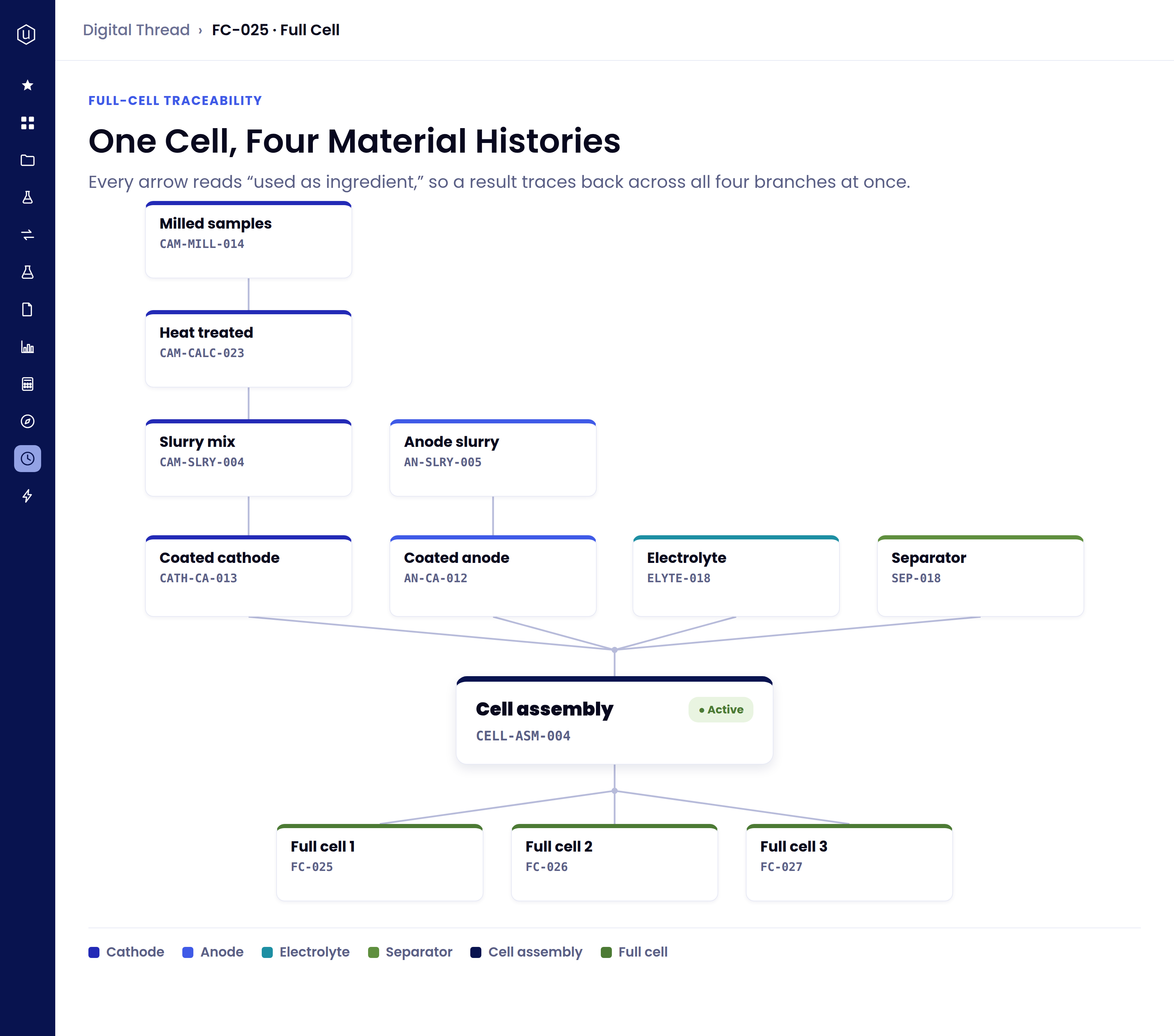
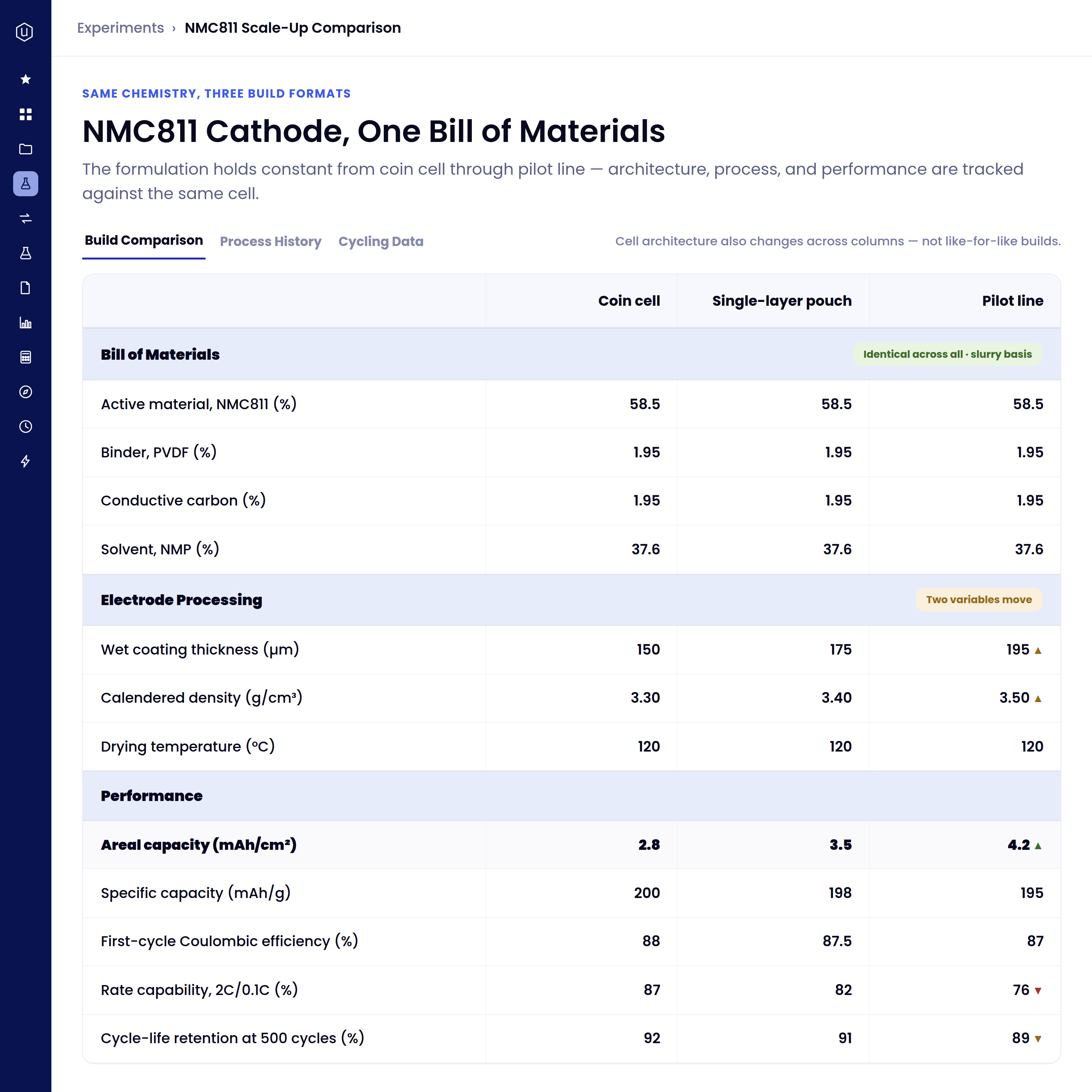
From first synthesis to pilot line, battery teams work from one bill of materials and one record, so every change between coin cell and production is visible.
1. Synthesize & track
Barcoded traceability from raw material through precursor to electrode and cell.
2. Test & characterize
Full voltage and capacity curves, dQ/dV, coulombic efficiency, and EIS stay with the sample that produced them, not flattened to a single number.
3. Design
DOE and predictive ML narrow cathode, electrolyte, and cell candidates to the ones worth building.
4. Scale
Carry the full record from early experiments into multi-million-dollar scale-up.
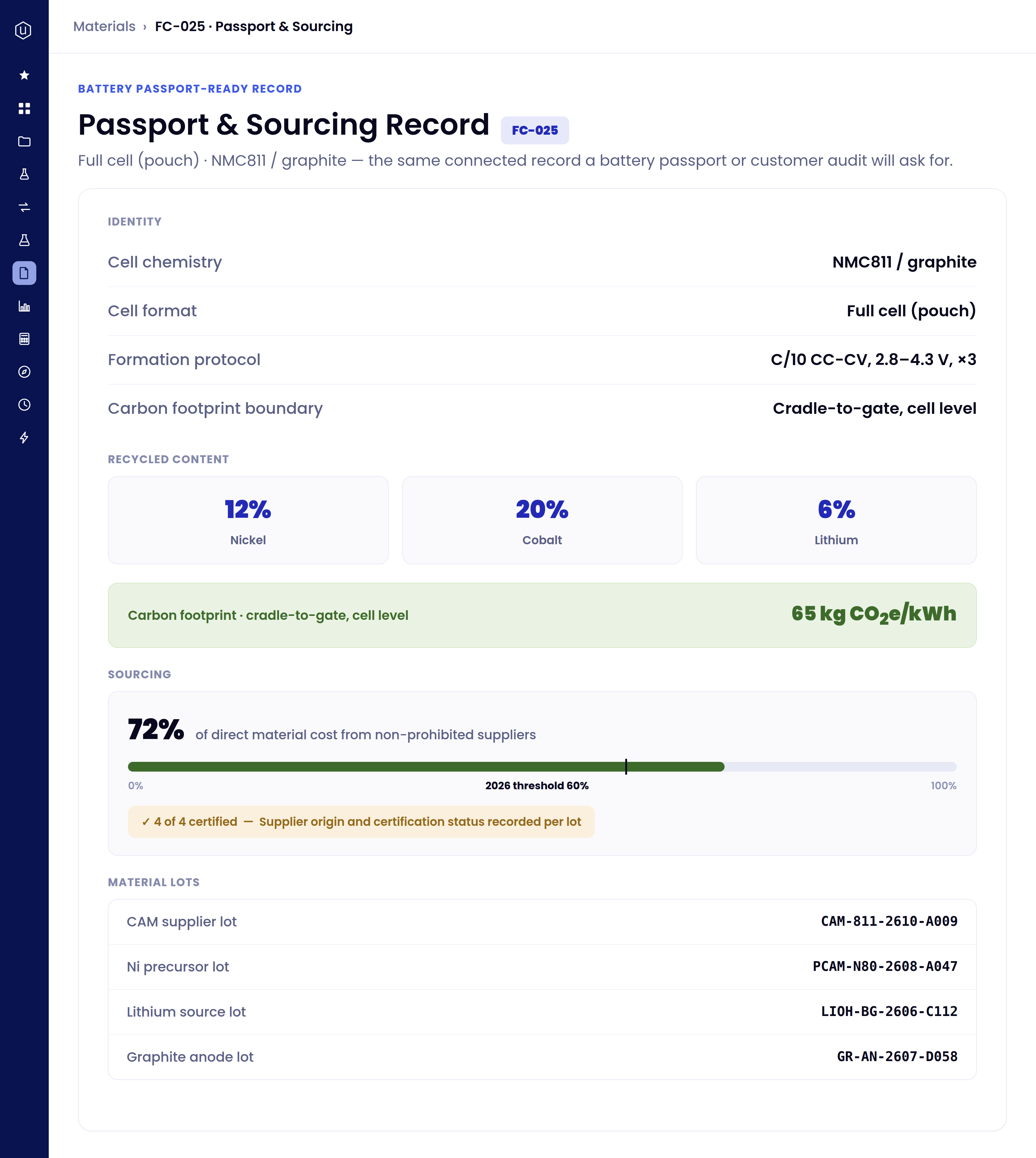
Everything battery R&D needs on one connected platform, including the sourcing and compliance data regulators and customers now require:
- Battery passport & compliance data: Recycled nickel, cobalt, and lithium content, cradle-to-gate carbon footprint, and certified supplier lots held on the same record.
- ELN: Structured, searchable records, not free-text notebooks.
- LIMS for R&D: Sample tracking with barcoded traceability from raw material to result.
- LIMS for quality: Root cause, deviation, and CAPA at production scale, with live SPC.
- Product Lifecycle Management (PLM): Move a material from R&D to production with stage-gate approvals and version control
Before and after Uncountable
The traditional way
The Uncountable way
What our customers say


The full stack for battery development
Every battery R&D team runs ELN, LIMS, cycler data, and reporting somewhere, usually in four different places. Uncountable puts them on one record, so nothing gets re-entered, re-exported, or lost in translation.
Get the data right before you scale
In battery materials, a broken data foundation shows its cost at scale-up: when early experiments can't be trusted or traced. Get the structure right early, and a capital-intensive expansion gets less risky, not more.
Mitra Chem adopted Uncountable before its lab was even running, structuring data and building barcoded traceability from raw materials to results on day one. Not retrofitted later.
That foundation now supports a $100M DOE-funded manufacturing expansion; full lineage from powder to cell, carried straight into scale-up.
Built around your chemistry
One platform for every program battery teams develop and scale, configured to the data each one generates:
NMC, LFP, and next-gen chemistries against cycling performance.
Graphite, silicon, and composites, tracked from powder to cell.
Formulation and stability linked to cell results.
Build parameters and cycling data on one record.
Novel materials and interfaces with full traceability.
Emerging chemistries on the same structured foundation.
Recovered-material streams tracked end to end.
Instrument and cycling data preserved, not flattened.
Link every test, trace every cell
See how Uncountable connects battery materials, cell builds and test results, so you can design the next cell from your data.


Every result traces back to the powder that made it.
Barcoded lineage from raw material to cell keeps the structure-process-property links intact, so scale-up stands on data you can trust. Structure first, AI second.
FAQs
Uncountable connects R&D, Quality, and PLM on one platform and unifies lab workflows, sample tracking, and results for battery materials. Teams get barcoded traceability from raw material to cell, preserve full cycling and instrument data, and carry context from early experiments through scale-up.
Every sample carries barcoded traceability, so a raw-material lot, precursor powder, electrode, and finished cell stay linked to the cycling and characterization results they produced. A result is always traceable back to the exact material and process behind it.
Yes. Design of experiments and predictive machine learning are built in and grounded in your own connected data, so they narrow cathode, electrolyte, and cell candidates to the ones worth building. Structure first, AI second.
Yes. Uncountable includes ELN and LIMS functionality and goes further, connecting R&D, Quality, and PLM on one structured data model with full instrument-data capture and live SPC.
Yes. Historical experiments, results, and instrument files are migrated during implementation as part of data-integration design, using bulk ingestion, the REST API, and 400+ instrument connections, so past work becomes searchable in the same structured system as new experiments. Uncountable's implementation team works with your power users to map and structure historical files, so migration is a guided step, not a dump.