The lab notebook that also answers questions
Uncountable's ELN keeps the salient story of an experiment and makes it structured against a shared ontology of materials, processes, and results, so every entry is searchable by content, backed by embedded data and plots, and connected to LIMS, QC, PLM, and Project Management.
Deployed by 175+ enterprise product development teams







Deployed by Enterprise R&D and Innovation Teams


Your notebook holds the story.
It just cannot answer a question.
A traditional ELN is a scientific word processor: salient, but the results live in sentences no one can query. So a year of good work becomes a folder of documents that can only be searched by title and date, and the moment a scientist leaves, their notebook stops answering questions. Uncountable's ELN keeps the narrative and makes every entry structured, so the same notebook is searchable by ingredient, process, or measured result, with the data and plots embedded in the record itself.
From first entry to connected record
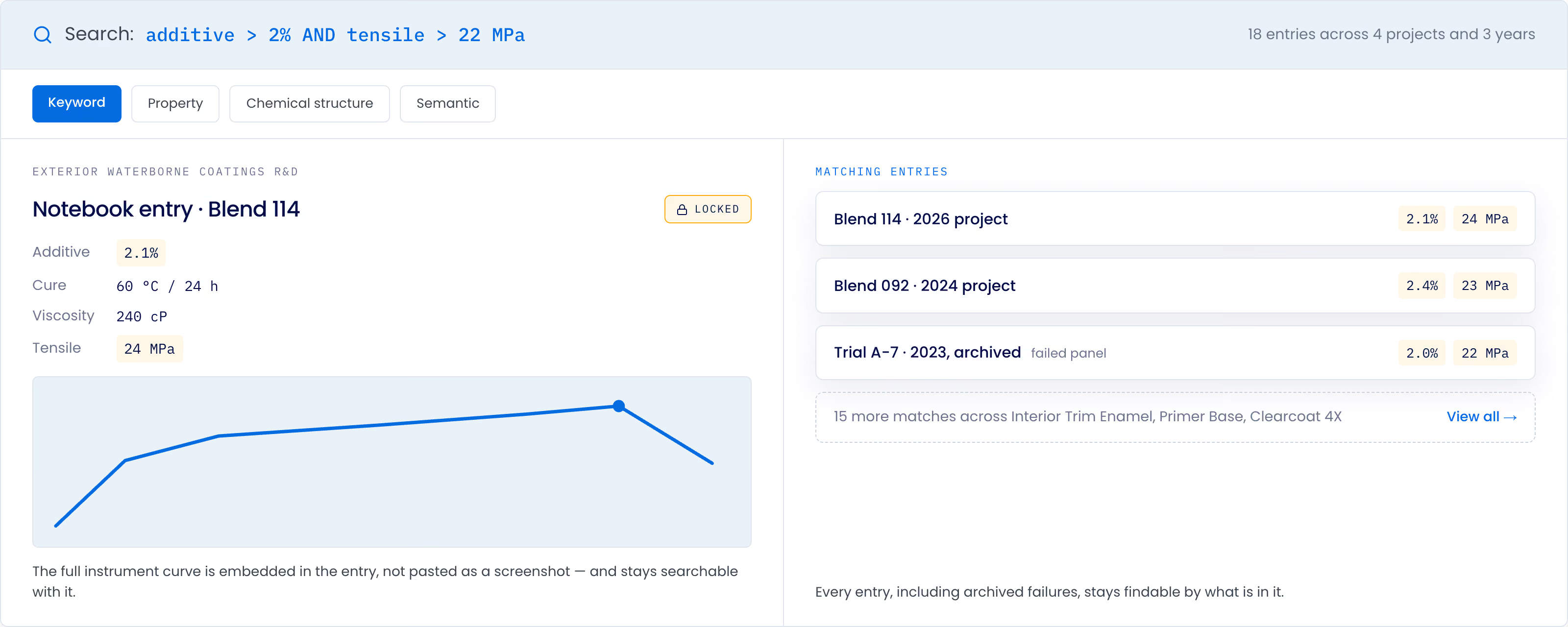
It starts at the bench. Capture the experiment the way scientists already work, and make it structured from the first keystroke.
Free-form narrative and structured fields, together: Write the experiment the way you'd tell it, while formulation, process, and observations are captured in configurable fields at the same time; not either/or, with templates for repeatable protocols so the record stays consistent without slowing anyone down.
The data lives in the entry: Instrument results, tables, and plots are embedded in the record, with full datasets preserved rather than pasted in as screenshots.
Fits how scientists work: Records are structured around the way the lab already runs, and much of the data flows in automatically from connected instruments.
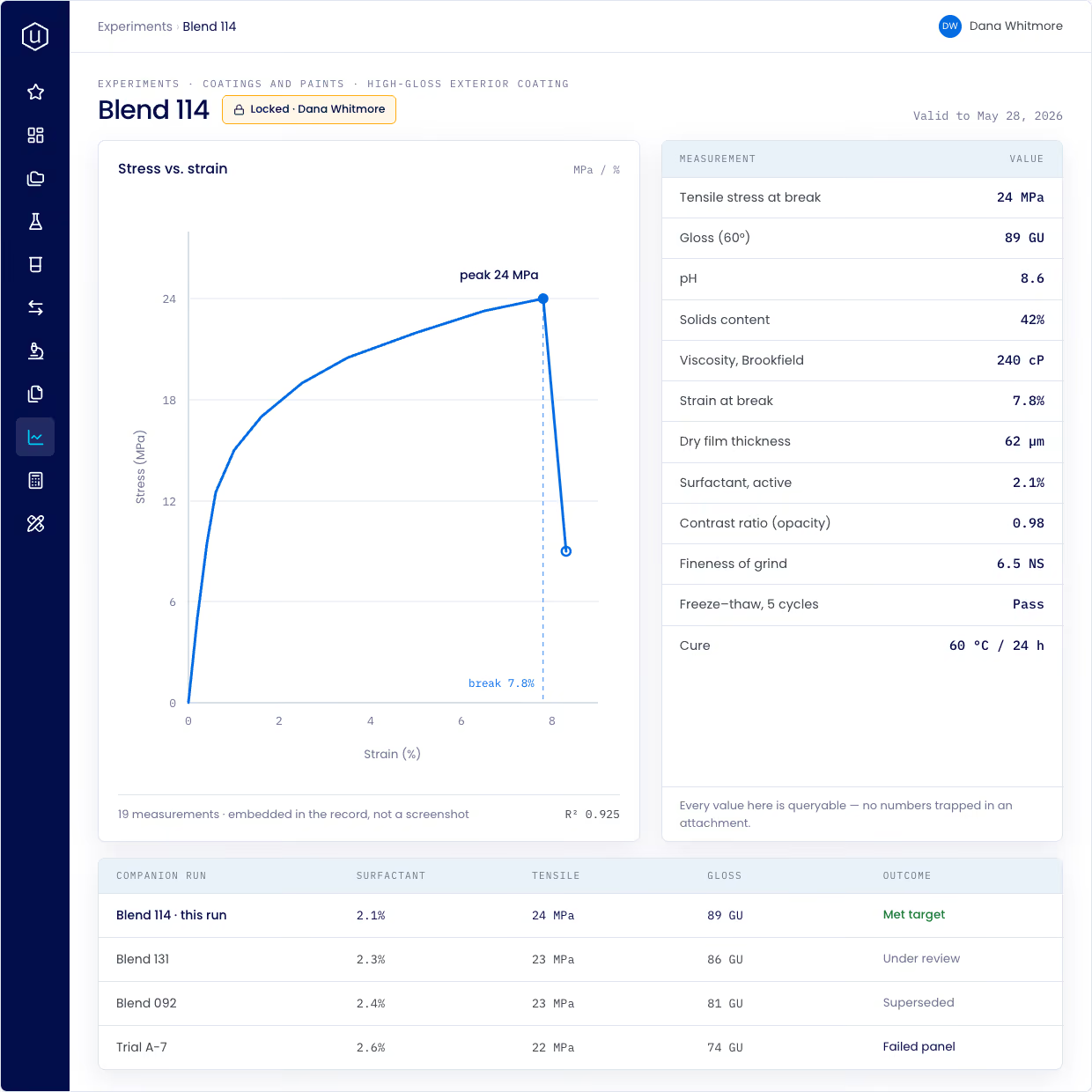
A year of work should answer questions, not just store them. Every entry is searchable by content, across projects and years.
Search by content, not by title: Find any entry by ingredient, process condition, or measured result, instead of hunting through documents named by initials and dates.
Failures stay findable too: Every experiment, including archived and failed ones, remains queryable and reusable, so a dead end still saves the next person time.
Knowledge that does not walk out: When a scientist leaves, their work stays searchable in the same system, so institutional knowledge does not leave with them.
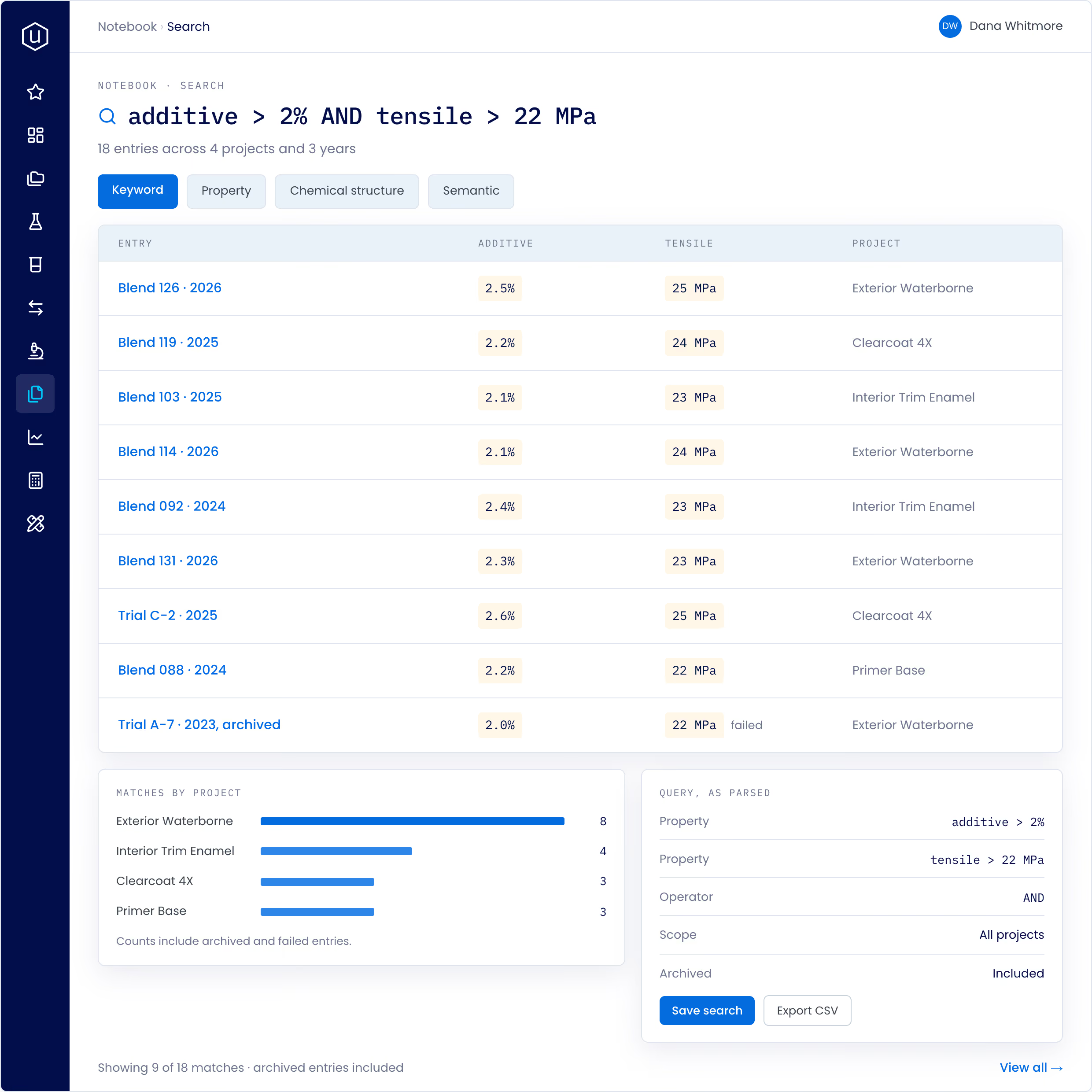
A governed, review-ready record should be a byproduct of the work, not a second job.
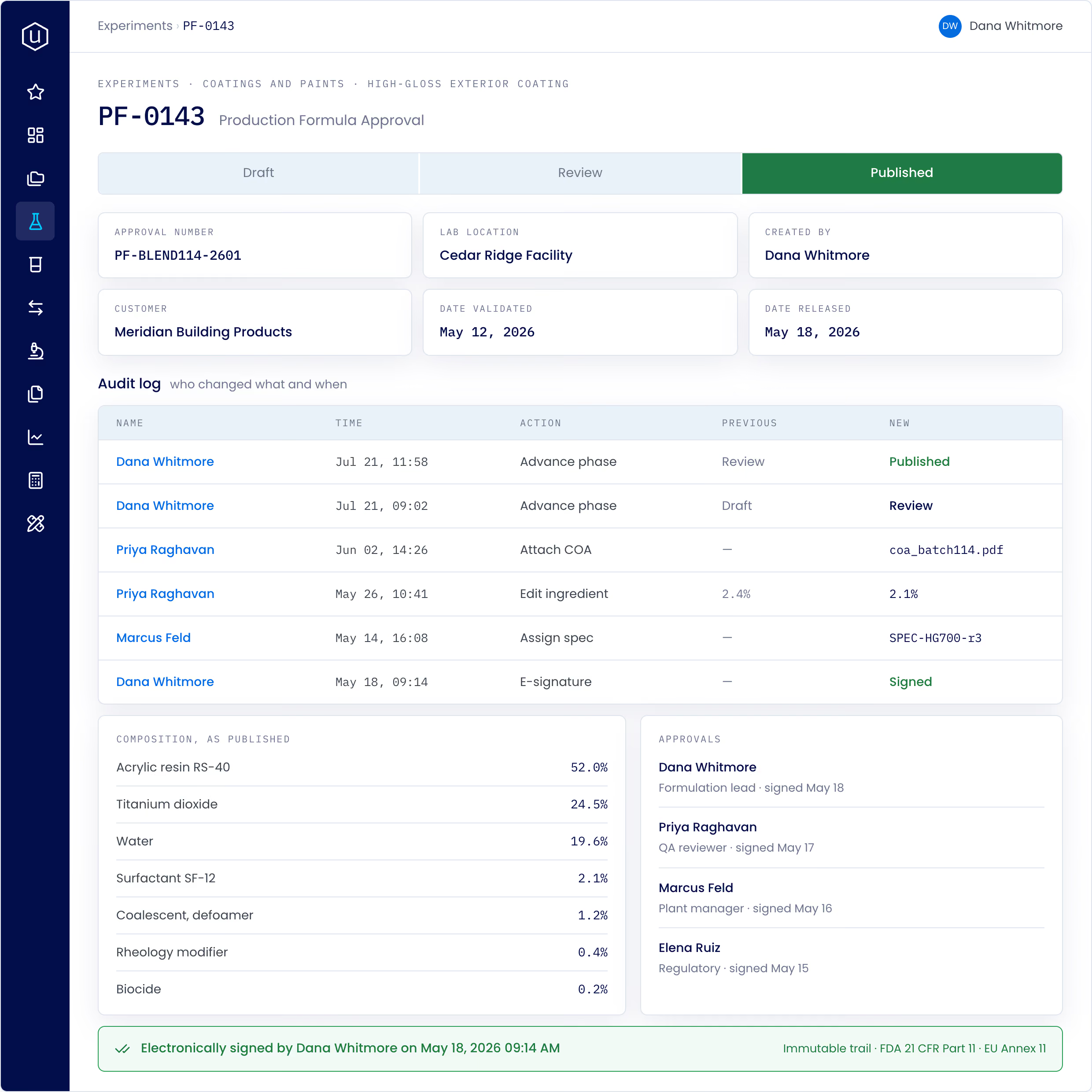
Review and e-signature built in: Structured review and electronic signatures are part of the entry, so sign-off happens in the same place the work does.
Automatic audit trails: Every change is recorded, who changed what and when, without anyone maintaining a separate log.
Compliant by design: Versioned records with audit trails and e-signatures meet FDA 21 CFR Part 11 and EU Annex 11, so audits are a report, not a scramble.
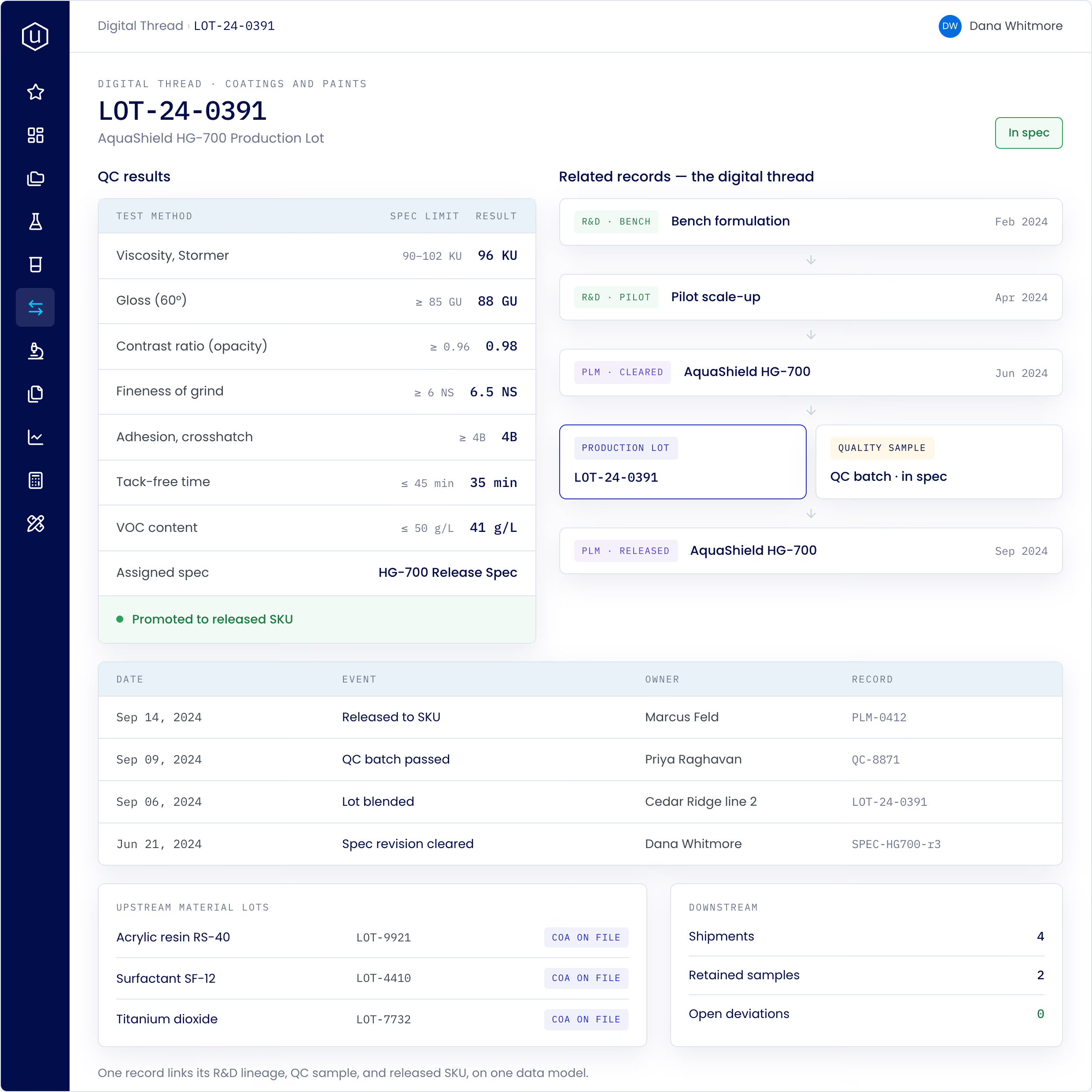
The notebook is one structured model with the rest of the platform, and it brings your history with it:
LIMS for R&D: Samples and full instrument data linked to the notebook entry.
LIMS for Quality & QMS: Carry the R&D record into quality, with results traceable to the entry.
Product Lifecycle Management (PLM): Move a formulation from the notebook to production without re-entry.
Project Management: Track timelines, tasks, resourcing, and incoming requests across every project without leaving the formulation record.
Bodie AI: Draft notebooks from an entry in plain language.
Bring your history with you: Existing notebooks are migrated during a guided, staged rollout, so past work is searchable alongside new work from go-live.
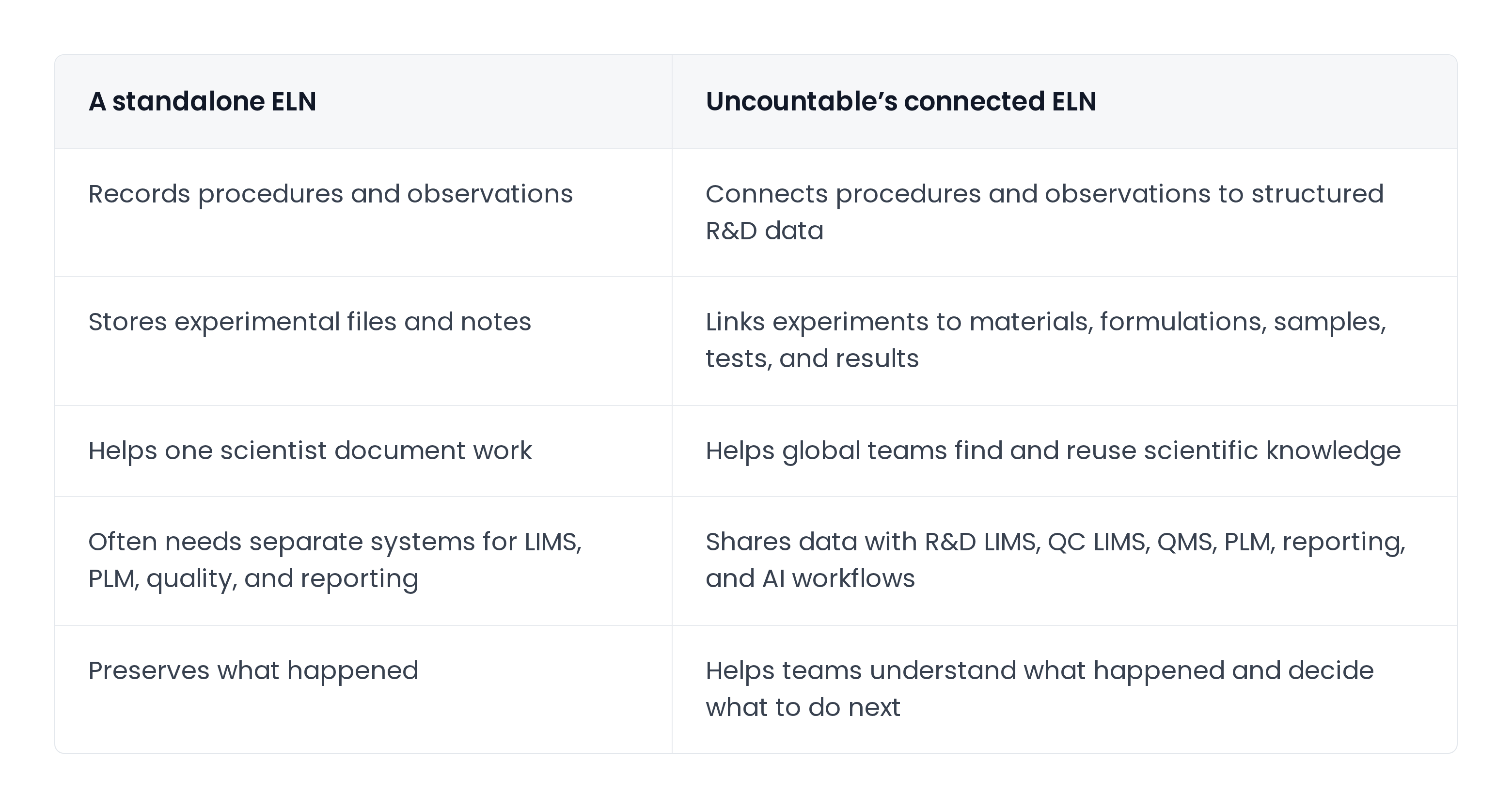
Traditional ELN vs Uncountable's connected ELN
A traditional ELN
The Uncountable ELN
Context in, reports out
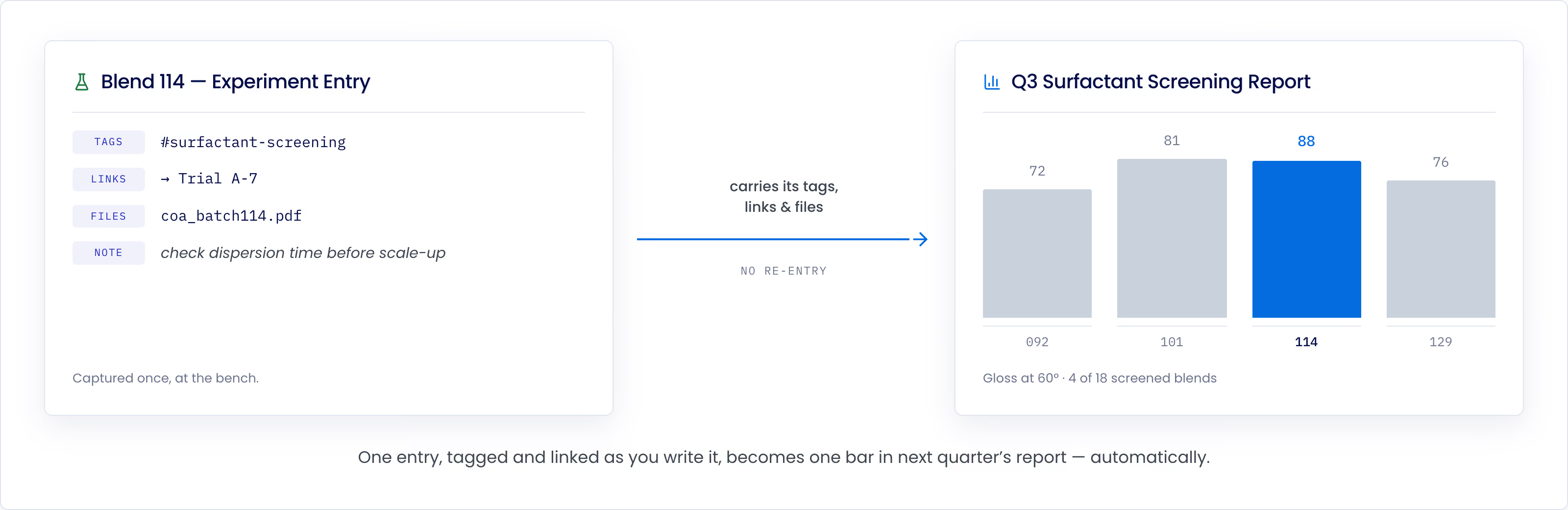
An entry is never just the experiment. Tag it, link it to related work, attach the files it came from, and it is already part of the next report; no extra step, no separate tool.
Tag, link, and annotate anything
Every entry is reportable
Reports stay current
The notebook, fully loaded

What our customers say

Senior Research Scientist, Carbon
When an ELN is not enough
A traditional ELN can preserve the narrative of an experiment. But product-development teams also need to understand how that experiment relates to the formulation, material, sample, test method, specification, quality record, project, and product change that follow.
Uncountable connects the lab notebook to the wider R&D data model. Scientists can retain the reasoning and observations behind an experiment while making the underlying data structured, searchable, and available to the teams responsible for formulation, quality, scale-up, and manufacturing.

.jpg)
.png)
The notebook that is also a database.
Keep the readable story of every experiment, and make it structured, so a year of research is searchable by what is in it and nothing is lost when someone leaves.
FAQs
It is the electronic lab notebook capability of the Uncountable platform, part of the Research & Development suite. It keeps the readable narrative of an experiment and makes each entry structured, so the notebook is searchable by ingredient, process, or result, with formulations, instrument data, and plots embedded in the record and linked to LIMS, QC, PLM and Project Management.
A traditional ELN is a scientific word processor: readable, but the results live in free text that can only be searched by title, author, and date. Uncountable's ELN keeps the narrative and adds structure, so entries are queryable by content, the data is embedded rather than pasted as a screenshot, and every entry connects to the rest of the platform.
Yes. Search across every entry by ingredient, process condition, measured property, or chemical structure, spanning projects and years, including archived and failed experiments. Past work is found by what is in it, not just by who wrote it or when.
Yes. Review workflows, electronic signatures, and automatic audit trails are built in and meet FDA 21 CFR Part 11 and EU Annex 11, so a governed, review-ready notebook is a byproduct of the work rather than a separate chore.
Yes. Existing notebooks and records are migrated during implementation, so historical experiments become searchable in the same structured system as new work, and teams can run in parallel through cutover so nothing is lost.
An ELN captures the scientific narrative of an experiment, including procedures, observations, calculations, and conclusions. A LIMS manages laboratory operations such as samples, materials, methods, tests, instruments, and results. Uncountable connects ELN and LIMS data so the experimental record and operational laboratory record remain part of the same R&D context.
An ELN captures experimental knowledge. A LIMS manages samples and laboratory workflows. An R&D data platform connects experimental, formulation, sample, test, and result data across teams and sites. PLM manages the controlled product record through scale-up, specifications, change, and commercialization. Uncountable connects these capabilities through one shared data foundation.
Formulation teams need an ELN to document experimental reasoning, processing conditions, observations, and conclusions. They also need connected formulation, material, and test-result data to compare trials, identify patterns, reuse knowledge, and make confident product-development decisions.