Keep every experiment searchable, not just the latest one
Electronic lab notebook, R&D lab data, and design of experiments on the same structured record as Quality and Product Lifecycle, so a formulation built in R&D is the same one QC tests and PLM ships, not a copy passed along in email.
Every experiment, on one record
R&D work is longer-running and less templated than QC: synthesizing results and learnings matters as much as running the test. The suite below covers the notebook, formulation, lab data, experiment design, and inventory.
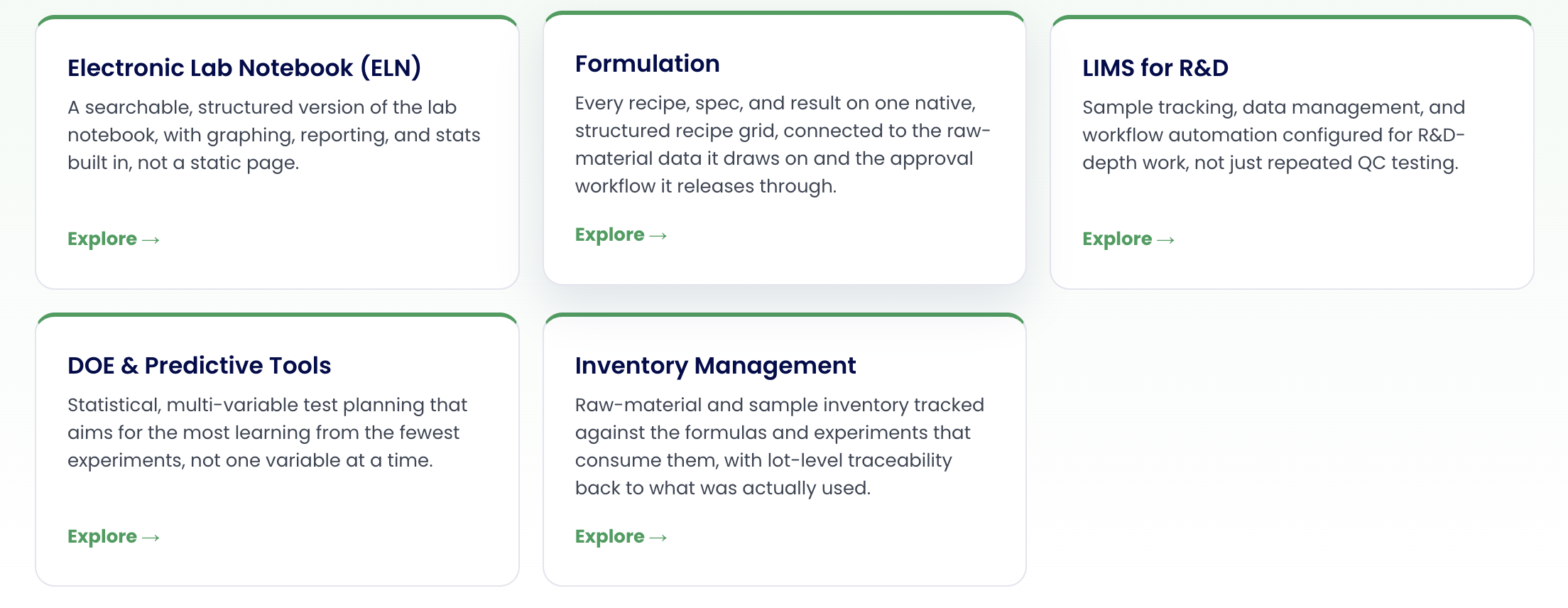
R&D, from first result to next design
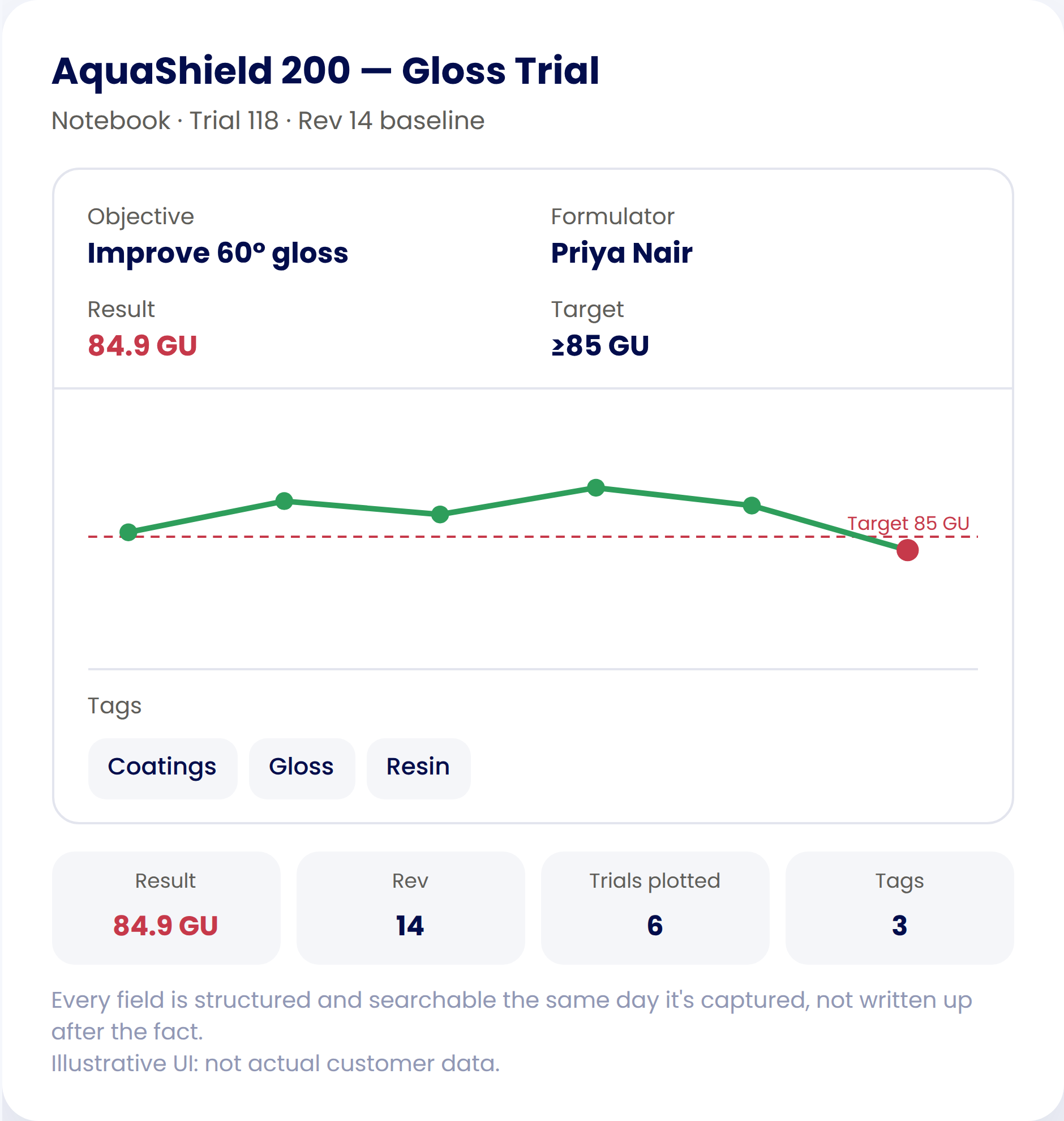
An experiment record that's structured from the start, so it still holds up as data the day someone needs to search it.
Structured, not a blank page: Fields, tags, and results are captured in a structured format, so an experiment holds up as data, not prose in a document.
Graphing and stats built in: Plot and analyze right where the data was captured, without exporting to a separate tool to make sense of it.
Years of history stay queryable: Every past experiment remains searchable on its own fields, not buried in a shared drive of file names.
Structured ELN. Built-in graphing. Tags & search. Version history
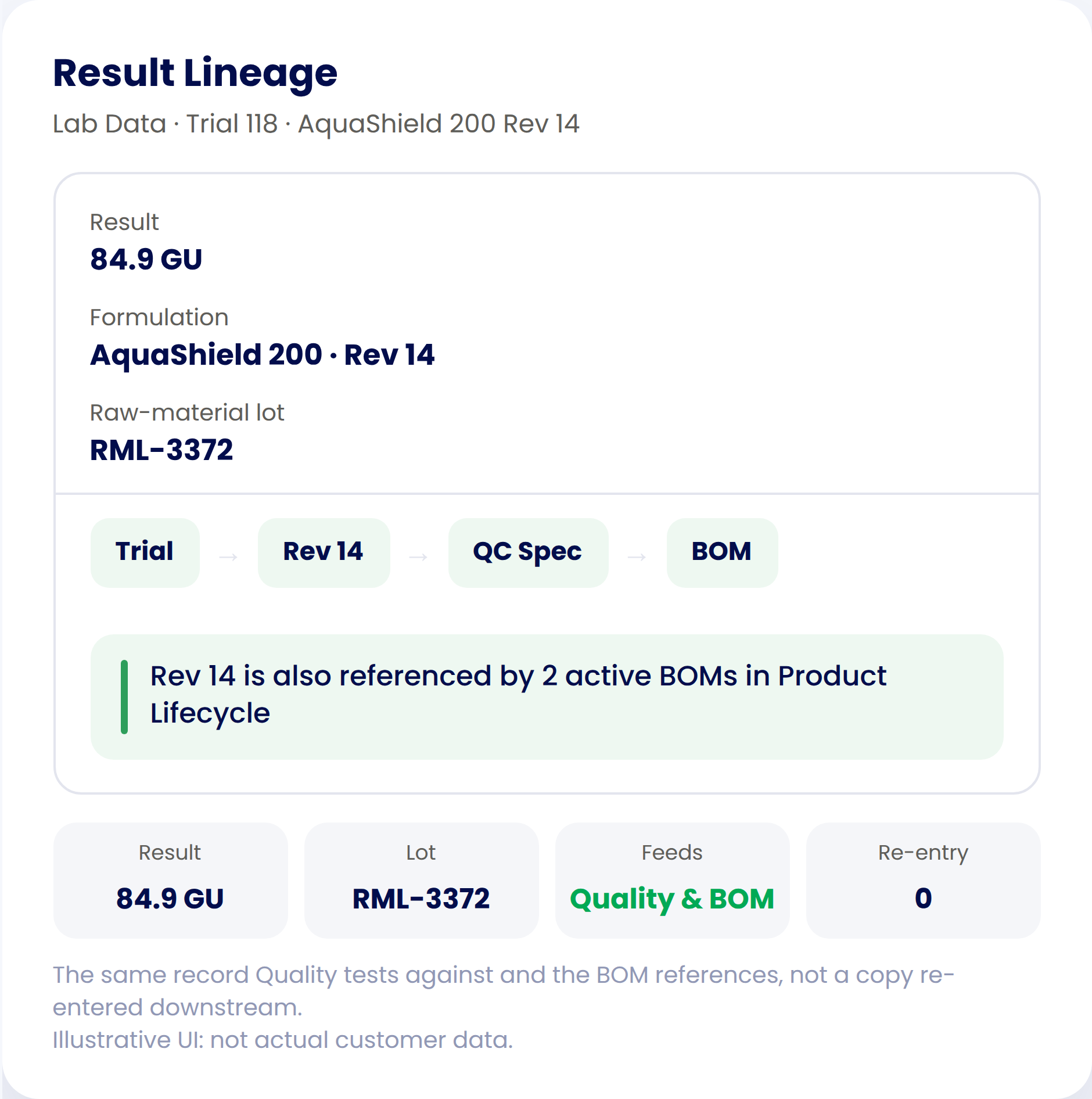
A result is only useful if it stays connected to what produced it, and to what it feeds into next.
Traces to the formulation and lot: Every result links back to the formulation revision and raw-material lot used, not a separate page in a lab notebook.
Feeds Quality and the BOM automatically: The same record Quality tests against and the BOM references, not a copy that gets re-entered downstream.
No re-entry between systems: Data created in R&D carries its context into Quality and Product Lifecycle without being retyped.
Formulation lineage. Batch & lot links. No re-entry. Shared record
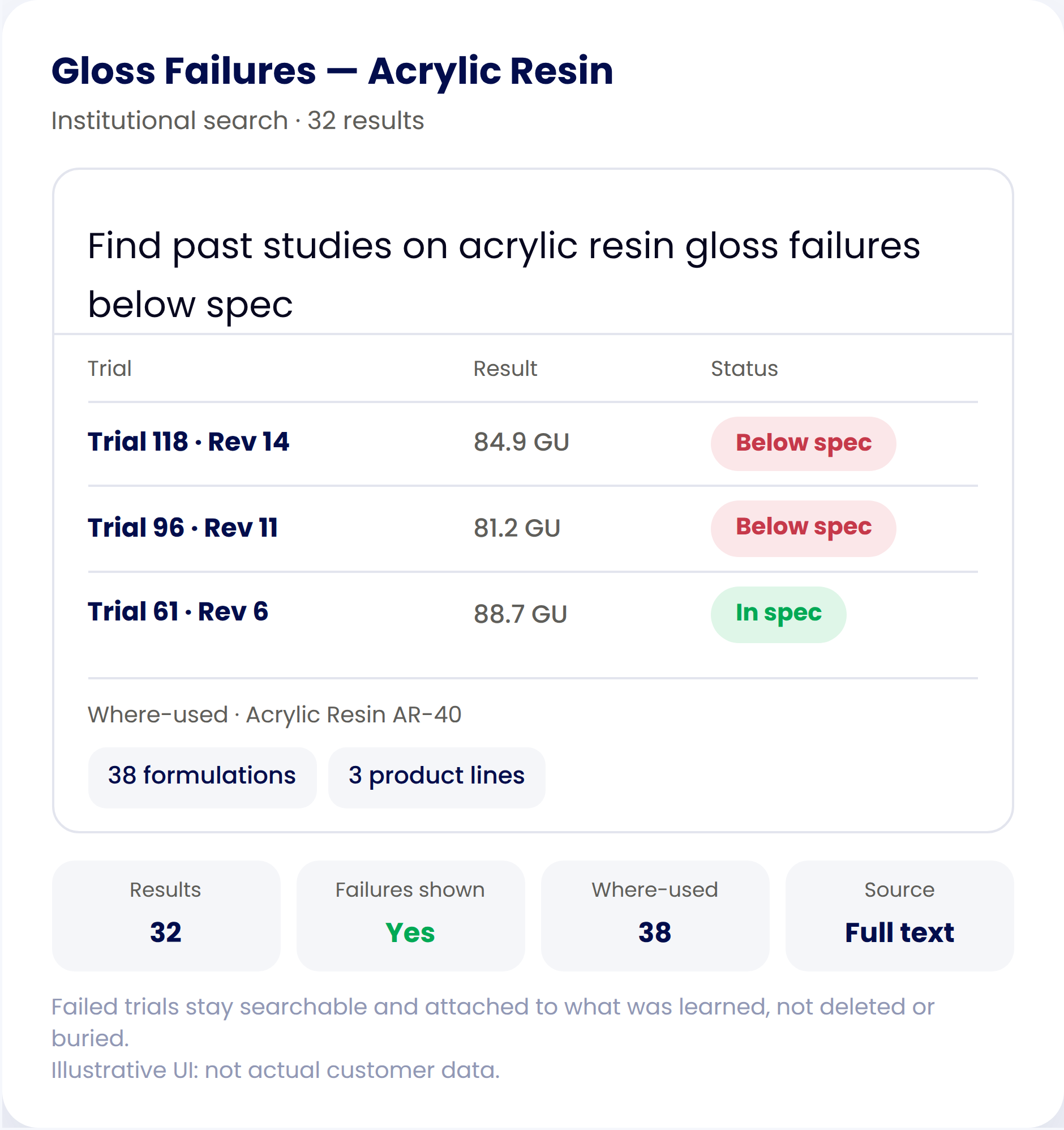
Institutional knowledge should outlive the person who ran the experiment.
Plain-language search across every experiment: Search by result, ingredient, or objective, not by trying to remember a file name.
Failures stay visible: Past failed experiments remain searchable and attached to what was learned, not deleted or buried.
Where-used, for any ingredient: See every formulation an ingredient touches before changing it, not after.
Institutional search. Failure history. Where-used. Full-text query
The best next experiment is the one that teaches you the most, not just the next one on the list.
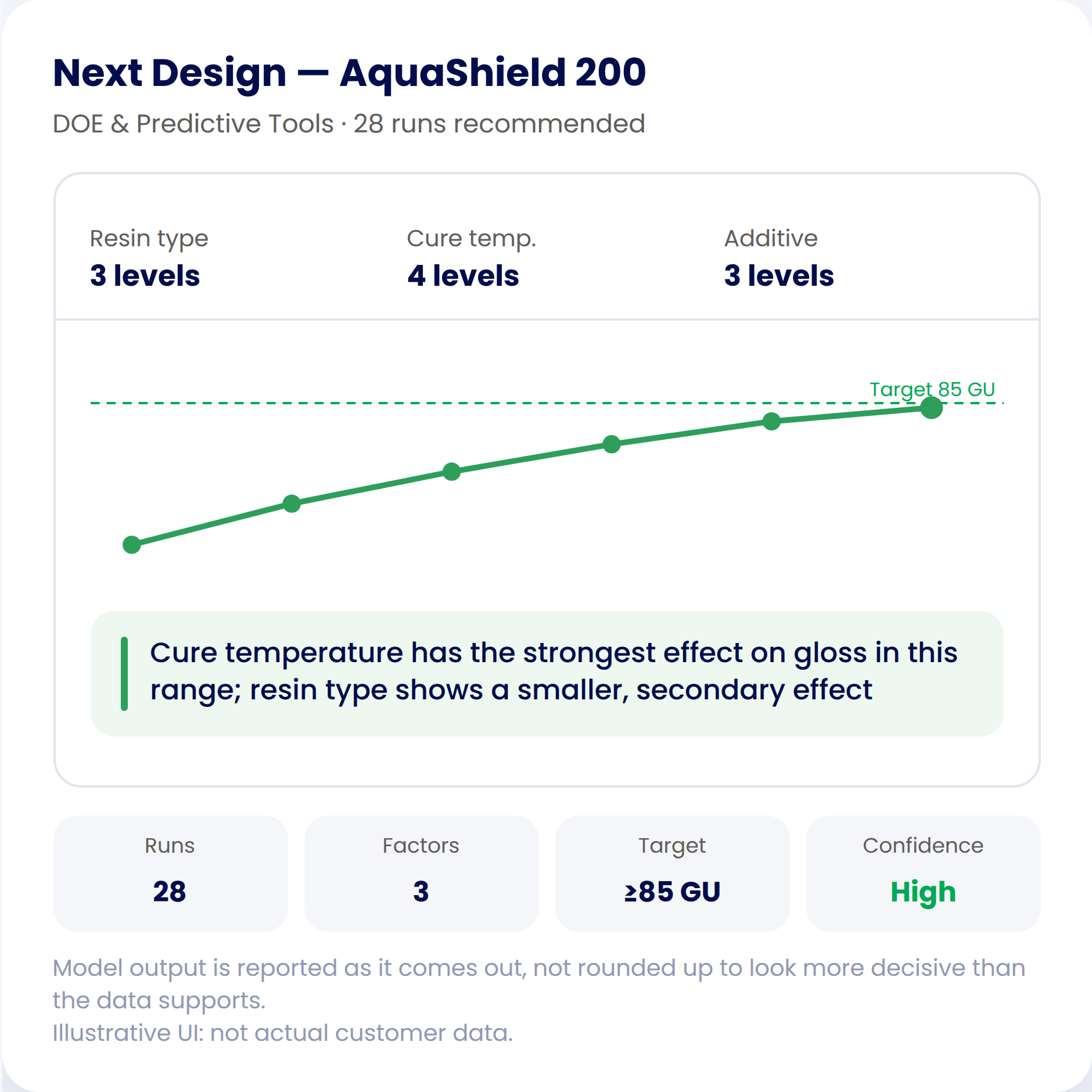
Statistical design, not guesswork: Multi-variable design plans a set of runs for maximum learning, not one variable changed at a time.
Explains what the model actually shows: Model output is reported as it comes out, not rounded up or trimmed down to look more decisive than the data supports.
Learns from project history: Constraints and prior results inform the next design, not a blank sheet every time.
DOE & Predictive Tools. Multi-variable design. Plain-language explanation. Recommended runs
What connected R&D is worth
When R&D, quality, product lifecycle, and project management share one data model, the payoff shows up as experiments never repeated and time given back to scientists.
CTO, Cooper Standard
CTO, Sun Chemical
46%
faster formula reviews, saving 34 hours each

15%
less matierals waste = more sustainable R&D

1,000+
users across 35 global sites

>50%
faster transition from testing to results

See the platform in action
Clariant partnered with Uncountable to replace a legacy ELN and build a structured scientific backbone connecting their synthesis and application teams. The results: 1,000+ users across 35+ global sites.
Shared by every suite
Bodie and the Portal work across R&D, Quality, Product Lifecycle and Project Management at once, on the same structured data model.

Bodie, the AI Layer

The Uncountable Portal
Where connectedR&D shows up
Not a formulator starting from a blank notebook and a guess at what's been tried before. Past experiments, including the ones that failed, are searchable by material, property, and outcome, so the project starts from what's already known.
Not a note buried in a spreadsheet that nobody checks before the next run. Inventory is tracked against the formulas and experiments that consume it, so a lot swap shows up against every formulation it touches, not just the one in front of you.
Not another full-factorial run because nobody's sure what's already been ruled out. DOE tools recommend the next set of experiments from the accumulated data, so each round narrows in instead of starting over.
Not a black-box number trusted or ignored on faith. Effect sizes and model quality are shown alongside the prediction, so a formulator can see what's actually driving it before acting on it.
Not a re-typed spec traveling by email to Quality and the BOM. The formulation, its test results, and its revision history move with it, so the next team picks up the same record instead of a summary of it.
Not a PDF filed away until someone remembers to read it. Supplier documents are parsed automatically into structured data, so the properties inside them are searchable and usable the same day.
Connected to the systems you already run
Uncountable sits at the center as the system of record for R&D and quality data, with a comprehensive API and integration layer connecting the systems around it.

A failed experiment should teach the next one something.
Most R&D systems store results. Because Uncountable keeps the full history searchable, including what didn't work, the next experiment starts from what's already been learned, not from scratch.
FAQs
It is a statistical, multi-variable design tool that plans a set of experiments to learn the most from the fewest runs, rather than testing one variable at a time. It generates constraints from project history and explains what the resulting model actually shows in plain language.
Yes. A formulation revision built in R&D is the same record Quality tests against and the Bill of Materials references, not a copy passed along by email or spreadsheet. Changes and results in either direction stay connected without re-entry.
Yes. Institutional knowledge search covers historical experiments including failures, so past learning stays available in plain language rather than being buried in files no one remembers to check.
It depends on the number of factors and levels involved, but a real response-surface design commonly lands in the range of 25 to 31 runs rather than a fixed round number. The tool reports what the underlying model actually shows for your data and design, not a single polished figure.
See it on your own R&D data.