Build sustainability into the formulation
Your sustainability profile lives on the recipe, not a separate report. Restricted substances screen automatically. Recycled content, bio-based content, and carbon footprint stay on the same record as you configure them. Reformulate to a target instead of reporting after the fact.
Deployed by 175+ enterprise product development teams







Deployed by Enterprise R&D and Innovation Teams



A report written after the fact can't change the product
ESG data usually lives in spreadsheets assembled after a product is formulated, disconnected from the recipe that drives it. By the time a restricted substance, a low recycled-content number, or a carbon figure surfaces, the product is locked. Changing it means starting over. Your sustainability profile is calculated from the recipe instead, not maintained alongside it. Change an ingredient and restricted-substance flags update immediately. Recycled content, bio-based content, and carbon footprint move with it too, using whatever data and calculation your team has configured, so your teams hit a target during formulation instead of measuring the gap after launch.
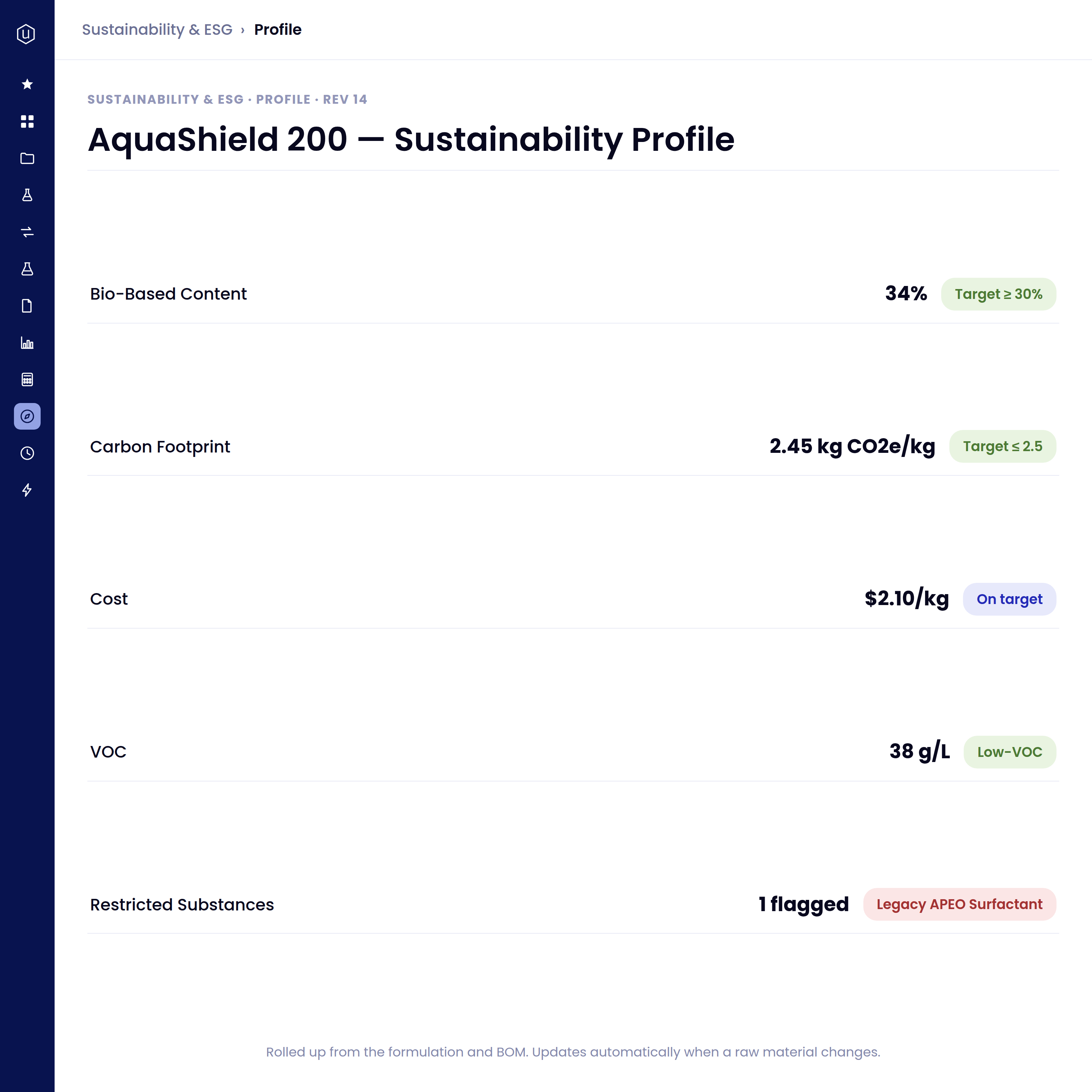
From profile to reformulation
One profile, always current
- Bio-based content, carbon footprint, cost, and VOC for AquaShield 200 (rev 14).
- All rolled up from the formulation.
- Bio-based content and carbon footprint reflect the material data and calculation your team has configured; restricted-substance flags come from the built-in screening lists.
- Each figure marked as supplier-declared or modeled, with the source captured.
- Change a raw material and the numbers move with it, and any restricted material flags automatically.
- One live profile instead of a spreadsheet assembled after the fact.
- The same product record the formulation, BOM, and QC teams already work from, not a separate ESG system.
- Updates the moment a revision is saved, no re-export or manual refresh.
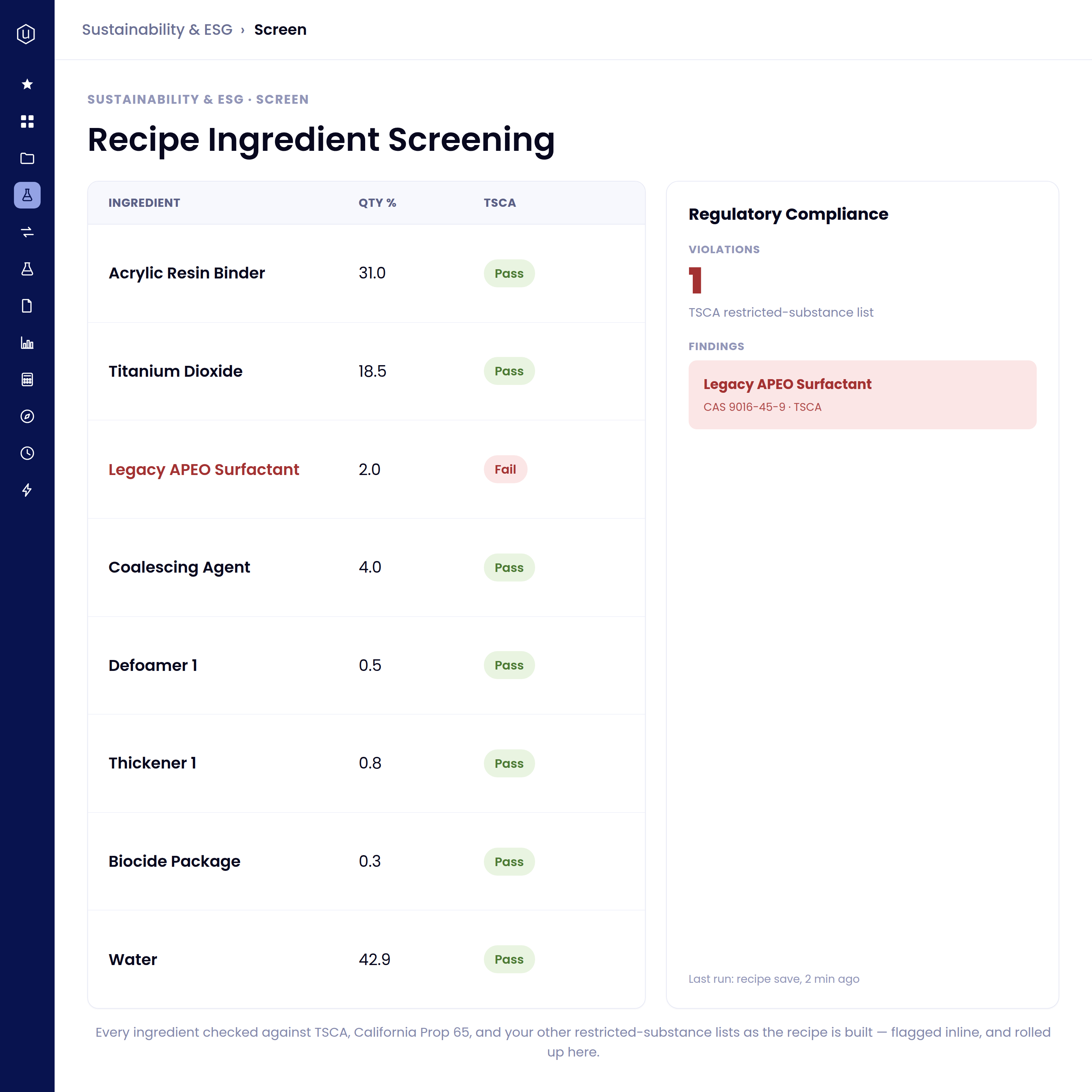
Screened as you formulate
- Every material is checked against restricted-substance and regulatory lists as the recipe is built.
- Ships with TSCA, California Proposition 65, and REACH SVHC built in, including REACH Annex XVII restrictions and CMR classifications; RoHS and other regional lists import as customer-maintained lists, plus your own banned and watch lists.
- Covers close to 20 jurisdictions out of the box, with an SDS review queue and per-recipe overrides for anything a preloaded list doesn't catch.
- The legacy APEO surfactant flags as TSCA-restricted.
- The rest of the materials stay clear.
- A flagged material surfaces during formulation, not in a later compliance review.
- Screening runs on every revision, not only at initial recipe creation.
- Each ingredient links back to its supplier and specification, so a flag traces to its source.
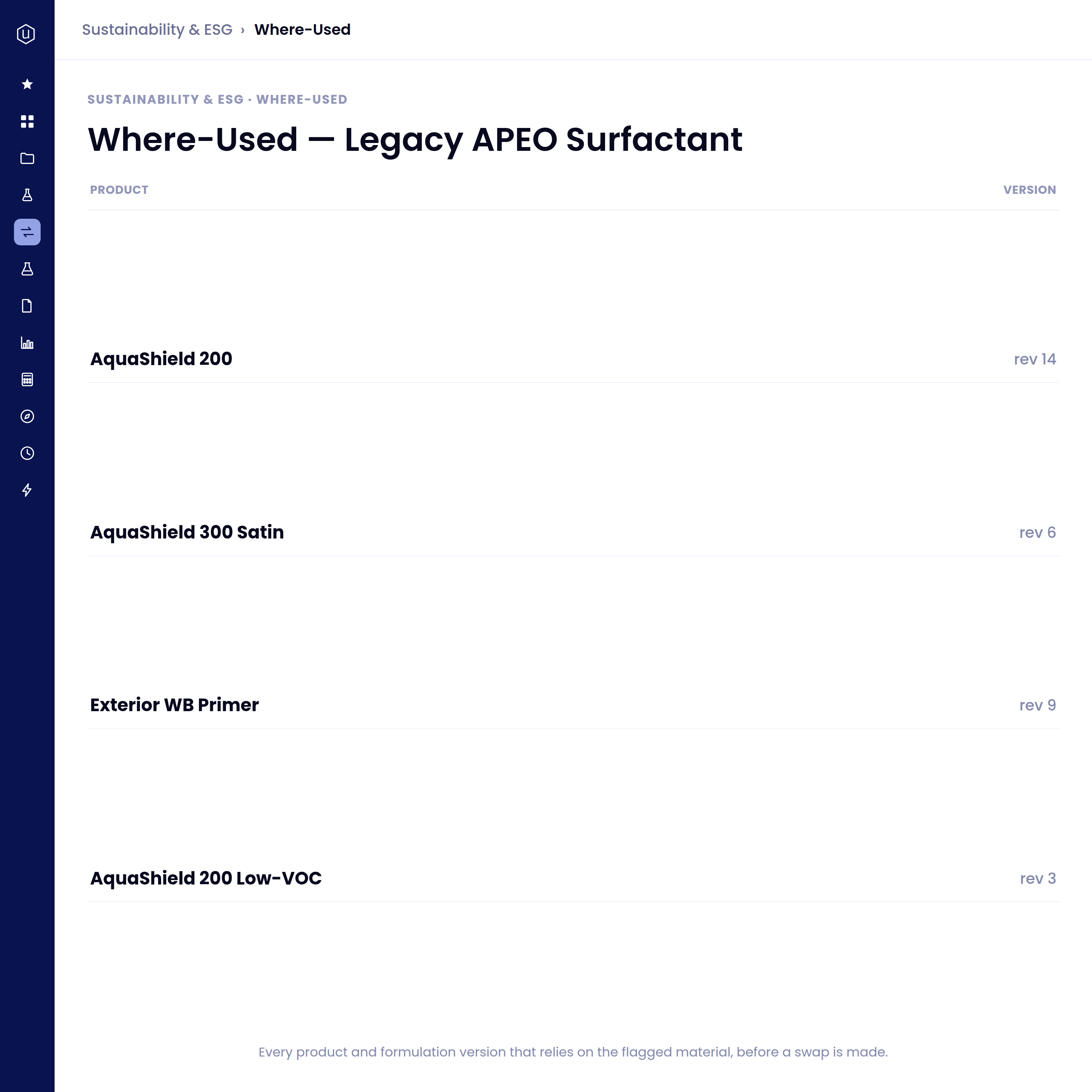
See where a flagged material is used
- Where-used lists the products and formulation versions that reference the flagged material.
- You see affected products before committing to a swap.
- Nothing depends on manually cross-referencing spreadsheets.
- The swap routes through change control and impact assessment before it ships.
- Covers finished products and the sub-recipes that feed into them, not just top-level formulations.
- The same where-used view used elsewhere in Product Lifecycle, not a separate ESG-only lookup.
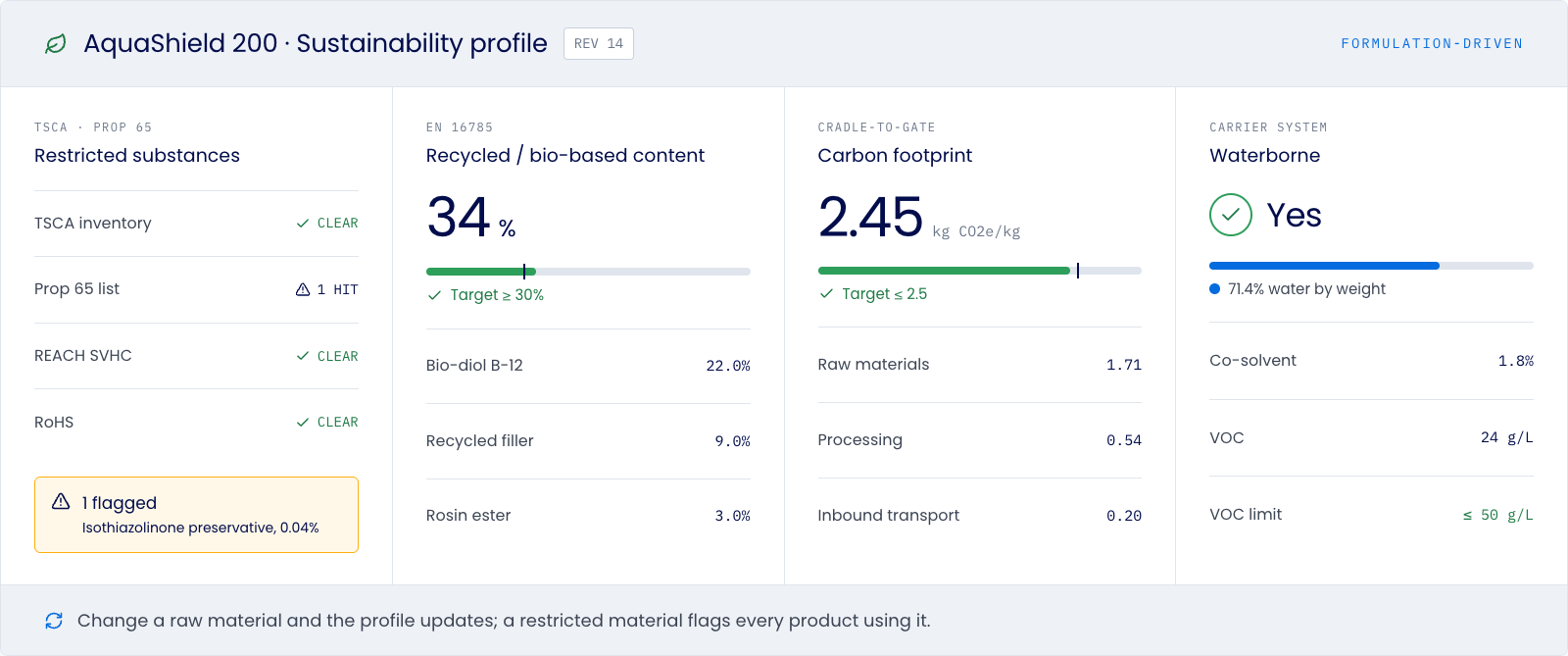
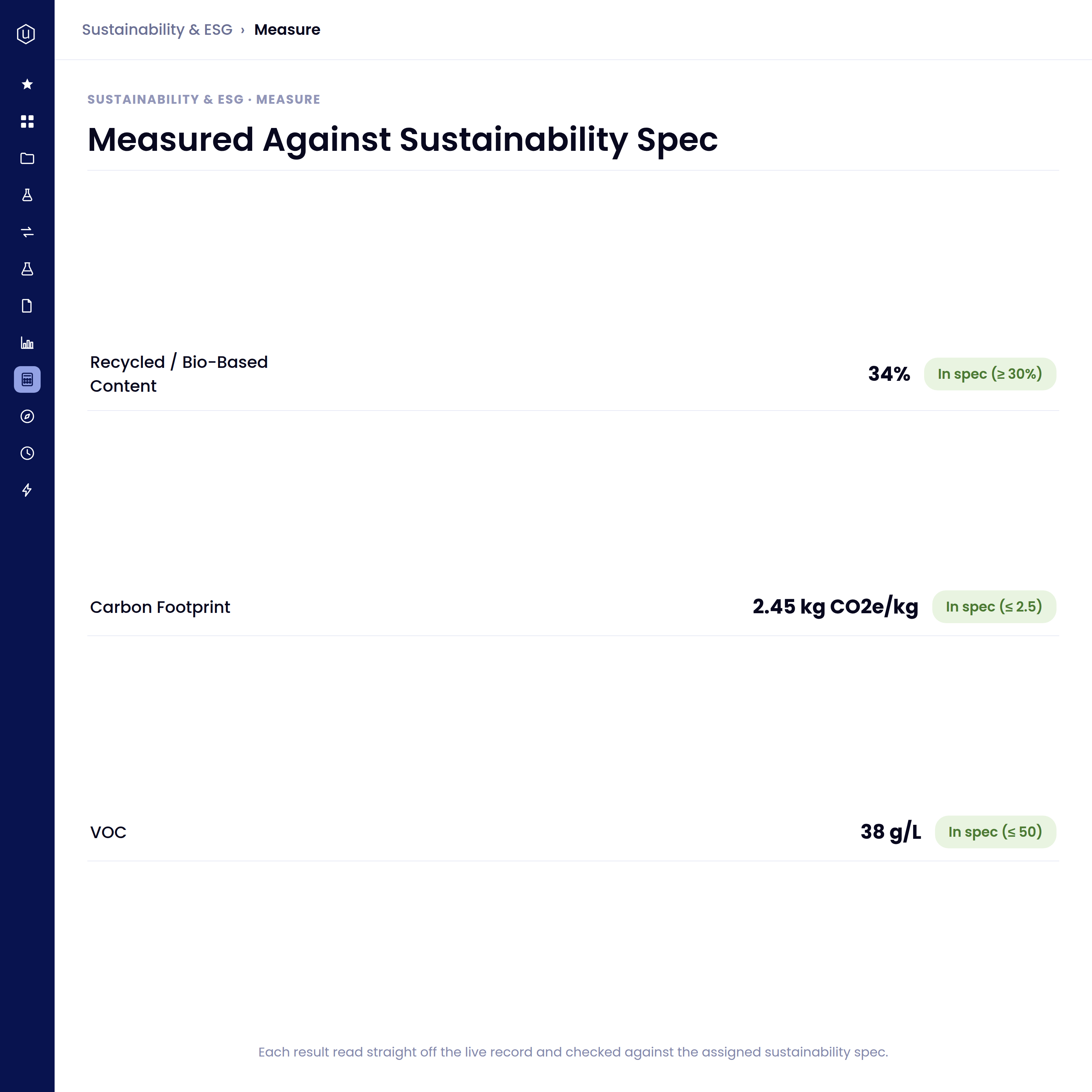
Measured against spec
- VOC is measured directly; recycled content and carbon footprint are calculated from material data your team configures, against the assigned sustainability spec.
- Each result is read straight off the live record.
- Recycled and bio-based content roll up from whatever material-level data your team has entered on the record.
- Carbon footprint is a cradle-to-gate calculation you configure on the same record: Uncountable runs the math, your team defines the data sources and emission factors, so it's a screening estimate rather than a certified life-cycle assessment.
- An out-of-spec result is flagged the same way an out-of-spec QC result is, so it cannot be missed.
- Sustainability specs are set and versioned the same way as performance specs, but gloss and other performance properties stay on the performance spec, not this one.
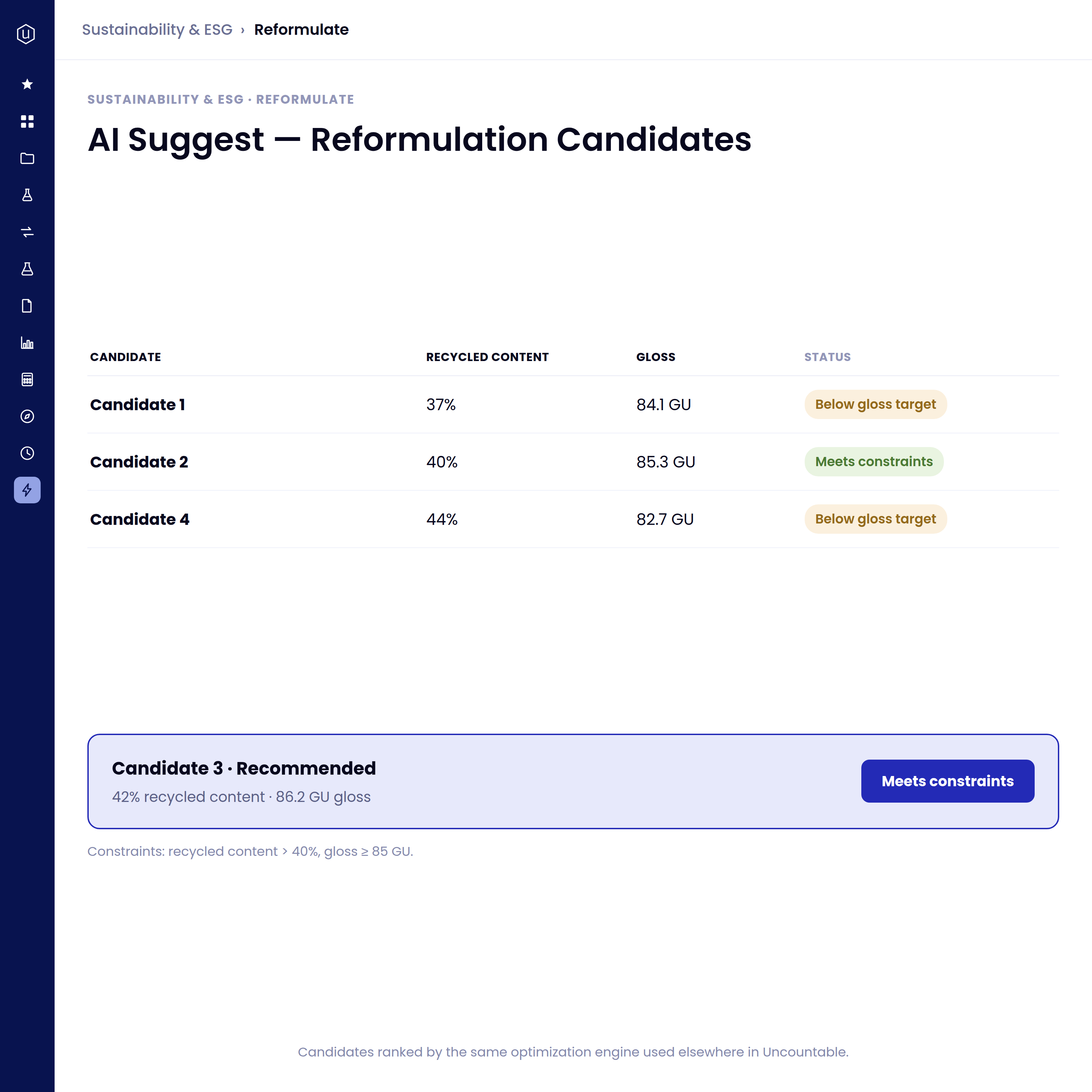
Reformulate to a target
- AI Suggest raises recycled content past 40% while holding gloss at 85 or above.
- Candidates come straight from the optimization engine, ranked against your constraints.
- Set a target for recycled content, footprint, or a restricted substance and reformulate against it alongside your performance specs.
- The same optimization engine used elsewhere in Uncountable, not a bolt-on tool.
- Every candidate is scored against your existing performance specs, not sustainability targets alone.
- Accept a candidate and it becomes the next formulation revision, on the same review and change-control path as any other change.
What changes when sustainability lives on the formulation
Without Uncountable
With Uncountable
End-to-end ESG
• Restricted-substance screening
• Regulatory list tracking
• TSCA & Prop 65 screening
• REACH SVHC built in
• Change control on restricted materials
• SDS review queue
• Recycled & bio-based content
• Cradle-to-gate carbon footprint
• Configurable to your data
• Reformulation to targets
• Design under constraints
• Declarations & documentation
• DPP-ready structured data
• Configurable, no consultants



Sustainability is a property of the formulation.
Screen, measure, and design against it on the same record your team already formulates on.
FAQs
It builds a product's sustainability profile on the same record as the formulation: restricted-substance screening runs automatically against built-in and customer-maintained lists, while recycled content, bio-based content, and carbon footprint are calculated from material data your team configures. Everything stays on the recipe, so the profile updates as the formulation changes instead of living in a separate spreadsheet.
Yes. Materials are screened against restricted-substance and regulatory lists as the recipe is built, with TSCA, California Proposition 65, and REACH SVHC (including Annex XVII restrictions and CMR classifications) covered out of the box across roughly 20 jurisdictions. RoHS, PFAS restrictions, and the ECHA SCIP database import as customer-maintained lists, alongside your own banned and watch lists and an SDS review queue for anything not preloaded. Overrides can be set per recipe, and a flagged material surfaces during formulation rather than in a later compliance review. Exact list coverage is confirmed during setup.
Yes, using Uncountable's AI Suggest capability. Set a target for recycled content, footprint, or a restricted substance, using whatever data you've configured for each, and reformulate against it alongside the performance specs, with candidates surfaced under your constraints.
Uncountable doesn't submit or manage a Digital Product Passport itself. What it provides is the structured product data, sustainability profile and material declarations, all living on the product record, that a DPP under the EU's ESPR framework would draw on. Exact DPP scope, formats, and any integration are confirmed at setup as the category requirements finalize.
Bring a formulation. We'll show you the rest.