Start every new grade from every batch you've made.
Recipes, process conditions and test results on one record, so new grades start from what your lab already knows.
Deployed by 200+ enterprise product development teams







Deployed by Enterprise R&D and Innovation Teams



In specialty chemicals, the customer spec moves faster than the data
Each customer grade depends on raw material lots, temperatures and hold times that get lost between lab, pilot plant and production. Uncountable keeps them on the recipe's record, so you can see what actually changed.
Illustrative example with demo data.
The workflow behind every grade
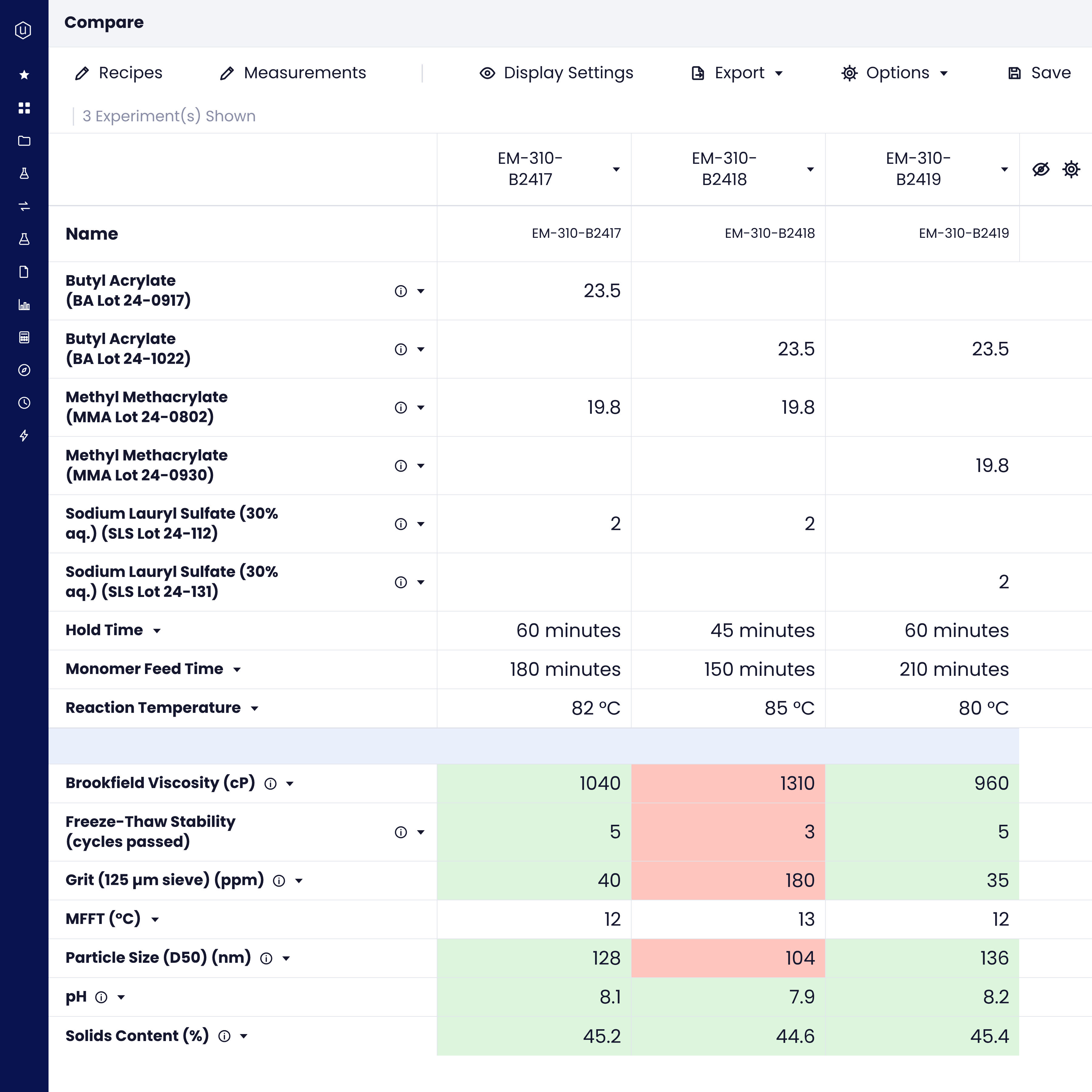
See lab, pilot and production batches side by side, so the one that drifted stands out before it reaches a customer.
Every batch in one view: Recipe version, raw material lots and process conditions next to viscosity, solids, particle size and every other result you track.
Out-of-spec results flagged: Each value is checked against the grade's spec as it's entered, so a drift doesn't wait for someone to compare spreadsheets.
Instrument data attached: GPC, rheology and particle size files sit with the batch they came from, not in a shared drive.
Same recipe, different result? The record shows what changed.
When a supplier discontinues a raw material or a substance is restricted, see every grade that uses it and how each one has performed.
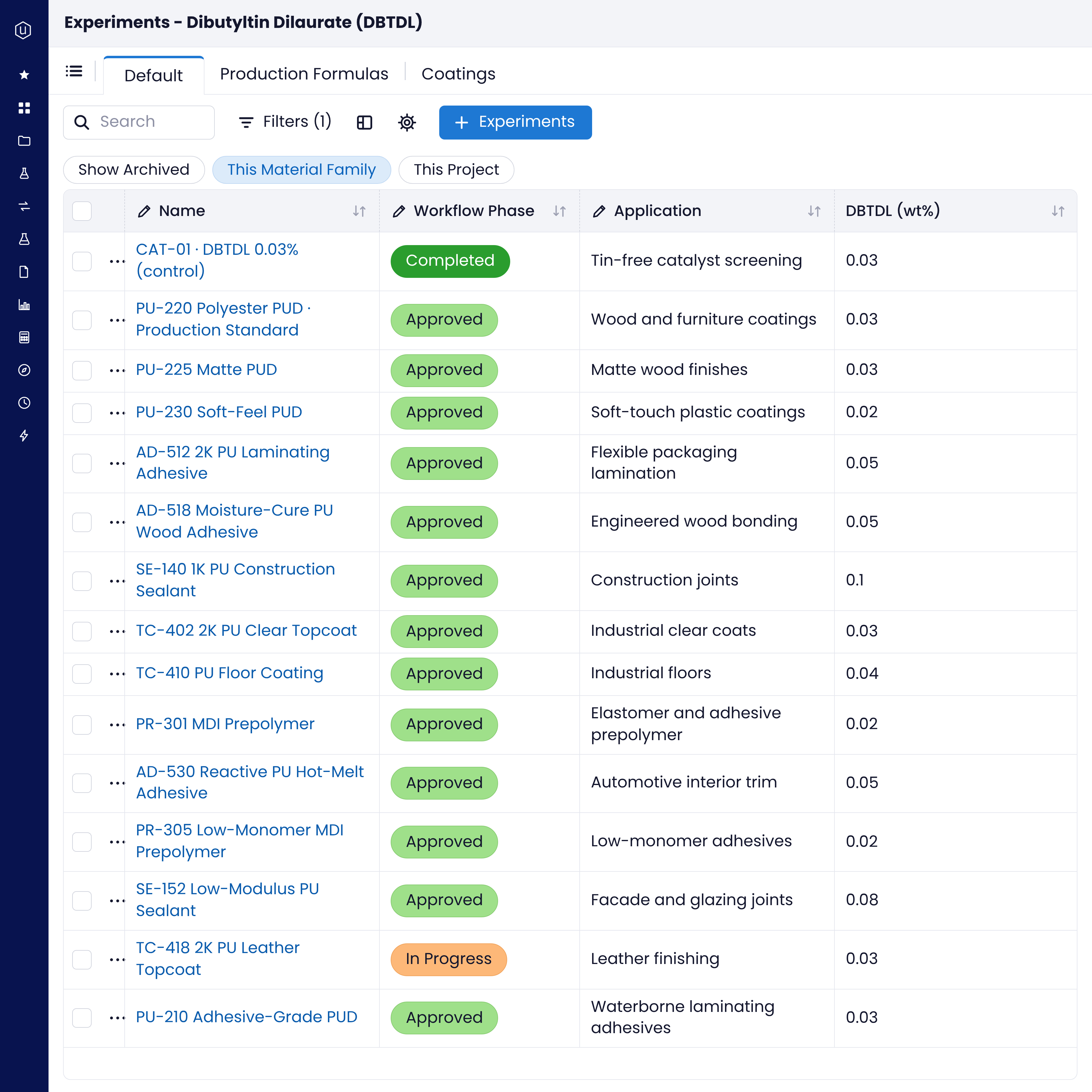
Every grade, at every stage: Search by raw material to list each recipe that contains it, from lab concepts to grades in production.
Know where to start: See each recipe's level of the material, its customers and its latest QC result, so commercial grades get looked at first.
Build on what's been tested: Past trials with alternative materials show what has worked and what to avoid.
Start the substitution from the trials you've already run, not a blank spreadsheet.
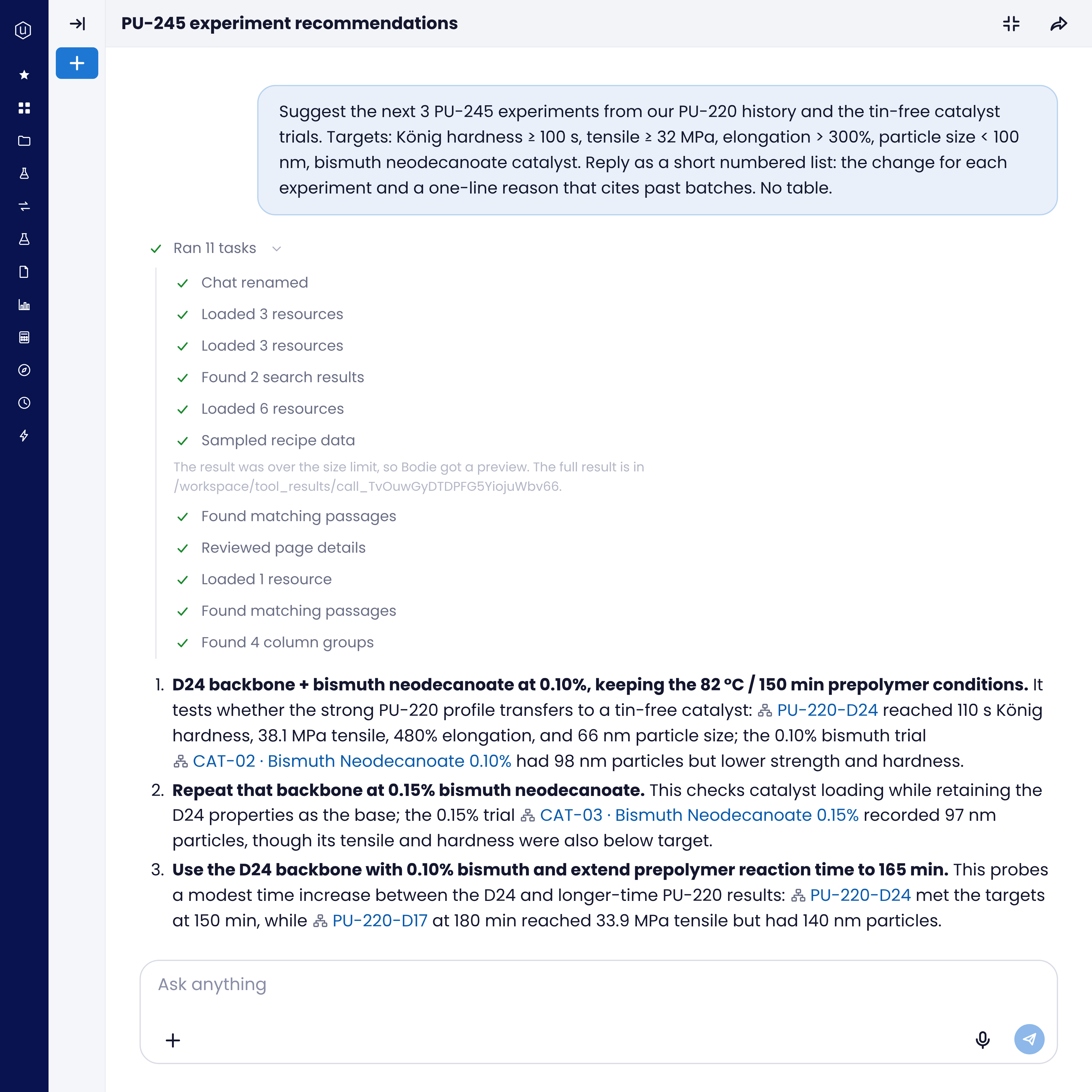
Set the targets a grade has to hit, and get the next experiments to run, with predicted results you can check before you make a batch.
Targets you set: Performance, cost and processing goals, each with its own range and priority.
Next experiments from Bodie: Bodie, Uncountable's AI agent, uses models trained on your past recipes to suggest raw material levels and process settings to try next, within the ranges you allow.
Predictions with uncertainty: Each suggestion shows its predicted result and how confident the model is, so you can choose between safe bets and new ground.
Every trial should tell you something the last one didn't.
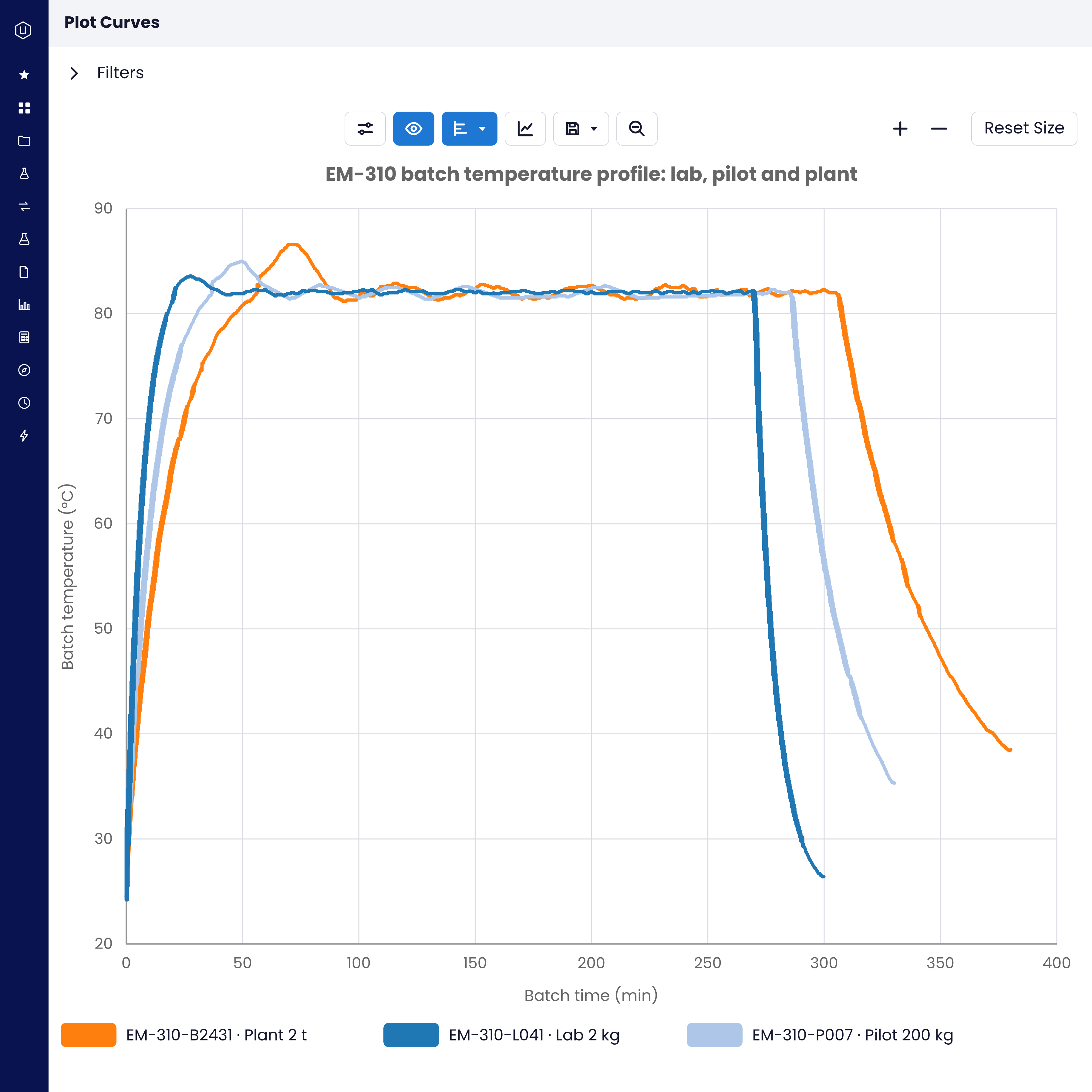
Follow one formulation from a 2 kg lab batch to a 2 t plant batch, with the process data from every scale on the same record.
Process traces on every batch: Temperature and other process profiles are stored as measurements, so lab, pilot and plant runs can be plotted together.
Scale-up differences in view: A slower heat-up or a longer cool-down at plant scale shows on the chart before it shows in a customer result.
Traced back to the recipe: Each batch links to the recipe version, raw material lots and process it was made with, so the investigation starts from the full record, not a batch number.
Scale up with the lab's evidence intact, not a fresh round of trials.
See exactly where your rollout stands: what's done, what's next and who's leading each step.
A phased plan with clear owners: Kickoff, configuration, data migration, testing, go-live and hypercare, each led by Uncountable, your team or both.
Configured to your lab: Test methods, specs, units and customer grades set up the way your team already runs them.
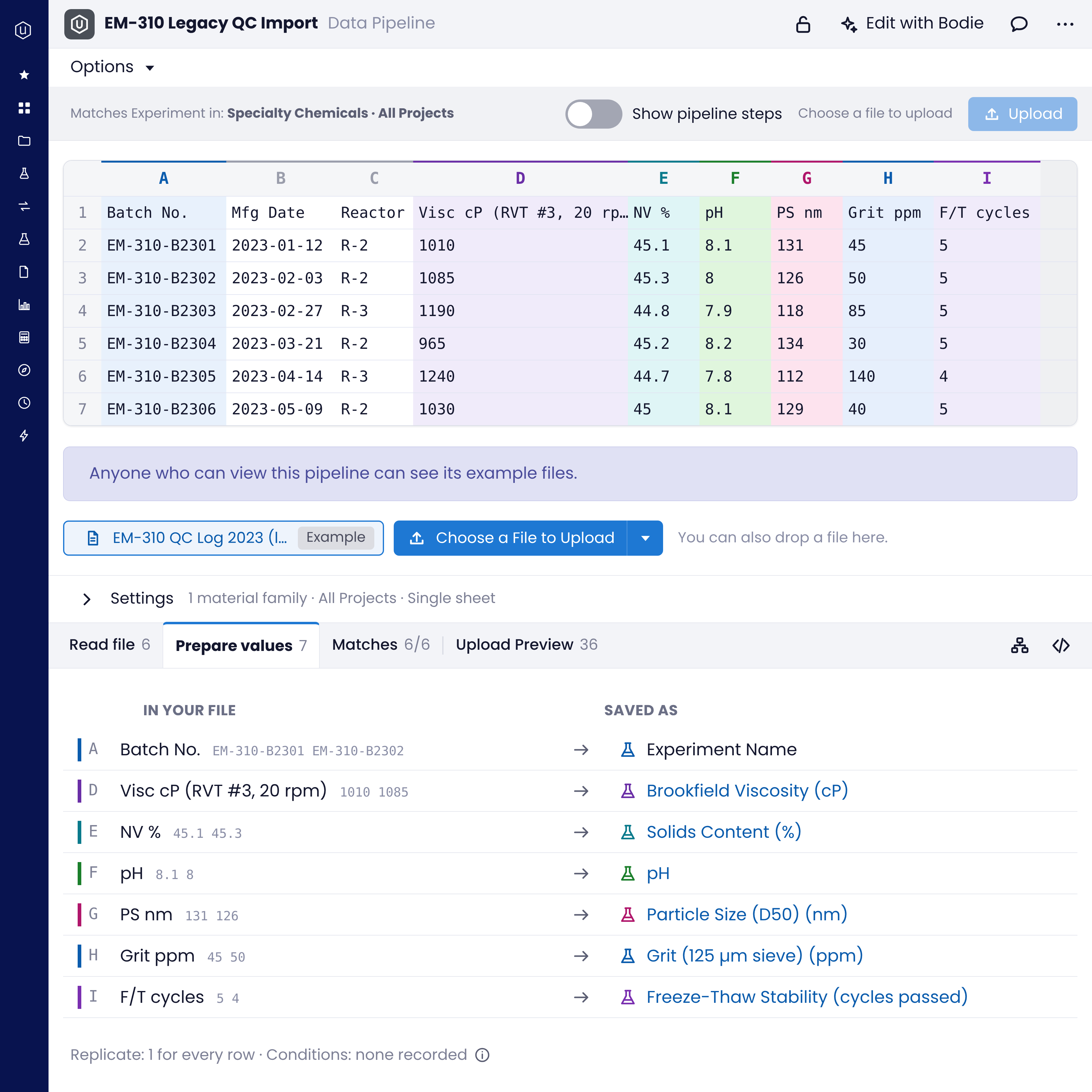
Your history comes with you: Historical recipes, batch records and instrument files are migrated, so past work is searchable from day one.
Configured to your lab, not the other way round.
One connected R&D foundation across 35+ sites
Clariant replaced its legacy ELN with Uncountable, connecting synthesis, formulation, testing and commercial workflows for more than 1,000 users on one structured data foundation.
What changes when your batch data is connected
Without Uncountable
With Uncountable
Built around your chemistry
One platform for every product line your team develops, configured to the tests and specs each one depends on:
Resins, pigments and additives tracked against gloss, adhesion and durability.
Bond strength, cure and aging results linked to the recipe and substrate.
Foaming, wetting and cloud point tracked against concentration and blend.
Viscosity, wear and oxidation stability results kept with every blend.
Dispersion, color strength and particle size tied to the milling process.
Molecular weight, viscosity and conversion recorded for every synthesis step.
Activity, selectivity and lifetime tracked against preparation and test conditions.
Instrument data preserved, not retyped from a report.
Check formulations against regulatory lists as you develop them, and author safety data sheets from the same record your chemists already work in.
See it on a real formulation
An all-purpose cleaner misses its cost target. Watch past results become five new formulations to test, and see Bodie, Uncountable's AI agent, show which ingredient drives viscosity. Your scientists decide what gets run.
Demo with illustrative data: from scattered past results to five recommended formulations in about a minute.
Your formulations stay yours
Recipes, process conditions and test data are the know-how your products are built on. Your data stays isolated per customer, with access you control.
Full documentation, including the SOC 2 report and penetration-test summary, is available on request.
Record the conditions, so every batch can be compared like for like.
Process conditions, raw material lots and test methods stay on the record with the recipe and its results, so teams can compare batches in the lab, the pilot plant or at scale.
FAQs
Uncountable is R&D software for specialty chemical makers in coatings, adhesives, surfactants, lubricants, pigments and additives. It connects R&D, QC and PLM on one platform with ELN and LIMS built in, so recipes, process conditions and test results stay on one structured record from the lab through scale-up and production.
Usually because something in the process changed: a raw material lot, an addition rate, a reaction temperature or a hold time. Uncountable records these as structured fields on each batch, next to its results, so you can compare batches on the conditions that produced them and see what changed.
Start from what you already know. In Uncountable, design of experiments and predictive models trained on your own historical recipes suggest which trials to run next and predict their results. Bodie, Uncountable's AI agent, finds past work and compares results, so each round of experiments is better targeted.
Uncountable migrates historical recipes, batch records and instrument files during implementation, so past work is searchable from day one. Clariant, for example, replaced its legacy ELN with Uncountable across more than 1,000 users.
First find every formulation that uses it. In Uncountable you can search by raw material to list each recipe that contains it, see how each one has performed, and screen alternatives against the same tests, so the substitution starts from evidence rather than a blank spreadsheet.

Bring us your toughest grade
Book a 30-minute intro call and see how Uncountable would connect your recipes, test results and process data.
Book an intro call