The recipe grid, native to R&D
Formulators search past production formulas, iterate toward a target, and move to scale-up in the same system. Every change is recorded in a full audit trail, and each formula stays connected to the raw-material records it draws on.
Deployed by 175+ enterprise product development teams








Deployed by Enterprise R&D and Innovation Teams



The recipe splits into three systems
R&D teams often run formulation work across disconnected places: recipes and process steps sit in one system while results sit in another, approvals route through email outside day-to-day formulation work, and raw-material reference data lives elsewhere again, cross-referenced by hand.
Without Uncountable
With Uncountable
From first search to a released formula
Formulators start from what already works instead of a blank page.
Search production formulas: Search all current and production formulas and use them as a starting point for new development work.
Start from a formula that works: Copy any current or production formula and use it as the starting point for new work, inside the platform rather than a static export saved off to the side.
A full audit trail of every change: Every field edit is recorded from old value to new in an append-only log, so you can see exactly what changed on a formula and when.
Add a reason to a change: Authors can attach a reason to a change, such as a qualified supplier or a new binder system, so the log explains itself where it matters most.
Separate what is live from what is archived: Filter by material family or project and keep active formulas apart from archived ones, so a search returns what is actually in production.
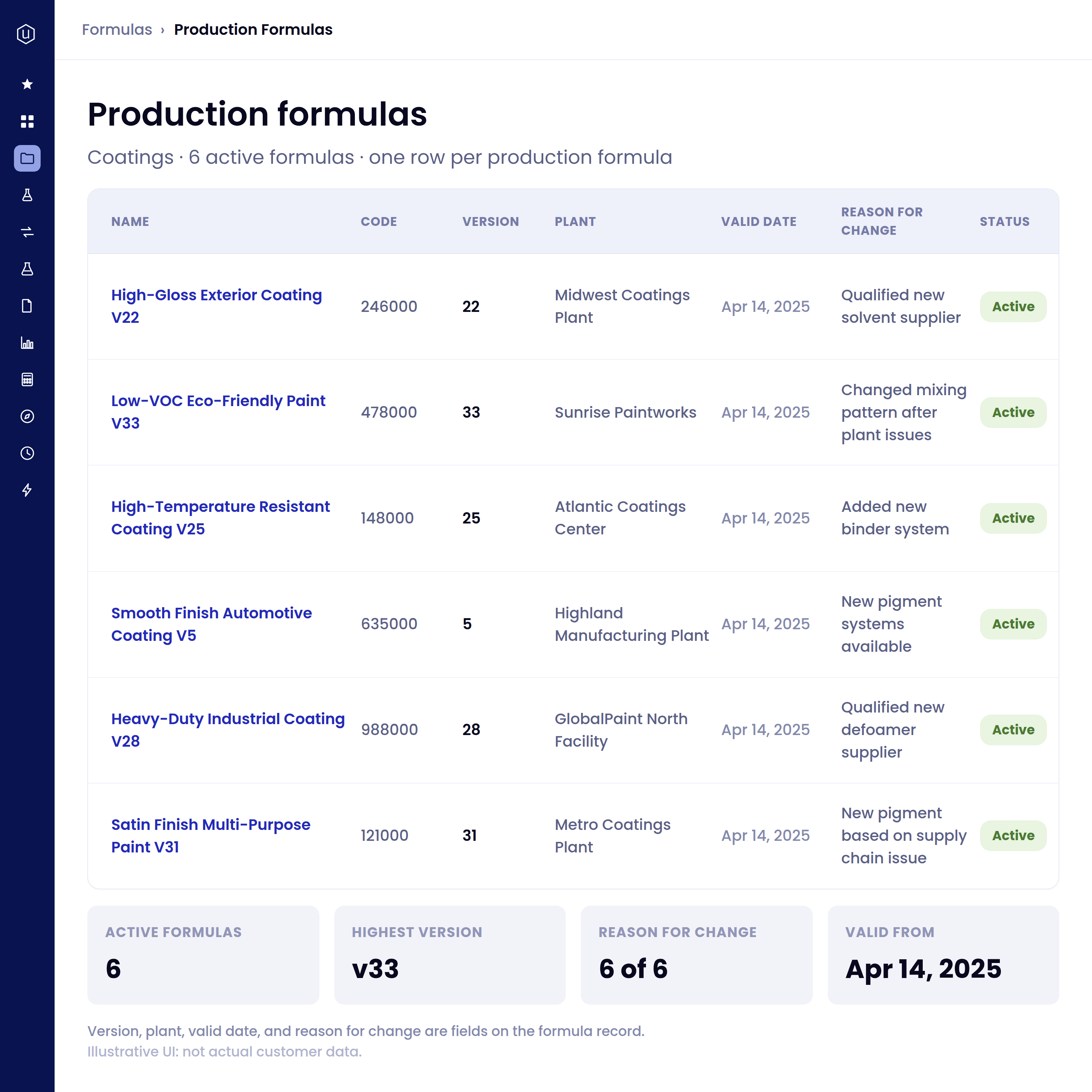
Every change stays on the native recipe grid, connected to the raw-material records it draws on, not exported to a spreadsheet along the way.
Iterate on the native recipe grid: Every change is recorded in a full audit trail, so a formula never drifts as a static file outside the system.
Connected to raw materials: Each formula stays linked to the shared raw-material record it draws on, so you can trace where any material is used.
Inventory and lot tracking: Track which specific supplier lot went into which formula, alongside inventory levels, so traceability reaches the material actually used.
Target checks, live: See where a formula sits against its target as ingredients change, instead of waiting on a separate analysis pass.
Formulation-native and flexible: Adapt data models and workflows without heavy engineering, built for industries where variants are common.
Unified system of record: R&D, QC, PLM, and project management in one platform, not four tools stitched together.
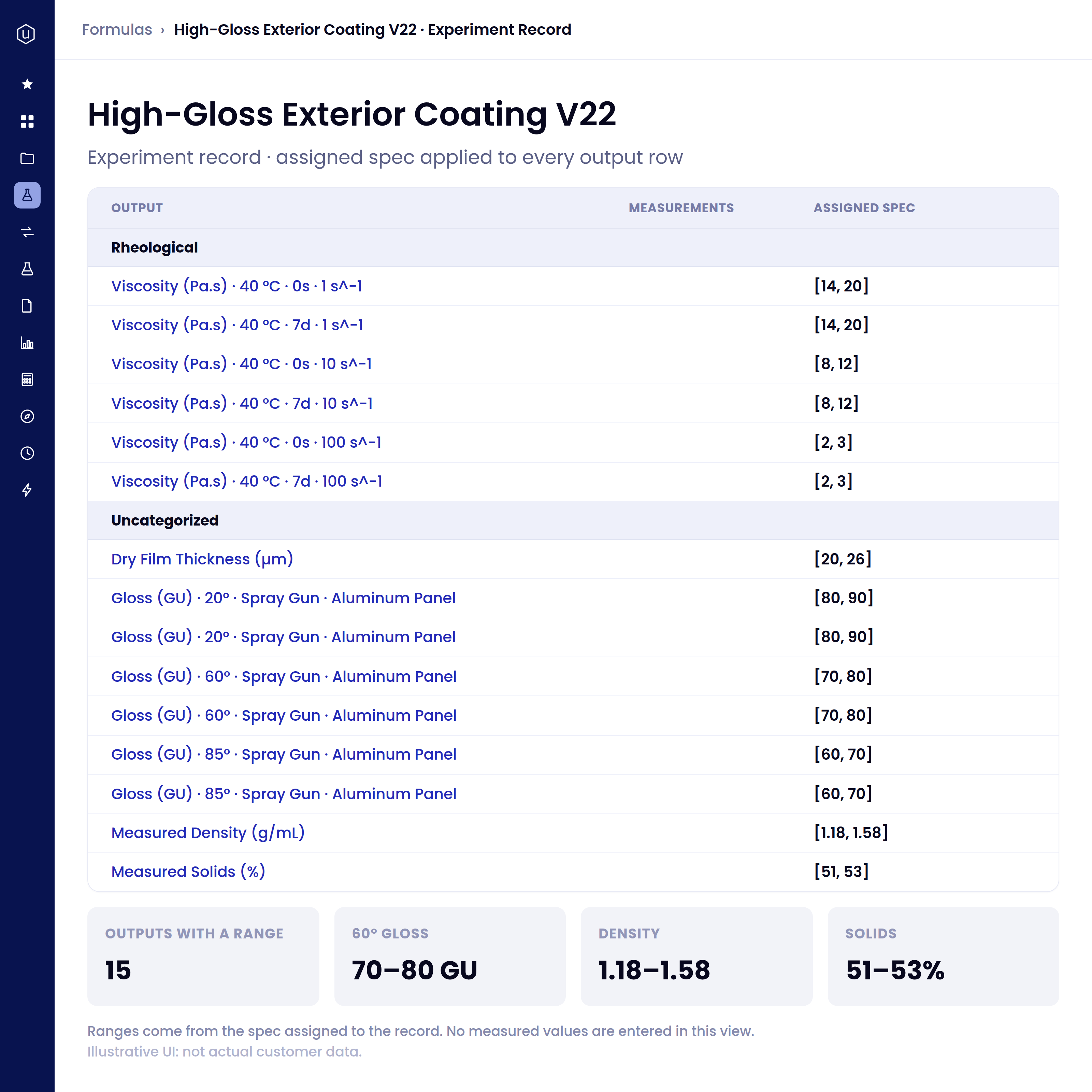
Models trained on your own lab data predict how a formulation will behave and suggest which experiment to run next.
Suggest and optimize: Machine learning models predict properties from a formulation and recommend the next best experiments to run toward your target, using Gaussian process models with Bayesian optimization to select candidates.
Design of experiments: Generate structured experiment designs and candidate formulations, so a campaign covers the space deliberately instead of one variable at a time.
Analyze what drives the result: Surface and interaction plots, effect analysis, and model insight over your own lab data, so you can see which inputs move which outputs.
Trained on your data, not a generic model: Predictions come from the experiments your own team has run, so the model reflects your materials, processes, and measurement methods.
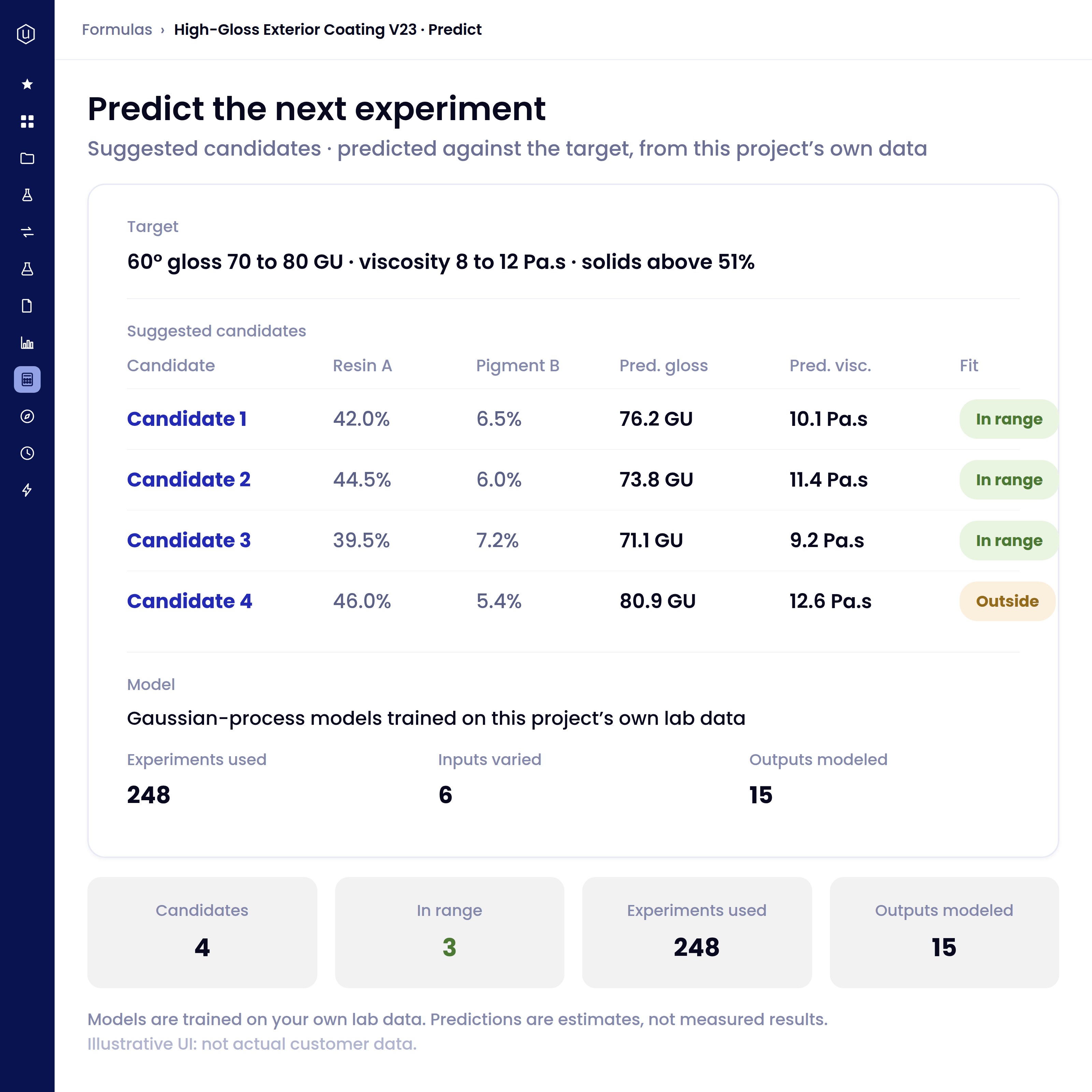
Once a formula is ready, it moves toward scale-up and approval in the same system it was built in.
Scale up in the same system: Scale-up and process chemists work in the same system, so handoffs carry their context instead of starting over.
Submit for approval, no re-entry: Once a formula is ready, formulators submit it for approval along with key product information, in the workflow they built it in.
API integrations: API integrations with ERP and CRM systems, a read/write API and SDK of our own, and lab instrument connections that bring readings straight into the record.
Notebooks and report export: Capture the formulation record in a notebook or project workbook, then export or publish reports to Word, PDF, or the customer portal.
Accelerated by Bodie: Uncountable's Gen AI assistant, Bodie, can help draft, search, and explain formulation work in plain language.
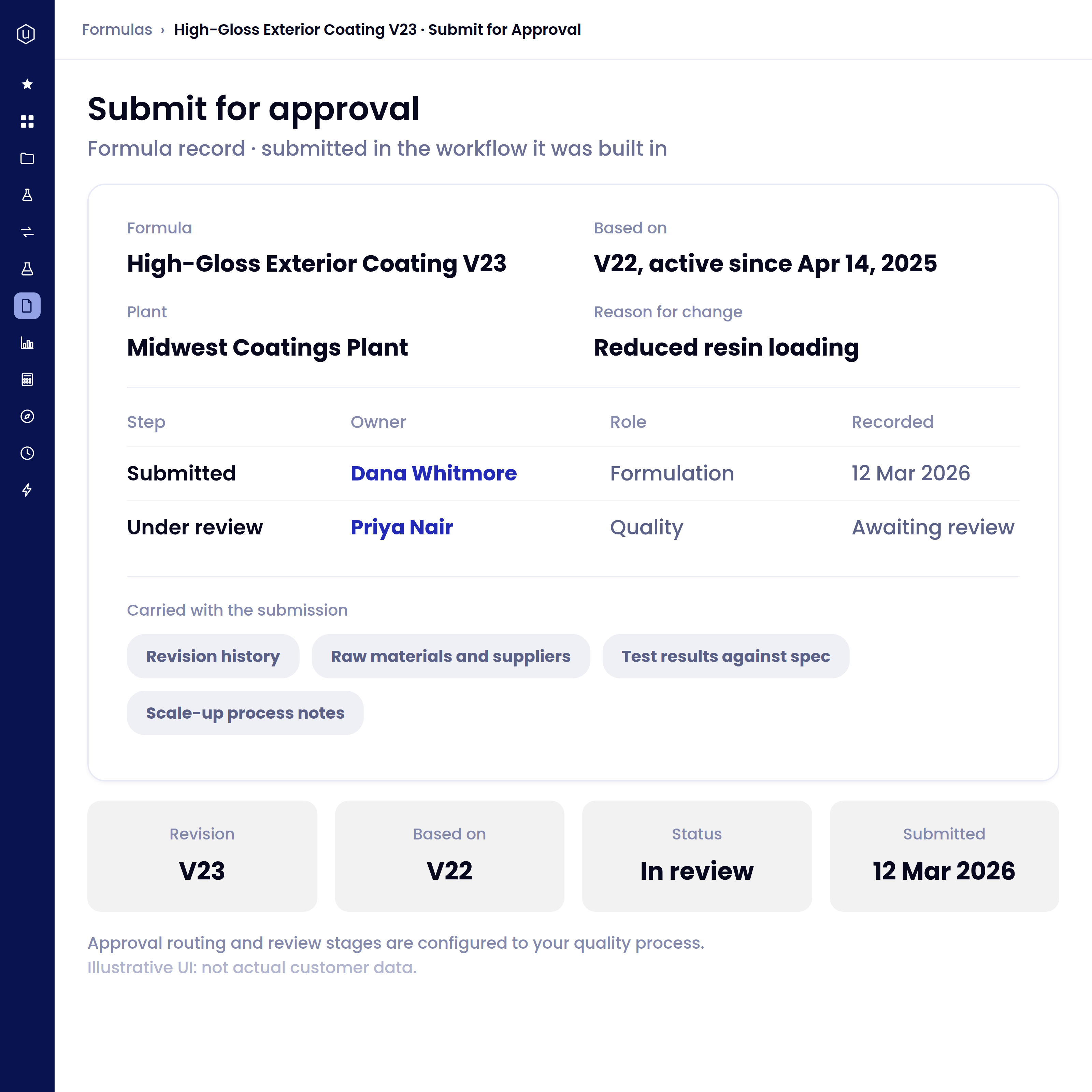
The platform behind the recipe grid
Built for industries where the product is the recipe
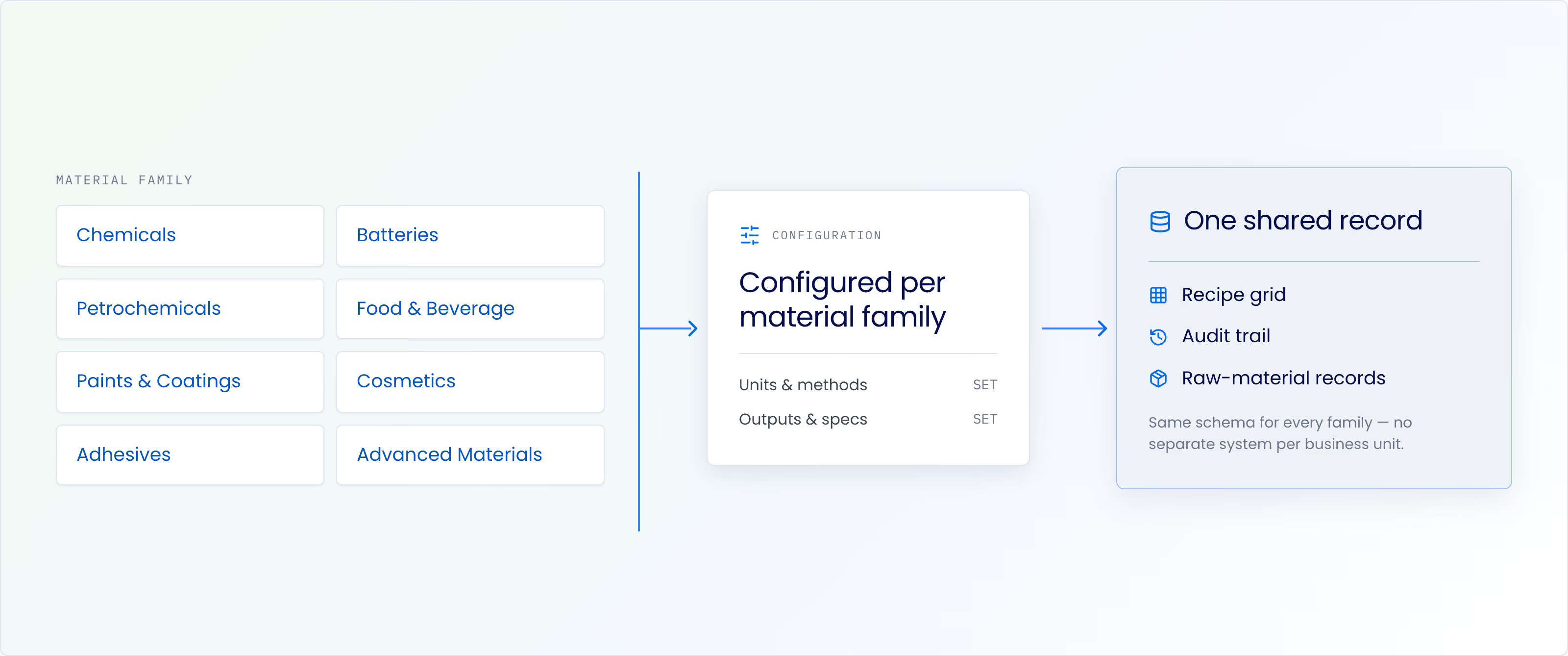
Formulation work looks different in every industry. The outputs you measure, the specs you hold to, and the variants you carry are not the same in a coatings lab as in a battery lab. The recipe grid is configured per material family, on one shared data model.


Search every formula your team has run, including the ones that failed.
FAQs
The recipe grid is native to the platform, not an imported file. Every change is recorded in a full audit trail, and each formula stays connected to the raw-material records it draws on.
Yes. Scale-up and process chemists work in the same system as the original formulator, and QC results and specs live alongside the formula rather than in a separate tool.
Each formula stays linked to the shared raw-material record it draws on, so that link holds when a supplier or spec changes. You can trace where any material is used and see every formula that draws on it, without searching across files.
No. Bodie, Uncountable's Gen AI assistant, accelerates formulation development but the recipe grid, audit trails and approvals work on their own.
See it on a formula you already have