Connect every coating formulation to the panels and results behind it
Keep formulation versions, application conditions, weathering results and QC data together. When a raw material changes, use past work to compare alternatives and plan the testing ahead.
Deployed by 175+ enterprise product development teams







Deployed by Enterprise R&D and Innovation Teams


A raw-material change starts a testing program, not just a new recipe
Replacing a resin, pigment or additive means checking more than the formulation. You need to understand how the change affects application, appearance and performance across the substrates and conditions that matter. When formulas, panel records, images and results sit in separate files, the team has to rebuild that picture by hand. Uncountable connects the work so you can find the original formulation, review previous testing and compare the replacement with the right context.
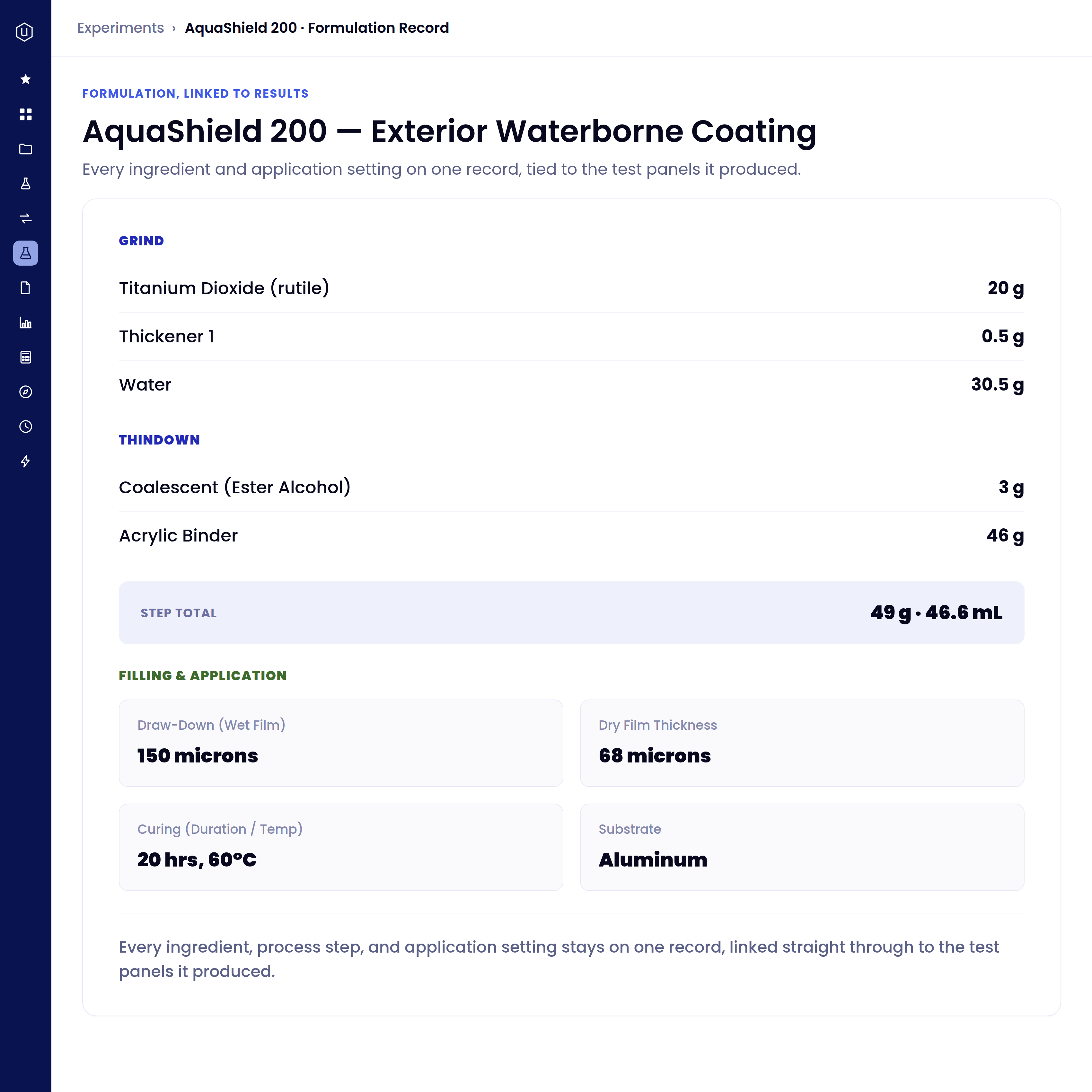
From formulation to weathered panel, keep the history connected
See what was made, how it was applied, which conditions it experienced and how it performed.
Find the starting point: Search past coatings by resin, pigment, additive or measured property. Review the formulation and its associated results before planning another round.
Compare results in context: Keep substrate, coat sequence, film thickness, application method and cure conditions alongside the results. Understand differences in test setup before drawing conclusions about performance.
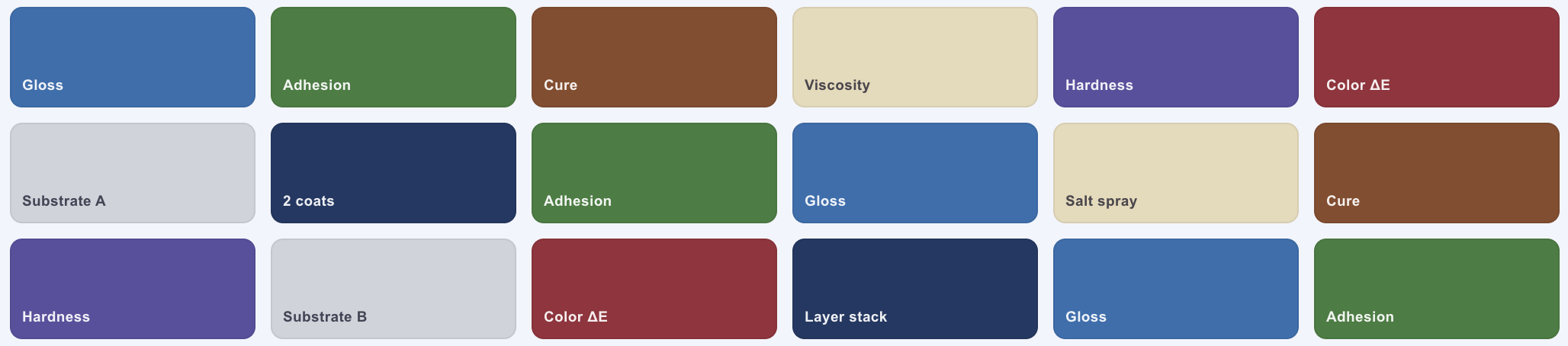
Keep images with measurements: Review panel images alongside gloss, adhesion, hardness and color measurements, with a link back to the formulation tested.
Follow testing over time:Keep exposure intervals and later measurements with the same panel, so the history stays clear as testing progresses.
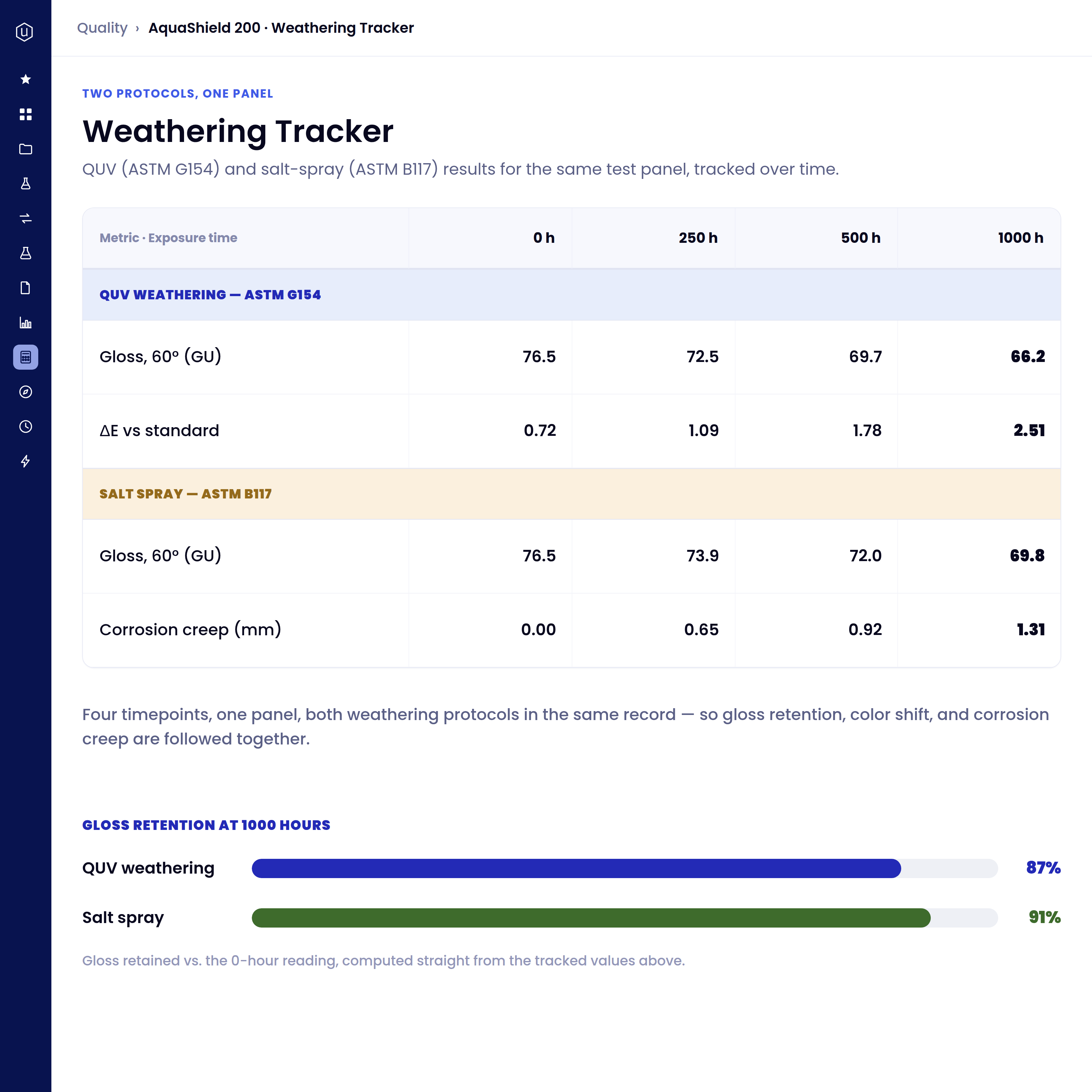
Run every weathering protocol against the same panel, so one record carries the whole exposure history.
Track QUV and salt-spray on the same panel, not two separate logs. Gloss, color shift, and corrosion creep all roll up to the same test panel, so one record shows how it weathers under every protocol it's run through.
See retention as a number, not a guess. Gloss retention at each exposure point is computed straight from the tracked readings, so comparing QUV against salt-spray performance never needs a side calculation.
Catch a protocol-specific failure early: if a coating holds up fine under QUV but degrades faster under salt-spray, that split shows up in the same tableinstead of two disconnected reports.
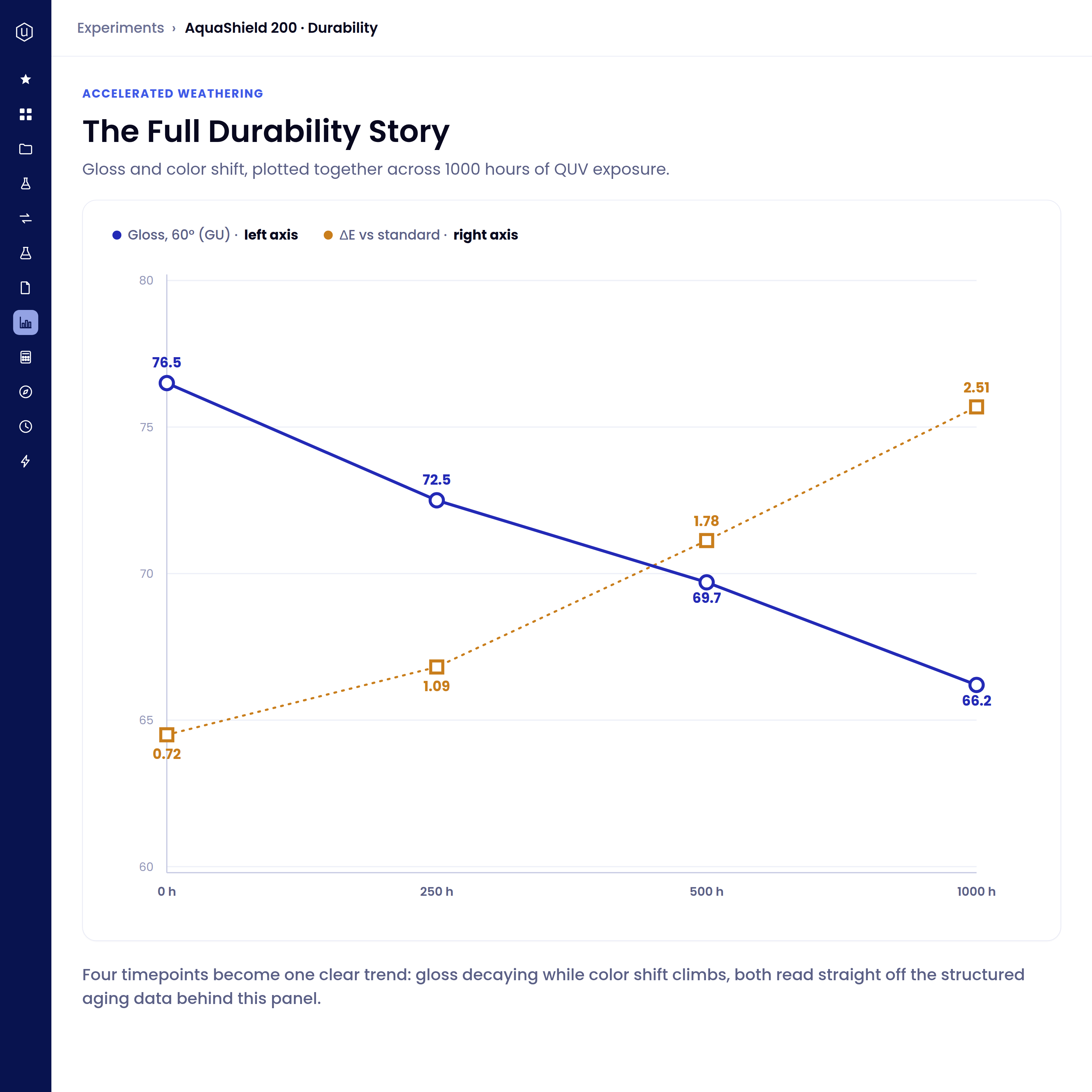
See exactly how a coating ages, with gloss and color shift plotted straight from the panel's weathering record.
Watch gloss and color age on the same timeline. Both properties are plotted against the same QUV hours, so a formulation's cosmetic life and its color stability read off one structured aging record, not two disconnected test reports.
Catch the inflection point before it's a failure. Four tracked timepoints become a clear trend line, so a coating decaying faster than spec gets flagged well before the full exposure cycle finishes.
Compare formulations by their actual aging curve, not their starting number: overlay two binder or pigment systems and see which one really holds gloss and color over 1000 hours, not just which one looked best on day one.
Configured for the coatings you develop
Architectural paints, automotive coatings, and inks don't test or formulate the same way; and your platform shouldn't force them to. Uncountable adapts to the workflows, substrates, and test protocols specific to each market you serve.
Color, durability, and cost balanced across large SKU ranges.
Corrosion, adhesion, and salt-spray performance on demanding substrates.
Multi-layer stacks, appearance, and cure tracked end to end.
Color matching, rheology, and substrate behavior.
Formulation and cure profile captured with bond performance. Covered in depth on its own page.
See adhesives & sealants →LAB color space support and dispersion development.
Formulation, application, and finish properties in one record.
Specialty finishes with full application and aging history.
What changes when you switch
The traditional way
The Uncountable way
From R&D formula to approved production formula
Behr ran formulation, product approvals and ERP transfer in separate systems, with approvals routed by email. Now its scientists formulate in Uncountable and prepare a formula for production approval with a single click.
Spend less time reconstructing the work
Less time finding, assembling and comparing past work means more of the lab's capacity goes on the testing that matters.
Locate relevant formulations and previous results before committing lab capacity to another trial.
Bring the formulation, conditions, measurements and images together when deciding which candidate to advance.
Record what changed, why it changed and which testing supports the decision.
See it in action
Dow Coating Materials shows how a connected digital workflow speeds R&D from experiment to insight.
Your formulations stay yours
Resin systems, pigment packages and panel data are the know-how your products are built on. They stay inside your own environment, with access you control.
When a formulation changes, keep the evidence connected.
Trace the revised formulation to its testing and results, while retaining the history of the version it replaces.
FAQs
Uncountable keeps each coating formulation version connected to the panels made from it, the application and exposure conditions, and the QC results. Teams compare results in context, find past work by ingredient or measured property, and move approved formulations toward production through review, with R&D, QC and PLM on one platform.
Design hundreds of panels across substrates, coats, and layer stacks, track them through aging with automatic reminders, and keep application and QC results, including images and LAB color, linked to the formula that produced them.
It brings formulation history and associated test results together so your team can review previous work and compare replacement candidates. Required testing and approvals still depend on the application and your change-control process.
No. The predictive tools are designed for formulators to use with their recorded formulation and test data. They help explore candidate formulations against selected targets. How useful a model is depends on the amount, consistency and range of the available data.
It includes ELN and LIMS functionality, but it is built around formulations and connects R&D, QC and PLM on one structured data model, so panels, conditions and results stay linked to the formulation version that produced them.
See it on your own coatings