
A coating defect is rarely just a defect.
Cratering, fisheyes, poor adhesion, orange peel, pinholing, gloss variation, settling, inconsistent color, and film-build issues can emerge during a lab trial, a pilot run, production, application, or after a product reaches the customer. The visible problem may appear simple. The root cause usually is not.
A defect can reflect a formula revision, a raw-material grade or lot, pigment dispersion, mixing energy, order of addition, hold time, substrate preparation, ambient conditions, application settings, flash-off, cure profile, or the interaction among several of those variables. For coatings teams, the challenge is not merely collecting more data. It is being able to connect the data they already have quickly enough to understand what happened and prevent it from happening again.
That is where many investigations break down. The formula lives in one file or system. Batch and process details sit in a lab notebook, spreadsheet, or production record. QC owns the test results. Technical service has the application observations. Quality manages the nonconformance or customer complaint. Procurement holds the supplier, grade, and lot information. The evidence exists, but it is scattered.
When the record is fragmented, teams spend days or weeks reconstructing the context around an issue. They ask experienced formulators whether they have seen it before. They search file names. They rerun tests. They may solve the immediate problem but fail to create a record that makes the next investigation easier.
That is why coating defects keep coming back.
A defect is an outcome, not a root cause
“Poor adhesion” is not a root cause. It is an outcome that may be linked to resin chemistry, a contaminated surface, insufficient pretreatment, film thickness, cure conditions, aging, or a mismatch between the coating and substrate.
“Gloss variation” is also an outcome. The cause may lie in pigment dispersion, viscosity, leveling additives, solids content, application equipment, film build, flash-off time, oven conditions, or raw-material variability.
Technical expertise remains essential. Coatings teams need to understand resin systems, rheology, pigment dispersion, film formation, curing, application behavior, substrate interactions, and end-use performance. But even the most experienced formulator cannot reliably identify patterns when the relevant context is split across disconnected records.
A high-quality investigation needs more than the name of the defect and the affected batch. It needs to connect that observation to the exact formula version, raw-material grades and lots, process conditions, application parameters, test methods, results, specifications, and prior related work.
Without that connection, a team may see the defect but not the sequence of decisions and conditions that produced it.
The evidence behind coating defects is scattered
Consider what it takes to investigate a customer complaint about inconsistent gloss in an industrial coating.
The formulation team may need to review the formula revision, pigment-to-binder ratio, additive levels, and recent substitutions. Procurement may need to verify whether a pigment, resin, or additive was sourced from a different supplier or arrived from a different lot. Lab teams may need to compare viscosity, dispersion, color, gloss, and application-panel data. Manufacturing may need to check dispersion time, mixing energy, temperature, order of addition, hold time, filling conditions, and equipment configuration. Technical service may need to document the substrate, spray settings, dry-film thickness, ambient humidity, flash-off conditions, and cure schedule at the customer site.
Each record can be relevant. Yet in many organizations, those records are captured separately, often in a mix of spreadsheets, PDFs, instrument exports, emails, shared folders, lab notebooks, ERP records, and quality systems.
The problem becomes more difficult at scale. A coatings manufacturer may have hundreds or thousands of formula variants, several manufacturing sites, multiple suppliers for a single material family, and different application requirements by customer or market. A team cannot rely on file names or institutional memory to understand whether a new complaint resembles a past failure.
The relevant question is not simply, “Have we seen gloss variation before?”
It is:
Have we seen gloss variation in a similar coating system, using this pigment grade or a comparable grade, at this concentration, on this substrate, at a similar film build, under similar application and cure conditions?
That is a search problem, a traceability problem, and a data-structure problem.
Four Questions Every Defect Investigation Should Answer
A coating defect investigation should do more than identify the affected batch and document a corrective action. To prevent repeat failures, teams need to answer four connected questions.
1. What changed?
Start by identifying what changed before the defect appeared. That could include a formula revision, an ingredient concentration, a raw-material supplier, grade, or lot, a mixing procedure, a production line, a batch size, an application setting, a substrate, or a cure profile.
The important point is to compare the affected batch with a known-good reference. A commercial material name alone is not enough: different grades and lots can vary in properties such as solids content, viscosity, particle-size distribution, impurity profile, or processing behavior. A small change can become significant when combined with a particular pigment package, substrate, application method, or cure window.
2. Where else has this combination appeared?
The next question is not simply whether the organization has seen the same defect before. It is whether it has seen a similar combination of materials, formula conditions, process parameters, and application conditions.
For example, a team investigating poor leveling should be able to search previous work involving the same resin family, pigment type, dispersant, material grade, substrate, film build, application method, and cure condition. This allows them to find relevant historical experiments, batches, complaints, and technical-service observations instead of beginning each investigation from scratch.
The goal is not to assume that a prior result provides the answer. It is to start with evidence the organization already has.
3. Is the issue formula-driven, process-driven, or caused by their interaction?
A coating formula can meet laboratory requirements yet fail during pilot production, manufacturing, or customer application. That does not necessarily mean the formula is wrong.
Mixing energy, dispersion time, addition order, temperature, milling conditions, hold time, equipment configuration, batch size, film thickness, flash-off, and cure conditions can all affect coating performance. In many cases, a defect is caused by an interaction between formula and process rather than either one in isolation.
Separating those possibilities prevents teams from making the wrong correction. Reformulating a product will not fix a process-control issue. Adjusting process instructions may not resolve raw-material variability. The investigation should compare successful and unsuccessful outcomes across both formula and process conditions before identifying the corrective action.
4. What evidence shows the corrective action worked?
A corrective action is not complete when a team has a plausible explanation. It is complete when the organization can show that the change resolved the issue under the conditions that matter.
That means linking the root-cause hypothesis to the revised formula, material specification, process instruction, or application guidance; then documenting the verification tests, results, approvals, and affected products or sites. If the issue involved a supplier grade or lot, the team should also assess where else that material was used and whether similar risks exist elsewhere in the portfolio.
This final step turns an individual defect investigation into reusable product knowledge. It creates a clear record of what happened, why it happened, what changed, and how the organization verified the outcome.
Formula and process cannot be investigated separately
A coating can perform well in the lab and fail at pilot or production scale even when the formula itself has not changed.
Process conditions are part of the product record. Mixing energy, dispersion time, addition order, temperature, milling conditions, hold time, batch size, equipment configuration, application method, and cure profile all affect the final coating.
This becomes particularly important when a team is investigating defects that seem intermittent.
Imagine a waterborne industrial coating that begins showing poor leveling and inconsistent gloss after a material substitution. The replacement resin has the same commercial family name as the original, so the formula appears unchanged at first glance. But the new grade has a different solids content and viscosity profile. At the same time, manufacturing shortens the dispersion cycle to maintain throughput, while the application line begins using a substrate with a slightly different pretreatment condition.
None of those changes may independently appear serious enough to explain the issue. Together, they create a different system.
If formula data, raw-material records, process parameters, application observations, and QC results are disconnected, the team must reconstruct that relationship after the defect appears. If those records remain connected, the team can compare successful and unsuccessful batches and test specific hypotheses: Was the defect linked to the resin grade? The shortened dispersion cycle? The substrate? Or the interaction among all three?
That distinction matters because the corrective action depends on the cause. Changing the formula may not solve a process problem. Tightening a process specification may not solve a raw-material variability problem. Treating every defect as a formulation problem creates unnecessary reformulation work and can introduce new risks.
What a connected defect record looks like
A coating defect investigation should connect the defect observation to the technical and operational evidence needed to explain it.
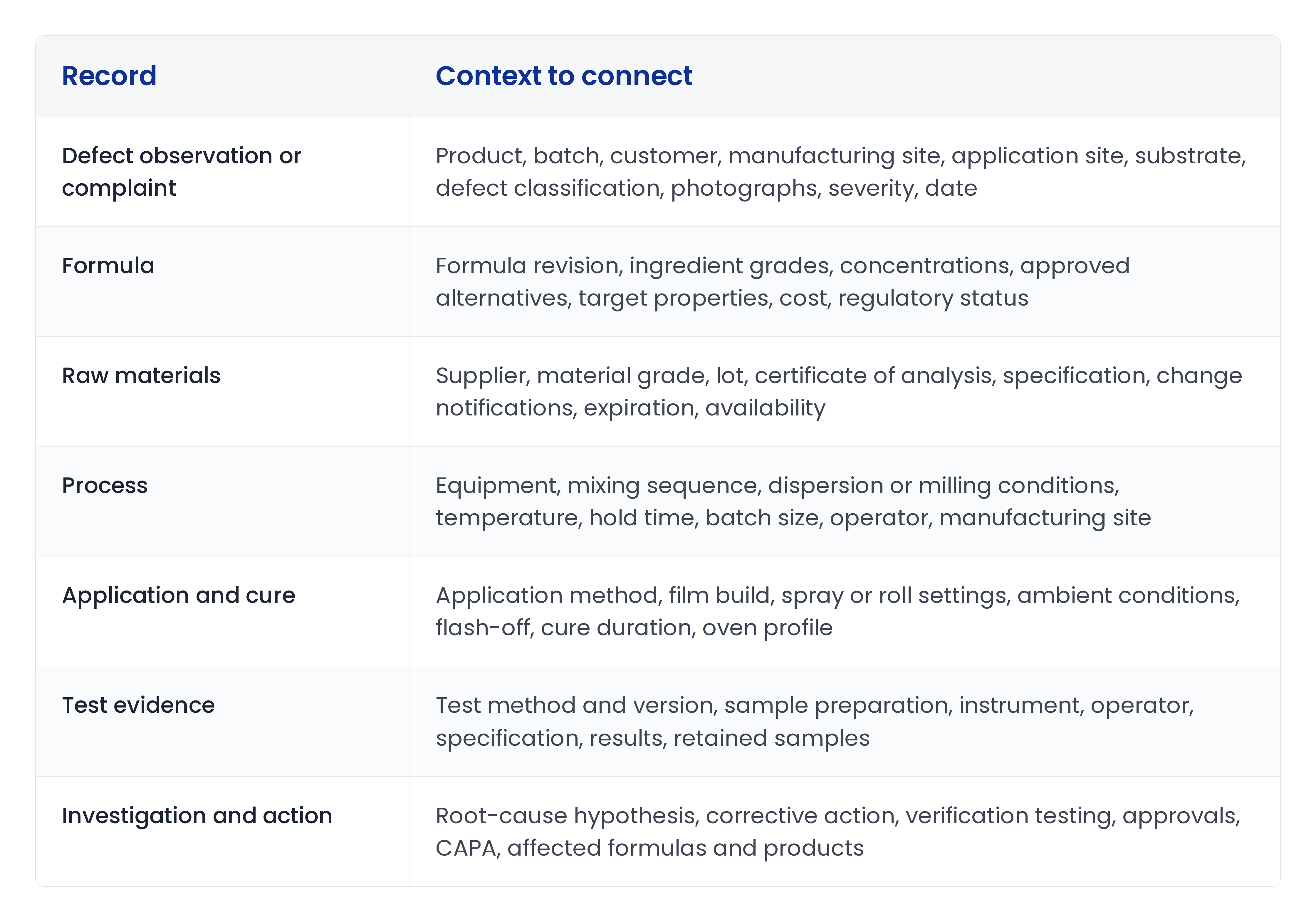
The point is not to create more administrative work. It is to preserve the technical context that determines whether a coating result can be understood, reproduced, compared, and reused.
For paints and coatings teams, that may mean structuring process flows alongside formula amounts, tracking materials by lot, associating panels with specific test conditions, and maintaining a searchable record of formulation and analytical results. Uncountable’s coatings workflows are designed around those realities, including multi-step processes, lot tracking, panel-based testing, formulation calculations, and search across experimental parameters and results.
Faster investigations create operational value
The cost of fragmented defect investigations goes beyond a single failed batch.
When teams cannot quickly identify the relevant formula, material, process, and quality context, they repeat experiments, delay product release, consume scarce laboratory capacity, and escalate routine questions to the same senior experts. Customer complaints take longer to close. Pilot batches may be repeated. Manufacturing and R&D can end up debating causes without access to the same evidence.
Those delays compound across a portfolio.
The same data fragmentation also makes change management harder. If a supplier discontinues a grade, changes a process, or updates a specification, the business needs to know which formulas, products, manufacturing sites, customer commitments, and performance claims may be affected. That requires precise traceability from a raw-material grade to formula revisions, product records, test results, process conditions, and approvals.
Connected data helps teams reduce the time spent looking for evidence and increase the time spent making technical decisions. It also creates a more reliable feedback loop between R&D, quality, manufacturing, technical service, and product management.
That is particularly important as coatings organizations face pressure to develop faster, reformulate for lower VOCs or new sustainability requirements, manage supplier volatility, and maintain performance across more applications and markets. Sustainable reformulation adds its own set of dependencies across material grades, cost, processability, performance, specifications, and supporting evidence.
Build a closed-loop defect process
The goal is not to eliminate defects entirely. Coatings development and manufacturing involve complex chemistry, variable raw materials, changing equipment conditions, and real-world application environments. Some uncertainty is unavoidable.
The goal is to make each investigation increase the organization’s ability to prevent and resolve the next one.
A closed-loop process connects:
- The observed defect to a specific product, batch, site, substrate, application condition, and customer context.
- The affected batch to the exact formula revision, raw-material grades and lots, process instructions, and actual process conditions.
- The root-cause hypothesis to relevant historical experiments, comparable formulas, prior quality events, and test evidence.
- The corrective action to revised formula or process instructions, verification tests, approvals, and affected products.
- The final learning to a structured, searchable record that can guide future formulation, scale-up, supplier, and quality decisions.
This is how a complaint becomes more than a complaint. It becomes usable product knowledge.
Coatings companies already generate the data needed to improve investigation speed and reduce repeat issues. The strategic question is whether that data remains trapped in separate systems or becomes a connected record that follows the product from formulation through manufacturing, quality, application, and customer use.
When formula, process, and quality data stay connected, teams can investigate with better evidence, scale with greater confidence, and turn every defect into an opportunity to strengthen the next product decision.
.png)
.png)
.png)
