For many R&D organizations, the challenge is not a lack of data. It is the inability to use the data they already have.
Chemicals and formulation-driven businesses generate large volumes of scientific and product information every year. Experiment records, analytical results, raw-material details, formulations, specifications, quality records, and product changes all capture valuable knowledge. Yet this knowledge is frequently dispersed across electronic laboratory notebooks, laboratory information management systems, product lifecycle management software, spreadsheets, shared drives, and individual researchers’ files.
As a result, R&D teams often repeat experiments, rebuild formulations from memory, or make decisions without the benefit of prior work. A scientist may suspect that a similar adhesive, coating, polymer, or specialty chemical was developed several years earlier, but finding and assessing that information can be slower than starting again.
The opportunity is to turn scattered records into reusable knowledge. R&D data management platforms can connect data from ELN, LIMS, PLM, and other systems so scientists can find relevant historical work, understand its scientific context, and apply it confidently to new formulation and product-development decisions.
The data reuse problem in R&D
Historical experiment data is often retained, but retention is not the same as reuse.
A laboratory may have complete records of an experiment in an electronic laboratory notebook. The related sample may be tracked in a LIMS, with analytical results stored under a different identifier. The final product specification may sit in a PLM system, while the rationale for a formulation change is buried in a spreadsheet, a presentation, or a scientist’s notes.
Each record may be useful on its own. Together, however, they tell a much more valuable story: what the team was trying to achieve, which materials and process conditions were used, how the formulation performed, what changed during development, and why the organization ultimately chose a particular approach.
When those links are missing, R&D teams face avoidable friction. Researchers spend time searching for files, asking colleagues for context, translating between naming conventions, and manually assembling results in spreadsheets. In some cases, the knowledge is technically available but effectively inaccessible because it is difficult to judge whether an old experiment is relevant to a current problem.
This is particularly costly in formulation-driven industries. A small change in raw-material grade, concentration, mixing sequence, temperature, curing condition, or test method can materially affect performance. Scientists need more than a final result. They need the conditions and decisions surrounding that result.
What ELN, LIMS, and PLM each contribute
ELN, LIMS, and PLM systems often support different parts of the same R&D lifecycle. The goal is not necessarily to replace them with a single system. It is to make the information held in each environment easier to connect, search, interpret, and reuse.
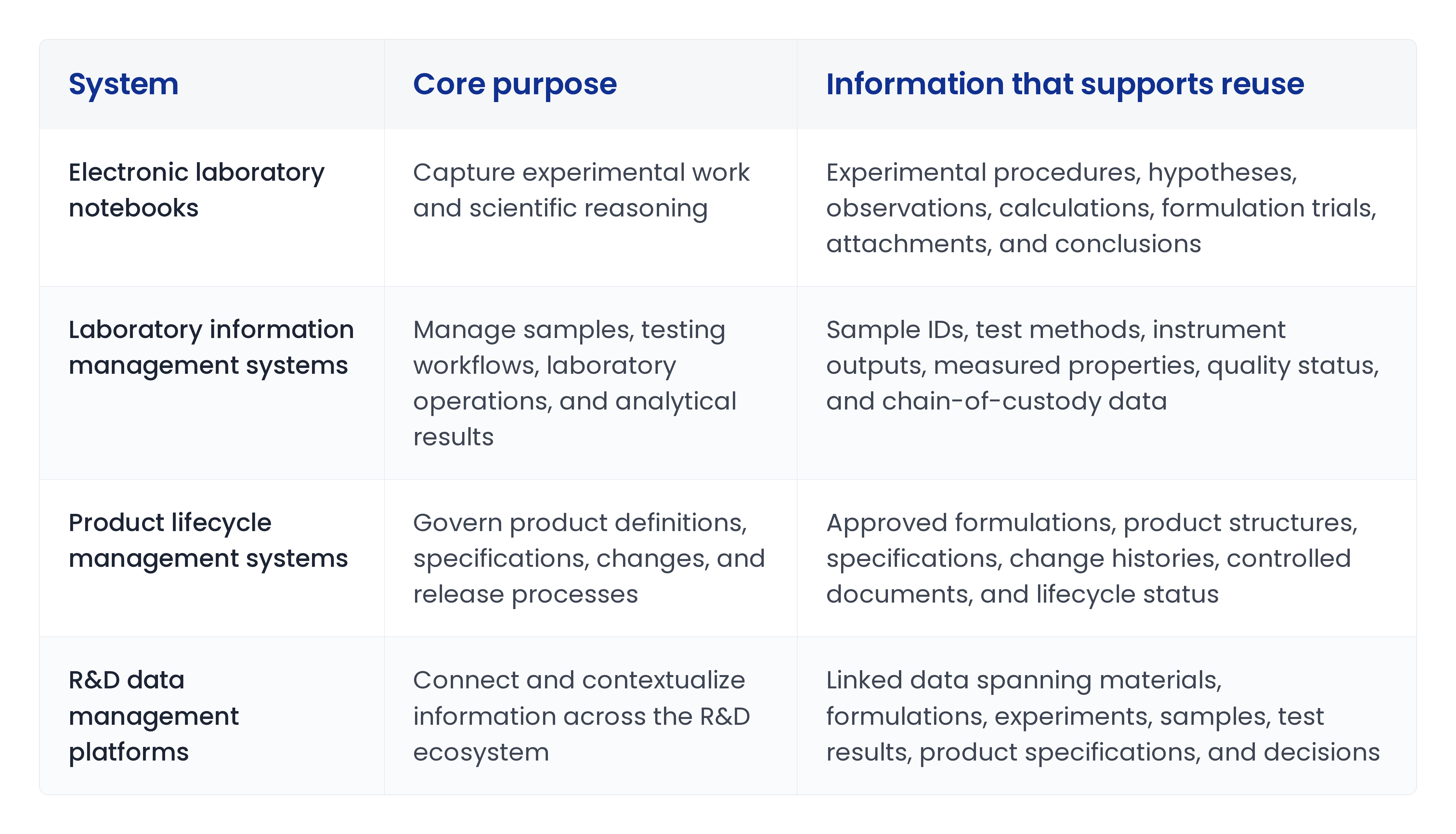
An electronic laboratory notebook may show how a scientist prepared a formulation and what they observed during the trial. A laboratory information management system may hold the corresponding viscosity, gloss, tensile strength, particle-size, or stability results. Product lifecycle management software may record which version became an approved product, which specifications apply, and what changes were made before commercialization.
Individually, these systems answer part of the question. Connected together, they allow teams to follow the full thread from an experimental idea through testing, product decisions, and eventual release.
Making historical experiment data reusable
For historical experiment data reuse to work, organizations need to preserve more than documents and measurement values. They need enough scientific context to make a result meaningful.
Consider a team investigating alternatives to a constrained solvent in a coating formulation. It is not enough to know that an earlier project tested a similar replacement. The current team may need to understand which resin system was used, the material grade and supplier, the concentration range, the mixing conditions, the sample age, the drying profile, the relevant test method, and the performance tradeoffs that led the earlier team to accept or reject the formulation.
That context makes the difference between a historical record that is merely archived and one that can guide a new experiment.
The most useful R&D data environments bring structured and unstructured information together. Scientists still need the flexibility to record observations, attach images, document unexpected outcomes, and explain their reasoning in natural language. At the same time, certain information must be captured consistently enough to support comparison across projects and sites. Material identifiers, ingredient concentrations, sample IDs, units of measure, test methods, process conditions, and measured outcomes are examples of data that benefit from a shared structure.
This does not require every historical record to be cleaned or standardized before the organization can see value. In practice, many teams make progress by improving data capture for new work while selectively enriching legacy records that relate to high-priority product families, strategic raw materials, recurring quality issues, or active reformulation programs.
Connecting systems around scientific questions
The strongest integration programs begin with the questions R&D teams need to answer, rather than with an abstract goal of consolidating data.
For example, a formulation scientist may need to identify every prior formulation that used a certain polymer family and achieved a target viscosity range. A quality team may need to determine whether a recent stability issue correlates with a supplier change, a raw-material lot, a process adjustment, or a formulation revision. A product-development leader may want to understand which trials led to a successful commercial formula and where the organization has already explored a similar technical path.
These questions typically span systems. The experiment may be recorded in an ELN, the sample and analytical results may live in a LIMS, and the approved product configuration may reside in PLM. A connected R&D data management platform can bring those records into a common scientific view while maintaining links to the authoritative source systems.
The value is not simply that users can see more data in one interface. It is that they can understand relationships. A scientist can move from a formulation to the experiments that evaluated it, the samples created, the tests performed, the measured results, the specification thresholds, and the product changes that followed.
This creates a connected chain of evidence:

With that chain in place, researchers can spend less time reconstructing previous work and more time deciding how to build on it.
Formulation data management in practice
Formulation data management is one of the clearest use cases for connected R&D data. Formulators rarely make decisions based on a single property or a single experimental result. They balance performance, processability, cost, availability, sustainability, regulatory requirements, and customer expectations.
A connected data foundation makes it easier to compare these tradeoffs across historical work. Rather than searching through individual project folders, scientists can identify formulations that share a material family, application, target property, or process condition. They can then examine the complete supporting evidence before deciding which formulations are useful starting points.
This matters in several common situations:
- Reformulation and raw-material substitution: When a material becomes unavailable, more expensive, restricted, or unsuitable for a sustainability target, historical data can reveal prior alternatives and the performance tradeoffs associated with them.
- Troubleshooting and quality investigations: Linked experiment, sample, test, and product-change data can help teams determine whether a failure is associated with a material lot, process condition, formulation revision, or test-method difference.
- Technology transfer and scale-up: Connecting laboratory records with specifications and product lifecycle information gives receiving sites a clearer understanding of critical parameters, prior learnings, and the evidence behind an approved formulation.
In each case, the objective is not to eliminate new experimentation. R&D teams still need to validate results under current conditions. The objective is to start from the organization’s existing evidence rather than from a blank page.
Designing an effective R&D data foundation
The most effective scientific data platforms make historical knowledge discoverable in the way scientists actually work. Searching by project title, document name, or folder location is rarely enough. Users need to find information through the concepts that matter in R&D: ingredients, material grades, applications, composition ranges, target properties, process settings, test methods, results, and product families.
A useful platform also makes data lineage clear. Researchers need to know where a result originated, whether it came from an exploratory trial or a controlled test, what version of the formulation was used, and whether the information is associated with an approved specification. This is particularly important when teams work across multiple sites, product lines, and regulatory environments.
Common identifiers play an important role. The same material may appear under a supplier name in one system, an internal material code in another, and a legacy abbreviation in a spreadsheet. Establishing consistent identifiers for materials, samples, formulations, test methods, and products makes it far easier to connect otherwise fragmented records. Perfect master data is not a realistic prerequisite for progress, but organizations do need enough consistency to establish meaningful relationships between systems.
Governance matters as well. Not every researcher should have access to every formulation, customer requirement, or commercial record. A strong R&D data management approach should support role-based access while allowing authorized users to discover and reuse relevant knowledge across teams and locations. It should also preserve links back to the original ELN, LIMS, PLM, or controlled source record, so users can verify the underlying information rather than relying on an isolated copy.
The path to better R&D decisions
Connecting ELN, LIMS, PLM, and other R&D systems does more than improve search. It gives organizations a practical way to preserve institutional knowledge as teams grow, employees change roles, products evolve, and development programs span multiple years.
For R&D leaders, the business case is straightforward. Better historical experiment data reuse can reduce duplicated work, shorten time spent locating information, improve formulation decisions, accelerate investigations, and support more consistent technology transfer. It also creates a stronger foundation for analytics, modeling, and AI initiatives.
AI is most useful when it can draw on connected, contextualized, and trustworthy data. A large archive of disconnected documents may contain important scientific knowledge, but it is difficult to analyze reliably when materials, samples, results, and product decisions cannot be linked. By contrast, connected formulation, experiment, and test data can support more meaningful pattern identification, recommendations, and predictive work over time.
The first step is not to migrate every historical file or rebuild every legacy system. It is to identify the high-value questions that repeatedly slow R&D work, connect the information needed to answer them, and improve the structure of new data as it is created.
When R&D data becomes easier to find, understand, and trust, past experiments stop being passive records. They become an active source of scientific and commercial advantage.
.png)
.png)