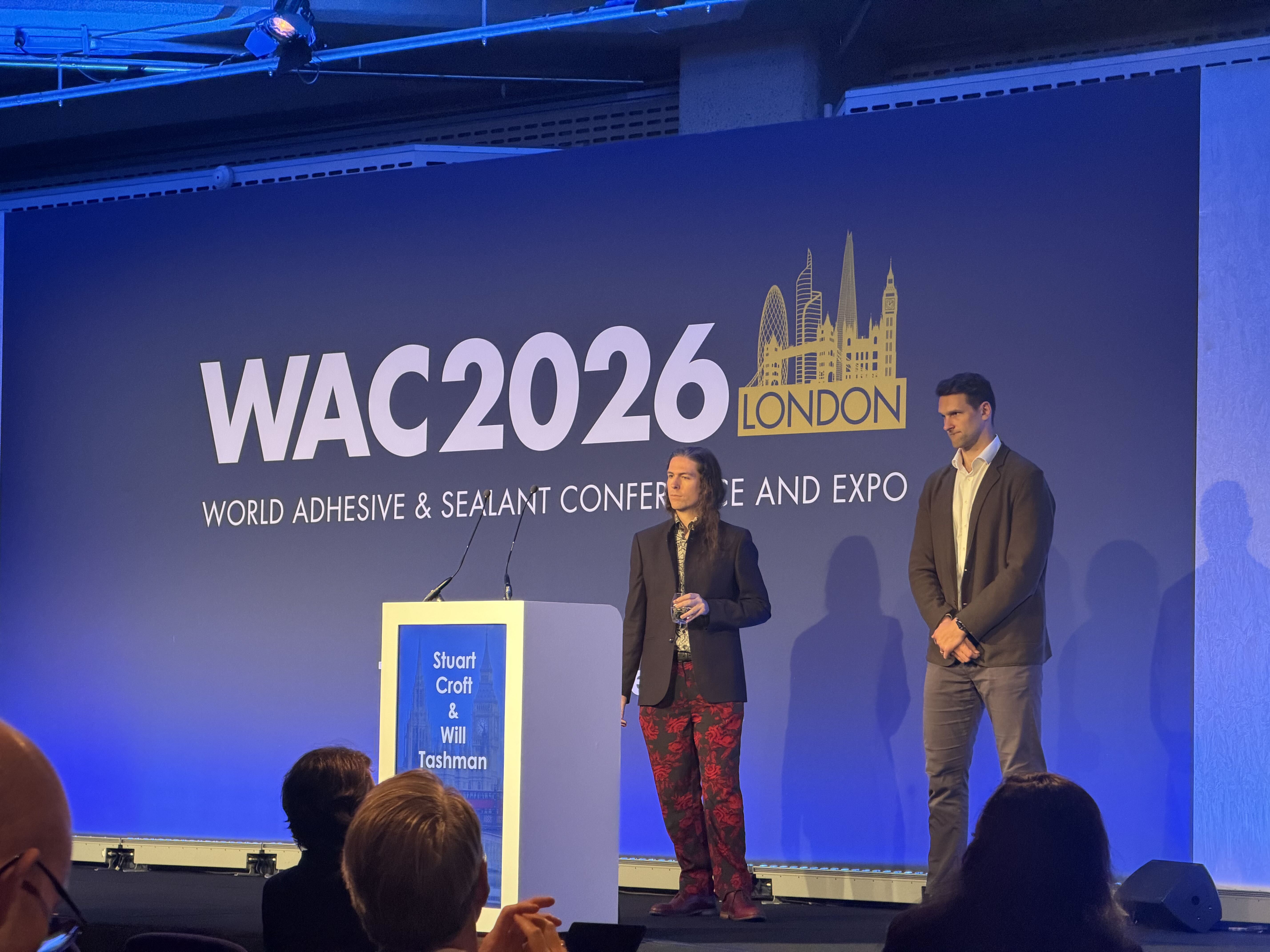
This article is based on a presentation delivered at WAC on 18 September 2026 by Will Tashman, co-founder and Chief Commercial Officer at Uncountable, and Stuart Croft, Global Project Lead for Sika’s Nuage platform. The discussion covered Sika’s global rollout of Uncountable, including its approach to data governance, laboratory adoption, automation, and machine learning-enabled formulation development.
For most R&D organizations, the hardest part of digital transformation is not selecting a platform. It is creating a system that scientists will use, data teams can trust, and global leaders can scale without losing the context that makes experimental data meaningful.
That was the central message from Sika and Uncountable at WAC 2026. In a joint presentation, Stuart Croft, Global Project Lead for Sika’s Nuage platform, and Will Tashman, co-founder and Chief Commercial Officer at Uncountable, explained how Sika has developed a global digital laboratory program from an early pilot in Leeds into a broader R&D data foundation.
Nuage is designed to connect laboratory workflows across Sika’s global network, bringing together electronic lab notebooks, formulation data, test and process conditions, laboratory management, automation, analytics, and AI-enabled tools. Sika operates 16 global technology centers across eight countries and 90 R&D locations; 45 locations currently use the platform.
Start with the scientist, not the system
Croft began with a principle that shaped Sika’s approach: data quality depends on whether chemists see tangible value in the platform. If scientists are asked only to document data for someone else’s future analysis, adoption will suffer. But when the system reduces repetitive administration, returns relevant information automatically, and helps teams make better decisions, users have a reason to take ownership of data quality.
That relationship matters because advanced analytics cannot compensate for unreliable inputs. In Croft’s words, the familiar challenge remains “bad data in, bad results out.” Nuage is therefore intended to make data capture a useful part of scientific work rather than a separate compliance exercise.
Create consistency without forcing sameness
Sika’s R&D teams work across adhesives and sealants, concrete, coating systems, thermoplastics, and other technologies. They also operate across countries, standards, and local processes. Scaling a shared system required common data foundations without treating every laboratory workflow as identical.
One example is test and process data. Recording that a team followed an ISO, DIN, or ASTM method is useful, but it may not provide enough information for results to be interpreted or compared accurately. By capturing the specific conditions behind a test, teams can make methods more understandable and data more reusable across sites. This also gives data scientists the context needed to analyze results, even when they are not specialists in a particular chemistry or application.
Automate the low-value work
The presentation emphasized that laboratory automation is as much about data quality as efficiency. When information moves manually between instruments, requests, spreadsheets, and reports, each handoff adds effort and risk.
Nuage links machines and workflows so test requests can be populated with the required information and results can return directly to the relevant system. Alongside equipment and raw-material management, these automations reduce repetitive work for chemists while creating more structured, reliable data for analysis across sites.
Use AI to guide experimentation
Sika is applying machine learning to support, not replace, scientific judgment. Suggested-formulation tools can help identify underexplored areas of a formulation space, while predictive capabilities can estimate results for related tests. For example, a model may help teams anticipate a more time-intensive measurement from an earlier, quicker test.
The organization reported that machine learning has reduced the number of experiments required by as much as 75% in certain projects. More broadly, it has contributed to faster time to market by helping scientists prioritize higher-value experiments and explore options that may otherwise have been missed.
Bodhi, Uncountable’s generative AI assistant, adds a natural-language interface for interacting with data. Sika can tailor prompts and incorporate its own source material, making the assistant relevant to local laboratory questions and specific scientific contexts.
Build governance before scaling
Sika’s rollout follows a phased model: begin with a pilot, develop internal expertise, establish governance, train and implement at new locations, then maintain continuous feedback and operational support.
Power users and core technology group experts are central to this model. They need scientific and platform knowledge, but they also need the ability to teach and champion new ways of working. Croft also stressed the importance of decision-making authority. With many countries, languages, technologies, and stakeholders involved, a program can quickly stall if every choice requires universal agreement.
Make the alternative less attractive
The final discussion addressed the enduring challenge of moving teams away from Excel. The answer was not a mandate alone. It was a combination of incentives and leadership.
Scientists need visible benefits: automatically returned results, automatically generated reports, and immediate access to formula cost, global warming potential, and regulatory information while they work. But leadership must also make clear that critical knowledge locked in isolated spreadsheet files is not a durable corporate asset. The goal is not to eliminate useful specialist tools; it is to connect their key outputs to the formulation workflow so scientists can act on them without repeatedly switching systems.
Turn R&D data into a connected scientific asset
Discover how Uncountable helps formulation and materials teams connect experimental data, laboratory workflows, AI, and business-critical context in one platform.
.png)