Same formulation, different result? See every condition behind it.
For formulators, test teams and R&D leaders in structural adhesives, tapes, sealants and hot-melts. Keep cure, substrate, pretreatment and test conditions with every peel, lap shear and rheology result, from first trial through scale-up.
Deployed by 175+ enterprise product development teams







Deployed by Enterprise R&D and Innovation Teams


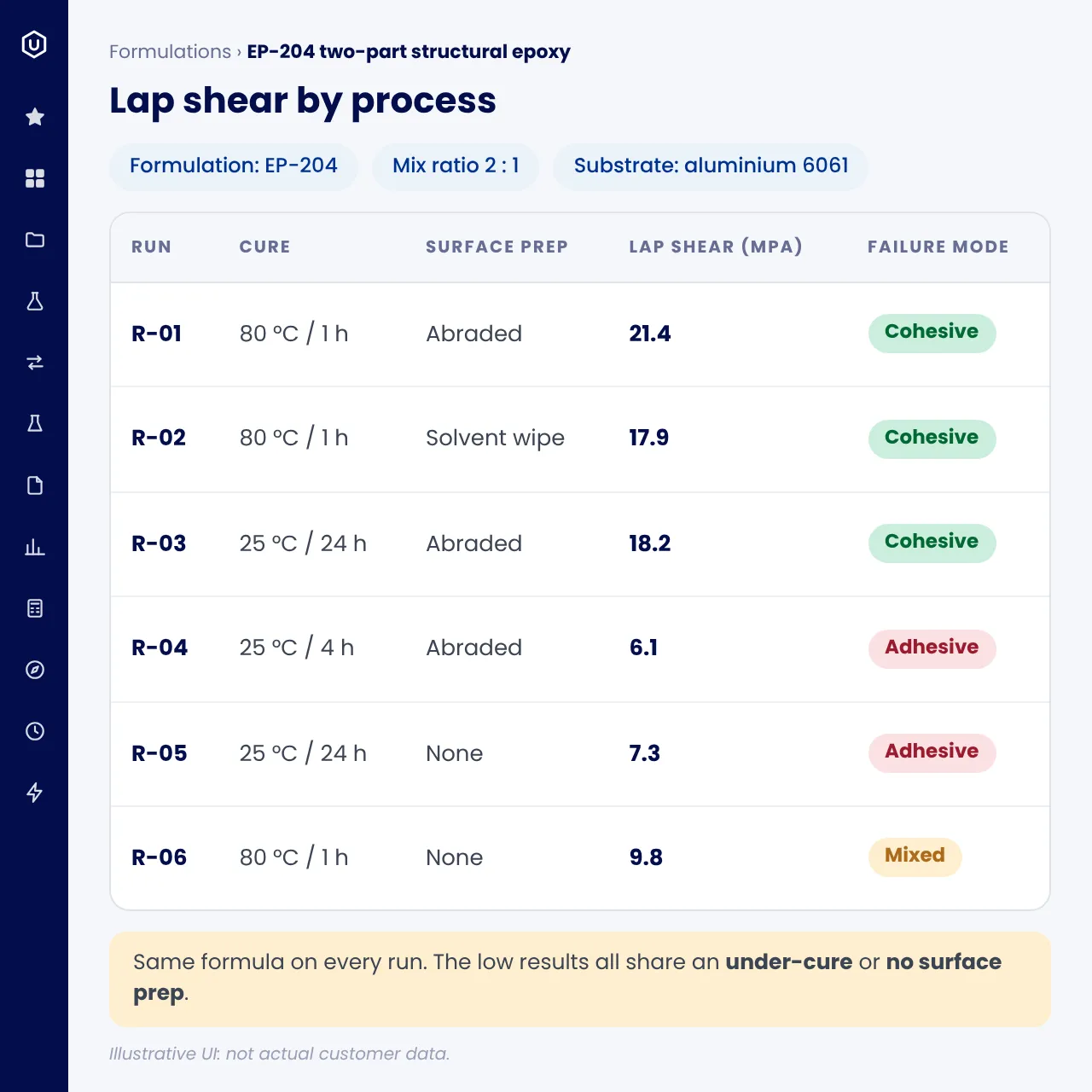
In adhesives, the conditions matter as much as the recipe
Cure schedule, dwell time, substrate, pretreatment and bond-line thickness can turn a pass into a fail on the same formulation. When those conditions sit in a notebook, a spreadsheet tab or someone's memory, two results look comparable when they aren't. Uncountable keeps them on the same record as the formulation and the test result, so you can see what actually changed.
The workflow behind the bond
Every peel, lap shear, tensile and rheology result stays linked to the formulation and the conditions that produced it.
Compare like with like:Filter by substrate, cure schedule, pretreatment or aging condition, so a change in test setup doesn't hide a real difference.
Keep failure mode with the number:Record cohesive, adhesive or mixed failure and attach photos of peels and panels alongside the measured values.
Find past work fast:Search by resin, tackifier, curative, substrate or property, not by file name or a colleague's initials.
When two results disagree, the answer is in the conditions.
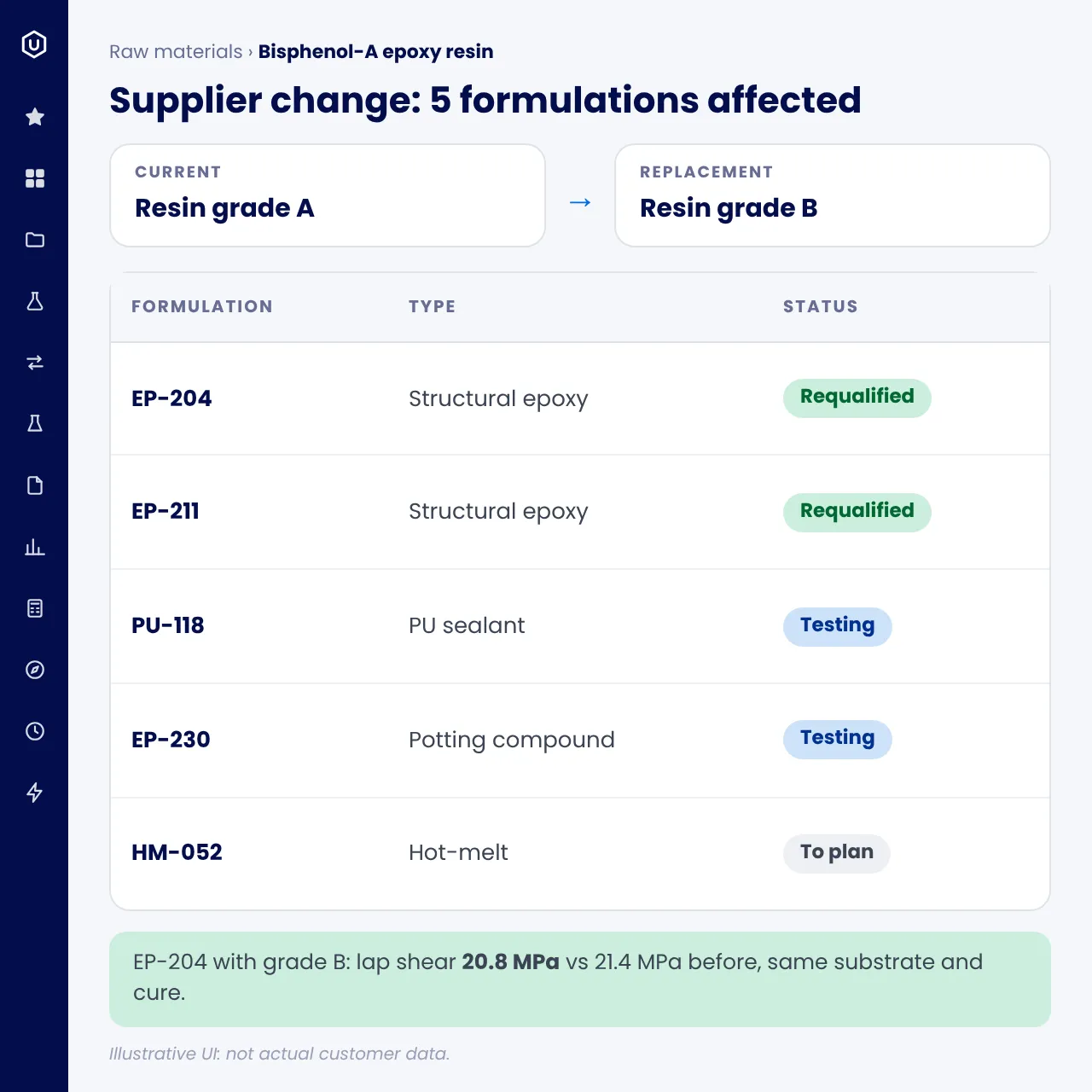
A raw material changes. On paper it's equivalent, but in the adhesive it may not be. Start from what your team has already tested.
Find every affected formulation: When a resin, tackifier or curative grade changes, see every formulation that uses it and how each one performed.
Screen alternatives side by side: Test candidate replacements on the same substrates, cure and aging conditions, so the switch is judged like for like.
Keep the history: Every substitution, requalification trial and decision stays on the formulation's record, ready for the next change or customer question.
Supplier change, regulation or cost-down: start from what you already know.
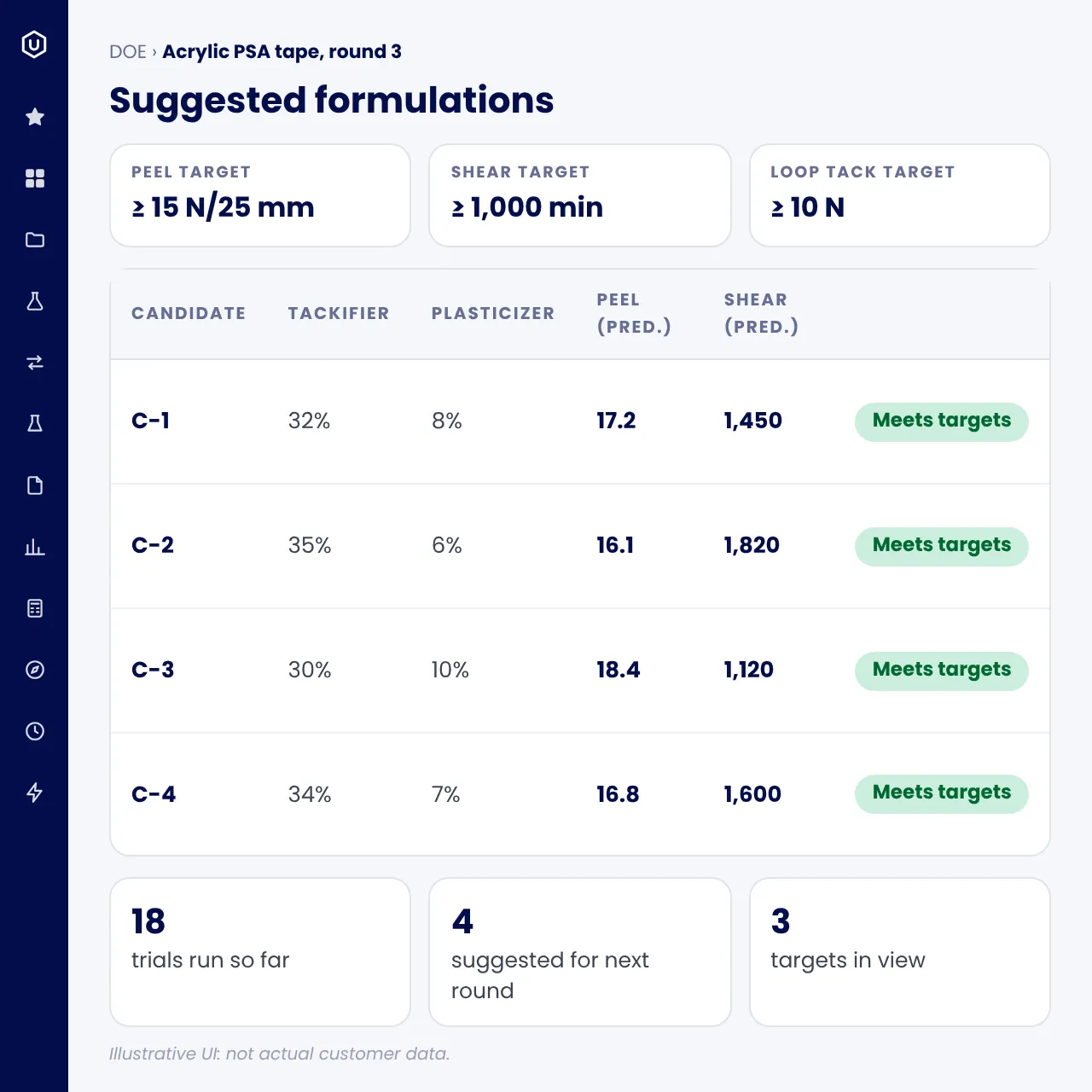
You can't test every combination of resin, tackifier, plasticizer and curative across every substrate. Use the results you already have to decide what to make next.
Plan the experiment: Design of experiments builds a trial plan around the ingredients and process settings you want to explore.
Predict before you mix: Models trained on your past formulations suggest candidates for your adhesion, cure and viscosity targets.
Learn from every run:New results feed the next round. The more varied your data, the sharper the suggestions.
Balance competing properties: Trade off tack, peel and shear, or open time against cure speed, against the targets you set.
Every trial should tell you something the last one didn't.
A formulation that passed in the lab still has to pass on the line. Carry the formulation, conditions and results from R&D into testing, QC and production.
Test requests that don't get lost:Send panels and samples to the test team, see what's queued and what's done, and get results back against the right formulation.
ELN and LIMS: Structured notebooks and sample tracking, with results and outside lab data linked to each formulation.
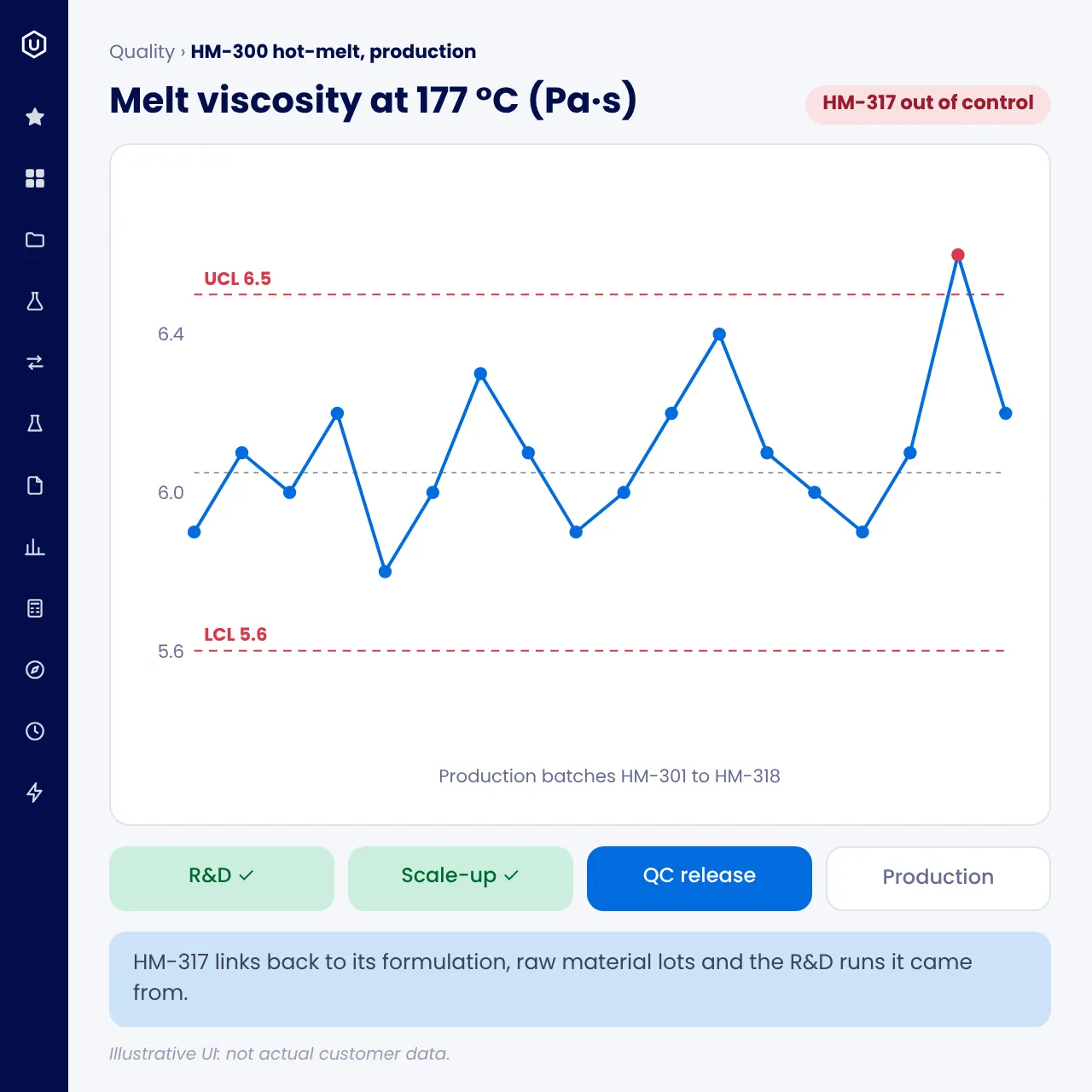
QC with live SPC: Release testing, deviations and CAPA at production scale, with live SPC on incoming results.
Product lifecycle management: Move a product from R&D to production with stage-gate approvals and version control.
Integrations: 400+ lab instruments, bidirectional SAP and ERP, REST API and SSO.
Ageing and durability: Heat, humidity and environmental ageing results stay with the formulation and batch they came from, ready for customer qualification.
Regulatory screening while you formulate: Check ingredients against restricted-substance lists such as REACH before a formulation is locked in, not after.
One record from first trial to production batch.
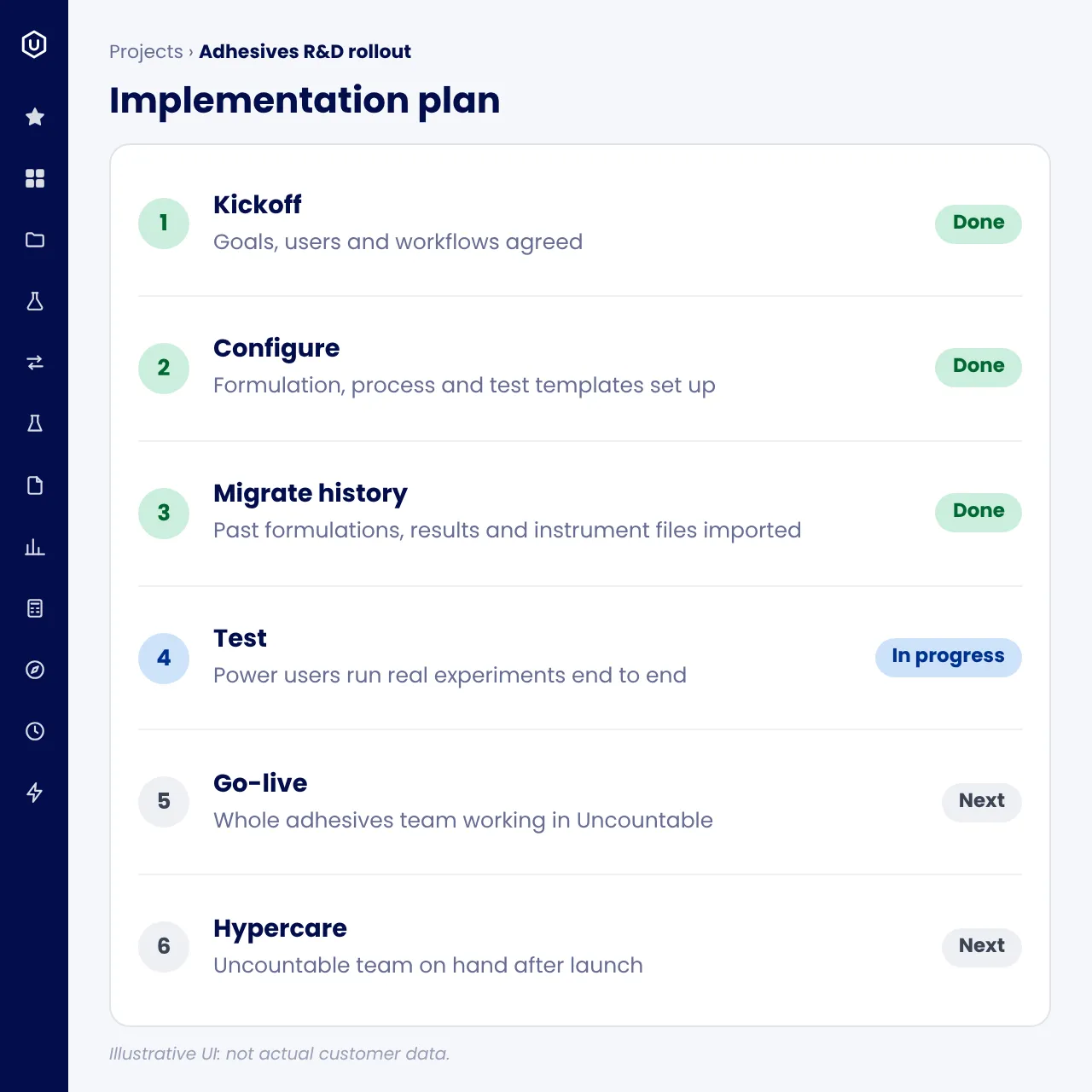
Going live shouldn't stop your lab. We configure Uncountable around how your adhesives team already works, with a light lift from your side.
Domain expertise:A team with adhesives and sealants R&D knowledge guides the rollout, not just software support.
Light internal lift:Configured to your existing processes, so your team keeps running experiments while it goes live.
Guided, staged rollout:Kickoff, configuration, testing, go-live and hypercare, led by Uncountable.
Bring your history:Historical formulations, results and instrument files are migrated during implementation, so past work is searchable from day one.
Your test methods, your units: Lap shear, peel, tack, rheology and cure tests are set up the way your lab already runs them.
Configured to your lab, not the other way round.
Before and after Uncountable
Without Uncountable
With Uncountable
Bring your formulation history with you
Years of adhesives work often sits in spreadsheets: the data exists, but no one can use it. Novatech moved its R&D onto Uncountable without leaving that history behind.
Built around your chemistry
One platform for every adhesive and sealant your team develops, configured to the tests and conditions each chemistry depends on:
Epoxy, polyurethane and acrylic systems against lap shear and cure.
Tack, peel and shear tracked against backing, substrate, dwell and aging conditions.
Cure, adhesion and movement capability on one record.
Skin-over time and cure linked to the formulation and the result.
Melt viscosity, open time and set time tracked with the recipe.
Solids, stability and viscosity tied to bond performance.
Light source, wavelength, dose and cure conditions kept with every result.
Instrument data preserved, not retyped from a report.
Your formulations stay yours
Resin systems, process settings and bond data are the know-how your products are built on. They stay inside your own environment, with access you control.
Full documentation, including the SOC 2 report and penetration-test summary, is available on request.
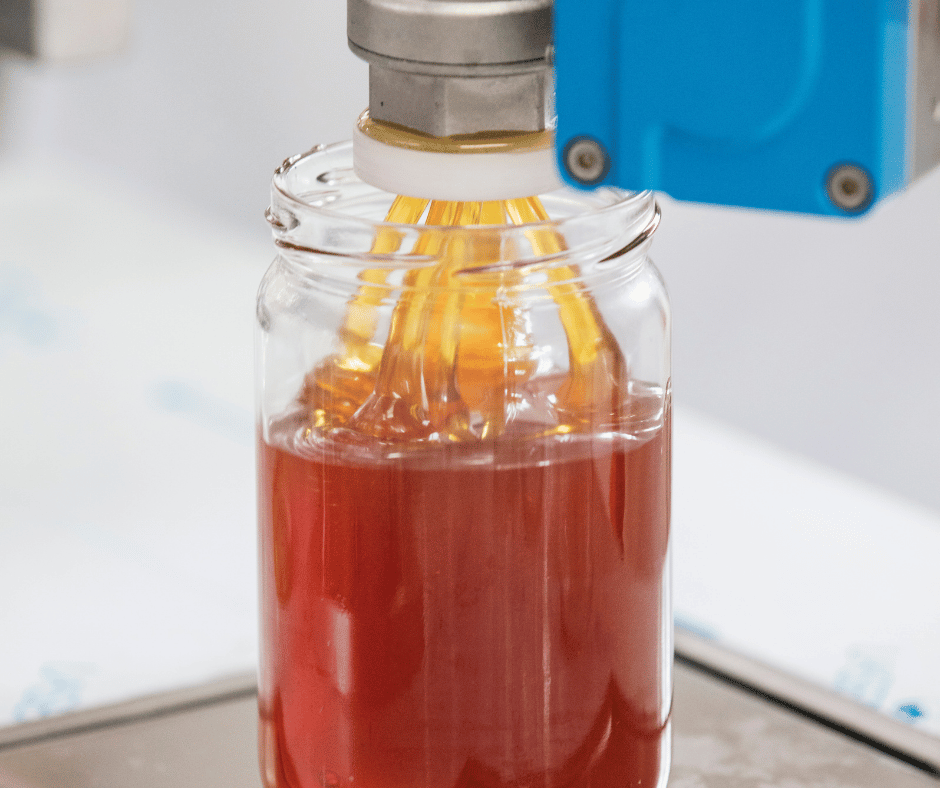
Record the conditions, and the result becomes reproducible.
Cure, substrate, pretreatment and test conditions stay on the record with the formulation and its results, so a bond that passed once can pass again, in the lab or on the line.
FAQs
Uncountable connects R&D, QC and PLM on one platform, with ELN and LIMS built in. Formulations, process conditions and bond results are kept as structured records, formulators and test teams work in the same system, and every result is traceable from the bench through scale-up and production.
Mix ratio, cure schedule, dwell, substrate, pretreatment, bond-line thickness and aging conditions are stored on the same record as the recipe and the result. Results that depend on conditions can be compared fairly and reproduced.
Design of experiments and predictive machine learning, built on your own formulation history, help narrow the experimental space to the candidates worth testing, so each round of trials teaches you more.
Yes. Historical formulations, results and instrument files are migrated during implementation, using bulk ingestion, the REST API and 400+ instrument connections. Uncountable's implementation team works with your power users to map and structure the files, so past work becomes searchable alongside new experiments.
Find every formulation that uses the material, see how each performed, and compare alternative formulations on the same substrates and conditions.