.png)
Quality control laboratories need more than a place to record pass/fail results. They need a connected, accessible system that links every test result to the sample, specification, formulation, raw material lot, instrument output, and decision that gives that result meaning.
A mobile LIMS can provide that foundation. By bringing LIMS software, formulation data management, raw material management, and laboratory test results into a single controlled environment, enterprise R&D and quality teams can reduce manual handoffs, improve traceability, and act on emerging quality signals faster.
What is a mobile LIMS?
A laboratory information management system (LIMS) is software used to manage laboratory samples, testing workflows, results, records, and reporting. In a quality control setting, it supports the controlled process from sample receipt through testing, review, release, investigation, and retention.
A mobile LIMS extends that capability beyond a desktop workstation. It gives authorized laboratory and quality users access to relevant tasks and data on tablets, handheld devices, or mobile-friendly interfaces, whether they are receiving samples, scanning a raw material lot, recording an observation on the lab floor, reviewing a result, or checking the status of an out-of-specification investigation.
The value is not simply that a LIMS can be viewed on a smaller screen. A useful mobile LIMS should make the right action and context available where work occurs, without sacrificing data quality, security, or traceability.
For quality control laboratories, that means connecting:
- Sample identifiers, chain of custody, storage locations, and test plans
- Raw material suppliers, lots, certificates, specifications, and status
- Formulation or recipe versions used to create the material being tested
- Instrument-generated data, observations, calculations, and laboratory test results
- Specifications, control limits, approvals, deviations, and release decisions
- Audit trails, user permissions, and retained quality records
When these data points sit in disconnected systems, spreadsheets, paper records, and individual inboxes, QC teams must reconstruct the story behind a result manually. A connected LIMS software environment changes that: the result becomes part of a complete, searchable quality record.
Why QC data becomes difficult to manage
Quality control laboratories in enterprise R&D organizations operate at the intersection of science, manufacturing, quality, and regulatory requirements. They may test incoming raw materials, in-process samples, finished goods, retained samples, stability samples, and competitive or investigative materials, often across sites, product lines, and changing specifications.
The challenge is not a lack of data. It is the lack of connected context.
Consider a viscosity result that falls outside the approved range. The immediate question is not only whether the test passed. The quality team may also need to know:
- Which formulation revision was used?
- Which raw material lots and suppliers were involved?
- Was the method performed on the correct instrument and against the current specification?
- Have related results been trending toward a limit?
- Did the same ingredient lot appear in other batches with similar results?
- Is there a linked deviation, nonconformance, customer complaint, CAPA, or change request?
- Can the organization demonstrate who entered, reviewed, changed, and approved the record?
In many environments, answering these questions requires exporting data, opening multiple systems, searching email threads, and reconciling spreadsheet versions. That work delays investigation and increases the risk of incomplete decisions.
A mobile LIMS should instead create a connected record from the moment a sample is logged. It should preserve the relationship between materials, formulations, tests, results, and quality events throughout the product lifecycle.
The value of mobile access
Mobile access is especially valuable when laboratory work does not happen in one fixed location. Samples may arrive at a loading area, testing may occur in multiple laboratories, raw materials may be stored in different locations, and review or release decisions may involve personnel across sites.
A mobile LIMS can support faster, more controlled execution of routine QC tasks.
Sample receipt and identification
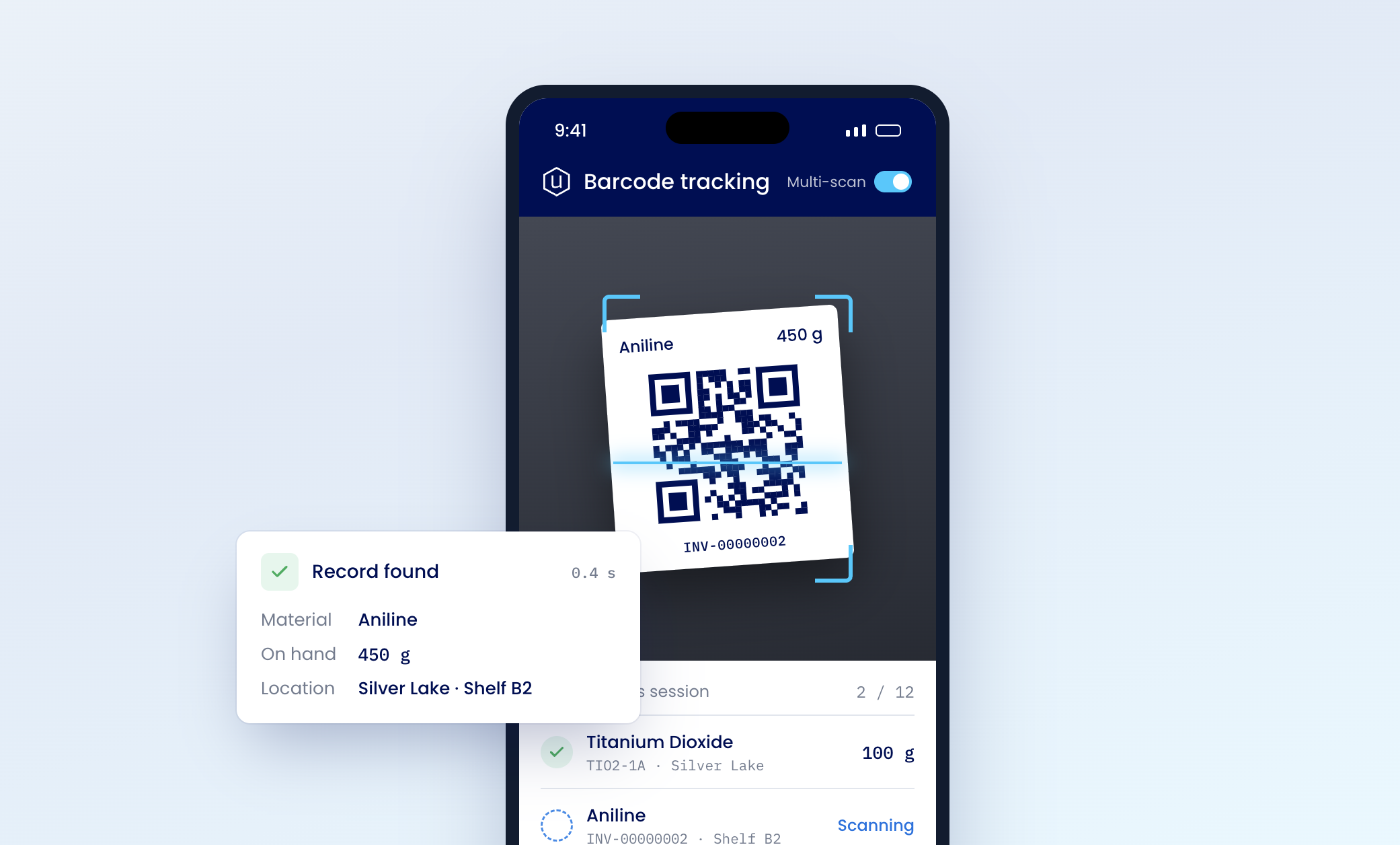
At sample receipt, laboratory personnel can scan a barcode or QR code to confirm the sample identity, associate it with a batch or raw material lot, record storage conditions, and assign the required test plan. This reduces handwritten labels and duplicate data entry while creating a clearer chain of custody.
Raw material verification
For incoming quality control, users can verify a material’s lot number, supplier, certificate of analysis, expiry or retest date, quarantine status, and associated specifications at the point of receipt or sampling. The system can guide users toward the correct workflow rather than relying on memory or informal workarounds.
Test execution and result entry
A mobile-friendly interface can present the current method, required fields, units, acceptance limits, and task status while a technician is performing the work. It can also capture observations, images where appropriate, and exceptions contemporaneously, rather than requiring users to transcribe notes later.
Faster review and response
Supervisors and quality reviewers can see whether critical results are pending, approved, out of specification, or awaiting investigation. Notifications can route tasks to the appropriate role, while the underlying result remains linked to its sample, material, formulation, and test history.
Mobile access should not mean uncontrolled access. In a mature implementation, permissions are role-based; workflows are configured around approved processes; and every relevant action is attributable to an authorized user.
Connecting test results to formulation and material data
The most useful LIMS software for enterprise R&D and QC does not treat laboratory test results as isolated numbers. It makes each result traceable to the inputs and process conditions that may explain it.
Formulation data management
Formulation data management provides the recipe-level context behind a finished product or experimental material. It captures components, quantities, target properties, process instructions, approved revisions, and often the relationship between development work and subsequent scale-up or production activity.
When formulation data management is connected to LIMS workflows, quality teams can investigate results with far more context. Instead of reviewing a result in isolation, they can identify the formulation version, target ranges, substitutions, and relevant development history associated with the tested material.
This is particularly important for formulated products such as coatings, adhesives, specialty chemicals, consumer goods, foods and beverages, personal care products, lubricants, and advanced materials. Small changes in ingredient grade, lot characteristics, processing conditions, or formulation composition can affect final performance.
Raw material management
Raw material management is equally critical. A raw material is not only a name on a recipe; it is a specific lot from a specific supplier, received at a specific date, with its own certificate, status, test record, and history.
A connected LIMS can link each raw material lot to:
- Supplier and manufacturer details
- Supplier certificate of analysis and internal verification results
- Material specifications and approved ranges
- Sampling and incoming inspection records
- Storage location, retest date, expiry date, and disposition
- Related batches, formulations, and finished-product test results
- Deviations, investigations, or supplier-quality events
That relationship enables more meaningful root-cause analysis. If a finished-product test result is unusual, the QC team can assess whether a material lot, supplier trend, formulation revision, or process variable may be contributing to the issue.
Laboratory test results
Laboratory test results should be captured in a structured format that retains the test method, analyst, instrument, unit, timestamp, specification, calculation logic, and review status. The result must also remain connected to the underlying sample and its material or formulation context.
Structured capture is more useful than attaching a static report after the fact. It enables teams to search, compare, trend, report, and trigger workflows based on the data itself.
For example, a laboratory information management system may identify that a result is technically in specification but trending toward a control limit. The quality team can then review comparable lots, related formulations, instrument performance, or supplier material history before the issue becomes an out-of-specification event.
Core capabilities to evaluate
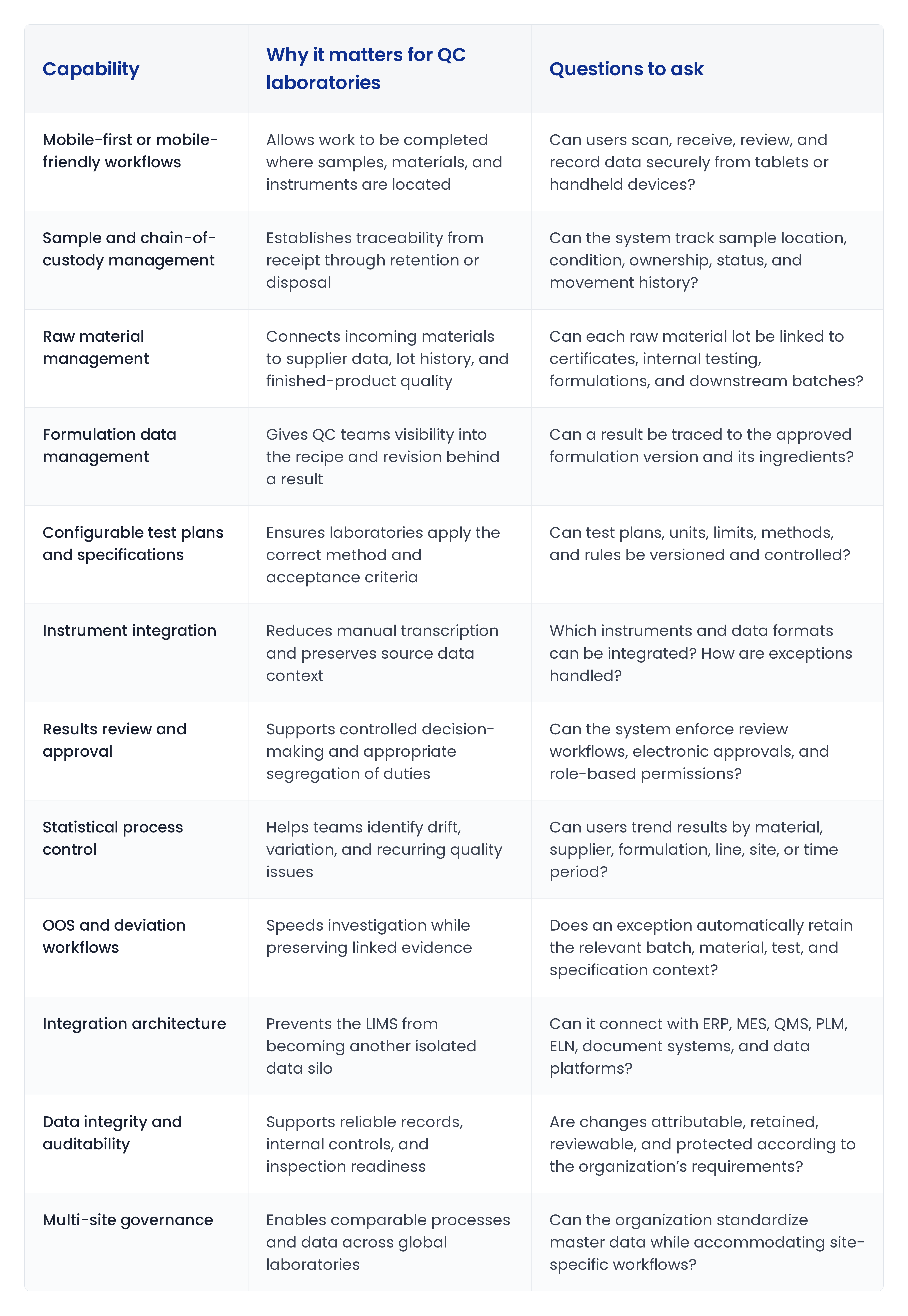
Mobile capability matters, but it should be evaluated as part of a broader QC data strategy. The following table summarizes the capabilities enterprise quality control laboratories should assess.
Data integrity and compliance considerations
For regulated organizations, selecting LIMS software is not simply a usability decision. The system must support the organization’s quality processes, record-retention requirements, validation approach, and applicable regulations.
In the United States, FDA guidance explains that 21 CFR Part 11 applies to certain electronic records and electronic signatures used to meet FDA recordkeeping or submission requirements. The agency also emphasizes that organizations must comply with relevant underlying “predicate rule” requirements and determine the appropriate controls through a justified, documented risk assessment.
For a LIMS, this often means evaluating controls such as:
- Unique user identities and role-based access
- Electronic signatures where required
- Audit trails or appropriate measures for changes to important records
- Version control for specifications, methods, and master data
- Data review workflows and approval controls
- Secure retention, retrieval, and export of records
- Change control, validation, and documented fit-for-purpose assessment
- Training and procedural governance for users and administrators
Compliance cannot be purchased as a checkbox. A software platform can support compliant processes, but the organization remains responsible for defining intended use, configuring workflows appropriately, validating as necessary, training users, and maintaining procedural controls.
For this reason, QC leaders should assess not only a vendor’s stated compliance capabilities but also the practical evidence available: audit-trail behavior, electronic-signature configuration, permission models, documentation, validation support, change-management procedures, and the ability to retrieve complete records during an audit or investigation.
From disconnected records to a connected quality record
A quality result has limited value if it cannot be explained. The most effective QC data model connects the result to the complete record of the material and product.
A useful connected record may include:
- Raw material context: supplier, lot, certificate, incoming test results, storage status, and prior history.
- Formulation context: approved formulation version, ingredient list, substitutions, target properties, and associated development work.
- Sample context: batch, location, sample point, chain of custody, sampling plan, and test schedule.
- Test context: current method, specification, instrument, analyst, raw output, calculation, and review status.
- Quality-event context: out-of-specification results, deviations, investigations, nonconformances, CAPAs, and disposition decisions.
- Business context: production site, product family, supplier performance, release status, and downstream systems such as ERP or QMS.
This model makes a material investigation more efficient because the investigation starts with evidence rather than data collection.
For instance, when a viscosity measurement fails, the laboratory should not have to assemble the record from a paper worksheet, a formulation spreadsheet, an ERP material master, an instrument file, and an email approval thread. The relevant information should already be linked: the result, test method, raw data, formulation revision, raw material lots, specifications, prior comparable batches, and any open quality events.
A practical implementation approach
Replacing or modernizing LIMS software is a significant operational change. A phased approach usually reduces risk and helps teams demonstrate value before broad rollout.
1. Start with the highest-friction workflow
Identify the workflow where disconnected data creates the greatest quality, speed, or audit burden. Common starting points include incoming raw material testing, sample receipt and tracking, finished-product release testing, stability testing, or out-of-specification investigations.
Define measurable outcomes, such as reducing manual result transcription, shortening investigation time, improving on-time test completion, reducing spreadsheet reporting, or increasing traceability across raw material lots and finished batches.
2. Establish the data model first
Before configuring screens and workflows, define the core entities and relationships: materials, suppliers, lots, formulations, samples, specifications, methods, instruments, tests, results, batches, and quality events.
This is especially important for enterprise R&D organizations. If raw material identifiers, formulation revisions, and specification ownership are inconsistent from site to site, a LIMS implementation may merely digitize existing fragmentation.
3. Standardize what should be global
Global standards may include naming conventions, units of measure, specification governance, test-method templates, material master data, approval roles, and key reporting definitions.
At the same time, the system should accommodate legitimate local differences, such as site-specific instruments, sample logistics, regulatory contexts, or testing sequences. The goal is governed flexibility, not a rigid system that users bypass or a fully localized system that cannot support enterprise reporting.
4. Integrate deliberately
A LIMS rarely operates alone. Consider integrations with:
- ERP systems for material masters, purchase orders, batches, inventory status, and release information
- PLM or formulation platforms for approved product and formulation data
- ELNs for experimental context and R&D records
- QMS platforms for deviations, CAPAs, change control, and document management
- MES platforms for manufacturing execution and process data
- Laboratory instruments and data systems for analytical results and metadata
Integration should be prioritized according to risk and business value. Direct instrument connectivity may reduce transcription risk, while a bidirectional link to formulation or ERP data may prevent duplicate master-data maintenance.
5. Run realistic user acceptance testing
Test the system with real workflows, representative samples, exception cases, current specifications, and actual user roles. Do not validate only the ideal path.
Include scenarios such as a failed result, a retest, a revised specification, a sample received without complete documentation, a material lot placed on hold, and a user attempting an unauthorized action. These scenarios reveal whether the workflow will support quality decisions in practice.
Choosing a mobile LIMS platform
The “best” LIMS software is not defined by a feature list alone. It is the platform that best fits the organization’s products, processes, data architecture, compliance obligations, site footprint, and future R&D strategy.
For enterprise organizations managing complex formulated products, the strongest option is often a platform that goes beyond standalone sample and result tracking. It should connect quality control laboratories with the formulation, raw material, and product data that explain laboratory outcomes.
When evaluating vendors, quality leaders should prioritize these questions:
- Does the platform connect QC results directly to raw material lots, formulation versions, and production or batch history?
- Can laboratory users complete critical workflows efficiently on mobile devices without weakening controls?
- Does it support structured data rather than relying on unsearchable documents and spreadsheets?
- Can it integrate with existing ERP, QMS, PLM, ELN, MES, and instrument environments?
- Does it enable controlled specifications, methods, workflows, approvals, and audit trails?
- Can it support both R&D and QC processes without creating duplicate records?
- Does it provide a practical implementation and validation approach for multi-site deployment?
- Can users investigate trends, deviations, and quality events with the underlying evidence already connected?
Platforms such as Uncountable are designed around this connected-data model. Its integrated LIMS capabilities bring together samples, raw materials, equipment, test results, analytical data, barcode workflows, and structured laboratory records; its quality capabilities are designed to link QC results with formulation revisions, raw material lots, specifications, and related quality workflows.
.png)