Every lab has a gap between the work being done and the point at which that work is recorded. Sometimes it is a few steps from the bench to a nearby workstation. Sometimes it means moving from the production floor, through a badge-controlled door, to an office where the system is available.
The distance is different in every facility, but the pattern is familiar. By the time someone enters the information, a quantity may have been rounded, a lot number recalled from memory, or multiple containers combined into one line because they contained the same material. A photo may remain on a phone because attaching it later requires finding the right record, and that task gets pushed aside.
This is not usually a carelessness problem. It is a workflow problem. When people have to handle materials, wear gloves, operate equipment, and keep work moving, recording data can become a separate task rather than part of the task itself.
The data is already changing
Laboratory informatics has rightly focused on creating better systems of record: connected data, integrations, traceability, and structured workflows. But those investments only help if the information reaches the system accurately in the first place.
In many labs, data is effectively recorded twice. The first record is what happened in the moment: the container used, the actual quantity added, the measurement observed. The second is a reconstruction made later from handwritten notes, photographs, labels, or memory.
That reconstruction is where detail tends to disappear. Lot numbers, container IDs, and actual-versus-target quantities are easy to defer because they take time to capture. They are also the details most likely to matter when a batch performs unexpectedly or a quality investigation begins.
The impact may not appear in a standard data-quality report. Instead, it shows up when an investigation takes weeks because the batch record cannot establish which raw-material lot was used, whether the recorded quantity was the planned or actual amount, or where supporting evidence was stored.
What mobile can solve
A phone is not a replacement for a workstation. It is a poor place to review a dense data table, compare documents, analyze a multi-series chart, or work through a portfolio dashboard.
Its value is simpler: it can be present where the work happens, and it has a camera.
That makes mobile useful for a limited but important set of actions:
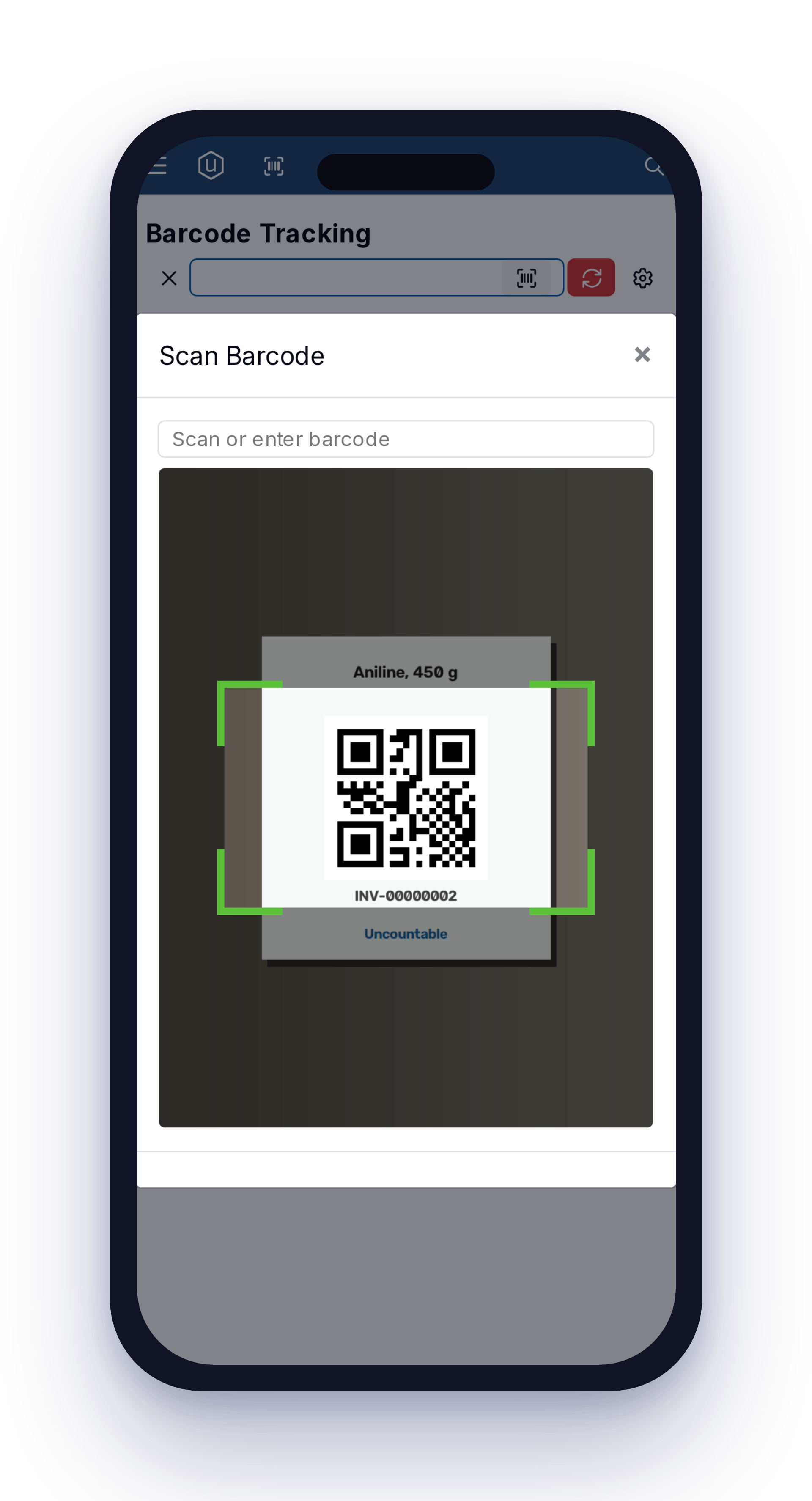
- Identifying materials: Scanning a barcode or QR code can capture a container or lot identity without asking someone to read, remember, or retype a string of digits.
- Capturing data at the point of work: A quantity, count, or measurement can be recorded while it is known, rather than reconstructed at the end of the task.
- Attaching evidence immediately: A photo can be linked to the relevant formulation, batch, sample, or quality record while the equipment, material, or observation is still in front of the user.
These are not advanced use cases. That is precisely why they matter. They address routine points of failure that are easy to overlook until someone needs to trace an exception back through the record.
What mobile should not do
Mobile does not need to support every function in a laboratory platform. In fact, trying to make every desktop workflow work on a five-inch screen usually produces an experience that is technically available but practically unusable.
The better question is not, “Can this function open on a phone?” It is:
Which tasks were specifically designed to be completed on a phone, and are people using them in real production workflows?
There is a meaningful difference between a responsive desktop interface and a mobile workflow designed around scanning, short data entry, photo capture, and confirmation. The former may demonstrate broad feature coverage. The latter may actually reduce errors and delays.
The record has to be shared
Mobile only improves data quality if it writes directly to the same underlying record used by the rest of the organization.
A separate mobile database that synchronizes later can create another version of the truth. Instead of removing the gap between work and documentation, it introduces a new reconciliation problem: what happens when the mobile record and the central system do not match?
The stronger model is to use the phone as an input device for the existing system of record. A scan, quantity, or photo should land directly on the formulation, lot, batch, sample, or quality record that laboratory, quality, and product teams already use.
That approach preserves the context around the data. The information is captured in a structured record rather than collected elsewhere and matched later. It also makes the mobile workflow accountable to the same permissions, audit trail, and data model as the rest of the platform.
For that reason, mobile is rarely the right starting point for a data-management initiative. If records are fragmented, inconsistent, or poorly structured, mobile can make that fragmentation happen faster. The foundation comes first: establish a connected, structured record, then make it easier to capture information at the point of work.
A practical way to assess it
Do not start with a vendor feature list. Walk through the lab and look for the moments where information leaves the process before it reaches the system.
Look for:
- A technician holding a container while trying to remember a lot number.
- A measurement written on paper for later entry.
- A photo taken as evidence but never attached to the relevant record.
- Multiple containers recorded as one because separate entries take too long.
- Data entered at the end of a shift, after the context has already faded.
Those are the workflows where mobile can make a material difference. They may be narrower than a vendor’s product demo suggests, but they are often more valuable than they first appear.
Capture material IDs, quantities, and supporting evidence where the work happens, directly in the records your teams already use. Explore connected laboratory workflows
.png)