
Surveillance-audit preparation often begins with a familiar checklist: review procedures, close overdue CAPAs, update the audit calendar and confirm management review is scheduled.
Those tasks matter. But they can create a false sense of readiness if the organisation has not tested whether it can retrieve and explain the evidence behind its quality processes. The following five questions provide a practical audit-readiness test.
1. Can we show the current procedure and the people who are trained on it?
Choose a critical process such as CAPA, supplier approval, document control, change control or complaint handling. Then ask:
- What is the current approved procedure?
- When did it become effective?
- Who owns it?
- Which roles need training or acknowledgement?
- Can we show that selected users completed the required training?
- Can we show how a past version was superseded and retained?
A controlled document is stronger evidence when it is connected to the people and activities it governs.
2. Can we trace one quality event from start to finish?
Select a recent nonconformance, deviation, complaint or audit finding. Can the team retrieve:
- The original event and affected scope.
- Immediate correction or containment.
- Investigation and root cause.
- CAPA or action plan.
- Owners, due dates and approvals.
- Completion evidence.
- Effectiveness review.
- Related changes, training or supplier/product/process information.
If users need to search several folders, spreadsheets and inboxes, the process may be functioning but the evidence model is weak.
3. Can we explain a recent change?
Select a recent change to a procedure, supplier, material, specification, product, process or system. Ask:
- What changed and why?
- What products, sites, processes or customers were affected?
- Who reviewed and approved the impact?
- Which documents and training were updated?
- How was implementation verified?
- Is there evidence of post-implementation review where required?
Change control is often where the connection between document control, operations, quality and training becomes visible.
4. Can we show how audit findings lead to improvement?
An internal-audit report alone does not demonstrate improvement. Select a finding and retrieve:
- The audit scope and finding.
- Assigned owner and target date.
- Corrective action or improvement plan.
- Evidence of completion.
- Effectiveness review.
- Connection to management review, metrics or broader quality planning where relevant.
This shows whether internal audits are operating as a learning mechanism rather than a compliance event.
5. Can we retrieve historical evidence without relying on individual memory?
Ask someone who did not create the original record to retrieve a historic document, CAPA, audit finding or change control. Can they explain:
- Where the authoritative record resides?
- Whether it is current, superseded, closed or archived?
- What related evidence is available?
- Why the record remains relevant?
- How the organisation retains and retrieves it?
This matters during audits, but it also matters whenever an experienced employee leaves or a cross-functional investigation begins.
Turn the questions into a mock audit
The most useful way to use this list is to run a short, timed mock audit. Choose five real examples. Assign someone outside the immediate process team to ask the questions.
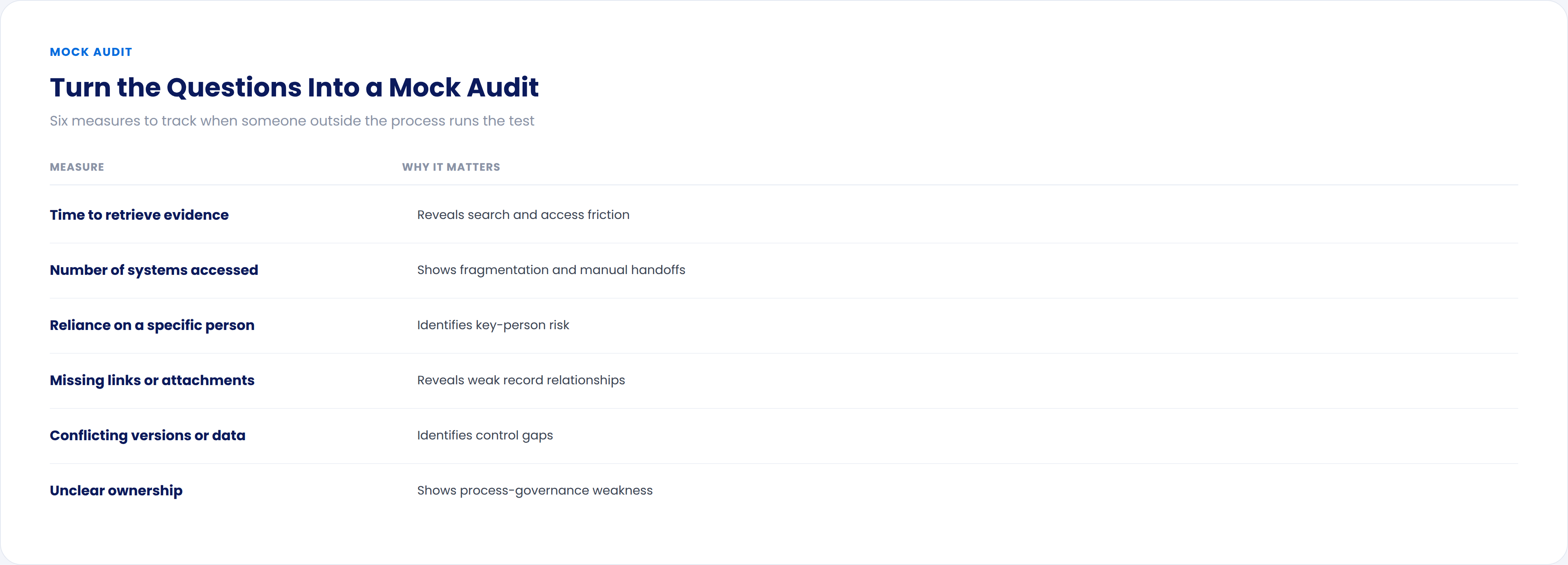
Use the results to prioritise improvement before the formal audit.
Prepare for ISO 9001:2026 with evidence, not panic
The sixth edition of ISO 9001 is scheduled for publication on 16 September 2026.[^1] The final standard and certification-body transition guidance should shape formal implementation plans.
In the meantime, these five questions are useful regardless of future clause wording. They test whether the organisation can demonstrate controlled processes, competence, corrective action, change and improvement today.
That is the foundation of audit readiness.
.png)
.png)
.png)
