.svg.png)
Getting Smart With Data: The R&D Challenge
For nearly two centuries, Rogers Corporation has been at the forefront of material innovation, engineering high-performance solutions for industries that demand precision, including aerospace, automotive, and medical technology. While its cutting edge research and development (R&D) efforts drive groundbreaking advancements, they also introduce significant operational complexities. As the company expanded across North America, Europe, and Asia, scaling its R&D processes efficiently became an increasing challenge.
One of the most pressing issues was the opportunity to tighten workflows within both research and production, which operated at three distinct levels:
- Lab Scale: Scientists experimented with new material formulations on a small scale, working with samples that fit in the palm of a hand. This stage was critical for early-stage innovation and concept validation, but was historically disconnected from later stages.
- Pilot Scale: This stage involved scaled-down versions of full-production equipment, where researchers could test materials under realistic conditions before advancing to full production. The goal was to refine formulations faster, cost-effectively, and minimize waste.
- Production Scale: Rogers manufactured customer-ready materials at this level at full capacity. Any inefficiencies at this stage had profound implications, potentially leading to delays, unnecessary costs, and resource waste.
Historically, there was limited visibility or structured data flow between these three scales. Insights from lab-scale experiments often did not translate effectively to pilot or production-scale processes, resulting in unexpected challenges, rework, and suboptimal manufacturing. Engineers needed a comprehensive system to track correlations between formulations and real-world production outcomes, to ensure that valuable discoveries made in the lab scaled efficiently to full production.
“We previously didn’t understand the correlation between all three scales—lab, pilot, and production,” explains Sahil Masih, a key engineer involved in process improvements. "Being able to capture and compare data across all three has completely changed how we scale new materials. Now, we can optimize at the lab and pilot scales first, reducing the need for costly full-production trials.” Beyond the challenges of scaling up research, data management was a significant constraint. Data was not centralized and was instead scattered across Excel spreadsheets, PowerPoint presentations, handwritten lab notebooks, and email chains. Tracking long-term experimental trends, retrieving previous results efficiently, or comparing findings across teams was difficult. Scientists frequently spent days—if not weeks—compiling reports, only to discover that key data were missing or inconsistent.
“We were spending 40% of our time just searching for past experiments and compiling reports,” recalls Sahil Masih, a Development Engineer at Rogers. "Even when we found what we needed, we had to verify its accuracy. That often meant re-running experiments to confirm previous results.” The company recognized the need for an efficient solution to address these issues, not just a tool for data storage, but a system that could structure, analyze, and optimize research.
A Turning Point: Partnering With Uncountable
The transition to Uncountable began in 2018, when Rogers partnered with Uncountable, an R&D data management platform that could support their industrial-scale experimentation and collaboration across sites. Uncountable’s initial rollout was focused on Rogers' R&D efforts. After initial success within R&D, Rogers adopted Uncountable at their Pilot Line facility in Carol Stream, Illinois, where they quickly achieved remarkable success, logging over 800 experiments within a single process, all within a few months through daily data entry. Their results sparked organic interest across the organization, particularly among formulation and production teams, accelerating broader adoption. As momentum continues into 2025, additional teams in Connecticut and Arizona joined, further expanding Uncountable’s footprint. Today, more than 105 employees across multiple regions utilize Uncountable to streamline R&D workflows, enabling structured experimentation, stronger collaboration, and faster, data-driven decision-making. The implementation of Uncountable marked a needed shift. Many scientists and engineers had developed personalized systems for tracking experiments, and transitioning to a structured, centralized platform required changes in technology and mindset. “At first, people were hesitant,” Masih stated. "They were comfortable with their systems, even though they weren’t as effective as they could be. But adoption took off once they saw how easy it was to access structured data, analyze past experiments, and make data-driven decisions.”
To ensure a smooth transition, Rogers implemented Uncountable in phases. The first step was introducing the platform at the pilot scale, where researchers were already capturing a large volume of processing parameters. By proving the system’s effectiveness in this controlled environment, adoption expanded to the lab scale, where scientists began tracking stoichiometry data —the precise ratios of chemical formulations —to ensure consistency from the smallest sample sizes to full production. Once these foundational elements were in place, the platform was rolled out company wide, integrating data from all three R&D scales into a single, cohesive system.
According to Alexis Flores-Betancourt, Uncountable’s Account Manager for Roger Corporation, “We started with the pilot line, but we knew that we had to go down to the lab scale and track formulations through production...Now, everything is configured—it’s just about using it and ensuring data quality.”
Uncountable in Action: A Strategic Breakthrough
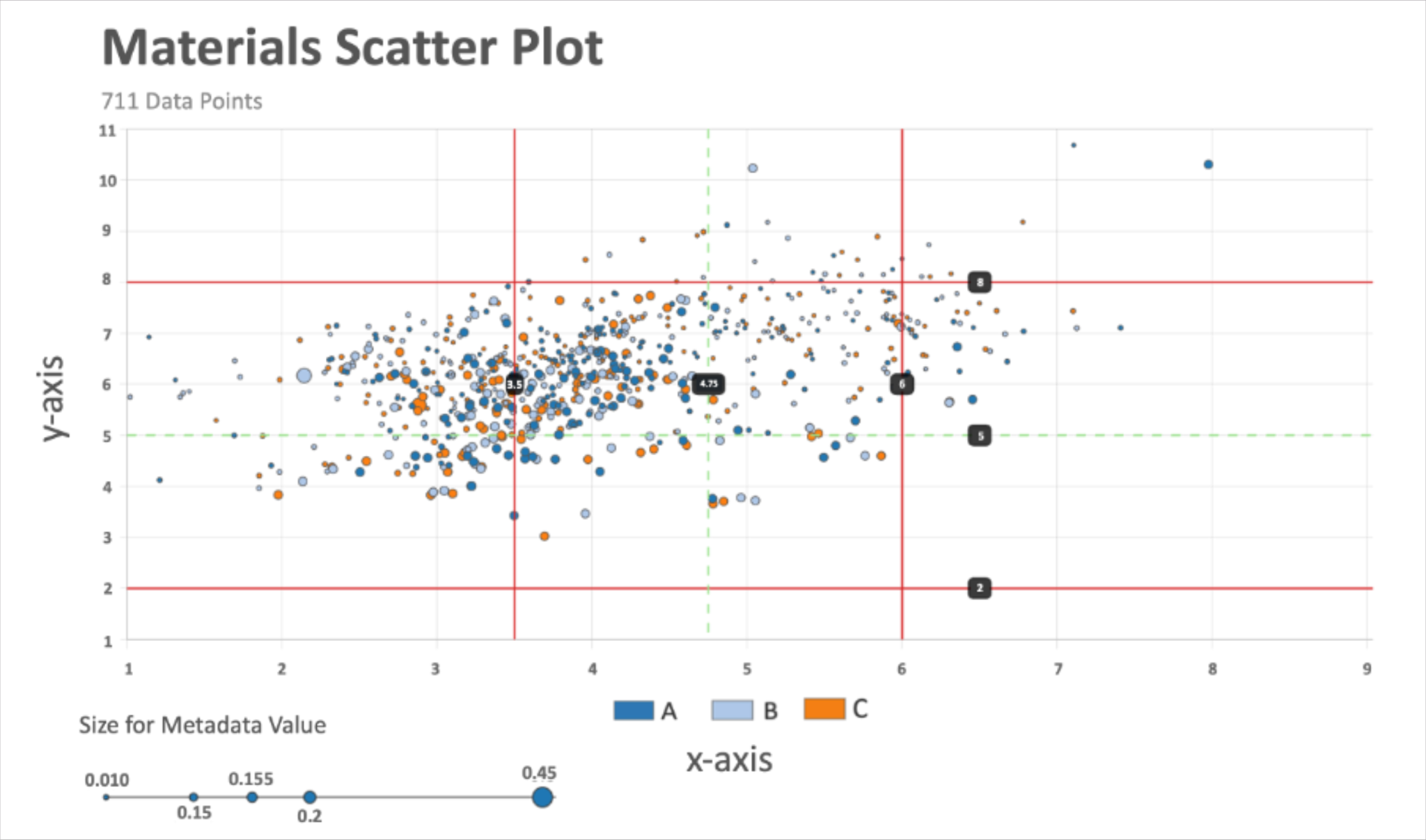
In late 2024, Rogers faced a critical production challenge: achieving a precise material thickness in one of its manufacturing processes. In the past, solving such an issue would have required multiple rounds of full-scale production trials, costing the company tens of thousands of dollars per iteration. Instead of defaulting to the traditional, costly trial and-error approach, the team turned to Uncountable’s AI-driven analytics. By analyzing 15 to 20 past experiments, the platform identified an overlooked process variable—flow rate. Adjusting this parameter enabled Rogers to achieve its target specifications without additional full-scale trials, avoiding unnecessary production costs. “This was a game-changer,” Masih explains. “We weren’t just guessing anymore. We were making data-driven decisions that delivered measurable impact.”
Environmental Compliance & Safety Tracking: Proactive Adherence to Regulations
Beyond cost and efficiency improvements, Uncountable also helped streamline Rogers's regulatory compliance and environmental sustainability efforts. Before implementing the platform, tracking safety data sheets (SDS) and hazardous materials was a time-consuming, manual process. Compliance data was scattered across multiple systems, making adherence to regulations more time-consuming and cumbersome. With Uncountable, Rogers centralized all compliance records, allowing for real-time monitoring of safety protocols and regulatory adherence. The system also enabled better inventory tracking, resulting in a 15% reduction in material waste, which in turn led to lower disposal costs and a more sustainable R&D process. “We now have complete visibility into material usage, safety protocols, and compliance records,” Masih notes. “That alone has saved countless hours and significantly reduced risk.”
The Future: AI, Machine Learning & Beyond
With a fully integrated and structured R&D dataset, Rogers is now positioned to leverage AI and machine learning for further optimization. The next phase of implementation will focus on automating experiment optimization, predicting material performance, and accelerating product development cycles. “A year ago, AI and machine learning felt like something far off,” Masih reflects. “Now, it’s within reach.”
The Uncountable Difference: A Strategic Advantage
By integrating Uncountable, Rogers transformed its R&D operations, reducing costs, increasing efficiency, and driving innovation at a faster pace than ever. The impact has been profound, and as Rogers continues to push the boundaries of material science, its ability to harness structured data will be a key competitive advantage for years to come.
About: Rogers Corporation
Rogers Corporation (NYSE: ROG) is a global leader in engineered materials to power, protect, and connect the world. With more than 185 years of materials science and process engineering expertise, Rogers delivers high-performance solutions for EV/HEV, advanced electronics, aerospace and defense, and industrial markets. Headquartered in Chandler, Arizona (USA), Rogers operates manufacturing facilities in the United States, China, Germany, Hungary, Belgium, and South Korea, with sales offices worldwide.
To learn more, visit www.rogerscorp.com