
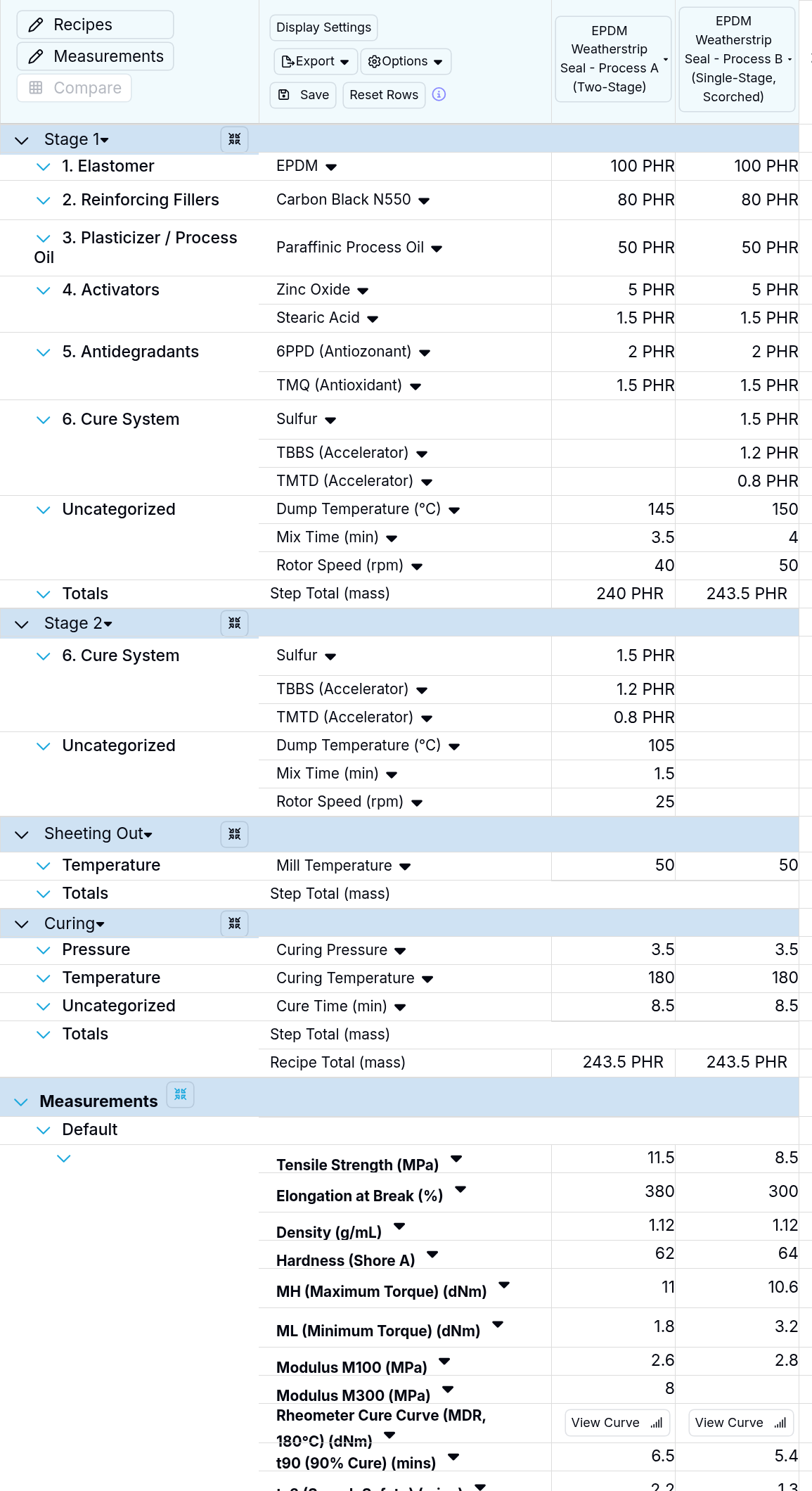
A rubber compound is not fully defined by its ingredient list.
A bill of materials can show the polymers, fillers, processing oils, curatives, accelerators, antioxidants, pigments, and other materials used in a compound. That record matters. It does not, by itself, show how to reproduce the compound or explain why it performs as it does.
Rubber performance depends on the relationship between the compound and the process used to make it. Order of addition, mixing time, rotor speed, temperature profile, dump temperature, milling conditions, calendering settings, extrusion parameters, cure time, and cure temperature can all influence the finished material.
A PLM system built around discrete parts and flat bills of materials often has no natural place to store those relationships. The formula is reduced to an ingredient list, while process instructions, test evidence, quality records, and production context are stored in separate documents or systems. Teams can still find the files, but they must reconstruct the technical record each time a question arises.
The process is part of the product
Consider two compounds with the same nominal ingredient percentages.
One may have a different mixing sequence, a higher dump temperature, or a modified cure profile. Those differences can affect filler dispersion, viscosity, scorch behavior, tensile strength, elongation, hardness, compression set, and consistency in the finished component.
When a product record holds only the ingredient list, it cannot show which process conditions were associated with a successful result. It also cannot make the relationship between a formula revision, a material substitution, and a later performance issue easy to trace.
For rubber teams, the product definition needs to connect:
- The compound formula and each controlled revision
- Raw-material grades, suppliers, lots, specifications, and approved alternatives
- Masterbatch, intermediate, and final-compound relationships
- Mixing instructions, order of addition, temperature profile, and dump criteria
- Milling, calendering, extrusion, molding, and curing conditions where relevant
- Laboratory and quality-test methods, samples, and results
- Product specifications, approvals, deviations, and corrective actions
- Manufacturing instructions and the effective date of each approved revision
That connected record gives technical, quality, manufacturing, and procurement teams a common basis for decisions.
Why a flat BOM creates risk
A flat BOM is useful for identifying what is in a compound. It is much less useful when the team needs to assess a change.
Suppose a supplier changes the specification of a carbon black grade, a polymer is temporarily unavailable, or a curative requires a replacement. The immediate question is not only which compounds contain that material. Teams also need to know which formula versions use it, which products rely on those compounds, which process conditions were validated, what test results supported approval, and whether the substitute creates changes in mixing, cure behavior, or downstream performance.
Without connected formulation data, answering those questions becomes a manual investigation. R&D may search laboratory files. Quality may review separate test records. Manufacturing may check work instructions or batch documentation. Procurement may maintain supplier information elsewhere. Each group can hold part of the answer, but no system presents the full impact of the change.
A formulation-aware PLM environment links those records. It helps teams identify affected products, compare prior material or formula changes, find the evidence associated with an approved compound, and route the change through the required review process.
Scale-up adds another layer
Rubber compounds often evolve across laboratory development, pilot runs, production trials, and full-scale manufacturing. Conditions that work in a small mixer do not always transfer directly to production equipment.
The product record therefore needs to preserve the context of each result. A laboratory compound might meet a target property under one mixing profile, while a plant trial reveals differences in dispersion, throughput, temperature control, or cure behavior. If that information stays in disconnected trial reports, later teams may repeat the same learning or struggle to explain why a compound behaves differently after transfer.
A connected formulation and process record helps teams compare lab, pilot, and production work without treating each stage as a separate product history. It gives them a clearer view of what changed, what evidence supports the decision, and what still requires validation.
What to require from PLM
When evaluating PLM for rubber compounding, ask vendors to demonstrate a real change scenario rather than a generic BOM workflow.
Use a compound with a masterbatch or intermediate, multiple raw-material grades, a defined mixing and cure process, and supporting test data. Then ask the vendor to:
- Create a controlled revision after replacing a raw material.
- Show every compound, finished product, specification, and process instruction affected by that material.
- Preserve the mixing sequence, process conditions, and cure profile with the formula revision.
- Link laboratory and quality results to the correct compound and process version.
- Route the change through technical, quality, manufacturing, procurement, and regulatory review as needed.
- Show the approved version, historical version, effective date, and decision record.
- Publish the approved information to downstream manufacturing or ERP systems without creating uncontrolled copies.
If the answer depends on attaching spreadsheets and PDFs to a flat BOM, the platform may store documentation, but it is not managing the compound as a connected technical product.
PLM built for the whole compound
Rubber compounding requires a system that can represent what the compound contains, how it is made, how it was tested, and why it was approved.
That means managing formulas and sub-recipes alongside raw-material grades, process conditions, test evidence, specifications, change control, and manufacturing handoffs. When those relationships remain connected, teams can investigate changes more efficiently, transfer knowledge across scale-up, and maintain a clearer record of how an approved compound should be reproduced.
For a broader guide to evaluating PLM across chemicals, materials, coatings, food, cosmetics, and other formulation-based industries, read How to Choose PLM for Formulation-Based Products.
See Uncountable’s formulation-aware PLM for a walkthrough of versioned formulas, mixing and cure conditions, material change impact, quality evidence, and manufacturing handoffs. Uncountable describes its PLM as managing the formulation and the process that makes it, including sub-recipes, order of addition, cure conditions, change control, where-used analysis, and ERP publication.

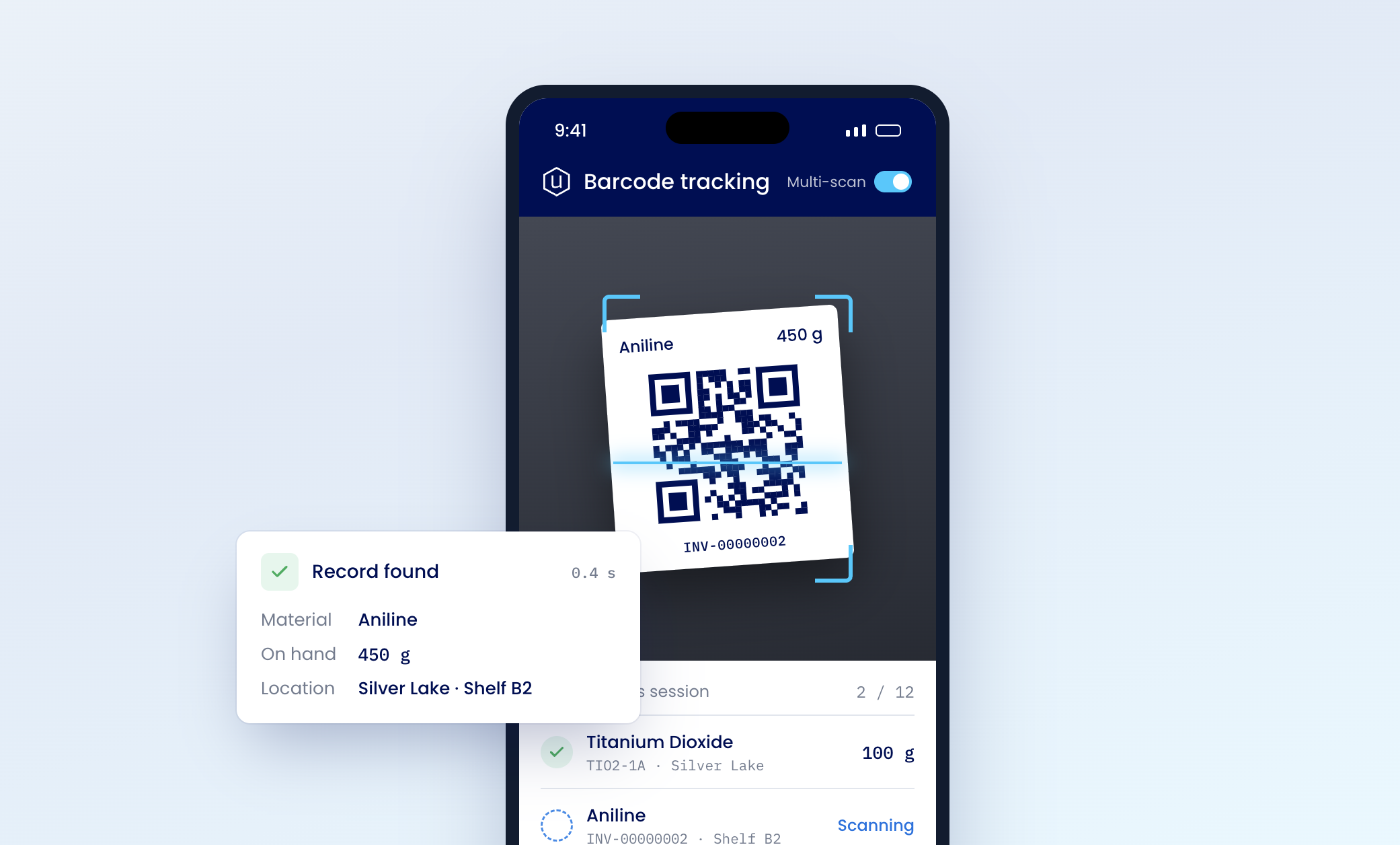
.png)
