
Most R&D transformations are run like a construction project. There is a start, a go-live, a ribbon-cutting, and then the team is expected to get back to work. The problem is that the pace of change in R&D no longer respects end dates. New instruments, new regulations, new sustainability mandates, and now a wave of AI and large language model capabilities arrive faster than any single rollout can absorb. The organizations pulling ahead are not the ones that finished a transformation. They are the ones that stopped treating transformation as something that finishes.
That shift, from change management to change fitness, is the difference between modernizing once and building the capacity to keep evolving. For R&D leaders deciding where to put budget and political capital, it is also where the real return lives.
What Is the Difference Between Change Management and Change Fitness?
Change management treats a transformation as a project with a defined beginning and end, while change fitness treats adaptability as a permanent organizational capability. The distinction matters because the cost of a one-time rollout shows up once, but the cost of a rigid organization compounds every time the market moves.
Traditional change management asks, "How do we get everyone onto the new system?" Change fitness asks, "How do we build the data, habits, and culture to absorb whatever comes next?" A team that has real change fitness does not panic when a new AI capability ships or a raw material gets restricted. It has the structured data and the working practices to fold the change in and keep moving.
Why Do So Many R&D Digital Transformations Stall?
Most R&D digital transformations stall because the organization treats adoption as a training event rather than a change in how people work. The software goes live, a few power users adopt it, and everyone else quietly drifts back to spreadsheets and the private folders that made them productive before. The tool is technically deployed and practically abandoned.
The financial exposure here is real, even if it rarely appears on a single line item. When adoption fails, three costs accumulate at once. First is the sunk platform investment that never earns its return. Second is the opportunity cost of a transformation that consumed a year of leadership attention and delivered shelfware. Third, and largest, is the ongoing cost the platform was supposed to remove: scientists still cannot find prior work, so teams keep re-running experiments that were already done, and institutional knowledge still walks out the door when a chemist leaves. Structured, connected data only pays back if people actually use it.
What Does Change Fitness Look Like in Practice?
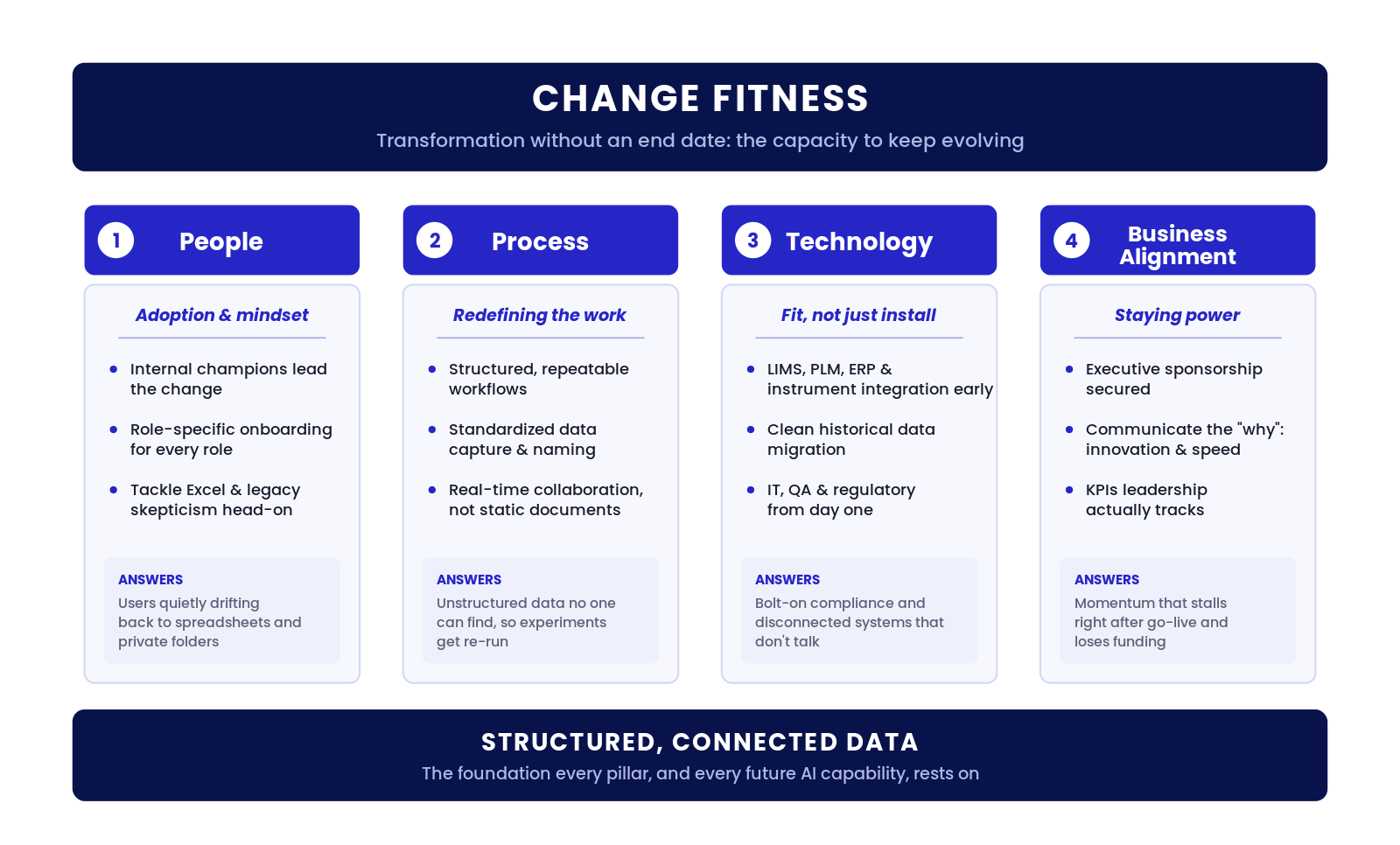
Change fitness in practice means building the transformation on four reinforcing pillars rather than a single software deployment: people, process, technology, and business alignment. Each pillar answers a failure mode that sinks R&D rollouts.
People is about adoption and mindset, not headcount. That means identifying internal champions who lead the change, delivering role-specific onboarding for scientists, formulators, technicians, and managers, and directly addressing the honest skepticism about giving up Excel or a familiar legacy system. Process is about redefining the work: digitizing formulation and experimentation into structured, repeatable workflows, standardizing how data is captured and named, and replacing static documents with real-time collaboration. Technology is about fit: planning integrations with LIMS, PLM, ERP, and instruments early, migrating historical data cleanly when a legacy system is being replaced, and bringing IT, QA, and regulatory in from the start so compliance is designed in, not bolted on. Business alignment is about staying power: securing executive sponsorship, communicating the "why" in terms of innovation and speed to market, and defining KPIs that leadership actually tracks.
How Do You Measure Whether the Change Is Working?
You measure whether the change is working with a small set of R&D outcome metrics, not software login counts. The metrics that matter are formulation cycle time, the reuse of prior knowledge, and experiment throughput, because those tie directly to cost and speed to market.
The upside is not hypothetical. Uncountable customers have reported the kind of outcomes these metrics are meant to capture: Repsol cut experimental workload by 30 to 40 percent per project after unifying two decades of data; SCG Chemicals reported up to a 3X return on investment and 45 percent less design-of-experiments workload; Sika reported about 75 percent fewer experiments and more than 50 percent faster time to market; Ripple Foods reduced time spent reconciling data by at least 30 percent and went live in four months. These are outcomes each company reported from its own use of the platform, and the common thread is that the value came from adoption that stuck, not from the install itself.
Why Does This Matter More Now?
This matters more now because the rate of useful new capability has outrun the one-time rollout. The clearest example is AI. Large language model and AI features are arriving in R&D software quickly, and they are only as good as the structured, connected data underneath them. An organization that treated its last transformation as finished has to run another disruptive project to take advantage. An organization with change fitness already has the foundation, so it adopts the new capability as an upgrade, not an upheaval.
That is the strategic case for R&D leaders. Investing in the data infrastructure, working habits, and culture of continuous change is not only about the near-term gains in cycle time and cost. It is about buying sustained agility, so that the next shift, whatever it is, becomes something your team absorbs rather than something that sets you back a year.
Change fitness starts with a data foundation you can build on. See how Uncountable unifies R&D, QC, and PLM data in one platform, so your team can absorb whatever comes next, from new regulations to the latest AI capabilities. Book a demo.
.png)
.png)
.png)
