
A Certificate of Analysis (COA) should be generated from the approved quality data behind a release decision, not rebuilt by hand in a template. When the certificate is an output of the governed quality record, teams remove a second round of copying and checking, and every issued COA stays traceable to the data and decision behind it.
A Certificate of Analysis is one of the most consequential documents a manufacturer sends to a customer.
.png)
It is the document that states: this defined product, lot, or batch was assessed against the applicable requirements, and these are the resulting values, conclusions, and release-related details. For many manufacturers, it also becomes the record customers use to decide whether to accept material, release it into their own process, investigate a question, or support downstream quality and regulatory documentation.
Yet COAs are often created as if they were an administrative afterthought.
The laboratory completes testing. Quality reviews the results. The lot is approved for release. Then someone opens a spreadsheet, Word document, or PDF template and begins copying product details, batch numbers, specifications, results, units, customer fields, and standard statements into a new document.
At first glance, that may appear to be a straightforward final step. In reality, it is a second data-management workflow after the quality decision has already been made.
A COA is not just a template. It is the customer-facing expression of a governed quality decision. Treating it that way changes certificate creation from a document people manually assemble into an output generated from the approved data, rules, and decisions already held in the quality process.
That distinction matters because the question is not simply whether a COA looks correct when it is sent. The question is whether the organization can show, quickly and confidently, exactly which product, specification, test results, approvals, and customer requirements supported the issued certificate.
COA information should be handled once, not twice
Most organizations already have the core information required to issue a COA. Somewhere in their product, laboratory, quality, or release records, they have:
- The correct product, grade, formulation, material, lot, or batch identity
- The effective specification, including applicable limits, methods, and units
- The completed test results and approved calculations
- The quality disposition and release status
- The relevant customer, market, or product-specific certificate requirements
- The document-control rules that determine which certificate format should be used
- The authorization information required to issue the document
The issue is not whether the information exists. The issue is that it is often stored, reviewed, and approved in one workflow, then recreated in another.
That recreation can be manageable at low volume. A small team can issue a limited number of certificates through careful checking, locally maintained templates, and the experience of a few people who understand the process. But as product variants, customers, manufacturing sites, test profiles, markets, and release volumes increase, certificate creation becomes a recurring coordination task.
The same information gets handled twice: first to make a quality decision, then to communicate that decision externally.
The second pass creates delay, rework, and a new opportunity for the customer-facing document to drift away from the controlled record. It also makes the process harder to scale. Every additional product grade, customer format, or site-specific requirement can create another manual branch that someone has to remember, interpret, and check.
A better principle is simple:
Information that has already been captured, reviewed, and approved in the quality process should not need to be manually reconstructed for the COA.
What a certificate of analysis actually represents
A COA is often described as a summary of test results. That is true, but incomplete.
A usable certificate connects several types of information that need to remain aligned:
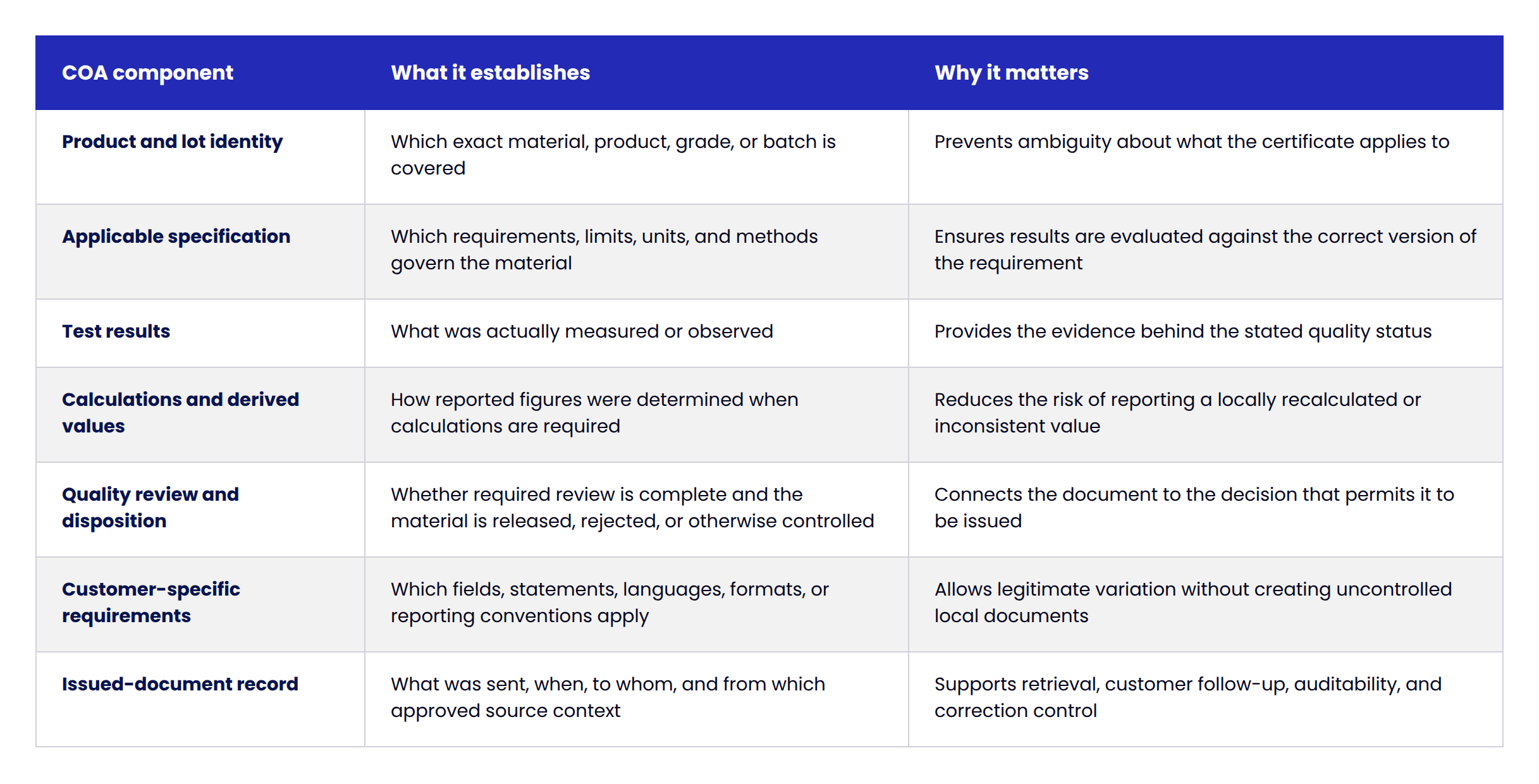
This is why a COA should not be treated as a standalone file. It is the output of a connected record.
In regulated pharmaceutical settings, for example, Good Manufacturing Practice (GMP) guidance for active pharmaceutical ingredients says authentic COAs should be issued on request and identifies information such as the product name, batch number, release date, applicable tests, acceptance limits, and numerical results as certificate content. EU batch-certificate guidance likewise links the certificate to the applicable specifications, analytical methods, analytical results, review of batch records, and release authorization.
The exact requirements vary by industry, product type, customer agreement, and market. But the broader operational lesson applies well beyond pharmaceuticals: a certificate carries more meaning than its visual layout. It communicates a specific quality decision, grounded in a specific data context.
Why a COA template becomes a risk point
Templates are not inherently the problem.
A controlled, well-designed template can make certificates consistent, readable, and appropriate for a particular customer or market. A template may determine the placement of a logo, the order of fields, a standard quality statement, whether results appear in a table, or which fields should be translated.
The risk begins when a template becomes a separate place where people reconstruct information that is already governed elsewhere.
In that model, the template is no longer only a presentation layer. It becomes an informal second system of record for specifications, units, statements, calculations, and customer requirements. That creates several avoidable control points.
A value can change during manual transfer
A result may be copied with the wrong decimal place. A unit can be omitted, converted incorrectly, or entered in a format that does not match the applicable specification. A result qualifier may be lost. A calculation may be repeated in a local workbook rather than drawn from the approved source.
Even a small discrepancy can lead to a customer question, a corrected certificate, an internal investigation, additional review, or uncertainty about whether the shipment and the associated certificate remain aligned.
A reviewer may catch the mistake. But repeatedly checking whether copied values still match approved data is work that a connected process can reduce by design.
The objective is not to assume people will stop making errors. It is to minimize the number of moments where a person must manually re-enter information that the business already has in approved form.
The right result can be paired with the wrong requirement
A certificate can contain an accurate result and still be wrong for the customer.
It may reference a superseded specification revision, an outdated limit, the wrong test method, an obsolete unit convention, or a customer requirement that no longer applies. This is particularly difficult to manage when an organization supports multiple grades, formulations, plants, markets, customer agreements, or regional labeling and regulatory requirements.
A familiar local template can still carry the wrong context.
For example, imagine two customers receive the same product grade but require different reporting conventions. One needs a particular method reference and a stated acceptance range. Another needs a different document layout and a customer-specific statement. If those distinctions live only in separate template files, the process depends on someone selecting the right file, confirming its version, and knowing whether its embedded content remains current.
In a governed process, the relevant certificate format and content rules are tied to the product, customer, site, and quality context. The system should determine what belongs on the certificate from approved relationships, not from a user’s memory of which file to open.
A final document can get ahead of release
A certificate communicates a quality conclusion. If certificate creation is detached from the release workflow, teams must rely on procedural checks to ensure a customer-facing COA is not issued before the required review, investigation, disposition, and release activities are complete.
That does not mean drafts can never be prepared early. In high-volume or time-sensitive environments, preparing a draft may be operationally useful.
But the process should clearly distinguish between a working draft and an issued certificate. A final COA should be generated and released only when the underlying data and decision status permit it.
The critical distinction is between:
- A document that is being prepared for review
- A document that contains approved values but is not yet authorized for external issuance
- The final, issued certificate associated with the approved quality disposition
When those states are managed separately, teams can move quickly without blurring the line between pending work and a final customer-facing quality document.
Local variation becomes difficult to govern
Many manufacturers have legitimate reasons to issue different certificate formats. Customers may require unique fields, specific statements, regional languages, test-reporting conventions, or document layouts. Product lines may have distinct analytical profiles. Different sites may have specific legal entity details or authorized signatory requirements.
Variation itself is not evidence of a weak process. Uncontrolled variation is. When templates multiply across shared drives, local folders, email attachments, and individual desktops, teams have to answer basic but consequential questions:
- Which template is currently approved?
- Who is authorized to change it?
- Which product, customer, site, or market does it apply to?
- Which fields are mandatory, optional, or conditional?
- Which version was used to issue a particular certificate?
- What happens when a product requirement or customer agreement changes?
Without clear answers, certificate creation becomes dependent on experience and local knowledge rather than governed rules.
The hidden cost of manual COA creation is not only an error
Manual COA work is often discussed as a transcription-error problem. That matters, but it is not the whole issue.
The larger cost is frequently the work required to prevent an error.
Quality and laboratory teams spend time locating source records, comparing templates with approved results, checking units and specifications, resolving missing fields, confirming release status, applying customer variations, formatting documents, coordinating approvals, and responding to questions after a certificate is sent.
In many organizations, that work is scattered across several roles. The laboratory may own results. Quality may own review and release. Customer service or supply chain may need the document before shipment. Product teams may own specification context. Regulatory or commercial teams may hold customer-specific requirements.
No individual task has to be especially difficult for the end-to-end process to become slow.
The operational consequences include:
- Slower customer response. Certificate turnaround can become a bottleneck between release and shipment, or between a customer request and a usable answer.
- More checking work. Teams repeatedly verify copied values because the document is not directly produced from approved source records.
- More dependence on key people. Experienced staff become the unofficial owners of customer formats, exception handling, release timing, and knowledge of where the right information lives.
- Less scalable service. Each new product, site, customer, test requirement, and document variant adds another manual branch to the workflow.
- Harder customer follow-up. When a customer asks about a reported result, teams may have to reconstruct how the issued certificate relates to the specification, test record, calculation, and approval decision.
- More difficult corrections. If a certificate requires correction, teams need to identify the original document, establish why it was wrong, determine whether the underlying record or only the document was affected, and ensure the replacement is clearly controlled.
- Weaker process visibility. It becomes harder to see how many certificates are pending, where delays occur, which variations create the most rework, and whether document turnaround is improving or deteriorating over time.
The goal is not to remove human expertise from quality. Quality judgment remains essential in setting requirements, reviewing results, managing exceptions, investigating deviations, and authorizing release.
The goal is to stop asking qualified people to perform repetitive document reconstruction after they have already performed the work that requires their expertise.
A COA should be generated from the quality record
A more governed approach begins with a simple design principle: The customer-facing certificate should be generated from the same approved information that supports the quality decision.
That does not mean every COA must look identical. Nor does it mean organizations have to eliminate customer-specific layouts or product-specific requirements. It means the document should be generated from controlled source records, with the selected format acting as the presentation layer for approved information.
A governed COA depends on six connected records:
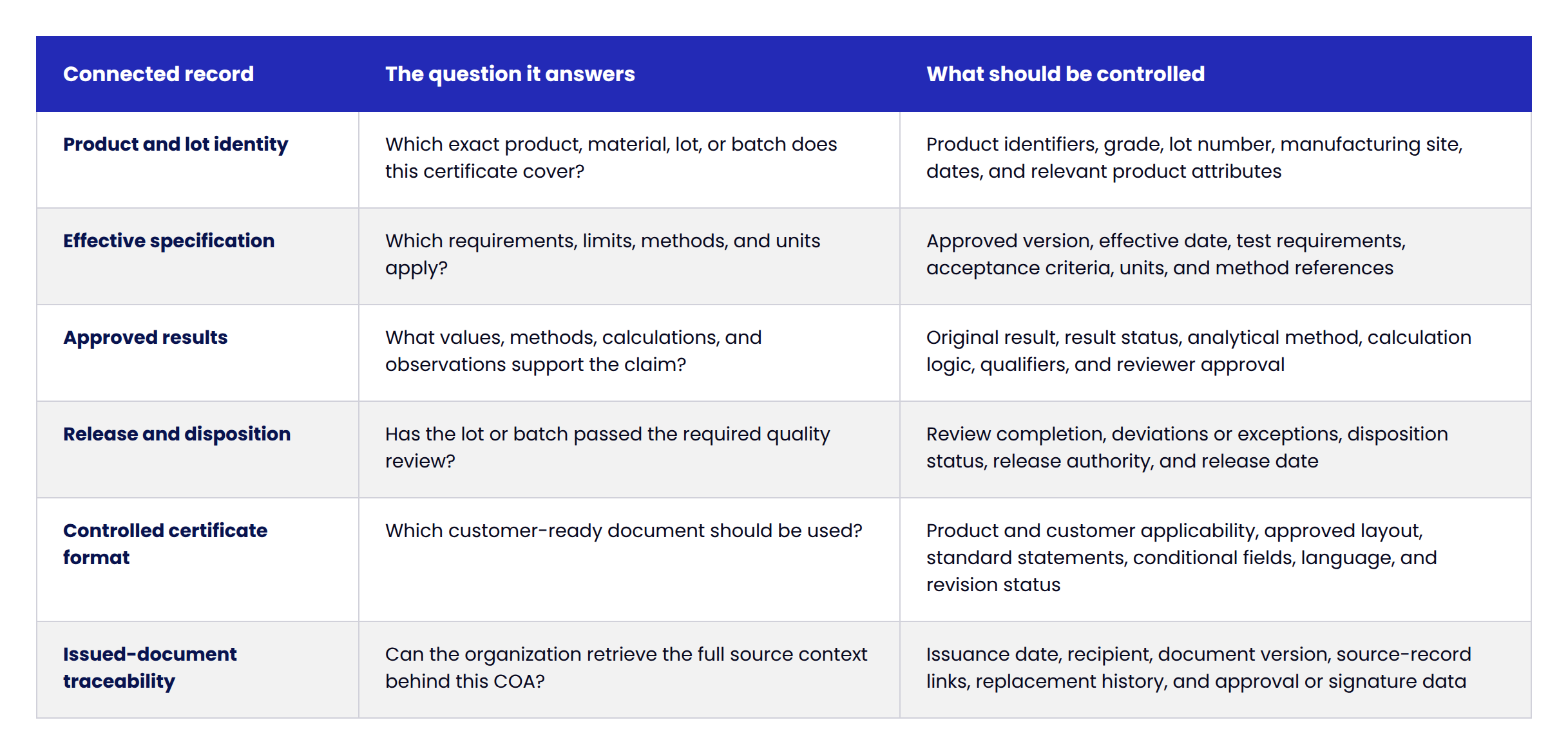
The key is the relationship among these records.
For a given batch, the system should be able to determine which specification was effective, which tests and limits applied, which results were approved, whether release is complete, and which customer-ready format should be used. The resulting certificate should preserve a traceable connection to those records.
That is a fundamentally different operating model from starting with a blank or semi-completed template and manually gathering information from multiple locations.
Manual template workflow vs governed COA generation
The difference is easiest to see in the workflow.
Manual template workflow
- Review results and approve the lot or batch.
- Find the relevant product, specification, test, and customer information.
- Identify the appropriate certificate template.
- Copy results, methods, units, identifiers, and statements into the document.
- Recheck the copied information against source records.
- Confirm that the correct customer format and document version were used.
- Route the document for review, save it, issue it, and retain it.
- Reconstruct the source context if a customer, auditor, or internal team later asks a question.
Governed generation workflow
- Complete the required testing, review, exception handling, and disposition activities.
- Confirm the applicable customer or product certificate requirement.
- Select the approved certificate format based on governed rules.
- Generate the customer-ready COA from the approved product, specification, results, and release data.
- Issue the document through the defined authorization and distribution process.
- Retain the issued document with direct traceability to its source context.
The second workflow does not eliminate control. It puts control closer to the point where relevant data and decisions are created.
Instead of treating the final document as a separate transcription exercise, it makes the certificate an output of the controlled workflow. Instead of relying on manual comparison to prove that a certificate matches approved records, it reduces the need for comparison by generating the document from those records.
COA automation does not mean uncontrolled issuance
“COA automation” can sometimes imply that certificates should be generated and sent with little oversight. That is not the right objective.
A governed approach should make it easier to apply the right controls at the right time. Depending on the product, organization, and quality model, those controls may include:
- Preventing final COA generation until the required disposition or release status is complete
- Restricting which approved certificate formats can be used for a given customer, product, or site
- Requiring an authorized review or signature before issuance
- Preserving the issued version rather than overwriting it when records later change
- Distinguishing between draft, approved, issued, voided, and superseded certificate states
- Retaining the source-data links needed to investigate a customer question or quality event
- Applying conditional rules when a result is out of range, a test is not applicable, a customer requests an additional field, or a statement requires review
In other words, the aim is not to automate around the quality process. It is to generate the COA through the quality process.
That distinction matters most when something does not go as planned.
A mature certificate process does not only handle the routine case where every test is complete, every result passes, and every customer uses the standard format. It should also support exceptions: retesting, specification updates, customer-specific requirements, omitted tests, document corrections, replacement certificates, and questions that arise after issuance.
The more directly the document is connected to governed records, the easier it becomes to understand and manage those exceptions without resorting to email trails, private spreadsheets, and local workarounds.
How Uncountable generates COAs from governed data
Uncountable can automatically generate COAs directly from governed data, without manual typing.
Customers do not need to leave their connected PLM, QMS, or PPM environment to create a certificate, because the relevant specifications, results, product data, and approval context can already be maintained in the same connected system.
That is the difference between a certificate process that depends on manual document assembly and one connected to the quality record behind it.
Rather than exporting approved information into a separate certificate template and re-entering it for customer delivery, teams can generate a customer-ready COA from the controlled data already used to manage the product and quality process.
This approach helps teams:
- Reduce repetitive copying after results have already been reviewed and approved
- Generate certificates from the applicable specification and approved result context
- Apply customer-specific formats without proliferating uncontrolled local templates
- Keep issued certificates connected to product, lot, quality, and release information
- Support faster retrieval when customers ask questions about an issued document
- Make certificate creation more consistent across products, sites, and teams
- Scale document output without scaling the amount of manual reconstruction required
The outcome is practical: less repetitive work, fewer opportunities for document-level inconsistency, faster certificate creation, and a clearer connection between what was tested, what was approved, and what the customer received.
Three questions to assess your COA process
Ask your team:
- Are certificate values manually typed or copied after they have already been reviewed and approved?
- Can you identify the exact specification, test records, calculation logic, and release decision behind any issued COA?
- Can you produce the correct customer format without relying on a local file, shared-drive folder, or a particular person’s knowledge?
If any answer is uncertain, your certificate process may still depend on more manual reconstruction than it needs to.
A useful next step is to map the current process for one common product and one difficult exception. For example, trace how your team creates a routine COA for a released batch, then trace what happens when a customer needs a unique statement, a specification revision changes, or a certificate must be corrected after issuance. The gaps are often easier to see in the exception path than in the routine one.
.png)
.png)
.png)
