
The right LIMS for specialty chemicals QA and QC is the one that keeps every result connected to the material, lot, specification, method, instrument, and release decision behind it. A laboratory information management system (LIMS) is the software a lab uses to register samples, assign tests, record results, and manage review and approval. Evaluate candidates on traceability, flexible specifications, data integrity, instrument connectivity, and links to production systems, and test them against your own exception scenarios rather than a generic feature list.
Choosing a LIMS for specialty chemicals is not mainly about replacing paper worksheets or collecting instrument results in one place. The stronger systems make it possible to connect a result to the material actually tested, the formulation and process context behind it, the method and instrument used, and the quality decision that followed.
For QA and QC leaders, that distinction matters. Specialty chemicals rarely move through a lab as simple, static samples. They are grades, blends, intermediates, customer-specific products, pilot batches, retained samples, rework materials, and raw materials with supplier-specific variability. A useful LIMS has to preserve that context without forcing the laboratory into rigid, generic workflows.
What the best LIMS means for specialty chemicals
There is no universally best LIMS. The right choice depends on the laboratory’s operating model, the maturity of its quality processes, its existing ERP and production systems, and whether the organization needs a conventional QC execution system, a broader quality platform, or a data layer that links lab, formulation, and manufacturing work.
.png)
That said, specialty chemicals teams should evaluate platforms against a more specific set of requirements than a generic LIMS checklist. The system should be able to manage complex material hierarchies, variable test plans, specification versions, and exceptions while making the resulting data usable beyond the lab.
A specialty chemicals producer may need to answer questions such as:
- Which lots of a raw material supplier’s product were used in batches that later showed a viscosity drift?
- Was the out-of-specification result caused by the material, the analytical method, the instrument condition, or a production parameter?
- Which certificate of analysis was issued for a particular customer shipment, and which approved specification applied at the time?
- What formulation, process conditions, and QC results distinguish an approved pilot batch from a commercial batch?
- Which active specifications, test methods, reference standards, and equipment calibrations supported a released result?
A LIMS that stores only sample IDs and final values makes those questions expensive to answer. A system that structures relationships among materials, lots, specifications, methods, instruments, people, and production batches can turn the same work into a usable quality record.
This is also where compliance requirements become operational requirements. ISO/IEC 17025 applies to the competence of testing and calibration laboratories and covers standard, non-standard, and laboratory-developed methods. Its approach to metrological traceability requires a documented, unbroken calibration chain linking results to appropriate references when calibration affects result validity. Even where a specialty chemicals QC lab is not accredited to ISO/IEC 17025, those principles are a sensible benchmark for equipment status, standards management, method control, and defensible reporting.
For organizations working under OECD Good Laboratory Practice requirements, computerized systems should preserve full audit trails that show changes without obscuring original data, and changes should be attributable to the person making them. FDA-regulated operations have additional obligations when required records are maintained electronically: Part 11 applies to electronic records created, modified, maintained, archived, retrieved, or transmitted under applicable FDA record requirements. Not every specialty chemicals manufacturer operates under Part 11, but the underlying controls, including access management, auditability, review, and record retention, are often valuable well beyond life sciences.
The LIMS selection criteria that matter most
Six criteria separate a LIMS that fits specialty chemicals QA and QC from one that only digitizes lab administration.
1. Material, lot, and sample traceability
A specialty chemicals LIMS should model the chain from incoming material through internal processing to finished-goods testing. At a minimum, it should connect supplier, material grade, supplier lot, internal lot, sample, test, result, specification, disposition, and certificate of analysis.
The important question is not whether a vendor can assign a barcode. Most can. It is whether the system can retain the relationships that quality teams need during investigation. If a finished batch fails color, particle size, moisture, assay, viscosity, density, or another critical property, users should be able to navigate back to the raw-material lots, process batch, retained sample, instrument, analyst, method version, and reference materials involved.
Look for configurable parent-child relationships rather than a flat sample register. The system should accommodate raw materials, intermediates, work-in-process samples, blends, finished goods, stability or retain samples, and external customer samples without creating disconnected records for each.
2. Flexible specifications and test plans
Specialty chemical portfolios are often characterized by many grades, regional variants, customer-specific requirements, and products that evolve as formulations or manufacturing processes change. A LIMS must therefore support version-controlled specifications, not just a fixed set of tests.
The strongest systems can assign test plans based on material, site, supplier, customer, manufacturing stage, product grade, risk level, or sampling event. They can also distinguish between release tests, in-process controls, characterization tests, investigation testing, and certificate-of-analysis reporting.
This should include more than upper and lower limits. Quality teams often need target values, warning limits, calculated results, unit conversions, conditional testing, replicate logic, and rules for retesting or escalation. If a laboratory routinely performs viscosity at defined temperature conditions, particle-size distribution using a particular preparation method, or color assessment against a customer standard, those contextual details need to be part of the controlled test definition, not an analyst’s informal knowledge.
Specification governance is especially important when products serve regulated or highly technical downstream markets. Under REACH, registrants must gather relevant available physicochemical, toxicological, and ecotoxicological information on substances, alongside use, exposure, and risk-management information; the information required for registration varies by production or import volume. A quality control LIMS does not replace a regulatory information-management system, but it should make analytical and quality evidence easier to locate, interpret, and reuse when product stewardship or regulatory teams need it.
3. Data integrity and reviewability
Audit trails should be assessed as a practical workflow, not a procurement checkbox. Ask a vendor to demonstrate what happens when an analyst corrects a transcription error, repeats a test, invalidates an instrument result, changes a specification, or releases a batch with an approved deviation.
A robust system should show the original value, the changed value, who made the change, when it occurred, and why. OECD guidance on computerized systems emphasizes that changes to electronic records should not obscure the original entry and should be time- and date-stamped and traceable to the individual who made the change. It also calls for audit trails to be available in a human-readable form.
Look closely at:
- Role-based permissions for analysts, reviewers, approvers, administrators, and quality managers.
- Electronic review and approval workflows that reflect the organization’s real release process.
- Configurable reason codes for corrections, invalidations, deviations, and overrides.
- Controlled versions of methods, specifications, worksheets, and report templates.
- Secure retention, backup, retrieval, and archival of records.
- A practical way to review audit-trail activity by exception rather than forcing quality teams to inspect every system event manually.
A platform that technically records everything but makes review difficult can create a new compliance burden rather than reducing one.
4. Instrument and method connectivity
Instrument connectivity can be one of the largest differentiators between LIMS platforms, but the right level of integration depends on the lab. A QC environment using chromatography, spectroscopy, particle sizing, rheology, titration, thermal analysis, and physical-property testing will have different needs from a smaller lab that relies primarily on balances, pH meters, moisture analyzers, and manual procedures.
The essential requirement is reliable capture of raw or reported instrument data, coupled with clear traceability to the sample, test, method, instrument, analyst, and calibration status. Avoid assuming that “instrument integration” means the same thing across vendors. It may range from file import and result parsing to bidirectional integrations with chromatography data systems, middleware, or laboratory execution workflows.
Ask whether the system can:
- Import instrument-generated results without manual transcription.
- Preserve links to source files or source systems.
- Prevent use of an instrument that is out of calibration, under maintenance, or otherwise unavailable.
- Associate a result with the approved method version and calculation logic.
- Record reference-material lots, standard preparations, and reagent status where relevant.
- Handle calculations, replicates, dilution factors, and unit conversions in a controlled manner.
ISO/IEC 17025’s calibration expectations provide a helpful lens. Equipment should be calibrated when measurement accuracy or uncertainty affects the validity of reported results, or when calibration is needed to establish metrological traceability. The LIMS should not be treated as the sole calibration-management tool, but it should make equipment status visible at the point of use and preserve the evidence that supports reported data.
5. Lab-to-production connectivity
For specialty chemicals, the highest-value LIMS integrations often lie outside the laboratory. Quality results influence batch release, production adjustments, hold decisions, blending choices, shipment approval, supplier performance, and customer documentation. Yet many LIMS implementations leave those processes dependent on exported spreadsheets, emailed certificates, and manual ERP updates.
The best-fit system should integrate, or at least exchange structured data reliably, with the systems that hold:
- Production orders and batch genealogy.
- Material master data and supplier records.
- Inventory and warehouse status.
- Customer orders and shipment data.
- Quality events, deviations, complaints, and CAPA (corrective and preventive action) records.
- Formulation, product-development, or process-development data where relevant.
- Business intelligence and statistical process-control tools.
The technical question is not simply whether an API exists. It is whether the integration model supports a trusted system of record for each data object and prevents duplicate, conflicting master data. For example, an ERP may own material codes and inventory disposition; a manufacturing execution system (MES), the software that runs and records production on the plant floor, may own production-batch execution; the LIMS may own sample status and analytical results. The implementation should make those boundaries explicit.
This also has implications for regulatory readiness. European chemicals regulation requires registrants of the same substance to share registration information, and it requires collection of information relevant to the substance, including relevant physicochemical data and use or exposure information. That does not mean every QC test belongs in a REACH dossier, but it reinforces the value of traceable, structured records over disconnected files and local spreadsheets.
6. Reporting, CoAs, and exception management
A LIMS should shorten the path from result to decision. That means more than producing a standard certificate of analysis. Quality leaders should be able to see pending work, late tests, samples awaiting review, out-of-specification results, recurring deviations, instrument downtime, and trends by material, supplier, product grade, site, or method.
For certificates of analysis, assess whether the system supports controlled templates, customer-specific layouts, approved signatures, specification-effective dates, multilingual or regional requirements where needed, and direct links to released lots. A CoA generated from an uncontrolled spreadsheet may be fast, but it introduces avoidable risk when specifications or customer requirements change.
The best platforms also make investigations easier. They should help users compare an unusual result with historical batches, related raw-material lots, instrument performance, or production conditions, rather than treating every outlier as an isolated laboratory event.
LIMS and quality platform categories to compare
Rather than beginning with a vendor shortlist, begin with the category of platform your quality operation needs. The following distinctions make procurement conversations more productive.
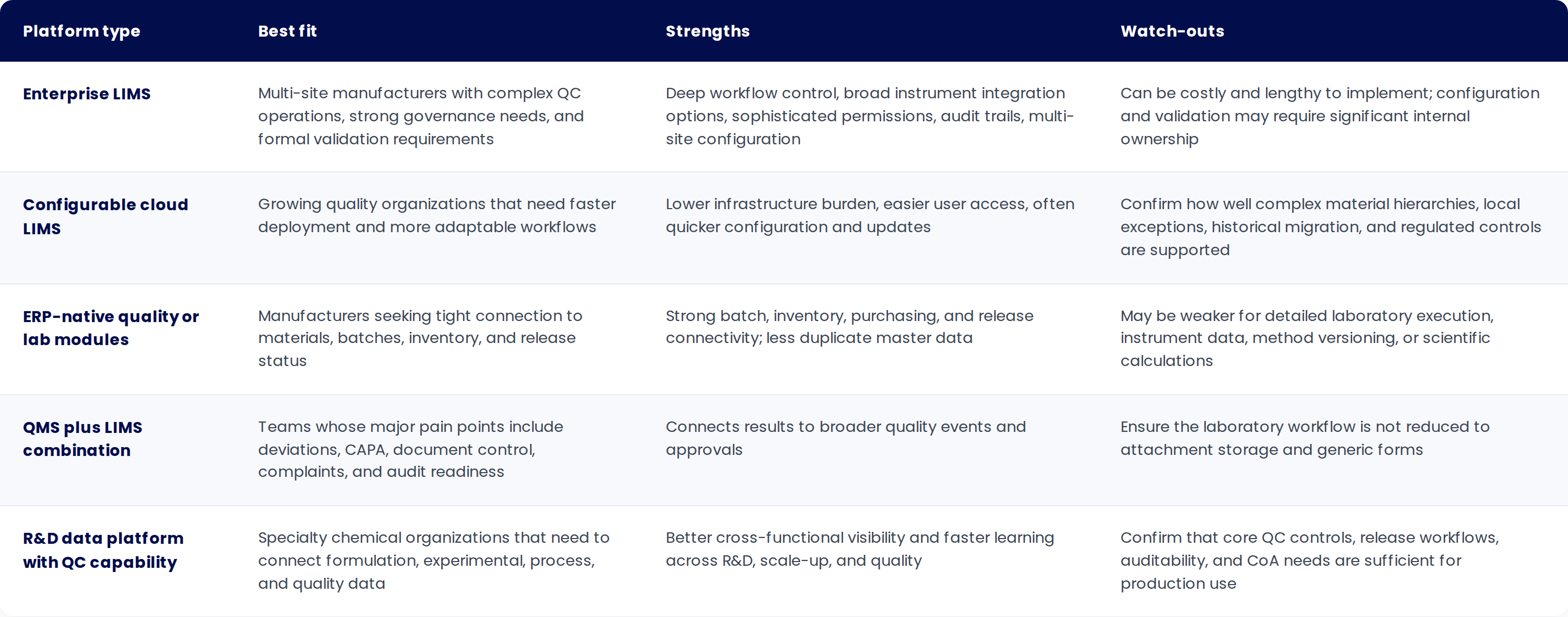
The category decision should follow the problem being solved. If the immediate issue is manual sample tracking and paper-based release, a well-configured LIMS may be the primary answer. If the larger problem is that QC results cannot be related to formulations, pilot batches, process conditions, raw materials, and production outcomes, the organization may need a broader data architecture alongside the LIMS.
Questions to ask in a LIMS vendor demo
Vendor demonstrations often look polished because they begin with a clean sample, a predefined test, and a passing result. Ask suppliers to show the exceptions that make specialty chemicals QA and QC difficult.
Request a scenario in which an incoming raw-material lot is sampled, tested against a supplier-specific plan, found to be borderline, placed on hold, retested under an approved workflow, linked to a deviation, and ultimately either released with justification or rejected. Then ask how that decision flows to ERP inventory status and how the records can be retrieved six months later.
A second useful scenario is a finished product with a customer-specific CoA requirement. The vendor should show how the system selects the correct specification version, confirms the relevant batch and test results, controls approval, and produces the document without manual assembly.
Finally, ask the vendor to demonstrate an investigation. Start from an out-of-specification result and navigate to the related instrument, calibration status, method version, analyst, reference-material lot, raw-material lots, process batch, historical trend, and final disposition. If this takes multiple exports, custom reports, or administrator intervention, the platform may not support the day-to-day investigation process as well as the sales demonstration suggests.
A practical LIMS shortlist process
A disciplined selection process generally works better than scoring dozens of generic features. Start by documenting ten to fifteen representative workflows from your own lab, and use a structured vendor evaluation checklist to keep scoring consistent. Cover workflows such as routine release testing, incoming inspection, in-process testing, retesting, nonconformance handling, CoA generation, instrument maintenance, sample retention, and customer-specific specifications.
Then categorize requirements into three groups:
- Non-negotiable controls, such as traceability, permissions, audit trails, specification versioning, approval workflows, data retention, and integration with the source of batch and material master data.
- High-value operational capabilities, such as instrument connectivity, mobile sample collection, configurable calculations, dashboards, automatic CoA generation, and exception-based review.
- Differentiators, such as direct links to formulation and process data, advanced analytics, prediction of quality outcomes, or cross-site standardization.
Use actual scenarios to test the shortlisted systems. This reduces the risk of choosing a platform that performs well on a feature matrix but poorly in the real conditions of a specialty chemicals laboratory.
What connected data changes in the specialty chemicals QC lab
Specialty chemicals quality control runs on tight specifications and constant sample volume. QC labs outgrow spreadsheets and disconnected tools because they cannot keep pace with that volume or hold the full context of a result. The common failure is treating quality control as an island: when QC data does not connect to formulation and process data, every investigation starts by reassembling information that should already be linked.
Connected data keeps every result linked to the batch, formulation revision, and raw-material lots behind it, so an out-of-spec investigation starts with the evidence already in hand. Live statistical process control adds to this: control charts update as results are entered, with real-time out-of-spec alerts, so drift is caught on the same screen a technician is already using instead of in a monthly export. Lubrizol runs quality control on Uncountable across five labs, with more than 1,000 users and over 300 batches a day, integrated bidirectionally with its enterprise system. Those figures are from Lubrizol's public announcement.
Compliance follows from the same record. Automatic audit trails, electronic signatures, and version-controlled records mean the history of a result holds up to review, and a certificate of analysis is generated from the same record that governs the batch rather than rekeyed from a separate system. A record that is fully traceable is also one that is defensible at audit.
Choosing a specialty chemicals LIMS: the bottom line
The best LIMS for specialty chemicals QA and QC is the one that creates a trustworthy, connected quality record from raw material through production and release. It should give analysts a workable daily system, give QA defensible review and auditability, and give R&D and operations the context needed to understand why a result occurred.
Prioritize systems that can model complex materials and lots, manage changing specifications and methods, preserve complete data history, connect to instruments and production systems, and make quality information usable beyond the laboratory. A LIMS that only digitizes lab administration will improve efficiency. A LIMS for Quality that connects laboratory evidence to the wider product and manufacturing context can improve decisions across the specialty chemicals business.
.png)
.png)
.png)
