
A chromatography data system and a scientific data management system both play important roles in a modern analytical laboratory, but they are not interchangeable. A CDS creates, processes, reviews, and reports chromatography data. An SDMS captures, indexes, retains, and retrieves scientific records across instruments and source systems.
The distinction matters when a laboratory is trying to improve data integrity, reduce the risk of lost raw files, support audit readiness, or connect analytical evidence with broader quality and product-development records. A CDS may hold the chromatograms and methods created during chromatography testing. But an SDMS provides a wider data-management layer for preserving and finding original laboratory records, often across many instruments, teams, sites, and file formats.
For regulated laboratories, the right question is not “CDS or SDMS?” It is:
Which system should own each part of the analytical data lifecycle, and how will the records remain complete, secure, traceable, and retrievable?
CDS vs. SDMS at a glance
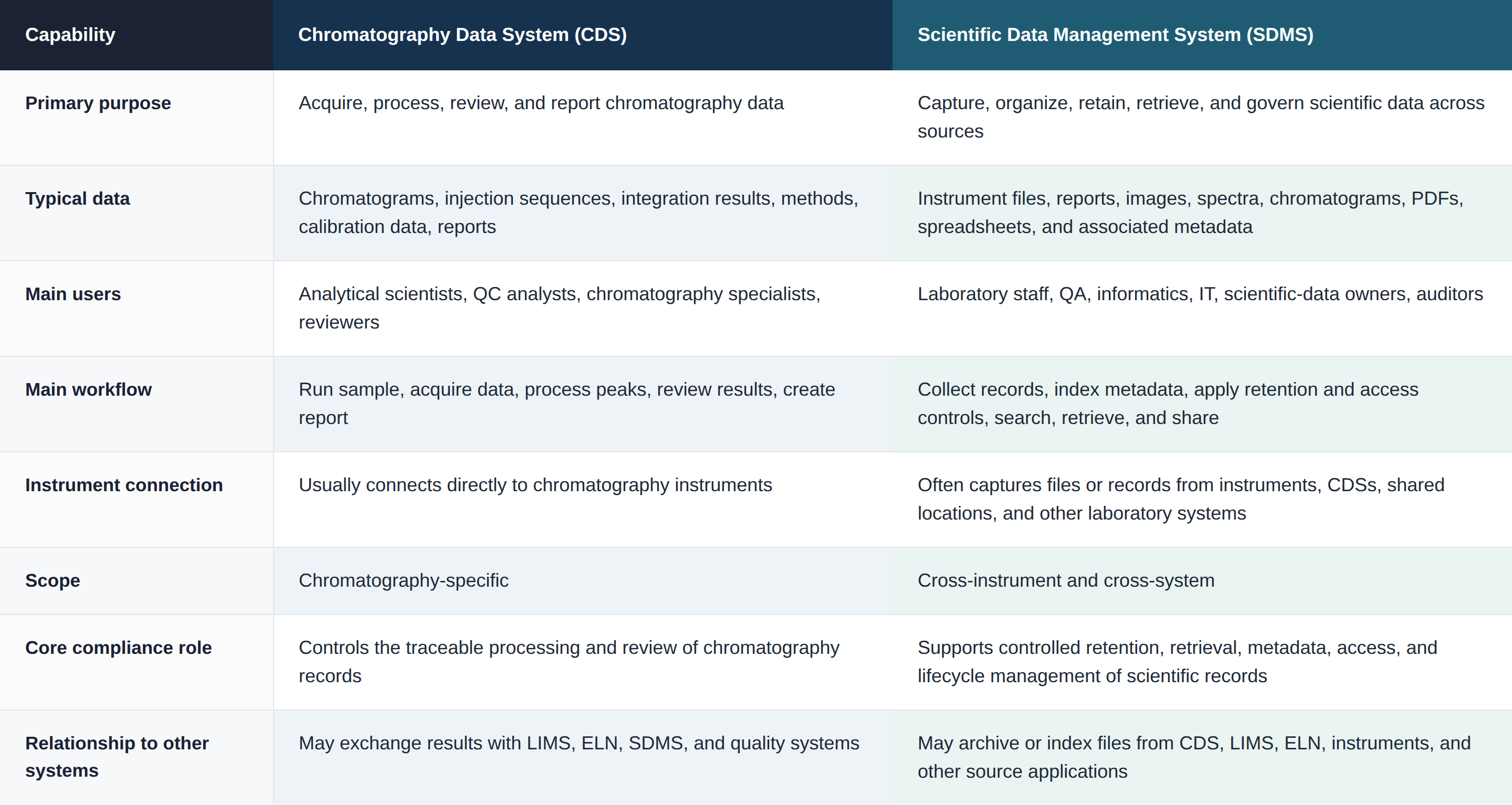
What is a chromatography data system?
A chromatography data system is specialized software for managing data generated through chromatography techniques, such as high-performance liquid chromatography, gas chromatography, ion chromatography, and related analytical workflows.
At its core, a CDS helps laboratories manage the analytical process from instrument control through to reviewed results. Depending on the system and configuration, that can include:
- Creating sample sequences and worklists
- Acquiring detector signals from chromatography instruments
- Generating chromatograms
- Applying processing methods and integration parameters
- Calculating peaks, concentrations, purity, or other reportable values
- Managing instrument methods and processing methods
- Recording review and approval activities
- Producing reports and supporting documentation
The CDS is therefore close to the source of chromatography evidence. It is where the laboratory sees the chromatogram, evaluates peak integration, assesses whether a run is valid, investigates unexpected outcomes, and generates a reported result.
That does not mean a CDS is automatically the laboratory’s complete long-term scientific-data strategy. A chromatography system is purpose-built for chromatography workflows. An enterprise laboratory may also need to manage files and records from balances, particle-size analyzers, spectrometers, rheometers, moisture analyzers, imaging systems, formulation tools, instruments with proprietary file formats, and other sources that sit outside the CDS.
What is an SDMS?
A scientific data management system is a platform for capturing, organizing, retaining, and retrieving scientific records and raw laboratory data. It is particularly valuable when critical files are distributed across instrument workstations, local hard drives, shared drives, removable media, or multiple applications.
Rather than replacing every specialized instrument application, an SDMS helps the laboratory establish a controlled record layer across them. Its capabilities can include:
- Automatically capturing files from instrument PCs, monitored folders, or connected systems
- Preserving original files and relevant metadata
- Classifying and indexing records so users can find them later
- Applying role-based access controls
- Supporting data retention and archival policies
- Maintaining a traceable record of access and changes
- Making historical files easier to retrieve during investigations, transfers, audits, or product-support work
- Linking analytical evidence with related sample, batch, product, project, or experiment records in adjacent systems
An SDMS is especially useful when a laboratory has a reliable way to generate data but no reliable way to retain and retrieve it at scale. That is a common problem in multi-instrument and multi-site environments, where analysts may complete their work in one application while raw evidence remains scattered across local storage locations.
The simplest difference: creation and processing versus retention and retrieval
A useful way to understand the relationship is to distinguish between the analytical workflow and the scientific record lifecycle.
A CDS sits within the analytical workflow. It helps a scientist or analyst run chromatography, process the signal, evaluate the data, and produce an analytical result.
An SDMS sits within the scientific record lifecycle. It helps the organization preserve and find the original files, associated metadata, reports, and supporting evidence after, and sometimes alongside, that analytical workflow.
For example, consider a QC laboratory using HPLC to test an incoming raw material.
- The analyst prepares samples and creates a sequence in the CDS.
- The instrument runs the samples and generates chromatograms.
- The CDS applies processing methods and calculates results.
- The analyst reviews the chromatograms and resolves any legitimate integration or processing questions.
- The reviewer approves the reportable result.
- The organization must still retain the underlying evidence in a controlled, retrievable form for as long as its procedures and applicable requirements demand.
- An SDMS can capture or index the raw files, reports, supporting records, and metadata so they remain searchable and accessible outside the individual instrument workstation or CDS environment.
The CDS owns the chromatography-specific analytical work. The SDMS helps ensure the broader organization can retain, locate, and use the resulting scientific evidence.
Why this distinction matters for data integrity
In regulated environments, data integrity is not limited to whether a final result appears in a report. It concerns whether the data is complete, consistent, accurate, attributable, and available throughout its lifecycle. FDA guidance defines data integrity in terms of completeness, consistency, and accuracy, and defines an audit trail as a secure, computer-generated, time-stamped electronic record that enables reconstruction of record creation, modification, or deletion.
For chromatography, the underlying evidence can include more than a final numeric value. It may include the original chromatogram, sequence information, processing methods, integration parameters, user actions, reprocessing activity, review evidence, and associated metadata.
FDA’s data-integrity guidance explicitly uses an HPLC run as an example. It notes that the audit trail should include the user, the date and time of the run, the integration parameters used, and details of any reprocessing; reprocessing documentation should include justification for the change.
A CDS is central to controlling and reviewing that chromatography-specific evidence. But the laboratory must also consider whether original files, related reports, and supporting records remain protected and retrievable over time, particularly where multiple instruments, versions, locations, or data repositories are involved.
That is where an SDMS can become important. It does not replace proper CDS configuration, validated workflows, access management, audit-trail review, or analytical review procedures. Instead, it helps extend control beyond a single instrument application by providing a managed environment for scientific records across sources.
When a CDS alone may be enough
A CDS may be sufficient as the principal system for chromatography data when the laboratory has a relatively contained environment and can demonstrate that the system, procedures, storage approach, and controls meet its operational and regulatory requirements.
This may be true when:
- The laboratory’s critical analytical data is overwhelmingly chromatography-based.
- The CDS provides appropriate acquisition, processing, review, audit-trail, electronic-signature, backup, retention, and retrieval capabilities for the intended use.
- Original records remain centrally available and protected rather than being distributed across unmanaged workstations.
- The organization can retrieve records efficiently for investigations, audits, product complaints, stability reviews, or technology transfer.
- The lab has clear governance for user access, method changes, periodic review, data backup, and system lifecycle management.
- File formats, storage volumes, and long-term accessibility are manageable within the CDS architecture.
Even then, the laboratory should assess the operational reality, not just the feature list. A system may technically store files while still making it difficult to find historical records across sites, link them to related product or quality information, or govern data from non-chromatography instruments.
When a lab needs both CDS and SDMS
Many enterprise laboratories benefit from using both systems because they solve different problems. A CDS supports controlled chromatography execution and review. An SDMS supports the broader, cross-system lifecycle of scientific records.
Using both is particularly valuable when:
- The lab uses chromatography alongside many other analytical techniques and instruments.
- Raw data is stored across instrument PCs, local folders, shared drives, network locations, or separate source applications.
- QA, R&D, QC, manufacturing, and IT teams need a reliable method for retrieving evidence across sites.
- Data must be retained for extended periods and remain accessible through software upgrades, instrument changes, migrations, or organizational changes.
- The organization needs a more consistent metadata and classification model for scientific records.
- Analysts need to find previous data by material, batch, product, test, project, method, instrument, site, or date range.
- A laboratory wants to reduce the risk that valuable analytical evidence remains accessible only to the person, workstation, or local environment that created it.
- The business is connecting laboratory information with LIMS, ELN, quality, formulation, product, or manufacturing data.
The combination does not need to create duplicate work. A well-designed architecture can automate capture, synchronize relevant identifiers, and preserve links between the CDS record and the wider scientific-data environment.
How CDS and SDMS fit with LIMS and ELN
The distinction becomes clearer when each platform is assigned a primary responsibility.
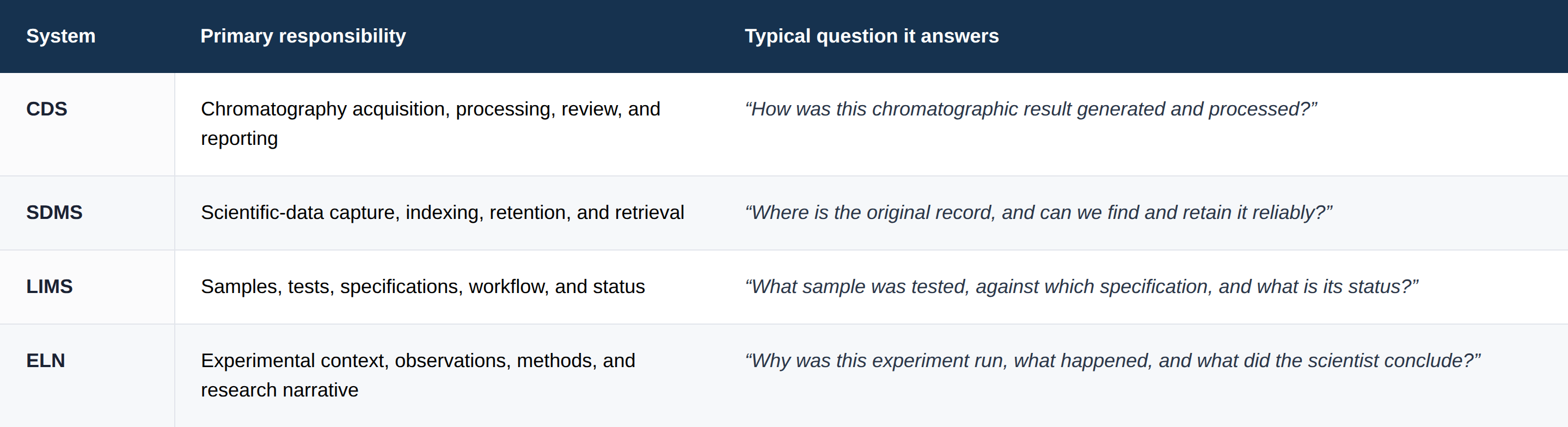
In practice, a single analytical event may touch all four systems.
A LIMS can schedule or track a sample. A CDS can acquire and process its chromatography data. An SDMS can retain and index the underlying files and reports. An ELN can document the research rationale, formulation context, observations, and next steps.
The goal is not to force one system to do every job. The goal is to ensure that data moves between systems with enough context to remain trusted, usable, and traceable.
Questions to ask when evaluating CDS and SDMS architecture
Laboratory leaders, informatics teams, QA, and IT should evaluate the systems together rather than in isolation.
Ask:
- Which system creates the original electronic record for each analytical workflow?
- Where do raw files live immediately after acquisition?
- Can the organization preserve original native files and the metadata needed to interpret them later?
- How are instrument methods, processing methods, integration parameters, and reprocessing activity controlled and reviewed?
- Which system holds the authoritative reportable result?
- How are records linked to samples, batches, products, projects, specifications, or experiments?
- Can authorized users retrieve complete records without relying on a specific instrument computer, analyst, or local folder?
- How are user access, audit trails, electronic signatures, data backup, retention, and archival governed?
- What happens when an instrument, CDS, file format, or storage environment is upgraded or retired?
- Can the organization search across chromatography records and other scientific data without manually reconstructing context from disconnected systems?
The answers should inform a data architecture, not simply a software selection. The most successful approach is usually one in which the CDS remains the trusted environment for chromatography operations while the SDMS provides reliable management of broader scientific records over time.
Build a connected laboratory data foundation
A CDS and an SDMS serve complementary purposes. The CDS is designed to manage the scientific and operational details of chromatography. The SDMS is designed to ensure scientific records remain organized, governed, and retrievable across instruments, applications, and laboratory locations.
For enterprise R&D and quality organizations, the larger opportunity is to connect those records with the formulation, material, product, process, test, and manufacturing context that gives data its meaning. When chromatography evidence is easy to find and connected to the decisions it informed, laboratories can reduce manual retrieval work, strengthen traceability, preserve institutional knowledge, and make historical data more useful for future development.
.png)
.png)
