

Chemical and materials companies are exploring artificial intelligence for a wide range of R&D challenges: identifying data anomalies, accelerating formulation development, improving product performance, and uncovering insights that are difficult to spot through manual analysis alone. But realizing that potential requires more than adding an AI tool to an existing workflow. It requires a reliable, connected foundation of product data.
At Uncountable, we build software for some of the world’s largest R&D organizations. Our platform supports the work that surrounds product innovation, including laboratory information management, electronic laboratory notebooks, quality control, quality management, and other core R&D processes. Across all of these areas, the objective is consistent: make the information teams generate every day more accessible, usable, and valuable.
AI is an important part of that vision. It is not a standalone capability reserved for a specialist team or an experimental project. It should be able to build on the data and processes already used across R&D, quality, and product development. That is why every component of the Uncountable platform is designed with the ability to leverage AI over time.
The data challenge behind AI in R&D
The conversation around AI often starts with what the technology can do. It can detect patterns, flag anomalies, recommend promising formulations, and help teams make faster decisions. Those capabilities are meaningful, particularly in chemical and materials development, where teams must evaluate a complex mix of ingredients, process conditions, test results, regulatory requirements, and performance outcomes.
However, the more fundamental question is whether the underlying data is ready to support those capabilities.
In many organizations, the information associated with a single product is distributed across disconnected systems, spreadsheets, laboratory records, quality documents, and regulatory sources. Experimental results may sit in one application. Specifications and quality information may sit in another. Regulatory data may be maintained elsewhere. Valuable contextual knowledge may be trapped in individual files, inboxes, or the experience of the people who created it.
This fragmentation makes it difficult for scientists and product developers to answer even basic questions quickly. It also creates a major constraint on AI. An AI model can only work with the data it can access; and it can only produce dependable recommendations when that data is complete, contextualized, and trustworthy.
From data collection to a unified product view
An effective R&D platform must accommodate how data is actually created and stored. In practice, there are two broad ways information enters the system.
First, teams can enter information directly into the platform as they perform experiments, document observations, manage workflows, or complete quality activities. This supports structured, standardized data capture at the point of work.
Second, organizations can connect existing data sources and automate uploads. This matters because digital transformation rarely begins with a blank slate. R&D organizations already have valuable historical data, existing laboratory systems, instruments, files, and business applications. Rather than asking teams to abandon everything at once, a connected platform should meet them where they are and bring relevant information into a common environment.
The result is a unified data layer: a shared foundation where all information associated with a product can be brought together.
For a formulation or material, that might include experimental results, raw-material and ingredient data, process conditions, performance tests, quality-control information, specifications, regulatory documentation, and other product-related records. Instead of treating these as isolated data sets, the organization can connect them to a common product context.
That distinction is critical. More data alone does not create better decisions. R&D teams need the ability to understand how different data points relate to one another, and to retrieve the relevant information without spending hours navigating systems, requesting files, or reconciling conflicting versions.
A better question for R&D leaders
A useful test for any R&D organization is simple: when developing or reformulating a product, can your team retrieve all relevant information through a single query, from a single location?
For many teams, the honest answer is no.
That is not necessarily a reflection of poor scientific practice. It is often the accumulated result of years of growth, acquisitions, local processes, specialized point solutions, and changing regulatory expectations. Yet the cost is real. Scientists lose time searching for information. Knowledge is harder to reuse. Teams may repeat work that has already been done elsewhere. Decisions can be delayed while people validate which data is current, complete, and applicable.
The impact becomes even more significant when companies begin using AI. Without a connected data foundation, AI initiatives can remain narrow and difficult to scale. Teams may be able to apply a model to one isolated data set, but they cannot easily extend that insight across the product lifecycle or connect it to the quality, regulatory, and operational context needed for confident decisions.
Making AI useful, not isolated
The opportunity is not simply to use AI to analyze more data. It is to make AI a practical part of everyday R&D work.
With a unified data layer, AI can help teams identify unusual results earlier, highlight relationships across experiments, surface relevant historical knowledge, and focus scientific attention on the areas most likely to affect product performance or reformulation decisions. It can support faster investigation without replacing the expertise, judgment, or accountability of the scientists and product leaders responsible for the work.
This is particularly valuable in chemicals and materials development, where innovation is often iterative. A reformulation may involve balancing performance, cost, availability, sustainability objectives, manufacturability, quality requirements, and regulatory constraints. The most valuable insight is rarely found in a single experimental result. It emerges from understanding the wider set of product data and the trade-offs it reveals.
That is why AI readiness is fundamentally a data and workflow challenge. The organizations most likely to gain lasting value from AI will be those that connect their experimental, product, quality, and regulatory information in ways that are accessible to the people, and systems, that need it.
The foundation for scalable innovation
R&D leaders do not need to choose between improving today’s processes and preparing for AI. The right digital foundation supports both.
.jpg)
By capturing data in structured workflows, connecting existing sources, and bringing product-related information into a unified layer, companies can reduce friction in day-to-day development work while creating the conditions for more advanced analysis. They can make knowledge easier to find, decisions easier to defend, and innovation easier to scale across teams and sites.
For chemical and material companies, the central question is no longer whether AI will play a role in R&D. It is whether the organization has created the connected, trusted product-data foundation required to make that role meaningful.
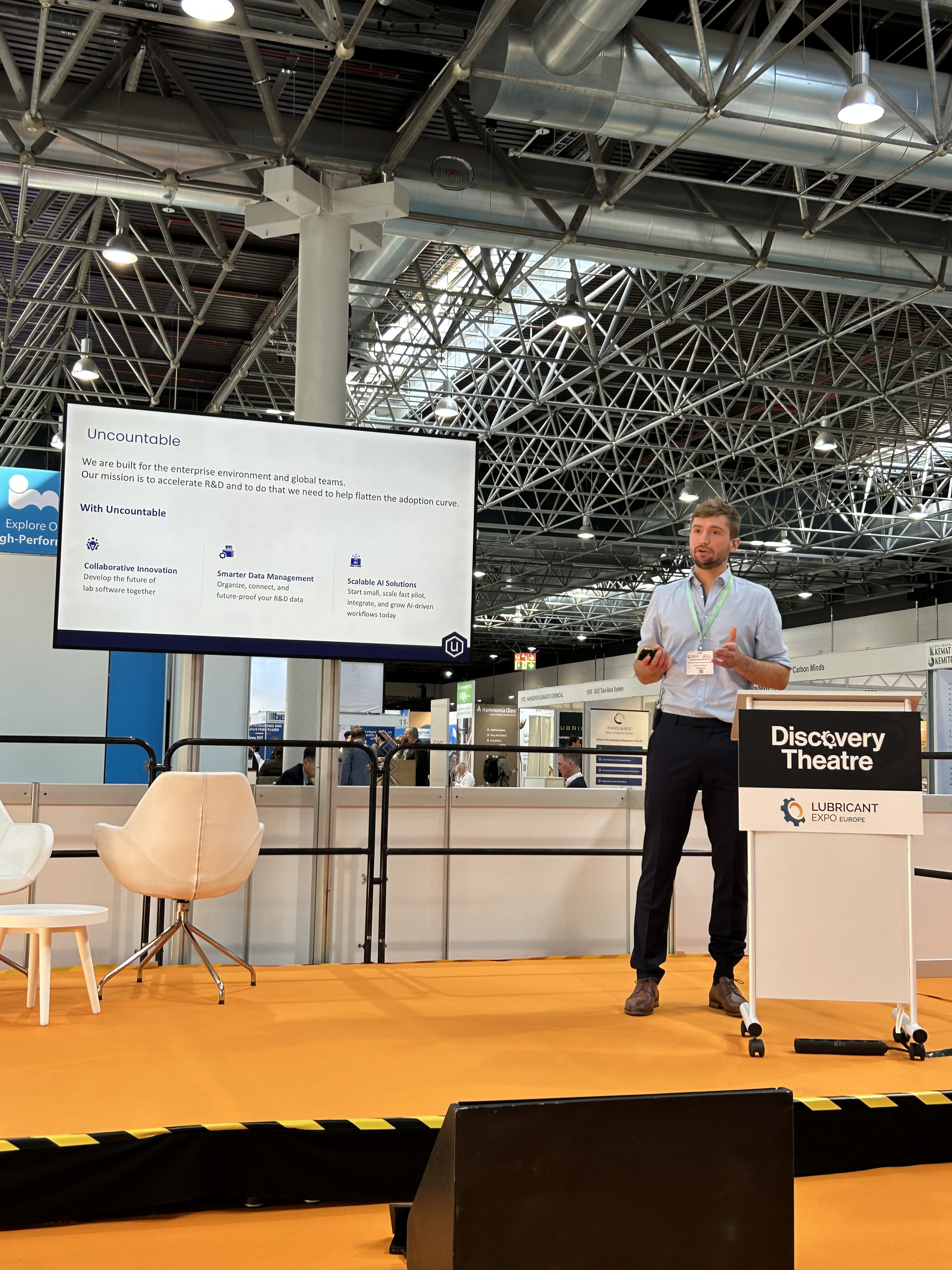
This article is adapted from a presentation delivered by Uncountable at Lubricant Expo Europe 2026, exploring how connected R&D data creates the foundation for practical, scalable AI in formulation and materials development.
Is your R&D data ready for AI? If your scientists still need to search across disconnected systems to understand a product’s experimental history, quality status, regulatory context, and formulation performance, it may be time to establish a more connected data foundation. Contact Uncountable to explore how a unified R&D platform can help your teams accelerate formulation development, make better-informed decisions, and put AI to work on trusted product data.
.png)
.png)
.png)
