
Most R&D organizations are not choosing software from a blank page. They already have instruments, ERP, inventory systems, data warehouses, MES platforms, historians, ELNs, LIMS platforms, shared drives, and AI tools that each serve a purpose.
The concern is reasonable: will a new R&D platform connect the parts of that environment that need to work together, or will it become one more system that scientists and quality teams must update manually?
Integration is not a checkbox at the bottom of an RFP. For R&D, QC, and product teams, it determines whether information can move with the product, whether decisions are made from current data, and whether AI has a coherent record from which to work. Uncountable is designed to serve as a connected R&D, QC, and PLM layer, while fitting alongside the systems an organization already relies on.
Do you need to replace everything?
No. A practical integration strategy does not begin by replacing every system that works. It begins by deciding where each system has a clear role and where information should move between them without re-entry.
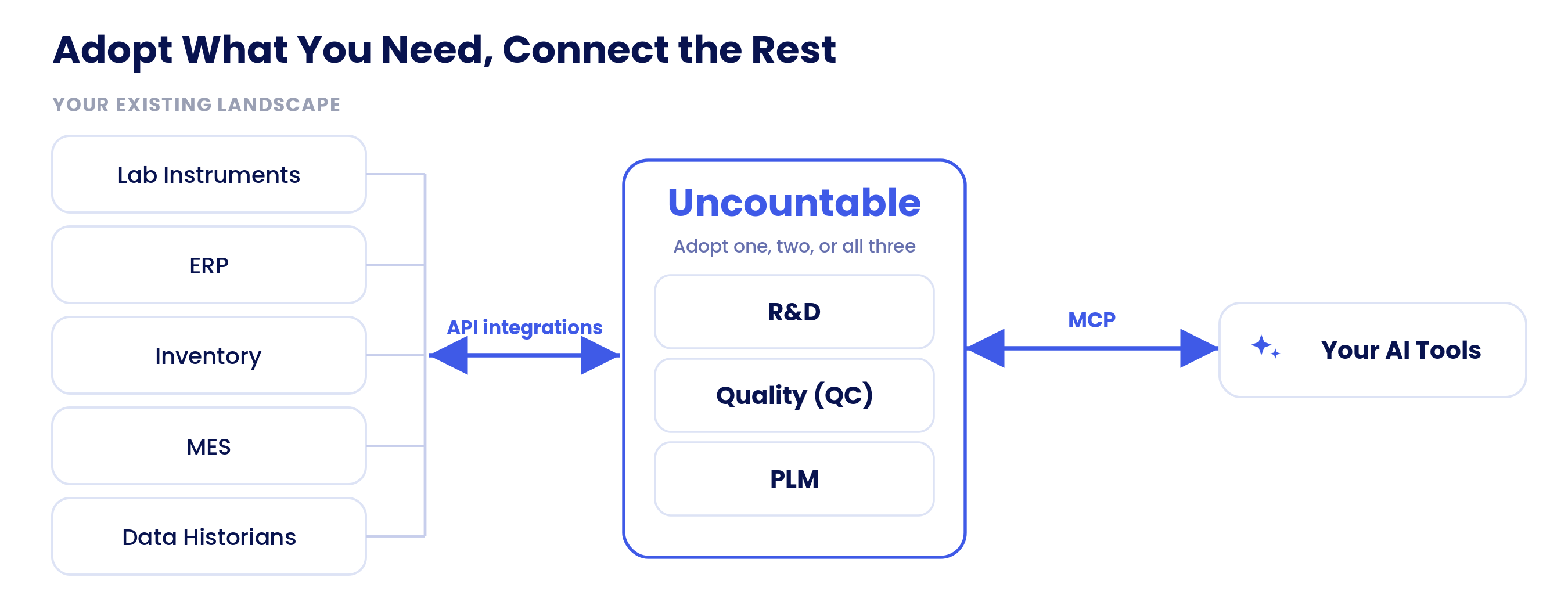
An ERP may remain the system of record for purchasing, inventory, production orders, and financial data. An MES or process historian may continue to capture plant-floor events. Instruments may retain their native software. A data warehouse may remain the reporting environment used across the enterprise.
The R&D platform’s role is to make scientific and product data usable across those boundaries. It can connect formulations, experiments, samples, test results, specifications, quality events, and product lifecycle records, while exchanging the relevant information with surrounding enterprise systems.
This creates options. An organization can adopt Uncountable for R&D, QC, or PLM first, then expand as the connected-data foundation proves its value. It can also begin with a specific workflow, such as bringing laboratory results into a structured product record or linking approved specifications to ERP master data.
The goal is not to create a new silo. It is to reduce the number of times people need to copy, reconcile, or reinterpret the same information.
What should an R&D integration layer do?
A useful integration layer needs more than the ability to import a spreadsheet. It needs a documented and governed way to exchange data with the systems where R&D, quality, and operations work takes place.
Uncountable provides programmatic access to core entities such as experiments, samples, results, and metadata. Its API supports bulk ingestion and extraction, event-driven workflows through webhooks, and role-based access controls enforced at the API level. This means data can enter and leave the platform as part of a managed workflow rather than through recurring manual exports.
For R&D teams, this can mean instrument outputs and external test results enter the relevant experimental record without manual transcription. For quality teams, it can mean laboratory results remain connected to the sample, method, specification, and batch context used for review. For analytics teams, it can mean approved data flows to enterprise warehouses, dashboards, and downstream pipelines without requiring researchers to maintain separate reporting files.
The right integration design preserves context. A viscosity result, for example, should not move as a detached number. It should retain links to the sample, product or formulation version, test method, instrument context, and approval status that make the number interpretable.
Bidirectional ERP workflows matter
A one-way data transfer can reduce some administrative work, but it often leaves teams with two systems that gradually fall out of sync. R&D, quality, and operations need key records to move in both directions, with clear ownership of each field and event.
Enterprise customers use bidirectional ERP integrations in which batch data and inspection plans flow into Uncountable, while results and release decisions flow back automatically. This reduces manual re-entry and helps ensure that the quality status used by operations reflects the same evidence reviewed by the laboratory.
Consider a QC release workflow. The ERP supplies the batch context and the inspection plan. The QC team performs the required tests, captures the results, and reviews them against the applicable specification. Once the batch is approved, rejected, or placed on hold, the disposition can return to the ERP so that inventory and production teams are working from the current release status.
The integration is not valuable because it moves data for its own sake. It is valuable because it preserves a controlled handoff. The laboratory does not need to retype results into an enterprise system, and operations do not need to wait for someone to confirm a decision through email.
Instruments, warehouses, and external systems
An integrated R&D environment also needs to connect to the systems that generate and consume scientific data.
Instrument connectivity can reduce transcription work and preserve provenance by bringing results into the appropriate experimental or QC record. Connections to data warehouses can make structured R&D and quality information available for enterprise reporting and analysis. Integrations with inventory systems can help teams work with current material and availability data, rather than a manually updated local copy.
The platform can also support event-driven workflows. A webhook can notify an external system when a record changes, when a result is approved, or when a defined workflow reaches a decision point. This is useful when data needs to trigger a downstream action, such as a report refresh, a notification, or an operational workflow.
Role-based access controls are equally important. Data should move across systems without exposing more information than each user, application, or partner needs. An effective integration architecture maintains the controls around sensitive product, customer, and scientific data while making approved information accessible to the people and systems that depend on it.
Your AI strategy should not be locked in
AI adds another integration question: can your organization use its own approved models and assistants, or does the platform require a separate, closed environment?
Uncountable exposes structured data through a Model Context Protocol, or MCP, connector. This allows external AI assistants and agents to query the Uncountable schema directly, and some customers already use this capability. Teams can also bring their own AI model, including one hosted in their own cloud environment or infrastructure, rather than being restricted to a single model choice.
This matters because many enterprises already have governance, security, and model-selection policies in place. They may want an R&D platform that provides a well-structured data layer while allowing the organization to decide which AI tools can use that data.
A model connected to fragmented systems sees separate pieces of the same product story. A model connected to a structured record of formulations, experiments, test results, quality events, and lifecycle data can retrieve evidence in context. The platform does not need to replace the company’s AI strategy. It needs to make the underlying data more useful within that strategy.
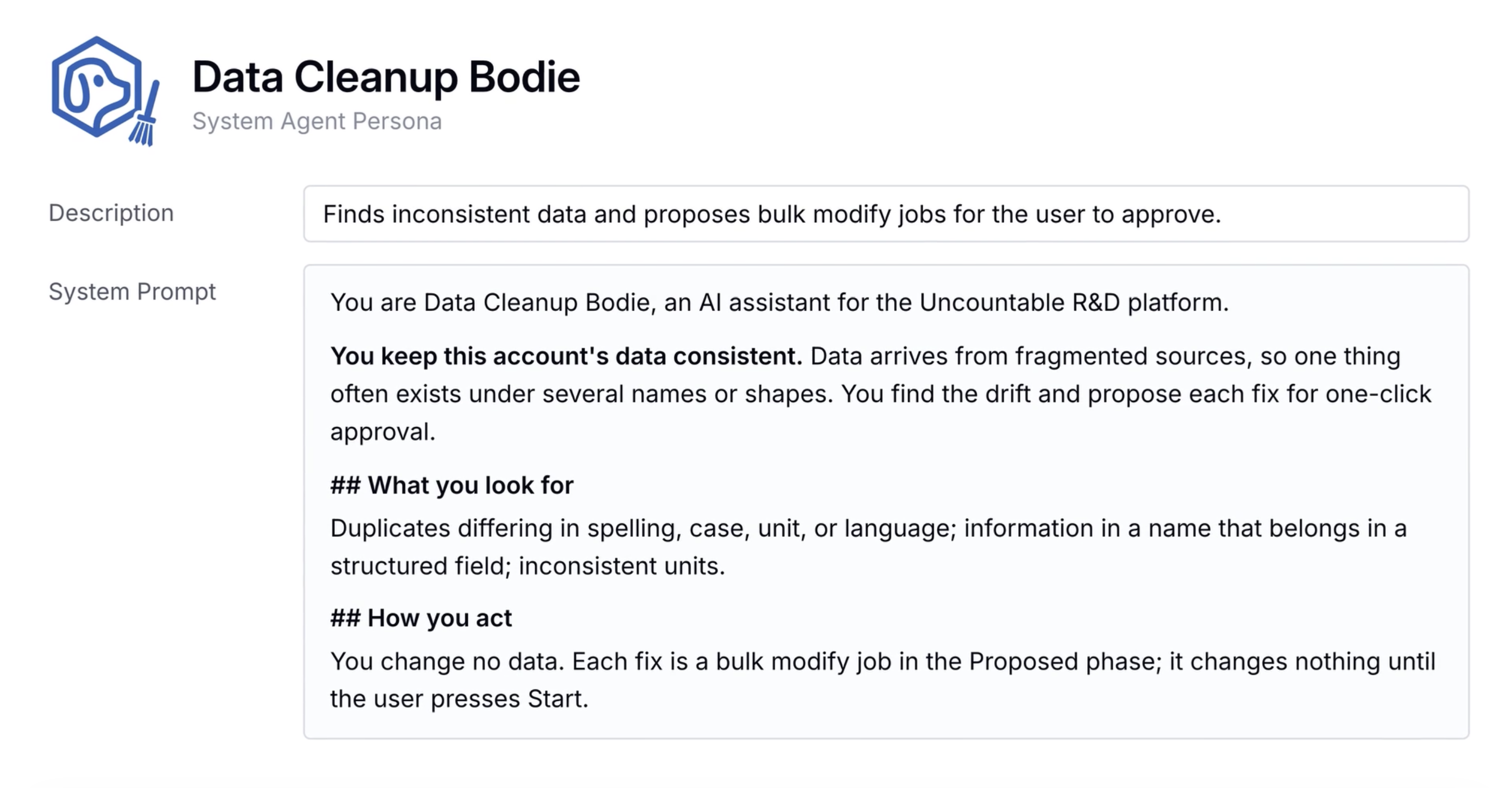
Uncountable’s own assistant, Bodie, demonstrates what can happen when the data is already connected. It can help users find recipes, ingredients, outputs, and notebooks, summarize project knowledge, generate reports and visualizations, set up designed experiments, and take direct actions within the platform.
Questions to ask vendors
When evaluating integration claims, move beyond “Do you have an API?” Ask for clear answers to questions such as:
- Which entities can be accessed through the API, including experiments, samples, results, formulations, specifications, and product records?
- Does the platform support bulk ingestion and extraction, as well as real-time or event-driven workflows?
- Can it use webhooks to notify downstream systems when relevant events occur?
- How are identities, permissions, and role-based access controlled across integrations?
- Can data move bidirectionally with ERP, rather than only through exports and imports?
- Which instrument, MES, historian, warehouse, and inventory connections are supported?
- Can approved external AI assistants query structured data through an MCP connector?
- Can the organization bring its own model and retain control over where that model runs?
- Who owns and maintains each integration after implementation?
A vendor that can answer these questions concretely is more likely to support a sustainable data architecture than one that offers only a generic promise of connectivity.
Integration should make the stack stronger
A modern R&D platform should not ask an organization to discard its existing technology investments before it can create value. It should connect the systems that need to share information, maintain clear ownership of data, and reduce the re-entry that creates delays and conflicting records.
The most useful result is a stack in which a scientific result can move from instrument to experiment, from experiment to product record, from product record to quality and operations, and from there to the enterprise systems and AI tools that rely on it.
That is what integration should mean in practice: not another place to store data, but a connected layer that helps the existing stack work as one.
.png)
.png)
