
A formulation PLM implementation succeeds when it gives teams a reliable way to manage the product definition as it moves from development through quality review, manufacturing handoff, and controlled change.
The work involves more than configuring workflows or migrating bills of materials. Teams need a connected model for formulas, sub-recipes, material grades, process context, specifications, test evidence, approvals, and product variants. They also need clear ownership, practical integrations, a migration plan that protects active work, and rollout practices that users can adopt.
Start with a workflow that creates measurable friction today: qualifying a supplier alternative, responding to a restricted substance, revising a formula, transferring a product from R&D to manufacturing, or managing a specification change across multiple product variants. Use that workflow to define the records, relationships, approvals, and system connections the implementation must support.
Before beginning, confirm that the selected platform can represent formulations and their related process and evidence records as connected product data. The live implementation article already emphasizes centralizing product data, workflows, ERP connection, and user training; this rewrite sharpens it around the decisions and operating model required to make those elements work together.
Start with a workflow and baseline
Do not start by attempting to model every formula, product family, and historical record. Select a workflow that is important enough to show measurable value and contained enough to implement well.
A supplier substitution is often a useful starting point. It requires teams to identify the material and supplier grade involved, find every affected formula and product, evaluate technical and quality evidence, assess cost or compliance implications, approve the change, and communicate the approved revision downstream. A formulation revision, scale-up handoff, or specification change can work equally well when those are the more urgent sources of delay or risk.
Document how the workflow operates today before configuring the new system. Record the systems involved, the number of handoffs, where people re-enter information, which evidence is difficult to locate, and how long the work takes from request to approved decision.
Those baselines make the project more concrete. They also help the implementation team distinguish a useful improvement from a technically completed configuration that has not changed how work gets done.
Define the formulation data model
The data model determines whether a PLM system can support the work teams need to perform after launch.
Define the core records and relationships before migrating large volumes of information. For a formulation manufacturer, those records commonly include materials, supplier grades, formulas, sub-recipes, intermediates, finished products, process instructions, specifications, test methods, samples, results, approvals, and change records.
The model should make it possible to trace an approved product definition from its formula through the material and process context, the specifications that apply, the evidence supporting approval, and the downstream records that need to receive the change.
This does not require every team to use the same interface or own the same records. It does require consistent identity, versioning, status, and relationships across the product lifecycle.
A helpful test is to ask practical questions that users will need to answer:
- What is the current approved formula for this product and market?
- Which supplier grades are approved for each ingredient?
- Which intermediate or sub-recipe revision does this finished product use?
- What process conditions were associated with the approved formula?
- Which test methods, results, and specifications supported the decision?
- Which products, specifications, and manufacturing instructions are affected by a material or formula change?
If the answers require separate spreadsheets, uncontrolled documents, or manual reconciliation across teams, the data model needs more work before rollout.
Model formulas, sub-recipes, and variants
Many formulation manufacturers work with more than a single flat ingredient list.
A finished product may use one or more intermediates, concentrates, masterbatches, bases, or sub-recipes. Those records can have their own versions, material dependencies, process conditions, cost implications, specifications, and approvals. A revision to an intermediate can affect many finished products, while a regional or customer-specific product variation may use the same base formulation with controlled differences.
Model those relationships directly rather than duplicating ingredient lists in multiple product records.
The goal is to create a usable product structure that supports reuse without obscuring variation. Teams should be able to see when a finished product uses a particular intermediate, when that intermediate changes, and whether the change requires review of affected products or supporting evidence.
Define what constitutes a formula revision, a product variant, a material alternative, and a local manufacturing adaptation. Consistent definitions prevent teams from creating different records for the same type of change and make later impact analysis more reliable.
Assign ownership and governance
Centralizing information without defining ownership creates a different version of the same problem.
Before migration, define which team owns each record type, who can create or revise it, who approves changes, and which system is authoritative. R&D may own development formulations and experimental evidence. Quality may own test methods, specifications, and release evidence. Procurement may maintain supplier and material-master attributes. Regulatory teams may own compliance status. Manufacturing may own execution-specific instructions and production parameters.
PLM should connect these records and govern the approved product definition.
Ownership should include practical rules for incomplete historical data, retired materials, obsolete formulas, active records with conflicting versions, and exceptions that require a temporary deviation from the standard workflow. The organization does not need perfect historical data to begin. It does need agreement on what information must be complete and controlled for active products and future changes.
Establish a cross-functional governance group that can resolve data-definition questions, approve changes to templates and workflows, and prioritize improvements after launch. Without this operating model, teams often recreate local workarounds when the first unusual product, supplier, or quality event appears.
Design change control and impact analysis
Change control should capture more than an approval status.
A useful formulation change record explains what changed, why it changed, which version was affected, what evidence was reviewed, who approved the decision, when it became effective, and what downstream actions remain. The level of review should reflect the risk and scope of the change. An early R&D iteration does not need the same workflow as a commercial formula revision or a material substitution affecting multiple released products.
Where-used analysis is central to this process. When a supplier changes a material specification, discontinues a grade, reports a quality issue, or raises a compliance concern, teams need to identify more than the formulas containing that material. They may need to see affected intermediates, finished products, specifications, test evidence, customer requirements, manufacturing instructions, and open development work.
Build those relationships into the implementation and test them before launch.
For example, choose a raw material used in several active products and ask the implementation team to demonstrate:
- Every formula and sub-recipe that uses the material.
- The supplier grade and approved alternatives associated with each use.
- The current product and formula versions affected.
- The specifications and test evidence connected to those versions.
- The workflow, approvals, and downstream records required to implement a change.
If users cannot answer those questions quickly and confidently, adding more data will not solve the problem. The missing element is usually a relationship, ownership rule, or workflow step.
Migrate records needed for decisions
Migration should not be treated as a document-upload project.
Start with the records that support ongoing product decisions: active formulas, current raw materials and supplier grades, approved specifications, active product variants, open change records, and the evidence needed to support products that are currently developed, manufactured, or sold.
Normalize material identifiers, units, formula versions, product hierarchies, supplier names, and record statuses before loading data. Decide how the team will handle duplicates, partial records, conflicting historical versions, and legacy documents that have no clear owner.
Archive lower-value historical files when appropriate, but preserve a way to retrieve them if required for technical, quality, commercial, or regulatory reasons. Migrating every legacy spreadsheet without improving structure can transfer confusion into the new system.
Use migration samples to test real user questions. Can a formulator find the current approved formula? Can a quality reviewer trace the evidence supporting a historical revision? Can procurement identify which finished products rely on a supplier grade? Can a manufacturing user see the correct effective version?
A migration is ready when the records support those decisions, not merely when a target number of files has been loaded.
Connect systems deliberately
Formulation PLM rarely operates alone. R&D, quality, manufacturing, supply, and commercial teams often work across ELN, LIMS, QMS, ERP, MES, document-management, and reporting systems.
The objective is not to make one platform perform every function. It is to define the system of record for each entity and preserve identity, version, status, and traceability as information moves between systems.
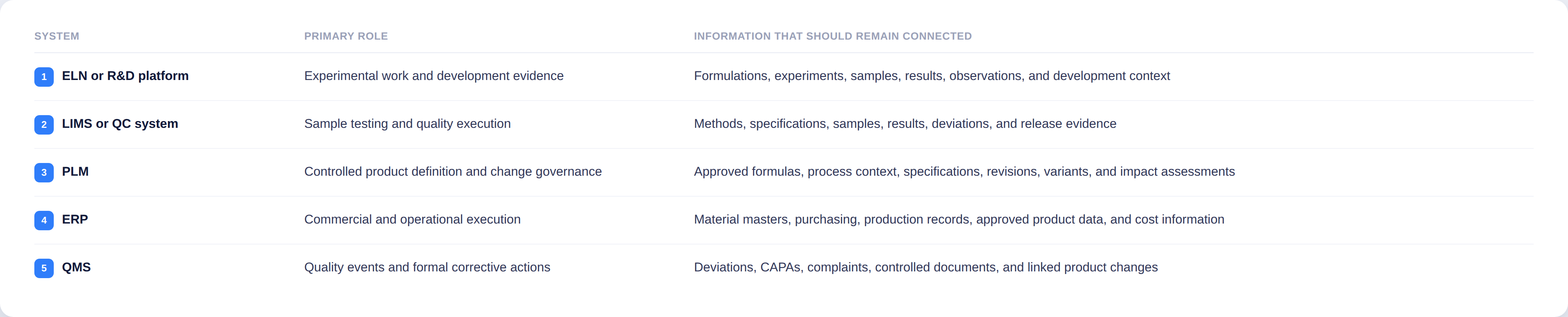
Integration design should begin with the decisions that need connected information. A formula approval may require test evidence from LIMS, supplier information from ERP, and a controlled specification in PLM. A quality event may require a reviewer to identify the affected formula versions, lots, products, and manufacturing instructions.
Define which system creates each record, which system approves it, which system consumes it, and how updates are reconciled. Avoid creating multiple “masters” for the same entity without a clear synchronization and governance model.
For more detail on the R&D-to-product handoff, see ELN to PLM: Why R&D and Product Lifecycle Belong in One System. Uncountable positions its platform around a shared data model across R&D, quality, and PLM, which is the kind of connected-record approach this architecture requires.
Roll out in stages
A phased rollout gives teams time to validate the model, correct gaps, and build confidence before expanding across the portfolio.
Begin with one product family, site, business unit, or workflow. The first phase should be large enough to test material relationships, formula versions, product variants, specifications, approvals, integrations, and downstream handoffs. It should also be narrow enough for the implementation team to resolve issues without delaying the entire program.
After the pilot, review where users still rely on spreadsheets, email approvals, duplicate entry, or offline records. Those behaviors often show where the system lacks a needed relationship, template, workflow path, or integration.
Expand only after the team can demonstrate that the pilot workflow works from initial request through approved change and downstream communication. Then apply the improved templates, governance rules, and integration patterns to the next product family or site.
A phased approach does not mean accepting inconsistent data indefinitely. It means establishing a practical, repeatable operating model before scaling it.
Design adoption into the rollout
Users adopt a system when it helps them complete real work with less uncertainty and less duplication.
Involve representative users from R&D, quality, manufacturing, regulatory, procurement, and product management in workflow design and user-acceptance testing. They will identify the information, decisions, and exceptions that a configuration workshop can miss.
Train people by role and decision rather than by generic system navigation. A formulator needs to create or revise formulas, compare variants, and attach development context. A quality reviewer needs to trace evidence, assess specification changes, and approve controlled records. A procurement user needs to understand supplier-grade changes and their product impact. A manufacturing user needs to identify the effective product definition and required instructions.
Designate power users within each function to support colleagues, surface recurring friction, and help the governance group prioritize improvements. Give those users a clear path to request changes to templates, workflows, permissions, and integrations.
Training is important, but it cannot compensate for a workflow that adds unnecessary steps. Treat persistent workarounds as implementation feedback, not user resistance.
Measure implementation by better decisions
Login counts and completed training sessions can indicate initial rollout progress. They do not show whether PLM is improving the organization’s ability to manage products and change.
Measure the workflows the implementation was meant to improve. Useful indicators may include:
- Time to identify products affected by a material, supplier, formula, or specification change.
- Time from change request to approved, effective product revision.
- Percentage of active products with a complete approved formula, specification, and assigned owner.
- Time required to locate evidence supporting a product or quality decision.
- Number of manual handoffs or duplicate data-entry steps in the selected workflow.
- Rate of late-stage changes caused by missing product, quality, or supplier information.
- Time required to prepare manufacturing, regulatory, customer, or quality documentation after a controlled change.
Compare these measures with the baseline collected before implementation. The objective is not merely to centralize records. It is to help teams assess changes, reuse evidence, and move approved product information through the organization with greater consistency.
Build the operating model, not just the system
Successful formulation PLM implementation combines a connected data model with clear ownership, disciplined migration, deliberate integrations, usable workflows, and ongoing governance.
Start with one high-value workflow. Make the product relationships required for that workflow explicit. Give people clear responsibilities for the records they create and approve. Test whether users can trace a change through formulas, materials, processes, specifications, evidence, and downstream systems. Then expand from a model that works in practice.
Schedule a demonstration with Uncountable to map a formulation PLM pilot around your highest-priority workflow—whether that involves supplier change, reformulation, specification control, R&D-to-manufacturing handoff, or product-data governance. Uncountable presents R&D, quality, and PLM as connected on a single data model, with the aim of reducing exports and re-keying between teams.
.png)
.png)
.png)
