
A Digital Product Passport (DPP) is a machine-readable record of a product's composition, origin, and lifecycle information, and requirements are being set product group by product group, starting with batteries. Materials R&D teams should prepare now by connecting the formulation, supplier, quality, and change records that a passport will eventually draw on.
Digital Product Passports are moving product sustainability, traceability, and lifecycle evidence closer to the center of product development.
For materials manufacturers, the immediate issue is not that every material or chemical product now needs a passport. Requirements are product-group-specific and depend on the applicable regulation or delegated act. The EU battery passport is the clearest near-term example: from 18 February 2027, electric-vehicle batteries, light-means-of-transport batteries, and industrial batteries above 2 kWh placed on the EU market must have a battery passport. European Commission battery-passport guidance
The broader signal is clear. Product data that once lived separately across R&D, quality, supply, manufacturing, compliance, and sustainability teams increasingly needs to be traceable, structured, and available across the lifecycle.
For materials R&D leaders, the practical question is not “Which passport software should we buy?” It is whether the organization can connect the underlying evidence: what a product contains, where its materials came from, how it was made, what specifications apply, what environmental information supports its claims, and which exact product version the evidence relates to.
What is a digital product passport?
A Digital Product Passport, or DPP, is a digital set of product-specific information that can be accessed electronically through a data carrier, such as a QR code. Under the EU’s Ecodesign for Sustainable Products Regulation, the detailed DPP information requirements are established through product-specific delegated acts.
The EU framework is designed to support product sustainability, circularity, traceability, and compliance across the Single Market. The European Commission describes a DPP as a digital container of product information that can support supply-chain transparency, more informed decisions, and regulatory compliance.
A DPP is therefore not one universal template. The fields, access rules, responsible parties, and timelines can differ by product group.
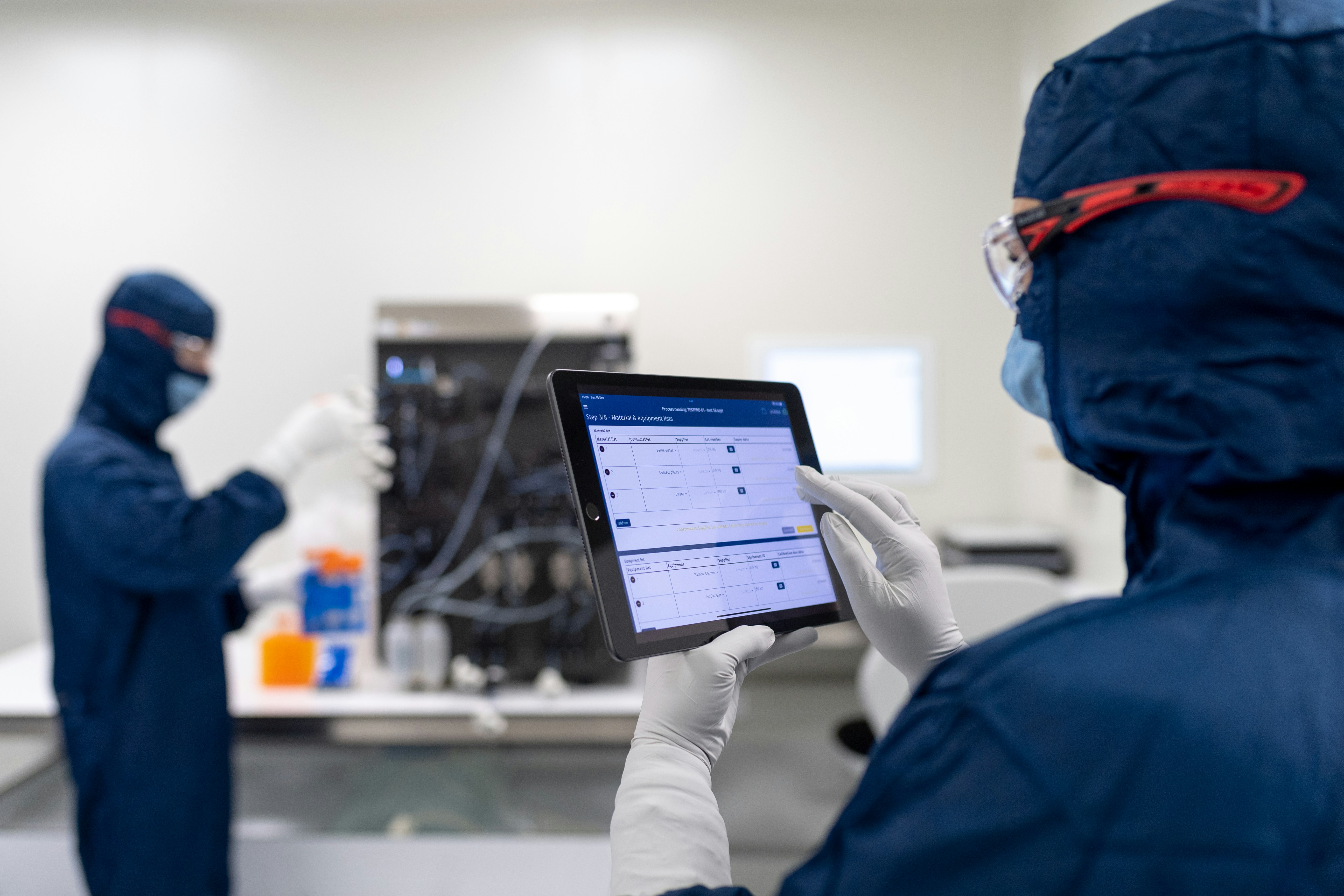
For materials companies, the data may involve composition, product identity, supplier and material provenance, recycled or bio-based content, environmental-performance information, conformity evidence, safe-use information, repair or end-of-life information, and other data specified for the relevant category.
The battery passport shows the direction
The EU Batteries Regulation provides the most concrete current DPP example for materials-intensive products.
From 18 February 2027, each electric-vehicle battery, light-means-of-transport battery, and industrial battery with a capacity above 2 kWh placed on the EU market must have an electronic battery passport. The passport must be accessible through a QR code and contain data defined in the regulation, much of which starts in battery R&D data (source).
For battery manufacturers and their suppliers, this creates a need to connect product configuration, material and component information, manufacturing records, technical documentation, and lifecycle data to the correct battery identity and version.
The battery passport does not make every materials product subject to the same requirement. It does demonstrate the operating model that other product groups may increasingly need: a product-specific record supported by traceable, verifiable data from across the value chain.
Why digital product passport readiness starts in R&D
A passport is only as reliable as the data behind it.
The information required for a product passport is usually created long before a compliance team compiles a record. Composition begins with formulation, materials selection, and supplier qualification. Product identity evolves through development, scale-up, manufacturing release, and controlled change. Performance evidence comes from laboratory, pilot, manufacturing, and quality work. Environmental information may depend on material sources, processing, transport, energy, recycled content, and product-specific lifecycle assessment methods.
When those records are scattered across spreadsheets, lab notebooks, supplier documents, LIMS systems, ERP records, shared drives, and email, producing product-level evidence becomes a manual reconstruction exercise. The work must be repeated whenever the product, supplier, material, site, or requirement changes.
When records are structured and connected, teams can identify the relevant product version, retrieve the underlying evidence, understand what changed, and prepare the inputs required by the applicable passport or declaration workflow.
The objective is not to force R&D teams to become compliance administrators. It is to preserve the technical context needed for later decisions.
The materials data a product passport draws on
The specific contents of a DPP vary by category, but materials manufacturers should be able to connect several core data domains.
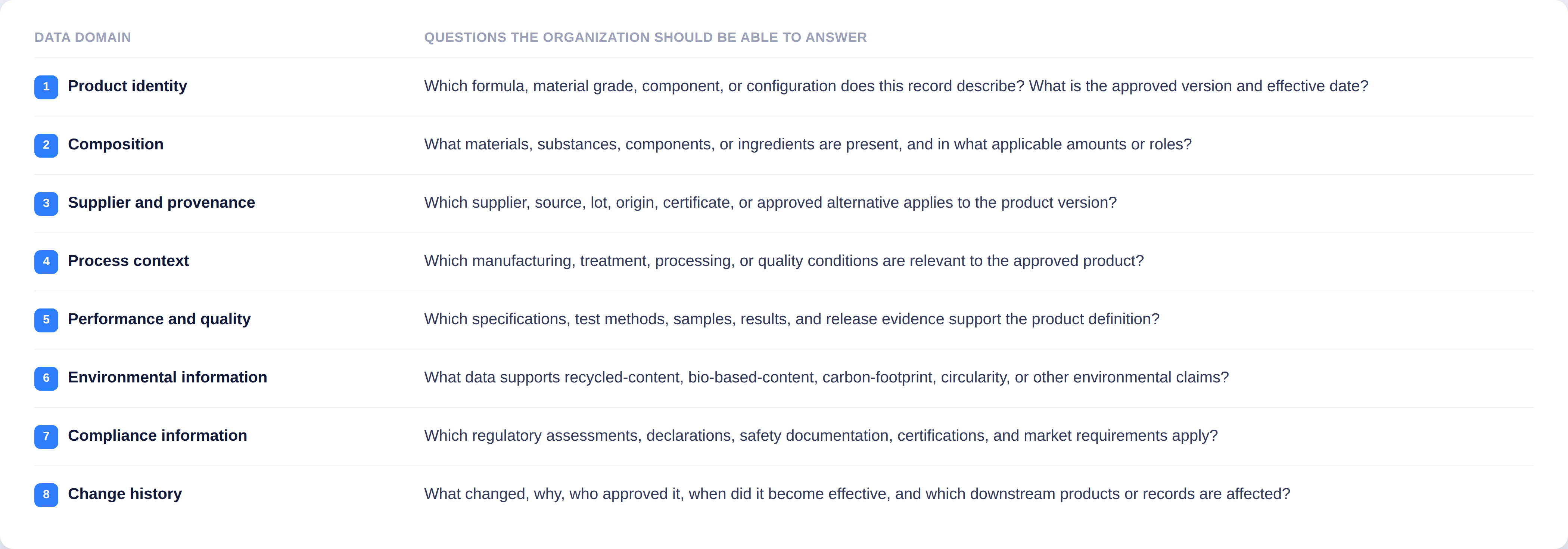
The aim is not to centralize every dataset in one application. It is to preserve the identity, version, status, and traceability of the information as it moves between R&D, quality, manufacturing, supply, sustainability, regulatory, and reporting systems.
Chemicals: prepare passport data, but do not assume a deadline
Chemical companies should prepare for more product-specific traceability and sustainability data requirements. They should not assume that an ESPR-based chemicals passport has already been mandated.
The European Commission’s first ESPR and energy-labeling working plan covers the period from 2025 to 2030. It identifies priority product groups for further work, while stating that a study would assess potential chemicals in scope and potential focus areas for future ESPR delegated acts related to chemicals, including polymers and plastics.
That distinction matters. The applicable requirements for a chemical product remain dependent on the product type, market, existing legal frameworks, and any future product-specific measures.
Chemical manufacturers already manage information that can become critical in a passport-style request:
- Formula and product composition.
- Supplier-specific raw-material grades and technical specifications.
- Batch, lot, and feedstock provenance where applicable.
- Recycled or bio-based content claims and supporting evidence.
- Safety data sheets, substance declarations, classification, and labeling information.
- Customer requirements and market-specific product restrictions.
- Test results, specifications, approvals, and formula-change history.
The problem is often not that these records do not exist. It is that they are difficult to connect to the exact formulation, supplier grade, product revision, market, and effective date in question.
A connected record helps regulatory, sustainability, R&D, and product teams assess what they know, what evidence is missing, and which products could be affected by a material or formula change. It does not replace legal interpretation, regulatory intelligence, safety assessment, or product-specific compliance work.
Chemical manufacturers can prepare by connecting formulas, supplier grades, product versions, safety and regulatory documentation, test evidence, and change history so teams can assess what they know, what evidence is missing, and which products a material or formula change could affect.
Product changes can change the passport evidence
A product passport, environmental declaration, or sustainability claim does not remain reliable simply because it was valid for an earlier product version.
A raw-material substitution may change product composition, supplier provenance, recycled content, emissions inputs, safety documentation, performance evidence, or regulatory status. A new manufacturing site may use different energy data, equipment, process conditions, or supplier networks. A revised formula may affect quality specifications, packaging, product use, or end-of-life information.
That makes change control central to passport readiness.
When a material, supplier, formula, process, site, component, or specification changes, teams should be able to identify:
- The product versions and variants affected.
- The composition, supplier, process, and performance records associated with those versions.
- The environmental, regulatory, quality, customer, and documentation evidence that needs review.
- The owners responsible for assessing each impact.
- The effective date and downstream systems that need the approved update.
The value of connected product data is not that it eliminates work. It prevents teams from discovering the scope of a change only after a declaration, passport, customer commitment, or production release has already become outdated.
Connect R&D, quality, and lifecycle data
Materials organizations often rely on specialized systems for different parts of the product lifecycle.
R&D teams may use electronic lab notebooks (ELNs) or development platforms to capture experiments, formulas, material characterization, process conditions, and observations. QC systems and laboratory information management systems (LIMS) may manage samples, test methods, results, specifications, and release workflows. ERP systems may manage material masters, purchasing, inventory, production, and cost. Sustainability, regulatory, and reporting tools may compile product-specific declarations, calculations, and submissions.
The DPP challenge is not solved by requiring one system to replace all of those tools.
It is solved by defining which system is authoritative for each record and preserving the relationships that connect them. A product identity should remain consistent across formula, material, batch, test, specification, supplier, manufacturing, and reporting records. Versions and effective dates should be clear. Approved changes should reach downstream systems without creating uncontrolled copies.
For a practical guide to connecting experimental work with controlled product information, read ELN to PLM: Why R&D and Product Lifecycle Belong in One System.
Start with a high-value evidence workflow
Do not begin by trying to build a passport for every product in the portfolio.
Start with a product family or recurring workflow that already creates evidence-retrieval problems. Examples include:
- Preparing an environmental product declaration (EPD) or customer sustainability questionnaire.
- Qualifying a recycled or bio-based raw material.
- Responding to a supplier change that affects product composition or provenance.
- Preparing battery data for the applicable EU battery-passport requirements.
- Assessing a formula revision against a market, customer, or product-specific requirement.
- Tracing the technical and environmental evidence associated with a product claim.
Map the records needed to complete the workflow. Identify where product identity, formula or composition, supplier data, process context, quality evidence, environmental information, and approval history become disconnected.
Then improve those relationships before expanding the program.
This approach produces value even where a specific DPP deadline is not yet defined. Teams can respond more quickly to customer questionnaires, sustainability requests, supplier changes, quality investigations, product claims, and emerging regulatory obligations because they are no longer rebuilding the technical record from scratch.
The same approach applies to sectors where passport requirements are being shaped now, such as construction products and coatings.
Prepare for evidence, not just the passport
Digital Product Passports are a visible example of a broader change in product data expectations. Customers, regulators, auditors, supply-chain partners, and internal decision-makers increasingly need to know what a product is made of, where it came from, what evidence supports it, and how the answer changes over time.
Materials R&D sits near the beginning of that evidence chain.
Organizations that connect formulas, material grades, suppliers, process conditions, specifications, test results, environmental inputs, and controlled change records will be better positioned to meet product-specific passport requirements as they emerge. They will also gain a more practical benefit now: less time reconstructing product history and more confidence in the evidence behind technical, quality, regulatory, and sustainability decisions.
Schedule a demonstration with Uncountable to explore how a connected R&D, quality, and product-lifecycle data model can support composition traceability, supplier and material changes, product claims, environmental evidence, and future Digital Product Passport workflows.
.png)
.png)
.png)
