
Gypsum looks simple from the outside. Calcine the rock to stucco, mix it with water and a handful of additives, form it, set it, dry it. Anyone who has run gypsum formulation R&D knows the opposite is true. Set time, slurry flow, board weight, strength, sag resistance, fire performance, and water resistance are all pulling on the same small set of levers, and moving one moves the others. The work is not short of data. It is short of a way to learn from the data it already has.
That gap shows up as repeated trials, slow development, and lab results that disappoint when they reach the board line. None of it is a chemistry problem. It is a data problem.
Why Gypsum R&D Keeps Repeating Itself
In a typical gypsum lab, a formulator chases a target: a lighter board that still passes nail pull, a faster set that does not cost strength, a more water-resistant core. They adjust the accelerator, the retarder, the dispersant, the foam, the starch, the glass fiber, and they run the batch. A few combinations work, most do not, and the results are written into a notebook or a spreadsheet named for the date and the person.
A year later, a similar target lands on someone else's bench. The earlier work is effectively gone, because nobody can search it by what was actually in the mix. So the trials get run again. The most valuable thing a gypsum lab produces, the map of which additive combinations do what, never accumulates into something the team can query. Each project starts closer to zero than it should.
Raw Material Variability Multiplies the Problem
Gypsum R&D carries a complication that many formulation fields do not: the base material itself is inconsistent. Stucco made from natural rock, from synthetic flue-gas desulfurization gypsum, and from recycled board all behave differently. Purity, particle size, and crystal habit shift water demand, set behavior, and final strength, sometimes lot to lot from the same source.
When a board starts setting too fast or losing strength, the cause is often the raw material, not the formulation. But that is only diagnosable if every result is linked to the specific stucco lot and its properties. In most labs that link lives in someone's memory, so the investigation becomes a guessing exercise instead of a query. As recycled content and synthetic sources grow for sustainability reasons, this variability is increasing, not shrinking.
The Weight-Versus-Strength Trade-Off Lives in the Data
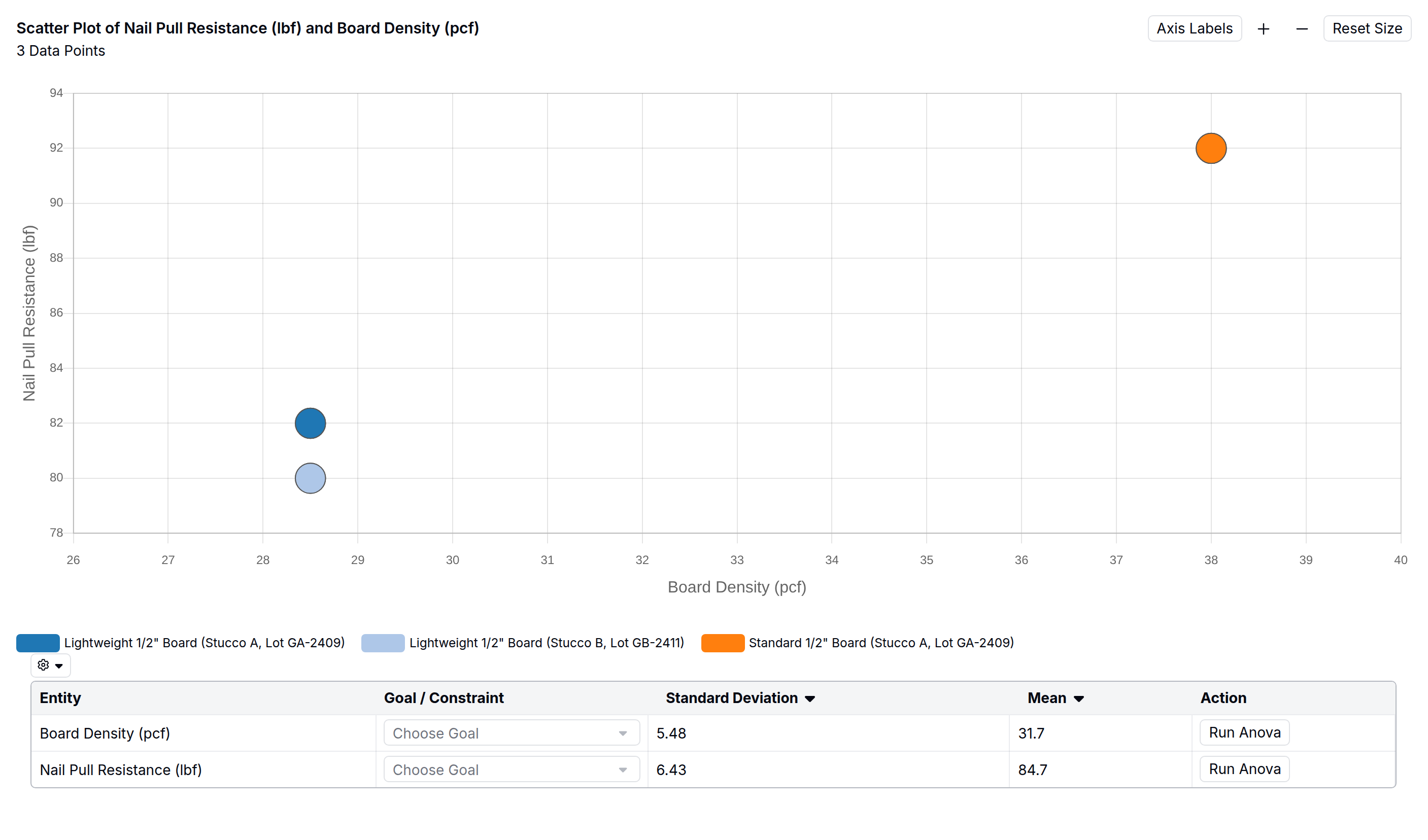
The defining tension in gypsum board is lightweighting. Foam reduces density and cuts both material cost and the energy needed to dry the board, but push too far and flexural strength, nail pull, and core hardness suffer. The sweet spot is a multi-variable balance between foam structure, stucco quality, and the additive package, and it moves with every raw material change.
You cannot manage that trade-off well from disconnected records. It requires seeing formulation, process, and the full set of performance results together, so you can ask which combinations held strength at a target density, and what they had in common. When that data is structured, the trade-off becomes something you can navigate deliberately. When it is scattered, you rediscover it by trial and error every time.
Where It Breaks: From Lab Batch to Board Line
The hardest moment in gypsum development is the jump from a lab batch to a high-speed board line. A formulation that behaves in a bench mixer can misbehave at line speed, because foaming, mixing energy, set time, and drying all change at scale. The chemistry did not fail, but the process context that the chemistry depends on was never captured alongside it.
When formulation and process parameters stay linked to the resulting board properties in one record, a scale-up problem becomes traceable. The team can compare the lab batch and the line run, see which process variables moved, and isolate what actually drove the shift. Without that connection, scale-up is debugging in the dark, and the fixes are slow and expensive.
What Connected Gypsum Data Makes Possible
The fix is to treat gypsum formulation R&D as structured, connected data rather than a pile of records. Every trial captured with its stucco source and lot, its full additive package and loadings, its process parameters, and its measured properties, all linked, so the work is searchable by what is in it.
With that foundation, a formulator can pull up every past mix that hit a target density and see how each performed on strength, set, and sag. They can trace a failing board back to a raw material lot. They can run a designed set of experiments that maps the interactions between additives and process in far fewer trials than changing one variable at a time. And because the data is consistent and connected, it becomes a foundation for machine learning that predicts properties and suggests formulations. The order matters: structure first, intelligence second. A model can only learn from gypsum history that is complete and queryable.
Where Uncountable Fits
Uncountable gives gypsum R&D teams one place to capture formulation, process, and performance data as structured, queryable records, linked to the raw material lots behind them and connected from lab development through quality and scale-up. Search by what is in the mix, navigate the weight-versus-strength trade-off against real history, trace variability to its source, and carry process context into the board line. The same structured data also supports designed experiments and predictive modeling, so the lab's accumulated knowledge compounds instead of resetting with every project.
Want to see what structured gypsum formulation data looks like in practice? Request a demo.
.png)
.png)
