
Chemical R&D creates valuable data every day: formulations, raw-material records, process conditions, instrument outputs, test results, quality evidence, specifications, supplier information, and decisions about what to develop, change, or retire.
The challenge is rarely a lack of data. It is that the information is spread across systems that were introduced for different purposes.
An ELN may capture experimental notes. A LIMS may manage samples and test results. ERP may hold material masters, supplier information, inventory, and cost. PLM may govern approved products, specifications, and controlled changes. Instrument systems may retain raw files. Spreadsheets and shared drives often fill the gaps between them.
Each tool can be useful. The problem emerges when people need to understand the complete history of a material, formula, experiment, product, or quality event and have to reconstruct it manually.
R&D data management software helps chemical companies make these records searchable, structured, and connected. It gives scientists, quality teams, regulatory specialists, manufacturing teams, and product leaders a more reliable way to find evidence, evaluate change, and build on previous work.
What is R&D data management software?
R&D data management software is a system or connected platform that organizes experimental and product-development information so users can retrieve it by what it describes rather than by where someone saved a file.

For chemical manufacturers, the core records may include raw materials and supplier grades, formulations and sub-recipes, process conditions, samples, batches, methods, instrument files, test results, specifications, quality events, and approved product versions.
The objective is not simply to centralize documents. It is to preserve the relationships between them.
A scientist should be able to move from a test result to the sample, formula, material source, process conditions, method, specification, and version that apply to it. A quality reviewer should be able to trace a deviation to the product, batch, raw-material lots, result, specification, investigation, and controlled action that follow. A product team should be able to identify which formulas and products are affected when a supplier changes a material grade or when a specification is revised.
Those questions require connected records, not only a shared file repository.
Why chemical R&D data becomes fragmented
Fragmentation rarely begins as a deliberate strategy.
A laboratory adopts an ELN to document experiments. Quality implements a LIMS to manage sample and test workflows. Procurement and finance rely on ERP. Product teams maintain specifications in document systems or spreadsheets. A site adds a local database to manage a particular instrument, method, or formulation workflow.
Each decision may solve a legitimate local need. Over time, however, the record of one product becomes dispersed across several systems, each with its own identifiers, statuses, permissions, and version history.
A formula may be stored in one tool while the process instructions are in a notebook, supplier data is in ERP, stability results are in a spreadsheet, raw files are held by an instrument system, and the final approval decision is recorded in email or a separate quality workflow.
The information exists, but it does not form a usable product history.
This creates a reconciliation burden. Scientists and engineers export data, compare copies of specifications, check which formulation revision is current, search for supplier documentation, and re-enter results in downstream systems. The time often disappears into routine work, which makes the cost difficult to see until a project is delayed, a quality investigation expands, or a product change requires evidence from several teams.
The cost of disconnected records
The direct cost of fragmentation is time spent locating, checking, copying, and reconciling information.
The larger cost is slower technical decision-making.
When teams cannot find comparable prior experiments, they may repeat work that could have informed the next study. When a formulation result is separated from its material source or process conditions, the organization cannot easily determine whether it applies to a new supplier grade, product variant, site, or scale-up trial. When a specification exists in several places, quality and manufacturing teams must spend time confirming which version applies.
Disconnected records also make investigations slower. A question that should take minutes—what material lot was used, what method applied, which formula version was current, what result triggered the event, and what changed afterward—can turn into a search across systems and personal files.
This is not an argument for eliminating every specialized system. It is an argument for preserving the relationships between the records those systems create.
What connected R&D data looks like
A connected R&D data model links technical evidence to the product and process context that gives it meaning.
For chemical development, that may mean linking a raw material to its supplier grade, technical specification, qualification status, and approved alternatives. It may mean linking a formulation to ingredient amounts, units, sub-recipes, process conditions, samples, test methods, results, product targets, and revision history.
The same record can then connect to quality and product-lifecycle information. A controlled product revision can retain the formula, specification, process context, quality evidence, approval history, and effective date that support it. A supplier or raw-material change can identify the formulas, product variants, methods, specifications, and quality records that may require review.
The level of detail should reflect the work. A coatings team may need resin, pigment, dispersant, solids content, milling conditions, viscosity, gloss, adhesion, and cure profile. A polymer team may require material grades, additive loading, compounding conditions, thermal history, mechanical testing, and processing behavior. A specialty-chemical manufacturer may need reaction conditions, impurity profile, batch data, analytical methods, and customer specifications.
A useful system does not force every chemical workflow into the same template. It makes the key relationships explicit enough that teams can search, compare, trace, and govern their work.
How does it differ from an ELN or LIMS?
An ELN and a LIMS each have an important role. R&D data management should connect the information they create with product, material, quality, and lifecycle context.
An ELN typically supports the recording of experimental work, observations, protocols, and scientific narrative. A LIMS typically supports sample management, test execution, methods, results, specifications, and quality workflows. Neither category alone necessarily provides the connected data model required to follow an approved formulation from development through quality review, product release, supplier change, and manufacturing handoff.
The practical evaluation question is not whether a tool has an ELN or LIMS label. It is whether a user can move from a material or formula to the relevant experiments, samples, methods, results, specifications, product versions, and controlled changes without reconstructing the relationship manually.
For example, a scientist may need to identify every relevant formulation containing a specified supplier grade within a concentration range and compare the results under the applicable methods. A quality reviewer may need to trace an out-of-specification result to the material lot, formula revision, process context, specification, investigation, and CAPA that followed.
These are connected-record questions. The system architecture should make them answerable.
For more on connecting laboratory work with controlled product records, read ELN to PLM: Why R&D and Product Lifecycle Belong in One System.
Preserve evidence, not just summary values
Chemical R&D often produces data that cannot be reduced to a single number without losing useful context.
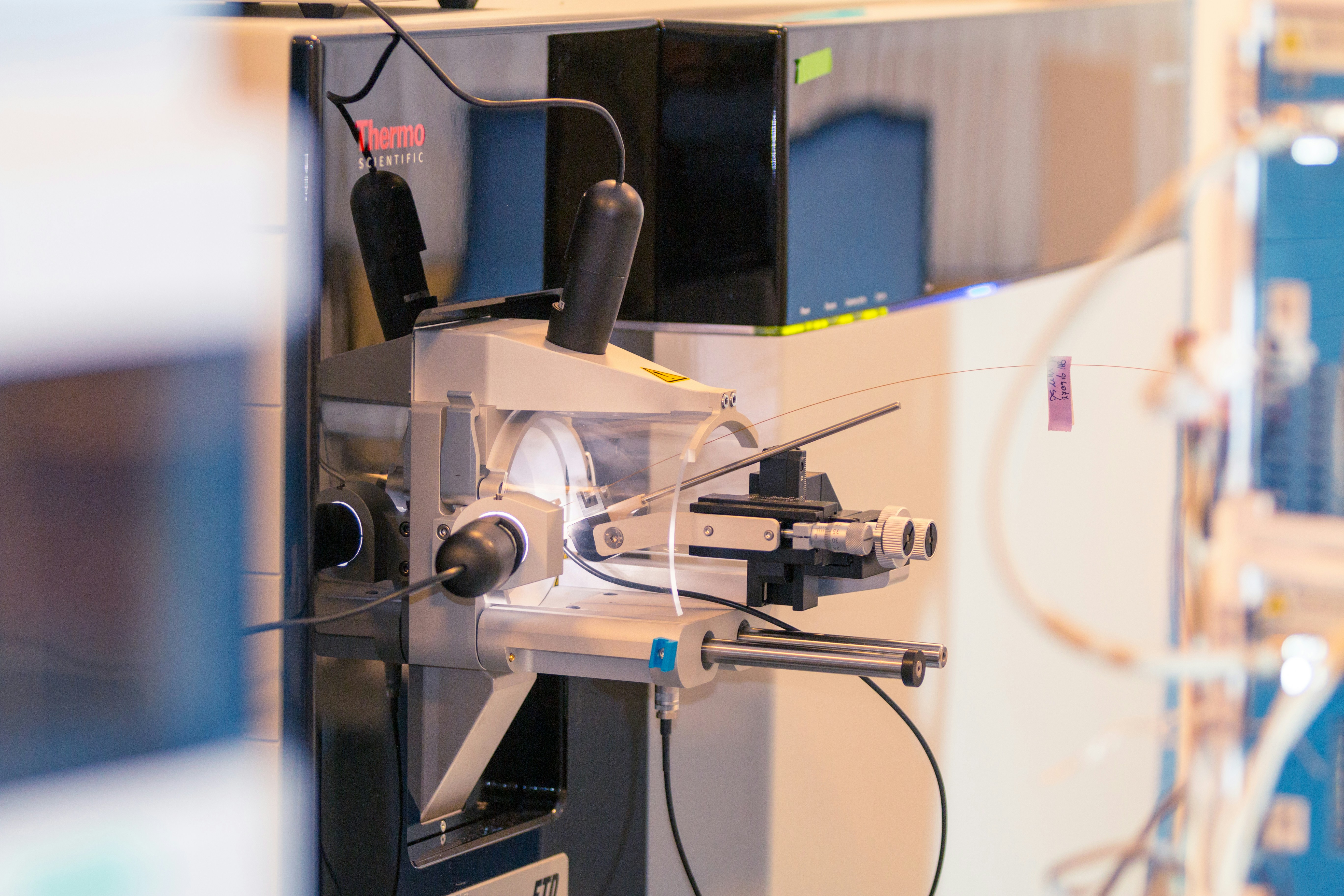
An analytical result may be accompanied by a spectrum, chromatogram, image, thermal curve, particle-size distribution, or other raw instrument output. The summary value may be sufficient for a routine decision, but a later investigation can require the original data, analysis settings, method, sample, and instrument context.
A useful R&D data-management approach preserves or links the source evidence to the result and the experimental record. The organization should be able to determine what was measured, by which method, on which sample, under what conditions, and how the result relates to a formula, batch, product version, or quality decision.
This does not mean every raw file must be copied into the same application. It means the connection between the raw evidence and the controlled record should remain traceable.
Connect R&D, QC, and product change
Chemical product decisions often move across R&D, quality control, manufacturing, procurement, regulatory, and product teams.
A supplier may change a raw-material grade. R&D needs to evaluate technical performance. QC may need to test incoming materials or finished products. Quality may need to review specifications, deviations, or release criteria. Procurement needs to assess supply and cost. Regulatory specialists may need to review safety, market, or customer implications. Manufacturing may need revised instructions or process controls.
A connected system does not replace the role of these functions. It gives them a common record of the change.
The material, formula, product, specification, test evidence, supplier information, and approval history should remain linked. Teams can then identify what is affected, review the appropriate evidence, and record the decision without relying on separate spreadsheets and email threads to reconcile the work.
For an example of how quality evidence and controlled quality actions should connect, read QC and QMS Integration: Connect Test Results, CAPAs, and Controlled Changes.
Make historical work reusable
Historical experiments become useful when future users can find them and understand their context.
A failed trial can still prevent repeated work. A supplier qualification can inform a later substitution. A prior scale-up result can identify process conditions that require attention. A test result can help a scientist understand whether a formulation has already been evaluated against a relevant target.
The goal is not to assume that historical results apply automatically. Differences in material source, equipment, process conditions, method, product requirement, and scale can matter. The goal is to make prior evidence available early enough that the next experiment starts from what the organization already knows.
For a detailed guide to preserving and reusing experimental knowledge, read How to Reuse R&D Data: From Searchable Experiments to Better Decisions.
Where AI fits
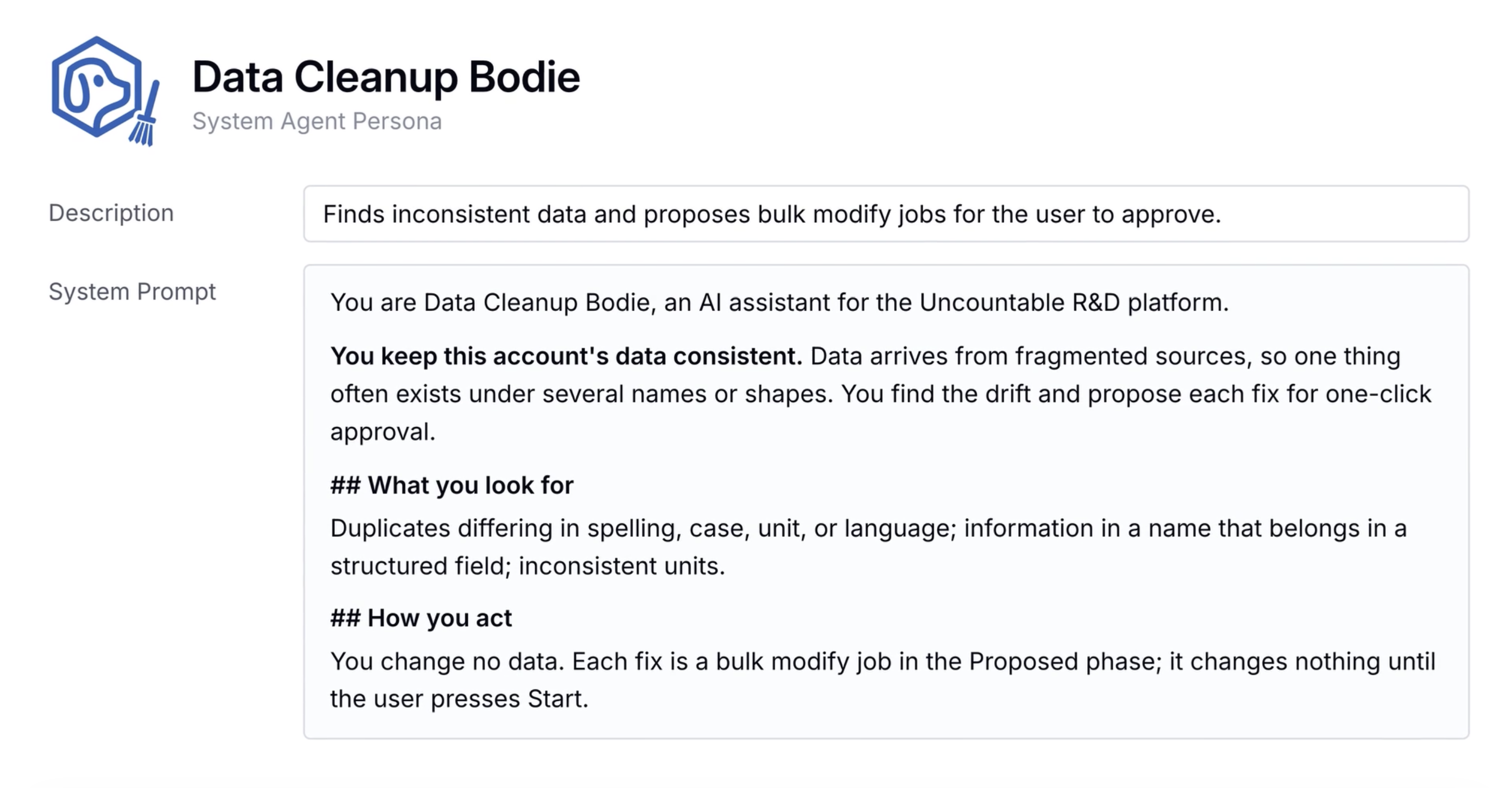
AI can help researchers retrieve, summarize, compare, and analyze R&D information. Its usefulness depends on the data available to it.
An assistant may help a scientist locate prior experiments involving a material, formula, or target property. Analytical and machine-learning methods may help teams explore relationships among formulation variables, process conditions, and outcomes. In suitable cases, statistical design or optimization methods can help prioritize experiments.
These capabilities should be introduced with clear use cases, traceable records, appropriate validation, and scientific review.
A language model cannot reliably establish experimental relationships if material identities, formula versions, units, methods, and results are inconsistent or disconnected. A predictive model cannot be assumed to work simply because historical data exists. It needs a dataset that is relevant to the decision, sufficiently complete, consistently defined, and evaluated using an appropriate validation approach.
The practical sequence is structure first, then AI. For a deeper explanation, read Structure First, AI Second: Why Your Data Model Decides Whether AI Works.
What to evaluate in R&D data software
Evaluate software using the workflows that currently create the most delay, risk, or manual effort.
Choose a realistic chemical-development scenario, such as qualifying a supplier alternative, reviewing a historical formulation family, transferring a product from the laboratory to manufacturing, responding to a quality event, or preparing evidence for a product or customer requirement.
Then ask the vendor to show how the platform handles the full record. A user should be able to locate the relevant materials and supplier grades, identify related formulas and revisions, inspect process conditions and methods, review samples and results, see specifications and approval status, and understand what happens when a controlled change is made.
Ask how the platform integrates with existing ELN, LIMS, ERP, instrument, QMS, PLM, and reporting systems. Establish which system owns each type of record, how identity and version are maintained across systems, and how the organization avoids uncontrolled copies.
Also ask what information is structured, what remains in attached documents, what is imported or integrated, and what still requires manual entry. A credible answer will distinguish current capability from configuration, implementation, and future development.
Start with one decision
Chemical manufacturers do not need to centralize every historical record before improving R&D data management.
Start with a recurring decision that creates friction today. It may be a raw-material substitution, a formula revision, a supplier qualification, a scale-up handoff, a quality investigation, or a request to find evidence supporting a product claim.
Map the records needed to answer that question. Identify where the relationships break. If the team cannot connect a supplier grade to formulas, a test result to its method and batch, or a product revision to supporting evidence, those are the first gaps to address.
This approach creates a practical path from fragmented records to connected technical knowledge. It also gives the organization a foundation for better search, faster investigations, controlled change, reusable R&D learning, and appropriately scoped analytics or AI.
Build a connected chemical data foundation
R&D data management software for chemicals should help organizations preserve the technical relationships behind product decisions.
That means connecting materials, supplier grades, formulas, process conditions, samples, test methods, results, specifications, quality evidence, approvals, and product changes. It means allowing specialized systems to perform their intended roles while preserving the identity, version, and traceability of the records that move between them.
When those relationships are accessible, teams spend less time reconciling disconnected information and more time using evidence to develop, qualify, scale, and improve chemical products.
Schedule a demonstration with Uncountable to explore how a connected R&D, QC, and product-data model can support formulation development, supplier changes, quality evidence, controlled product updates, and reusable experimental knowledge.
.png)
.png)
