
Most labs run their Electronic Lab Notebook and Laboratory Information Management System as two separate tools that don't share a data model, which means every result gets entered twice, once for the experimental record and once for sample tracking. That gap isn't a minor inconvenience. It's a measurable source of R&D waste, and the numbers behind it are larger than most lab budgets acknowledge.
The scale of the problem
Roughly 50% of preclinical research in the United States can't be reproduced, a landmark 2015 analysis in PLOS Biology found, generating a direct economic loss of approximately $28 billion annually in the US alone. Extrapolated globally using industry R&D distribution data, that figure approaches $90 billion a year. Separately, 80 to 90% of data generated in industrial research settings is estimated to be "dark," meaning it's saved somewhere but effectively unfindable by anyone who might reuse it. Disconnected ELN and LIMS systems are a direct contributor to both problems: when experimental context lives in one tool and sample data lives in another, neither system captures the complete picture, and future researchers can't reliably find or trust what came before.
The efficiency cost compounds from there. One documented enterprise deployment consolidating legacy LIMS and ELN systems into a single platform tripled process development project capacity without adding headcount, delivered a 60% improvement in scientific and engineering analysis efficiency, and generated more than $50 million in annual operational savings. Industry analysis of ELN-LIMS integration more broadly points to 25 to 40% faster processing times, 30% higher experimental throughput, and cost reductions in the 10 to 25% range.
Why ELN and LIMS don't naturally work together
The two systems were built to do different jobs, and that's exactly why they clash without integration.
ELNs are narrative-driven. They give scientists a flexible, searchable space to document experimental design, procedures, and observations, essentially a digital version of the lab notebook with version control and collaboration built in.
LIMS are operational. They manage sample tracking, inventory, and compliance workflows, and they're built around structure and standardization: consistent naming conventions, units, and formats enforced across the organization.
When these systems don't share a data model, the practical result is duplicated manual entry, increased error risk, and lost context every time information crosses from one tool to the other. A scientist who documents a novel observation in the ELN has to manually re-enter the relevant details into the LIMS for sample tracking, and any nuance that doesn't fit the LIMS's rigid fields simply doesn't make the trip. As data volume grows, so does the risk that isolated pockets of information become impossible to access, analyze, or act on collectively.
What actually changes with integration
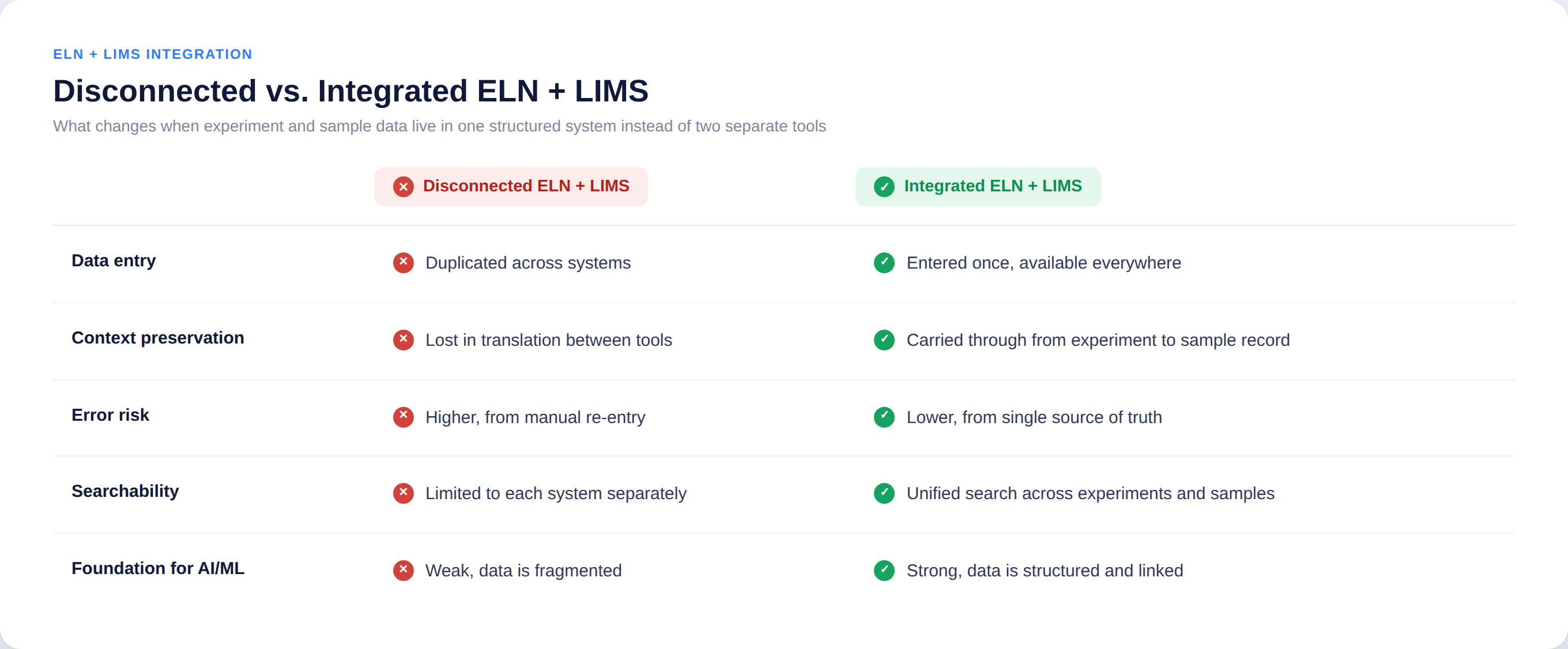
An integrated system creates a single source of truth for all scientific activity, from initial idea to sample preparation to final analysis. A scientist can design an experiment, record outcomes in structured form, and see the corresponding sample and material tracking update in the same interface, with no export step and no re-entry. That single record also becomes the foundation for advanced analytics: because the data is contextualized and standardized rather than duplicated across disconnected systems, it can actually support trend identification, formulation optimization, and predictive modeling grounded in historical results.
What this looks like in practice
Reported outcomes from integrated ELN/LIMS deployments follow a consistent pattern across industries. A materials science company reduced experimental duplication by more than 30% within six months of implementation. A specialty chemicals manufacturer cut time-to-decision in half by using integrated data models to surface insights from past work rather than starting from scratch. These aren't isolated wins: they reflect what happens when researchers can search prior experiments and reuse templates instead of unknowingly re-running work that's already been done, which is exactly the failure mode behind that $90 billion irreproducibility estimate.
What to look for before choosing a platform
Integration by design is different from integration bolted on after the fact. Systems built as two separate products stitched together later tend to preserve the same seams: partial data transfer, inconsistent field mapping, and context that still gets lost somewhere in the handoff. A platform built from the ground up as one system, where experimental data is standardized and linked to batch records, raw materials, and formulations from the start, avoids reintroducing the exact problem integration was supposed to solve.
For more on how this fits into the broader structured data picture, see why structured lab data matters for R&D organizations and what unified laboratory informatics software actually looks like. For global R&D teams weighing ELN choices specifically, why enterprises need integrated ELN systems built for scale is worth a closer look too.
The labs closing the gap between ELN and LIMS aren't just saving time on data entry. They're recovering a meaningful share of the research budget currently lost to work that has to be repeated because nobody could find it, trust it, or connect it to what came before.
.png)
.png)
.png)
