
Most Electronic Lab Notebooks were built for a single lab, not a global R&D organization running dozens of sites across multiple continents. That mismatch is why so many enterprises end up with an ELN that technically works but quietly limits how fast they can actually move.
The category is growing fast: independent market estimates put the global ELN market between roughly $700 million and $1.4 billion in 2025, expanding at compound annual growth rates ranging from 5% to over 11% depending on the source and forecast window. That growth is being driven almost entirely by enterprises outgrowing standalone, single-site notebooks and needing something built for scale.
Where standalone ELNs actually break
A traditional ELN does one job well: it captures lab notes and experimental data. The problem shows up the moment an organization tries to connect that data to everything else R&D depends on.
They don't talk to other systems. Most standalone ELNs operate as isolated applications, disconnected from LIMS, analytics platforms, inventory systems, and ERP software. That isolation creates data silos by design, not by accident, trapping information within specific teams and making it nearly impossible to share or analyze at an organizational level.
They weren't built for distributed teams. Global R&D rarely happens in one place. Research on distributed teams found that even a single hour of time zone difference can reduce real-time collaboration by roughly 37%, and teams spanning three or more zones end up pushing 43% of their communication outside normal working hours just to get overlap. A notebook designed around one lab's working hours makes that problem worse, not better.
They can't handle enterprise data volume. Complex, cross-departmental workflows generate data at a scale that many standalone ELNs simply weren't architected for, leading to clunky interfaces and scalability limits exactly when an organization can least afford them.
They create compliance exposure. Inconsistent data handling across sites, without a unified system tying it together, raises real risk in regulated industries where audit trails and data integrity have to hold up across every location, not just the one where the ELN was originally deployed.
What an integrated ELN actually needs to do differently
The fix isn't a better standalone notebook. It's rethinking the ELN as one connected layer inside a broader R&D data system, with four specific capabilities that traditional tools lack.
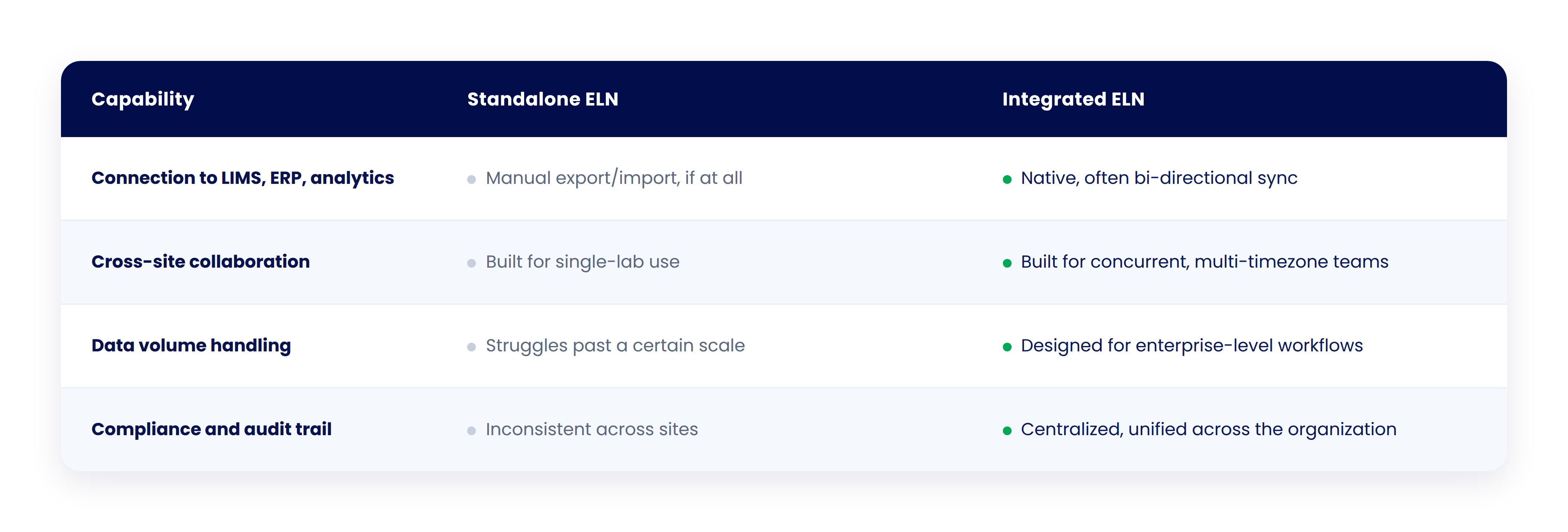
Seamless integration with the rest of the R&D ecosystem matters because it's what actually eliminates silos, letting insights generated in one department inform work happening in another without a manual handoff. Real-time collaboration across time zones matters because global R&D teams lose usable overlap time exponentially as time zone gaps grow, not linearly, so the platform itself needs to compensate for that math rather than assume everyone can just "sync up." Scalable data management, including automated capture and reporting, is what keeps human error from creeping in as data volume grows past what any manual process can reliably handle. And centralized compliance is what makes audits and reproducibility checks tractable across dozens of sites instead of a site-by-site scramble every time a regulator asks a question.
The strategic case, not just the operational one
Choosing between a traditional ELN and an integrated system isn't a convenience decision at enterprise scale. It determines whether an organization's R&D data compounds into a genuine competitive advantage or stays fragmented across departments that can't fully see each other's work. Enterprises that get this right free up their researchers to focus on the science instead of working around the limitations of their own tools.
The enterprises pulling ahead aren't the ones with the most feature-rich notebook. They're the ones whose ELN is actually connected to everything else their R&D organization runs on.
.png)
.png)
.png)
