One record for every project, from idea to launch
Ideation, intake, stage-gates, and the documents behind them, connected to the same experiment and formulation data used everywhere else on the platform, not a separate spreadsheet of project status.
Every project, from idea to launch
Project Management sits above the individual product record, covering a project from its first idea through staged execution and the documents that support it, evaluated and coordinated against strategic objectives throughout.
A closer look at each stage
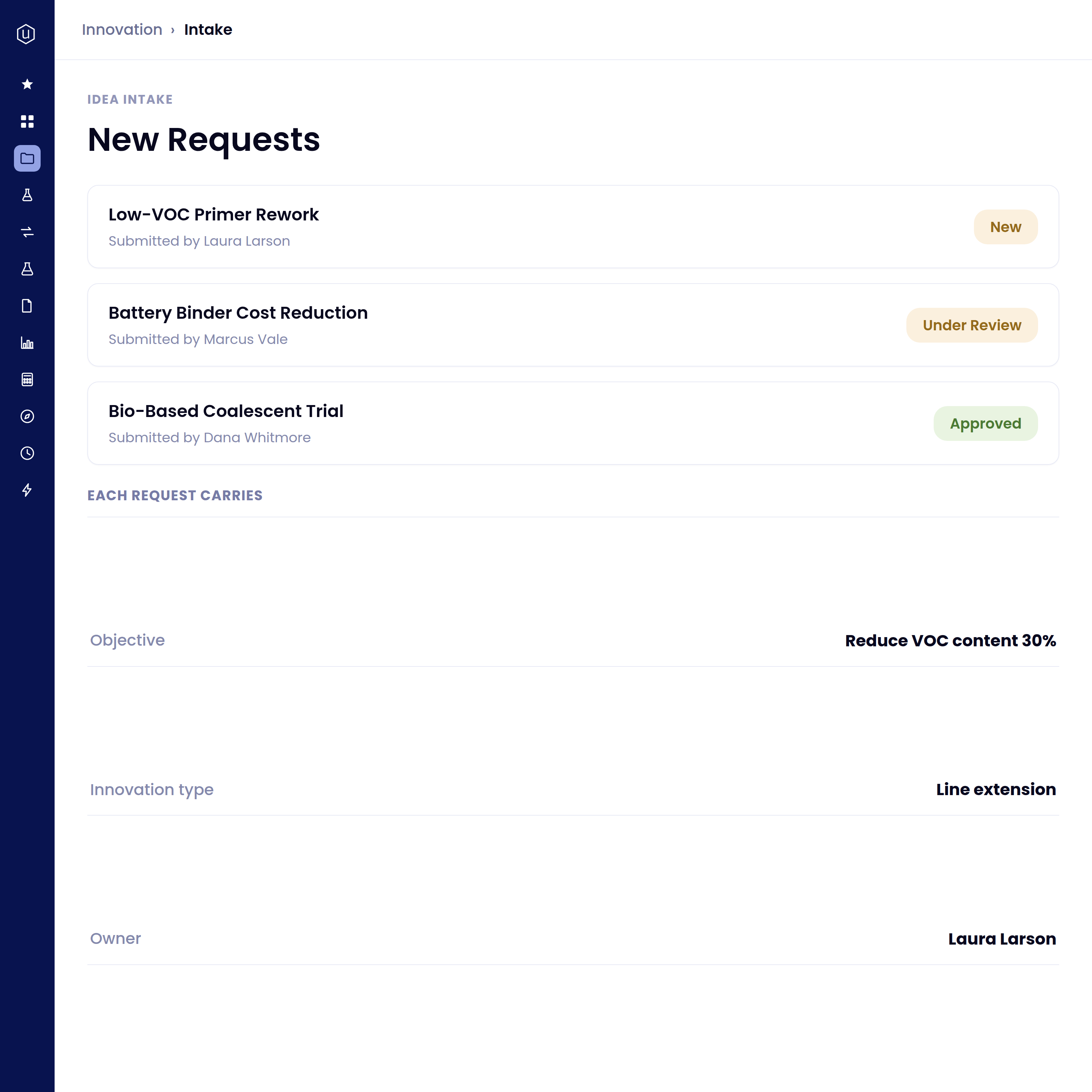
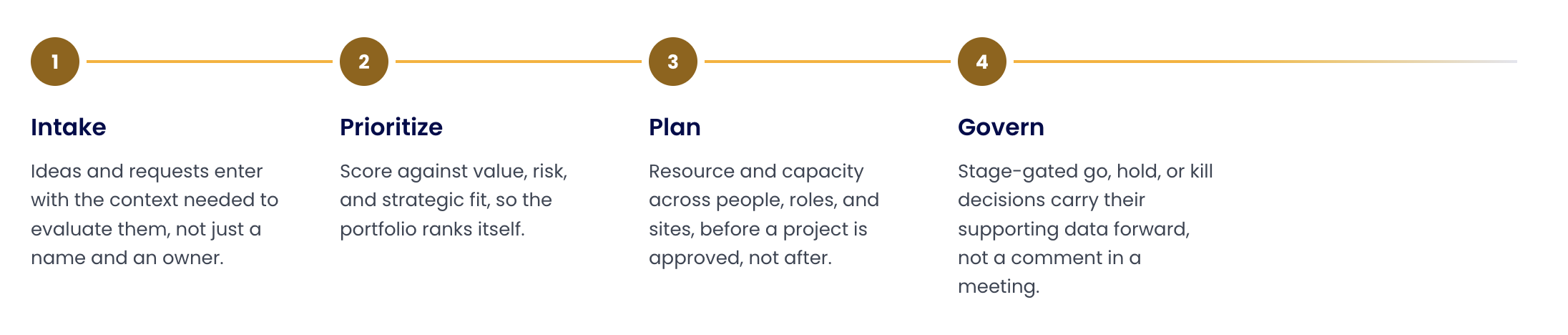
An idea should carry enough context to be evaluated the day it's submitted, not chased down in a follow-up meeting.
Structured idea intake: Requests come in with an objective, owner, and innovation type attached, not just a name in a spreadsheet row.
Nothing starts from a blank project: A new project inherits the data behind the idea that spawned it, rather than starting from a blank form.
Visible from day one: Every submitted idea is visible in the portfolio view, not sitting unopened in someone's inbox.
Idea intake. Structured requests. Portfolio visibility. Project creation
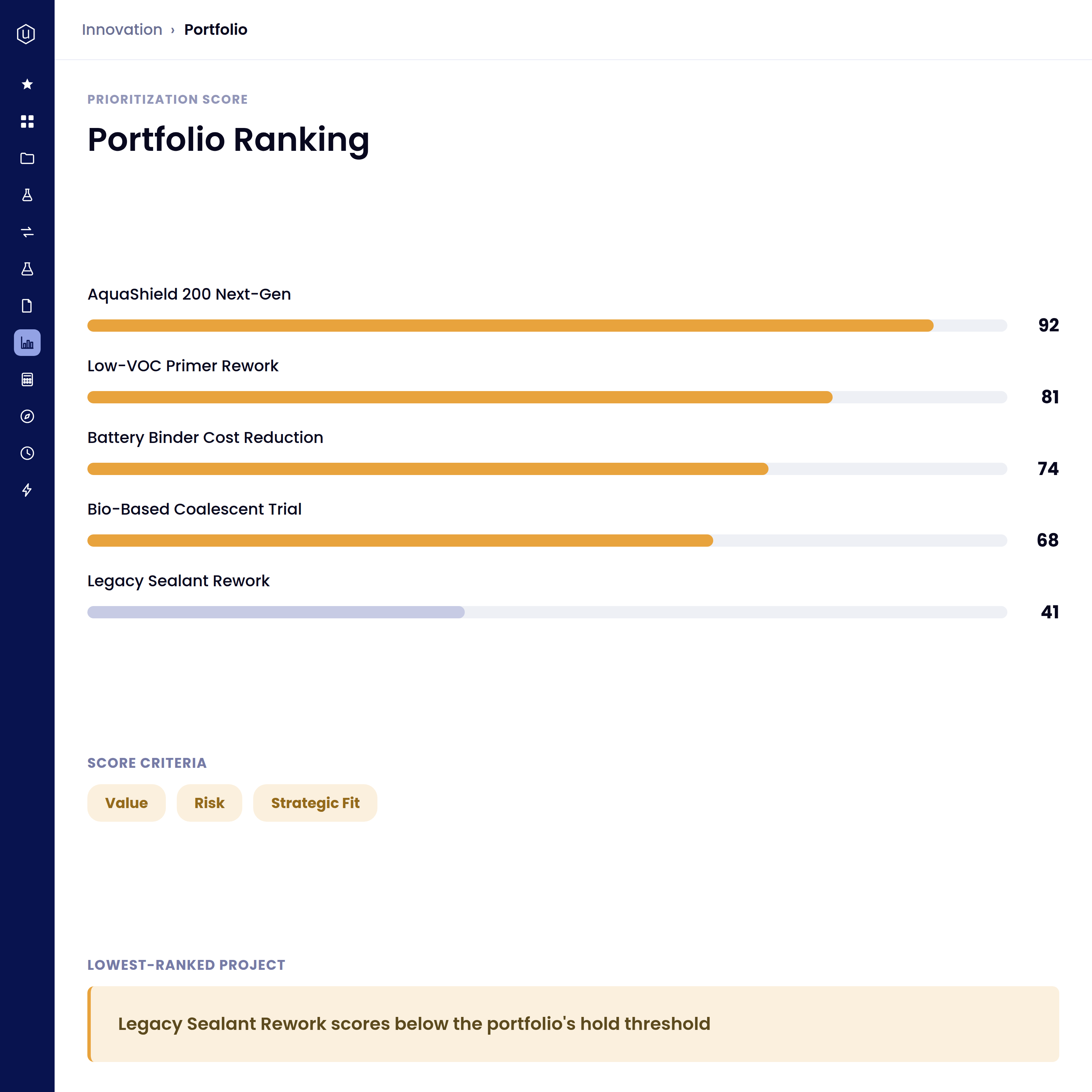
A portfolio should rank itself against the criteria that matter, not whoever argued last in the room.
Score against value, risk, and strategic fit: Each project carries a prioritization score built from criteria you define, not a gut call.
Rank the full portfolio at once: See every project ordered by score, side by side, rather than compared one at a time.
Reprioritize as conditions change: Scores update as new data comes in, so the ranking reflects the current portfolio, not last quarter's.
Prioritization scoring. Value & risk criteria. Portfolio ranking. Configurable weights
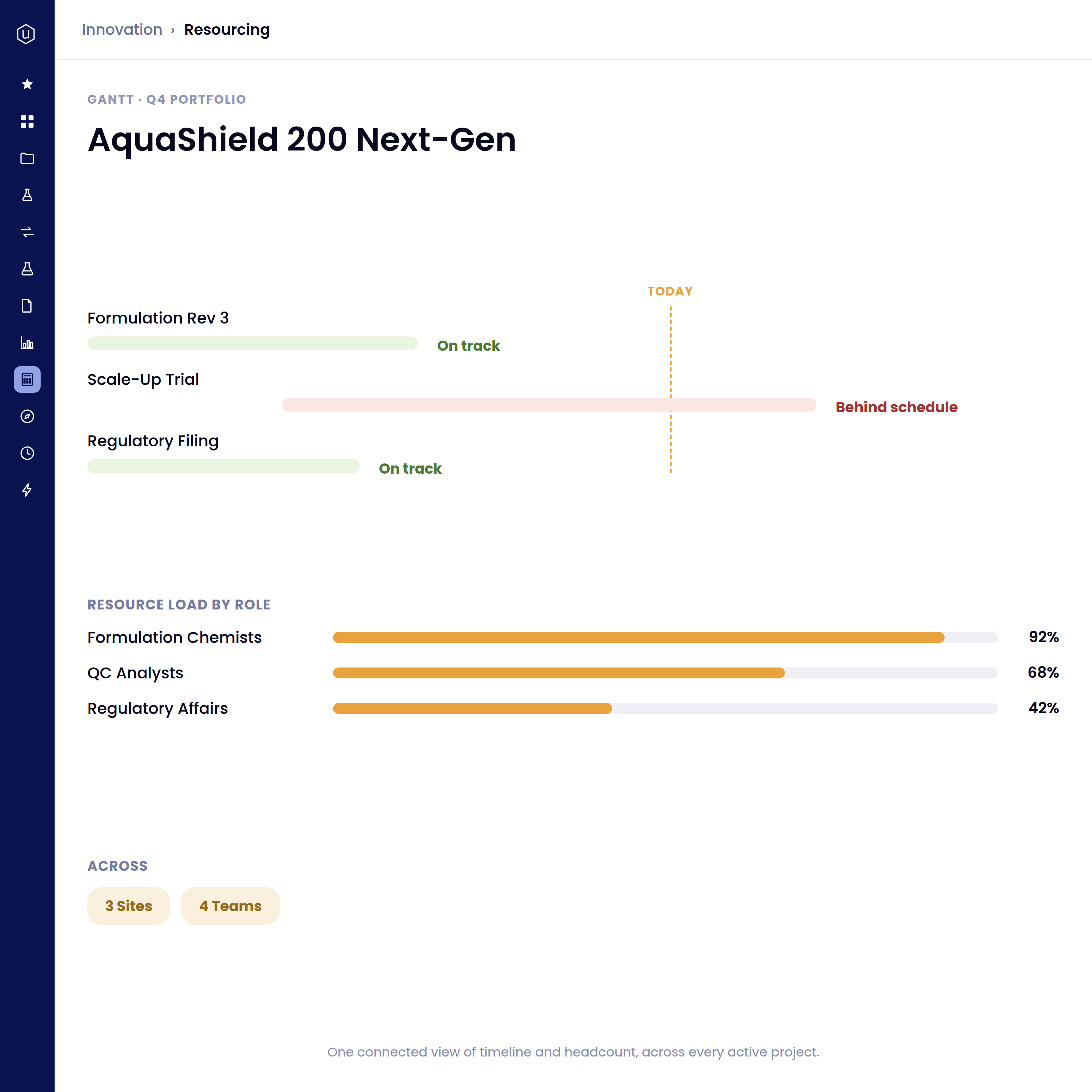
Approving a project without knowing who has the capacity to run it is how portfolios get overcommitted.
Resource and capacity by person, role, and lab: See where capacity exists, and where it doesn't, before committing to a new project.
Across teams and sites: Plan resourcing across the full organization, not just one team's calendar.
A Gantt view tied to real status: A task bar extending past today reads as not done, not as a status someone forgot to update.
Resource planning. Capacity by role. Cross-site view. Gantt view
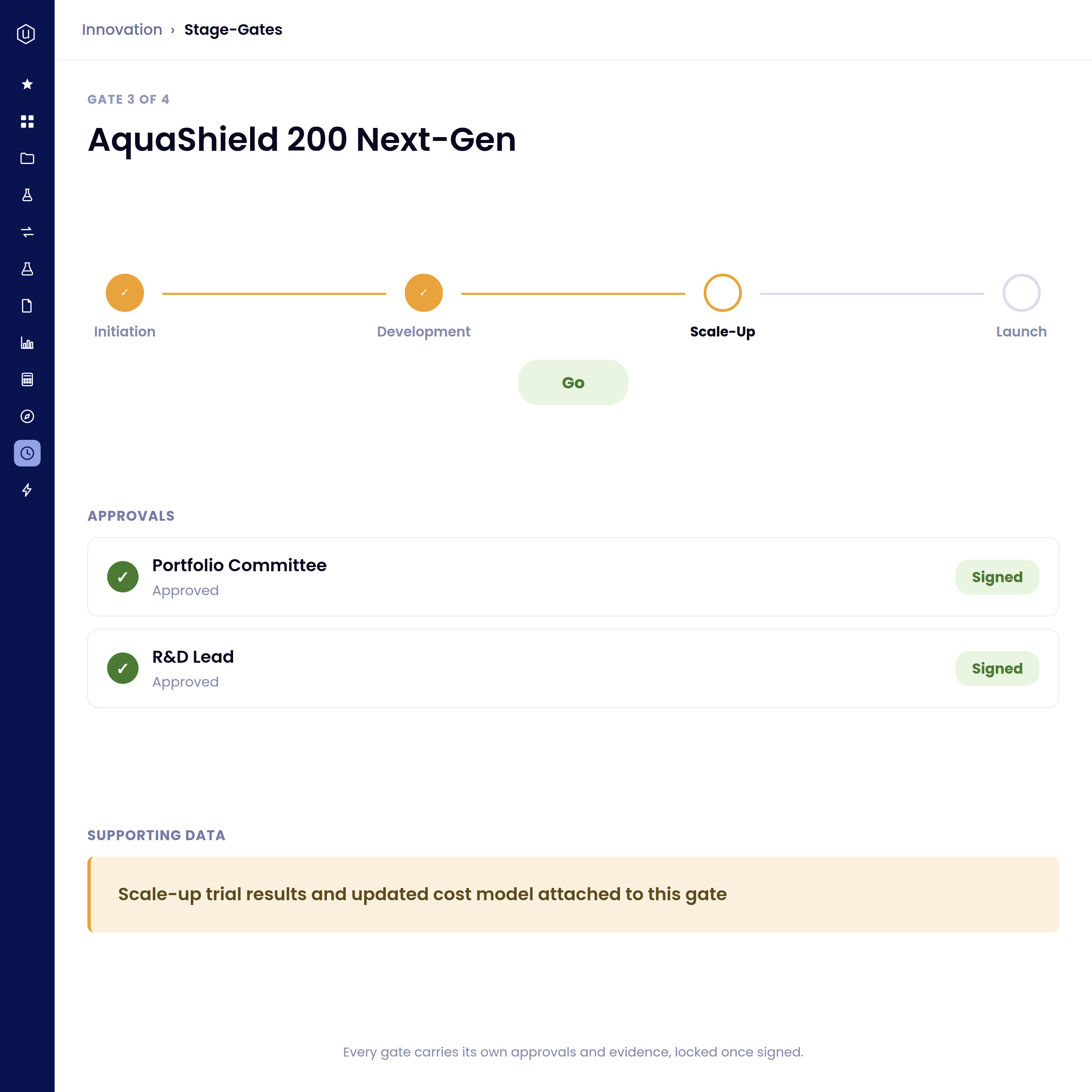
A stage-gate should be a decision with evidence attached, not a status update.
Four stages, start to finish: Initiation & Scoping, Development & Feasibility, Scale-Up & Validation, and Launch Readiness & Handover, each with its own gate.
Go, hold, or kill, with the data attached: Every gate decision carries the supporting data behind it, not a verbal recommendation.
One record, not a status meeting: The gate decision and its rationale live on the project record, visible to the next person who asks why.
Stage-gates. Go/hold/kill decisions. Supporting data. Governance record
From idea to launch, staged and scored
A project is only as useful as the discipline behind it. Because Project Management sits on the same record as R&D, each stage below already has the data it needs.
See Project Portfolio Management in action
Uncountable gives R&D leaders one live view of every project's stage, resourcing, and priority score; no more stitching spreadsheets together before a portfolio review. Projects move, and the plan updates with them.
Shared by every suite
Bodie and the Portal work across R&D, Quality, Product Lifecycle and Project Management at once, on the same structured data model.

Bodie, the AI Layer

The Uncountable Portal
When it changes, so does the plan
Kicking off a project you haven't scoped beforePull in the team and every task, dependency, and deadline is generated from the template, rather than building a project plan from scratch.
A handoff that shifts the critical path shows up across the project immediately, not after the sprint closes.
When a dependency's date moves, every task waiting on it reflects the new timeline, without someone chasing it down by hand.
Checking every active project against its deadlines at once, rather than project by project on request.
The current owner, blockers, and last update are already attached to the task, not reconstructed after the request.
A project that was on track can slip after a scope change, and the impact is visible on the project itself, in the same place the team already looks.
Security, compliance and integrations
Uncountable meets the security and compliance bar enterprise R&D requires, backed by independent third-party audits. Your data stays isolated per customer, encrypted in transit and at rest, and covered by a complete audit trail, with a 99.9% uptime SLA and a 10-minute RTO/RPO.
.png)

.png)
A project decision should carry its evidence with it.
When every project is linked to its experiments, quality, and production, the project view is always current and every gate decision stands on evidence.
FAQs
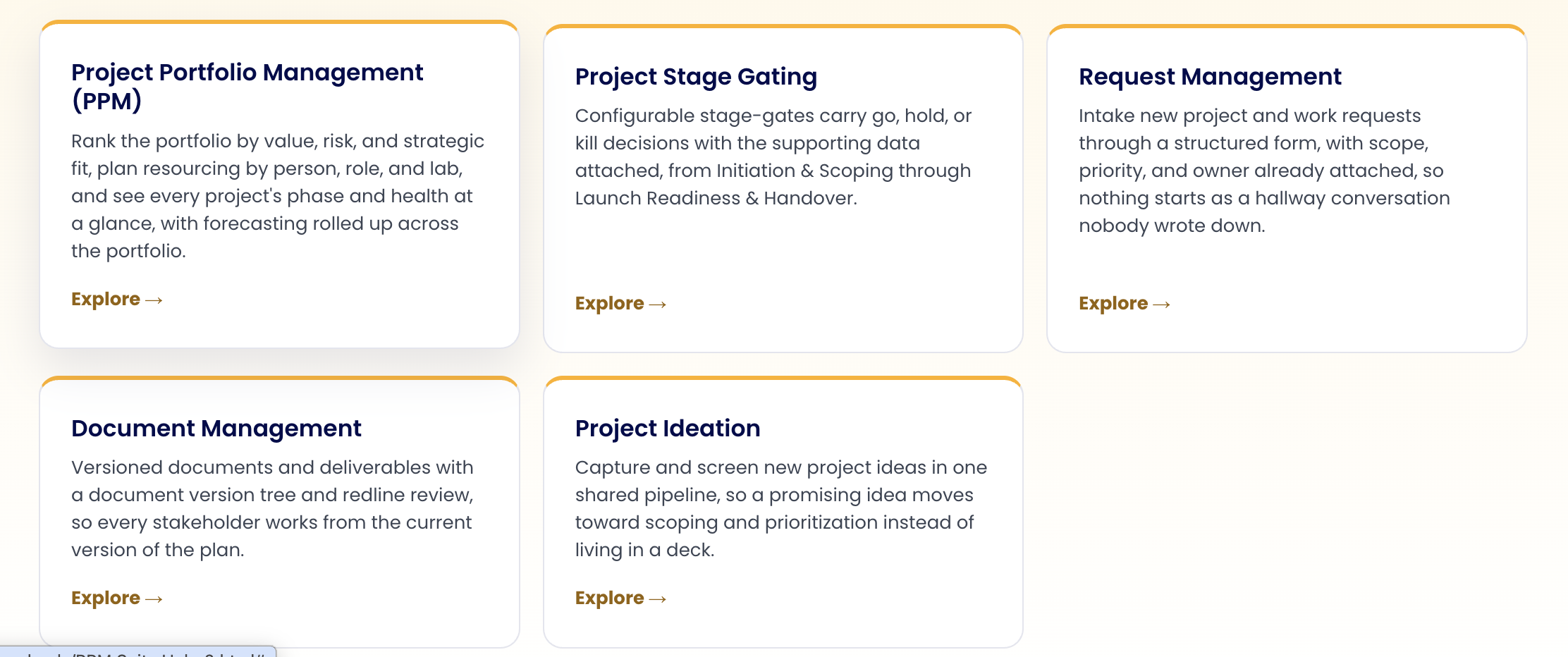
Five connected products: Project Ideation for capturing and screening new ideas, Request Management for structured intake, Project Portfolio Management (PPM) for prioritization and resourcing, Project Stage Gating for go, hold, or kill decisions, and Document Management for the plans and deliverables behind them.
Projects move through configurable stage-gates: Initiation & Scoping, Development & Feasibility, Scale-Up & Validation, and Launch Readiness & Handover. Each gate is a go, hold, or kill decision made with supporting data attached, rather than a verbal recommendation in a meeting.
Each project carries a score built from criteria you define, typically value, risk, and strategic fit, so the portfolio ranks itself rather than depending on whoever argued last in the room.
Yes. Capacity is planned by person, role, and lab, across teams and sites, so a new project's true resourcing cost is visible before it's approved, not after.
Yes. Project Management sits on the same structured record as the rest of the platform, so a project's status can reflect real experiment and QC data rather than a manually updated slide.
See your own projects on one record.