Quality that is connected to the data behind it
Quality management software and LIMS on the same structured record as R&D, so every result, deviation, and corrective action traces back to the formulation, batch, and raw-material lot that produced it.
Every Quality event, on one record
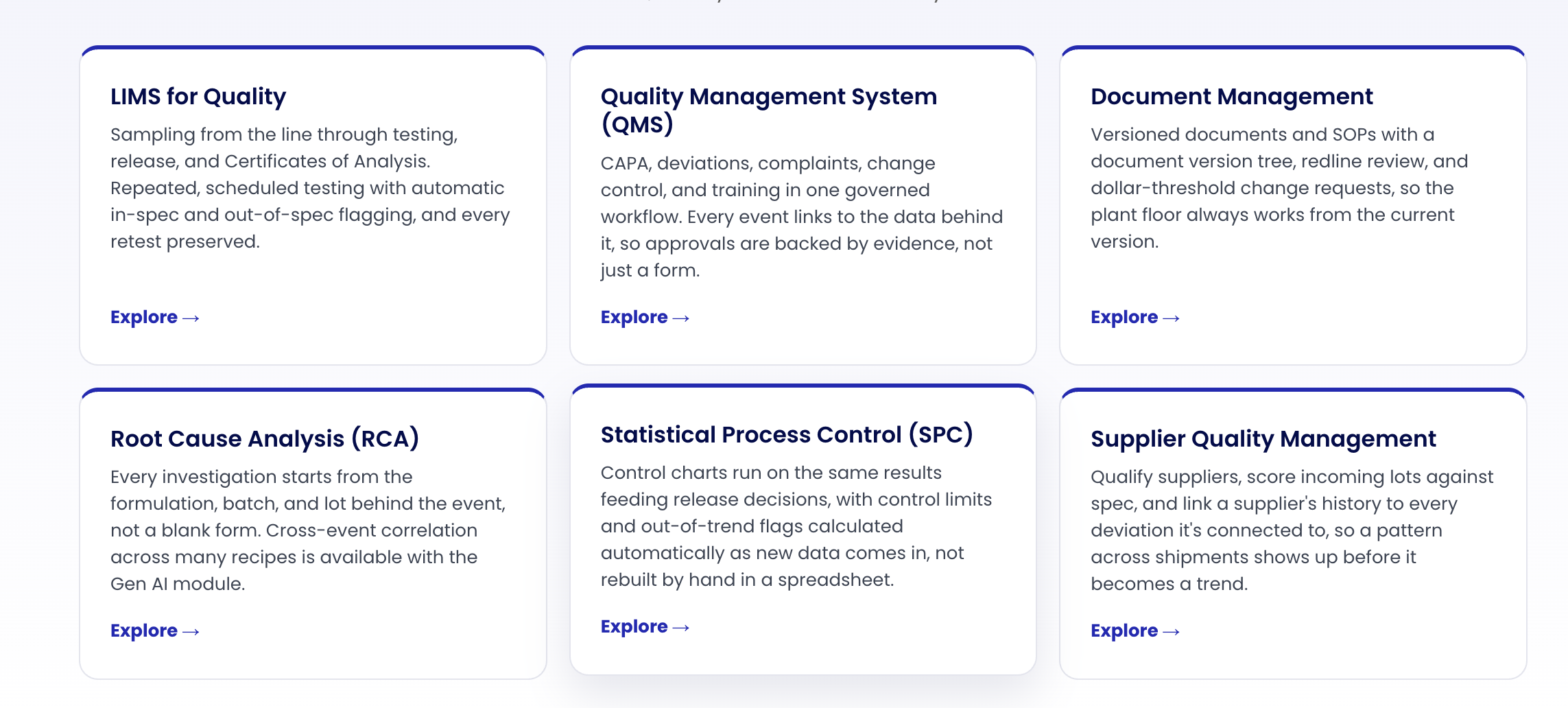
Most buyers start with one question: do you care about samples coming off the line, or do you care about documents? Start there. Document management and data-driven root cause meet in the middle, once you know which side you're on.
Quality, from detection to certification
A failed result should explain itself, and a passing one should certify itself. Because quality runs on the same record as R&D, each stage below already has the evidence it needs.

A closer look at each stage
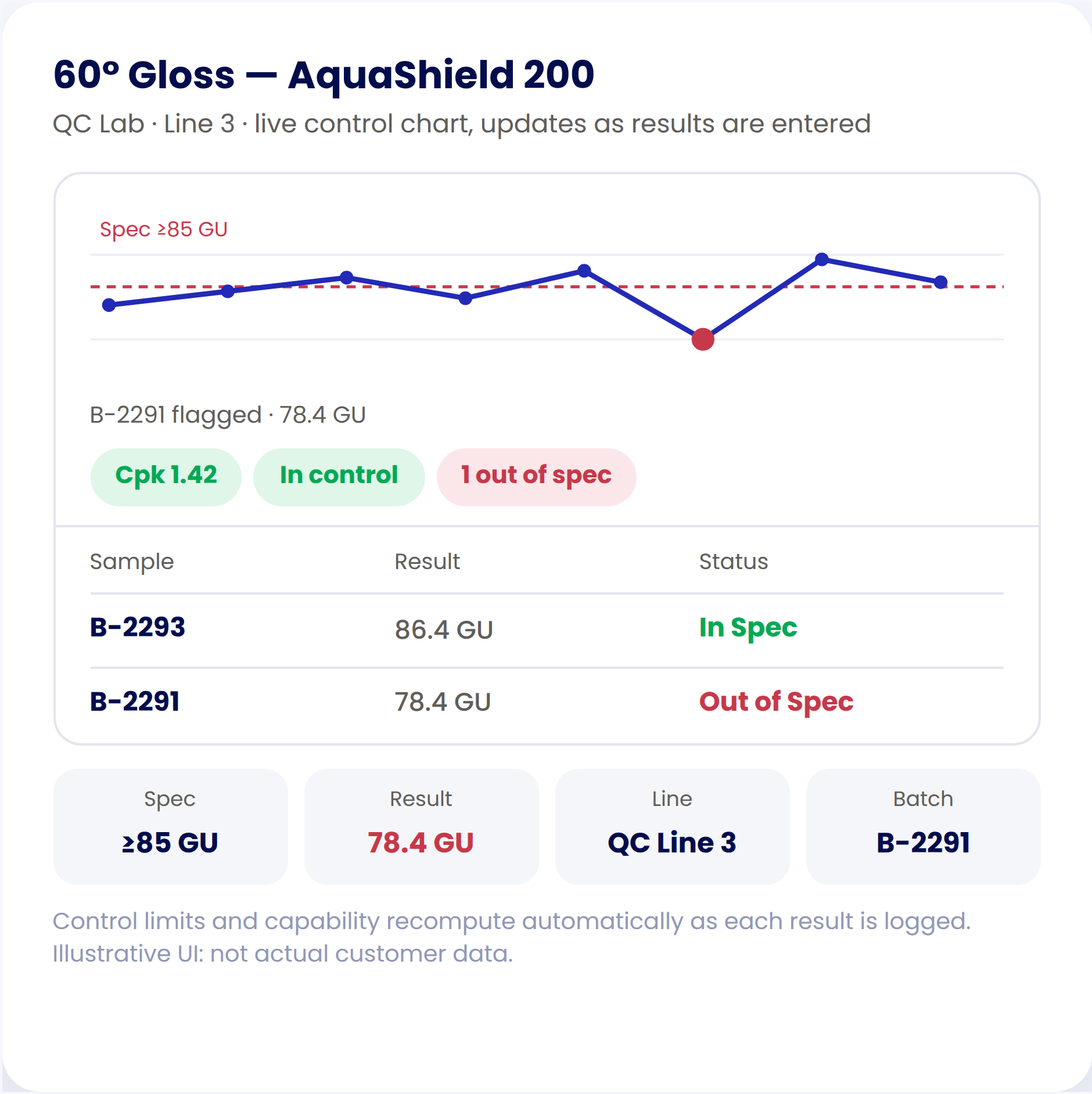
Statistical process control that happens as results are entered, rather than in a monthly export to a separate stats package.
Live control charts: Control limits and capability recompute as each result is logged, from the stable in-control baseline rather than from every point ever recorded.
Out-of-spec flagged at entry: A result outside its release spec is flagged the moment it is recorded, so the line hears about it in minutes rather than at month end.
Repeated testing without retyping: Scheduled, templated test plans per product line, so a technician running the same panel three times a day is not rebuilding the form each shift.
Live SPC. Capability indices. Spec limits. Scheduled test plans. Certificates of Analysis
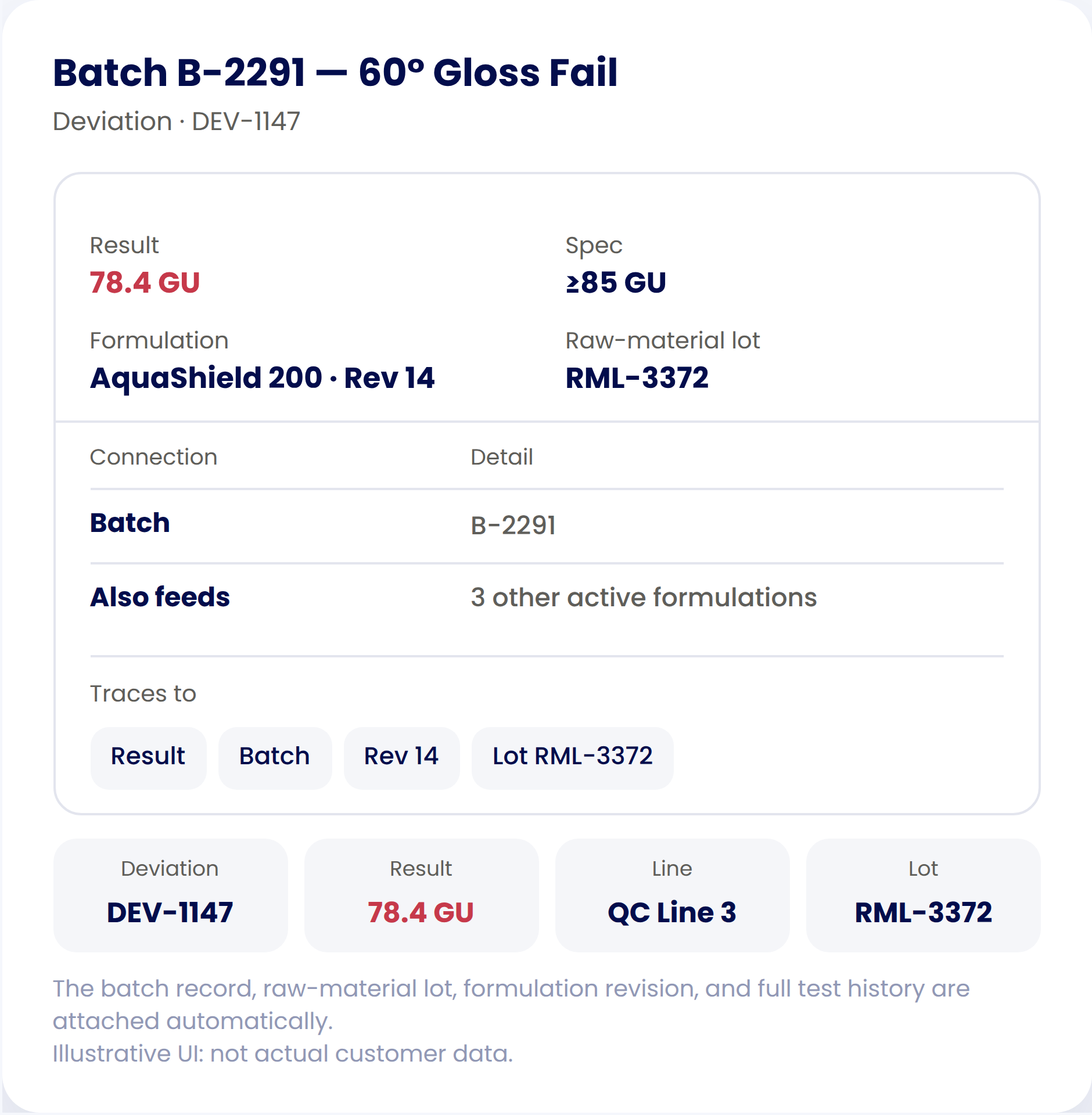
A deviation is only as useful as the data attached to it. Here it opens already linked to everything that could explain the failure.
The evidence is already attached: The deviation carries the batch record, the raw-material lot, the formulation revision, and the full test history, so nobody assembles a folder by hand.
Retests are preserved, not overwritten: Most systems keep the final value and lose the original failure. Uncountable keeps both, which is what makes an investigation possible at all.
Root cause traces to the recipe: Follow the failing batch back to the formulation revision and the lot that went into it, then check every other product that used the same lot.
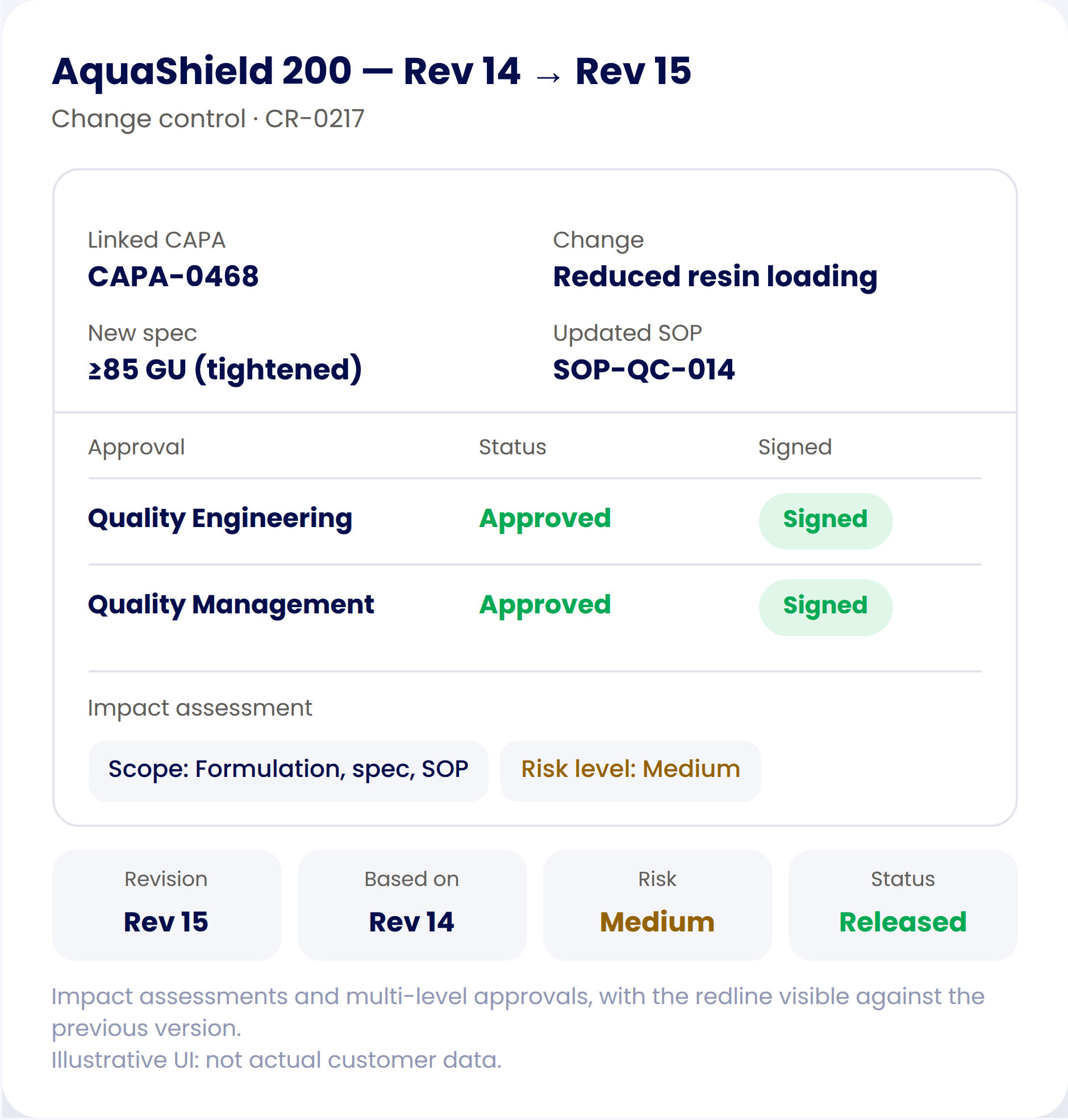
The corrective action has to reach the specification, or it is paperwork. In Uncountable, the CAPA executes the spec change.
CAPA governed in one place: Each CAPA is stage-gated and links to the triggering formulation revision, batch, and test data. QC references and hands off, and Quality Management owns the CAPA.
Change control with real approvals: Impact assessments and multi-level approvals, with the redline visible against the previous version rather than described in a comment.
Documents and training stay in step: A released SOP change triggers retraining and a graded knowledge check, so the plant floor is working to the current version.
CAPA. Deviations. Change control. Document and SOP control. Supplier quality. Training records
Audit readiness should be a byproduct of doing the work, not a project you run for six weeks before an inspection.
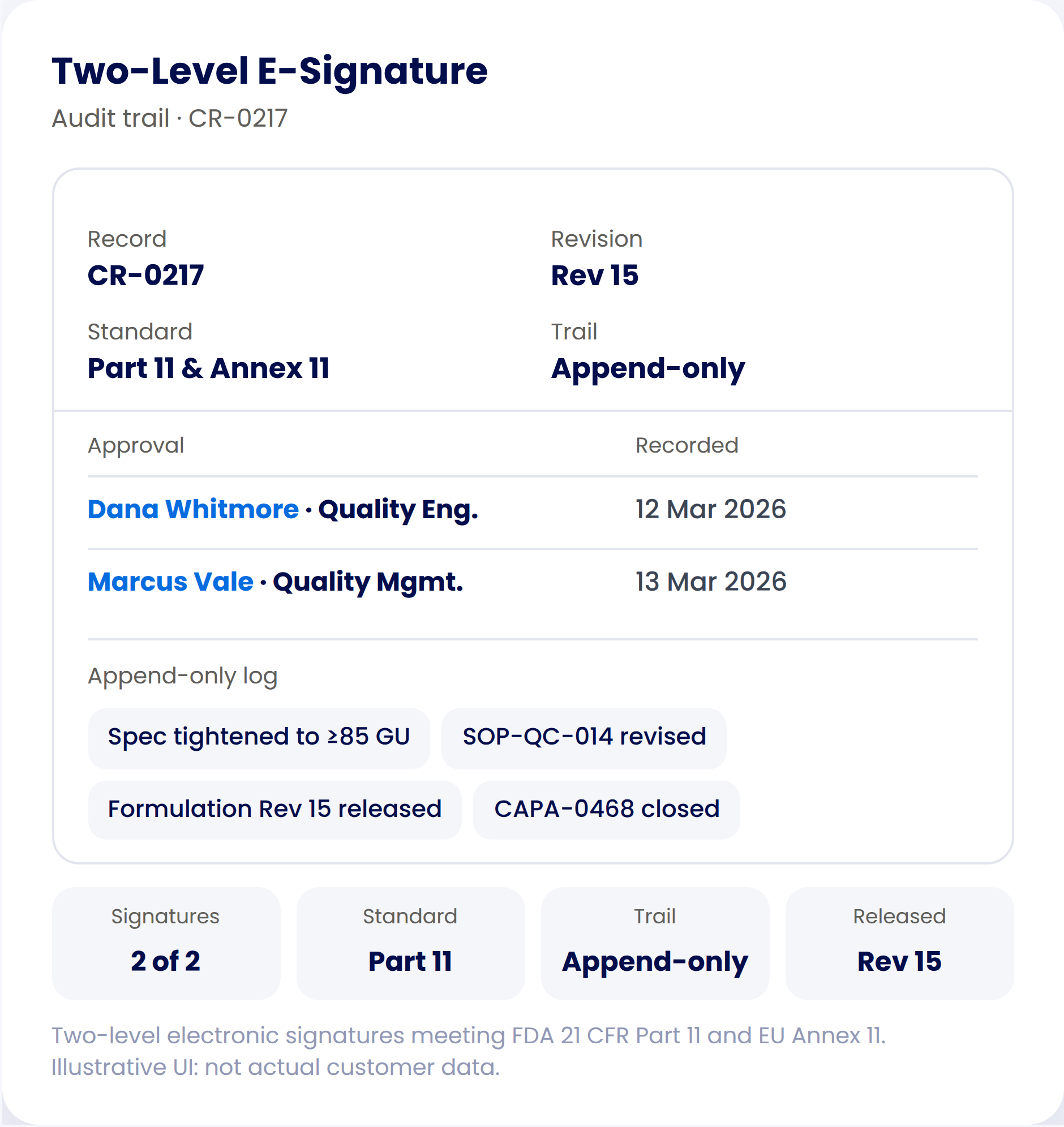
Audit trails you did not have to build: Every change to a record is captured automatically with who, what, when, and the previous value, on an append-only trail.
E-signatures that meet the standard: Two-level electronic signatures meeting FDA 21 CFR Part 11 and EU Annex 11, applied at the points in the workflow that need them.
One chain, end to end: Failed result, deviation, CAPA, change control, new revision, tightened spec, updated SOP, retrained operator. One connected chain an auditor can follow in a single system.
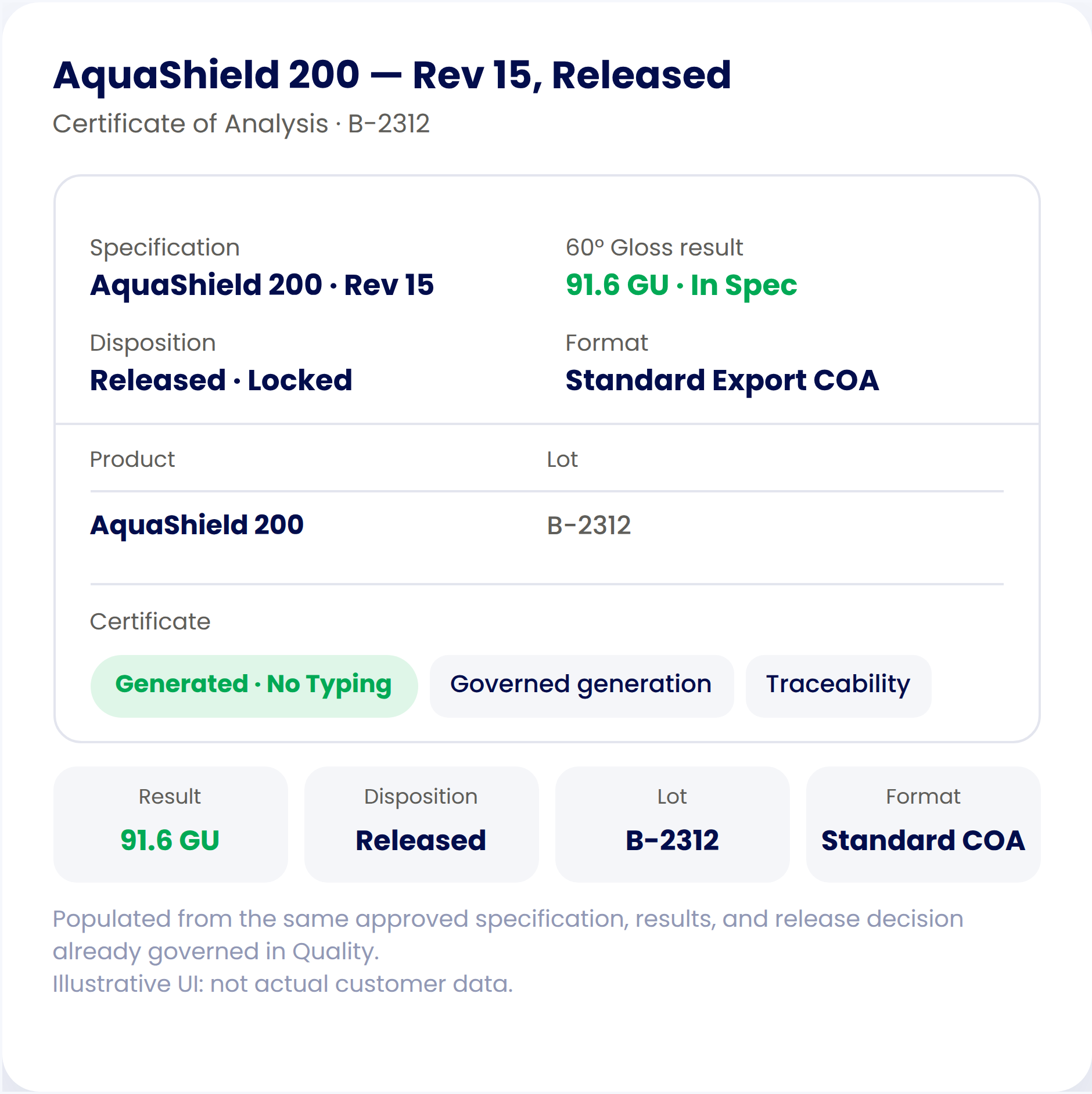
A Certificate of Analysis is a customer-facing statement, not an administrative afterthought. It should be generated from the record, not rebuilt in a spreadsheet after the decision is already made.
Generated from the record: The certificate populates from the same approved specification, results, and release decision already governed in Quality. Nothing on it is retyped.
Controlled formats, not local copies: Certificate formats and customer-specific variants are centrally owned and version controlled, not maintained as separate files on someone's desktop.
Traceable back to what it certifies: Every issued COA stays connected to the specification, results, and approval behind it, so a customer question doesn't turn into a search across folders and email.
Governed generation. Controlled templates. Customer-specific formats. Traceability
One LIMS for Quality, five labs, 300+ batches a day
Lubrizol runs Uncountable's LIMS for Quality across 5 labs and 1000+ users, testing more than 300 batches each day, with bidirectional integration with SAP.
5 labs
1,000+ users
300+ batches a day
Connected to the systems you already run
Uncountable sits at the center as the system of record for R&D and quality data, with a comprehensive API and integration layer connecting the systems around it.
Where connected Quality shows up
Not a note in a binder and a scramble to find the formulation behind it. The result, the batch, the lot, and the SOP in force are already linked, so the investigation starts with the data instead of a search for it.
A substitution that changes the compliance picture shows up on the recipe immediately, not after the reformulation is finished.
Not a week spent assembling binders and cross-checking versions. Every signature, revision, and approval is already time-stamped and attached to the batch it belongs to, ready to pull up on request.
Not an email blast and a hope that everyone read it. Retraining assignments go out automatically to everyone on the affected SOP, and the old version can't be worked from once it's superseded.
Not a phone call to the supplier before anyone knows if it's even a pattern. Incoming inspection data links straight to that supplier's history, so one bad lot shows up against the trend instead of in isolation.
Not a spreadsheet copied out of the LIMS and rechecked by hand. Results roll up against spec automatically, and the Certificate of Analysis generates from the same data, so release is a decision, not a data-entry exercise.
Shared by every suite
Bodie and the Portal work across R&D, Quality, Product Lifecycle and Project Management at once, on the same structured data model.

Bodie, the AI Layer

The Uncountable Portal
.png)
An out-of-Spec result should explain Itself.
Most quality systems can tell you a batch failed. Because Uncountable holds the formulation, the process, and the test history on the same record, it can also tell you which revision and which raw-material lot to look at, and which other products used them.
FAQs
Every quality event links to the formulation revision, batch record, raw-material lots, and test data behind it, because all of that lives on the same structured record. An out-of-spec result can automatically generate a deviation, and the resulting corrective action reaches the specification itself rather than sitting in a separate document.
Yes. Automatic audit trails and electronic signatures meet FDA 21 CFR Part 11 and EU Annex 11, including multi-level signature steps and an append-only change history that records who changed what, when, and what the previous value was.
Yes. QC lab work is scheduled and repetitive by nature, so test plans are templated per product line and can be curated per customer for Certificates of Analysis. Lubrizol runs LIMS for Quality across five labs with more than 1,000 users and over 300 batches a day.
No. Uncountable holds the quality and development record and integrates bidirectionally with your ERP. Production batch history stays where it lives today in your MES and QC systems of record. Uncountable connects to them rather than claiming to replace them.
Yes. Certificates of Analysis populate directly from the approved specification, results, and release decision already governed in Quality, so nothing has to be retyped into a separate template. Formats and customer-specific variants are centrally controlled, and every issued COA stays traceable back to the data and approval behind it.
See it on your own Quality data.