A LIMS and an SDMS both help laboratories manage information, but they are designed around different primary objects. A LIMS manages samples, tests, specifications, workflows, and reportable results. An SDMS manages scientific records and raw instrument data, including the files and metadata that support those results.
That distinction becomes important when a laboratory asks a deceptively simple question:
Where does the original evidence live?
A LIMS can show that a sample was received, tested, reviewed, and released. It can capture results, assign work, track specifications, and manage laboratory status. But the chromatogram, spectrum, instrument export, image, or native file that supports a result may originate, and remain, somewhere else.
An SDMS is designed to provide a controlled layer for collecting, retaining, organizing, and retrieving those scientific records. It does not replace the sample and workflow functions of a LIMS. Instead, it helps connect the laboratory’s reportable results with the underlying files, data context, and evidence needed to understand and defend them.
For many laboratories, the answer is not LIMS or SDMS. It is a well-defined architecture in which each system has a clear role.
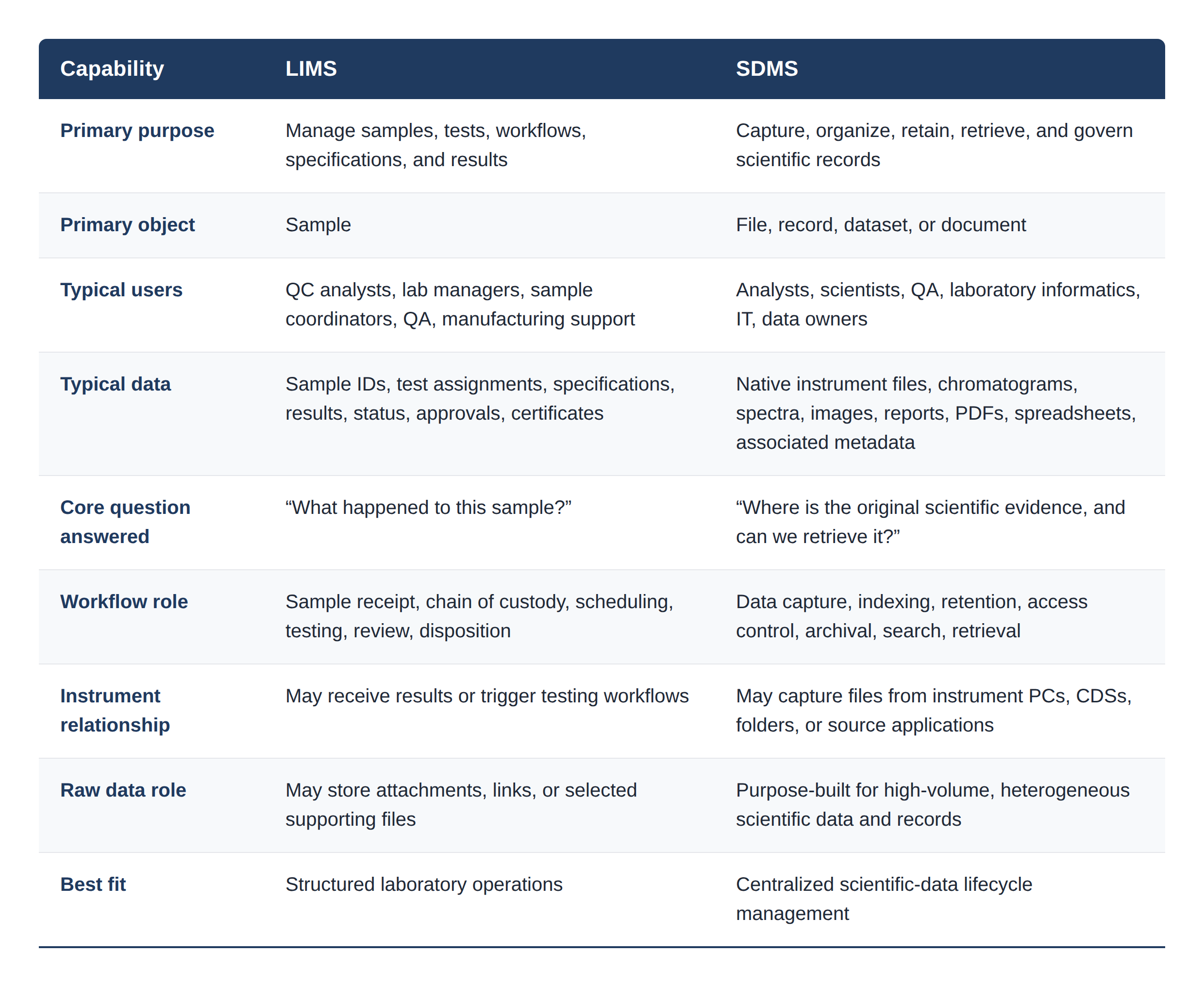
LIMS vs. SDMS at a glance
What a LIMS does
A laboratory information management system is usually organized around the lifecycle of a sample. It gives laboratories a structured way to know what was received, where it is, what testing is required, who is responsible, whether the work is complete, and whether the result meets the relevant specification.
A LIMS can support activities such as:
- Logging samples and assigning unique identifiers
- Tracking sample location, custody, storage, and disposal
- Assigning tests, methods, analysts, instruments, and due dates
- Managing specifications, limits, calculations, and result-entry rules
- Recording structured test results
- Supporting review, approval, exception management, and release workflows
- Generating certificates of analysis and laboratory reports
- Managing reagent, inventory, stability, and environmental-monitoring workflows, depending on the implementation
- Exchanging information with instruments, CDSs, ERP systems, QMSs, manufacturing systems, and other applications
In a QC environment, a LIMS often becomes the operational backbone of the lab. It helps ensure the right sample receives the right testing and that results move through a controlled review and disposition process.
This sample- and workflow-centric design is a strength. It also means that LIMS data is often highly structured: sample number, material, batch, specification, test, result, unit, limit, analyst, date, status, and approval.
However, structured results are not the same thing as every original record used to produce them.
What an SDMS does
A scientific data management system is organized around scientific records themselves. It is designed to capture, index, preserve, and retrieve data produced by laboratory instruments and applications, especially when those records are spread across workstations, file shares, local folders, proprietary applications, and multiple sites.
An SDMS can manage:
- Native instrument files
- Raw data exports
- Chromatograms and associated records
- Spectra and spectral libraries
- Microscopy images and image-analysis outputs
- Balance, titration, particle-size, rheology, and thermal-analysis records
- Instrument-generated reports
- Spreadsheets, PDFs, and scanned supporting documentation
- Associated metadata such as sample ID, batch, method, project, product, test, analyst, instrument, location, and date
An SDMS may collect records automatically from monitored folders, instrument workstations, CDSs, or other connected systems. It can then apply metadata, access controls, retention rules, search capability, and a governed retrieval process.
The value is not simply “more storage.” An unmanaged drive can hold files. An SDMS is intended to help a laboratory understand what those files are, how they relate to one another, who can access them, how long they should be retained, and how they can be found later.
The difference between a result and the evidence behind it
The most useful distinction is this:
- A LIMS commonly records the result that matters to the sample, test, specification, or release decision.
- An SDMS commonly retains the scientific data and supporting files that help demonstrate how that result was generated.
For example, a LIMS might record that a finished product sample met a specification for assay, impurity, viscosity, moisture, or particle size. But supporting evidence can exist elsewhere:
- A chromatography data system may hold the chromatogram, processing method, sequence, integrations, and analytical review history.
- An instrument workstation may hold the native file produced by a particle-size analyzer or rheometer.
- A spreadsheet may contain a calculation or data transformation.
- A PDF report may document a result review.
- An SDMS may collect, index, and preserve these materials so they remain associated with relevant metadata and can be retrieved when required.
This does not mean every LIMS lacks raw-data functionality. Many LIMS implementations can store attachments, receive instrument outputs, or link to external records. The architecture should be assessed based on the laboratory’s data types, data volumes, retention needs, record-integrity expectations, and ability to retrieve complete evidence later.
The key question is not whether a LIMS can attach a file. It is whether the laboratory can reliably preserve, govern, search, and reconstruct the original record across all relevant instruments and workflows.
Why raw instrument data needs its own strategy
Raw instrument data is often difficult to manage because it is diverse, voluminous, proprietary, and created at the edge of the laboratory.
A single site may use dozens or hundreds of systems that generate different files, including chromatography data systems, spectrometers, balances, thermal-analysis tools, imaging systems, particle size analyzers, formulation software, and instrument-specific applications.
Without a deliberate data management strategy, those records can become fragmented across:
- Instrument PCs
- Local hard drives
- Shared drives
- Departmental folders
- Removable media
- Email attachments
- Legacy application servers
- Individual analysts’ spreadsheets
- Disconnected cloud storage locations
That fragmentation creates practical risks. A scientist may not be able to locate a previous result. A QA reviewer may need to ask several people to reconstruct a record. A technology transfer team may find only the reported value, not the original data and context. During an audit or investigation, the laboratory may struggle to retrieve the full electronic record quickly and consistently.
A LIMS can help organize the sample workflow around this data. An SDMS can help preserve and retrieve the record set itself.
Data integrity: why the boundary matters
For regulated laboratories, data integrity depends on more than the final result. FDA guidance defines data integrity as the completeness, consistency, and accuracy of data. It also describes audit trails as secure, computer-generated, time-stamped electronic records that allow reconstruction of the creation, modification, or deletion of an electronic record.
For analytical data, the original record may include information that does not appear in a final LIMS result: the native data file, instrument method, processing settings, sequence details, user activity, review evidence, and, in applicable workflows, any reprocessing or justified changes.
FDA has specifically noted that electronic raw data includes the computerized format generated by analytical instruments, including information such as chromatograms or spectra, sample queues, method details, analyst identity, and other relevant records. A paper printout alone may not contain the full information needed to establish the validity of the electronic record.
This does not mean every laboratory needs a separate SDMS to meet its obligations. It means laboratories need an architecture and procedure set that can preserve relevant original records, maintain appropriate controls, and make information available for review and retrieval. An SDMS can be one way to support that goal, particularly where data is distributed and the LIMS is not designed to serve as the repository for all native instrument data.
When a LIMS may be sufficient
A LIMS may be sufficient as the primary laboratory information platform when the data environment is relatively controlled and the system can support the organization’s actual workflow, evidence, retention, and retrieval needs.
That may be the case when:
- The laboratory primarily needs to manage sample receipt, testing, specifications, results, and disposition.
- Instrument data volumes are modest and the LIMS has suitable integration or attachment capabilities.
- Most supporting records can be reliably linked to the relevant sample and test.
- Users can retrieve original evidence without depending on local instrument computers or informal file-sharing practices.
- The laboratory has well-controlled procedures for backup, access management, audit trails, data review, and retention.
- The organization does not need to harmonize large volumes of heterogeneous data from many instruments, sites, or applications.
The decision should be based on demonstrated usability and retrievability, not simply a procurement checklist. If a laboratory cannot efficiently locate a complete record months or years later, it may have a data-lifecycle problem even if the required final result exists in the LIMS.
When a lab may need an SDMS alongside LIMS
An SDMS becomes more valuable when the LIMS is doing its sample-management job well but the laboratory still lacks a dependable way to manage the underlying scientific evidence.
Consider adding or strengthening SDMS capabilities when:
- Raw files are routinely saved to instrument workstations or shared drives.
- The laboratory uses multiple types of instruments with different native file formats.
- Analysts rely on manual file naming and folder structures to find historical data.
- The organization needs centralized search across data generated by different instruments or sites.
- QA must retrieve complete records for investigations, inspections, deviations, complaints, or product-quality reviews.
- Data has to be retained for long periods while instruments, applications, personnel, and storage environments change.
- Existing file repositories do not maintain sufficient metadata or links to samples, batches, tests, products, projects, or specifications.
- A laboratory is consolidating sites, transferring methods, migrating systems, or preparing for modernization.
- R&D, QC, quality, manufacturing, and IT need to access a common evidence base without copying files between disconnected systems.
The ideal outcome is not data duplication. It is a connected architecture. The LIMS should retain responsibility for structured laboratory workflow and status. The SDMS should retain responsibility for controlled scientific-data capture, retention, and retrieval. Shared identifiers should preserve the link between a sample and the evidence generated during its testing.
How LIMS and SDMS work together
A connected LIMS–SDMS architecture can make the sample record and its underlying data mutually discoverable.
For instance:
- A LIMS assigns a sample ID and test request.
- The identifier is made available to the instrument workflow, CDS, or analyst.
- The instrument or source application generates raw data.
- The SDMS captures or indexes the resulting files and applies relevant metadata.
- The LIMS receives the structured result, status update, or reportable outcome.
- Users can navigate from the LIMS sample or test to the supporting data record in the SDMS.
- QA, scientists, and authorized users can retrieve the complete evidence set when needed.
This is particularly useful for paperless laboratory workflows. One industry example notes that linking LIMS and SDMS can allow the LIMS to use raw data retained in the SDMS when producing a certificate of analysis, rather than relying on disconnected paper records or manual file searches.
The precise design will differ by laboratory. What matters is that identifiers, ownership, metadata, record versions, access controls, and retention responsibilities are clearly defined.
LIMS vs. SDMS vs. CDS vs. ELN
Laboratory informatics becomes easier to understand when each system has a primary responsibility.
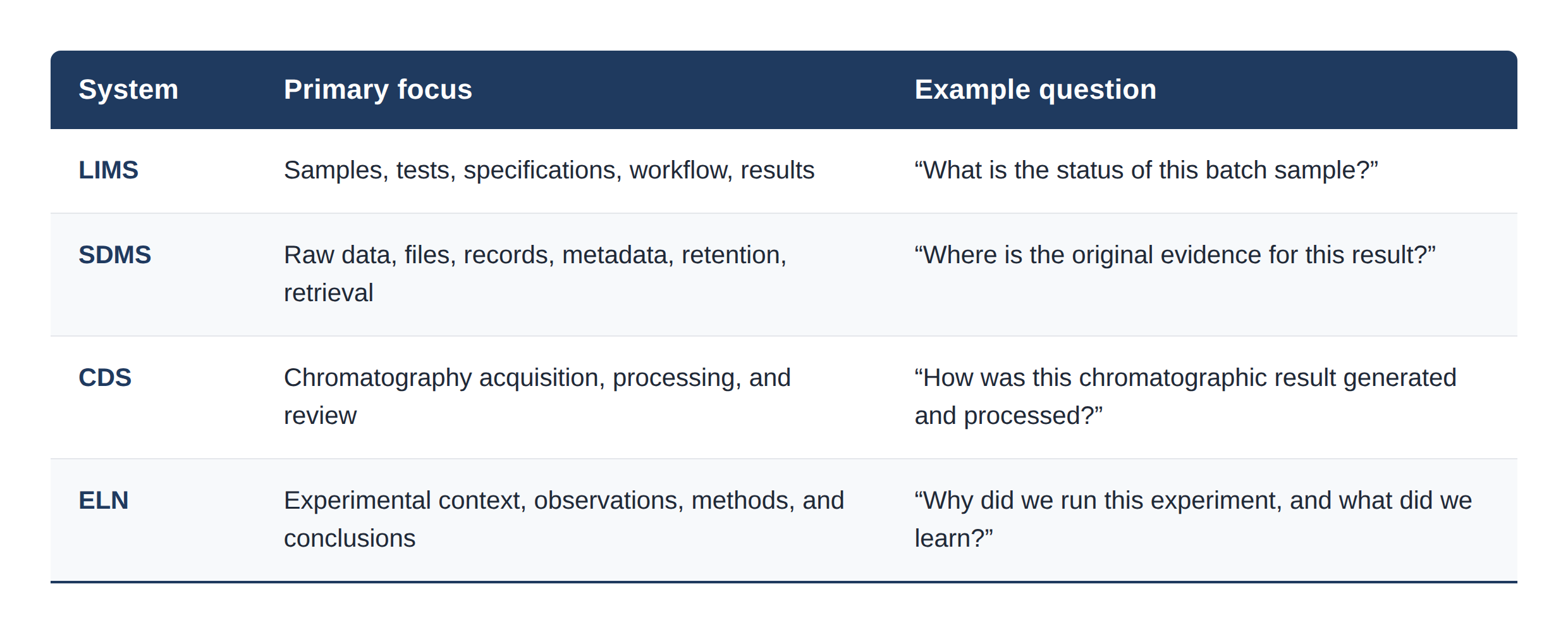
There can be overlap. A LIMS may attach a report. An SDMS may hold a LIMS export. An ELN may reference a raw file. A CDS may include sophisticated record-management capabilities for chromatography workflows.
But overlap should not obscure system accountability. When a laboratory defines which platform owns which data object and lifecycle activity, it reduces duplicate entry, improves traceability, and makes future integration and migration much easier.
Questions to ask before choosing
Before deciding whether to use LIMS, SDMS, or both, involve laboratory operations, QA, IT, and data owners in a shared assessment.
Ask:
- What types of raw data do our instruments and laboratory applications create?
- Where are those files stored today, and which locations are unmanaged or difficult to search?
- Which records must be preserved in their original or complete electronic form?
- Can we trace a final result in LIMS back to the supporting raw data, methods, calculations, and review activity?
- Which system is the authoritative source for sample identity, test assignment, result status, and final disposition?
- Which system is the authoritative source for native files and associated scientific records?
- Which identifiers need to flow between systems?
- Are users manually downloading, renaming, emailing, or attaching records to maintain traceability?
- Can authorized users retrieve a complete record for a historical sample without relying on one analyst, one workstation, or one file share?
- How will data be retained, backed up, protected, migrated, and accessed through system changes?
The answers often reveal whether the issue is missing software, incomplete integration, unclear process ownership, or all three.
Build a laboratory data architecture that preserves context
LIMS and SDMS are not competing definitions of the same thing. They represent two essential but different layers of laboratory information management.
A LIMS helps a laboratory run its sample and testing workflow. An SDMS helps the organization preserve and retrieve the data that supports that workflow. Together, they can connect a sample, the test it underwent, the result it produced, and the original analytical evidence behind that result.
For organizations moving toward connected R&D, QC, and quality data, that connection is the real objective. When results, raw files, scientific context, and product information remain linked, teams spend less time searching for evidence and more time using trusted data to make decisions.