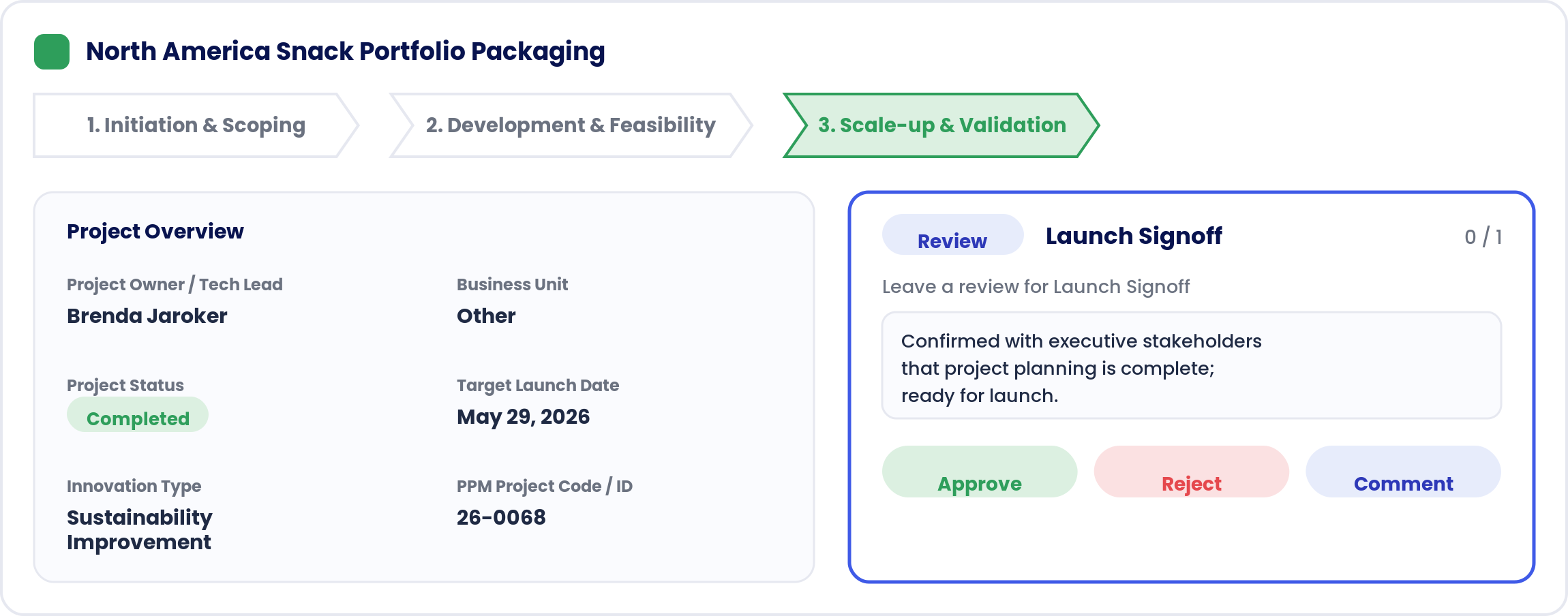
To run stage-gate reviews on evidence rather than opinions, connect each project's status to the experiments and quality results behind it, and record every go, hold, or kill decision together with the data that supported it. A stage-gate process moves an R&D project through defined phases, and at each gate leaders decide whether it continues, pauses, or stops.
Why do stage-gate reviews break down?
Stage-gate reviews break down when the status they rely on is manual, stale, and disconnected from the work. In many R&D organizations, project status is typed in by hand into a tool separate from the experiments and quality data that actually define progress. By the time the review happens, the spreadsheet or slide is already out of date, so the gate meeting debates opinions rather than evidence, and the go, hold, or kill decision is only as good as the last person to update the sheet.
What an evidence-based stage-gate looks like
An evidence-based stage-gate captures the decision and the data behind it at the same moment. At each gate, the team records the go, hold, or kill and the resourcing decision, with the supporting lab data attached to that decision. Uncountable's project portfolio management (PPM) organizes projects by configurable stage-gates, from initiation and scoping through development and feasibility, scale-up and validation, and launch readiness and handover, so every phase has a clear checkpoint and a documented rationale.
How Uncountable derives project status from real data
Uncountable derives project status from the experiments and quality results underneath each project, rather than from a status field someone remembered to update. Because PPM runs on the same platform as the experiments, quality, and production behind it, every project links to its own data, and its phase and health reflect that work. When status is grounded in the underlying records, gate reviews start from evidence.
How do you catch a stalled project early?
You catch a stalled project by watching signals the project itself produces, not by waiting for someone to report it. Uncountable's PPM surfaces a quiet project on its own using time-in-stage, missed milestones, and a lack of recent data activity, so a stall shows up as evidence rather than a surprise at the next review. That lets leaders act early, redirect people and lab capacity, and rationalize the portfolio on evidence rather than politics, answering the portfolio questions behind each big R&D bet.
What to review at each stage-gate
Each gate should have criteria agreed before the project reaches it, so the review checks evidence against a standard rather than debating what good looks like. The phases below are a common pattern; adapt the criteria to your products and risk level.
- Initiation and scoping. The project objective, target properties or performance, constraints such as cost or regulatory limits, and the criteria that will define feasibility.
- Development and feasibility. Experimental results compared with the targets, the technical questions still open, and whether the remaining risk justifies further investment.
- Scale-up and validation. Pilot results, quality results, open deviations, and the status of any supplier or material qualification the project depends on.
- Launch readiness and handover. Approved specifications, complete quality evidence, and a clear handover of the product definition to manufacturing.
For example, a coatings project that has met its gloss and durability targets in the lab but still has an open raw material qualification may be a reasonable "go" to scale-up with that qualification recorded as a condition, rather than a "go" that quietly assumes the issue is closed.
Two habits make the process more reliable. First, record the reason for a hold and the evidence needed to resume, so the project does not drift. Second, treat a well-supported kill decision as a useful outcome: stopping an infeasible project early frees people and lab capacity for stronger ones. The project portfolio management guide covers how these decisions roll up across a portfolio.
See evidence-based stage-gates on your own portfolio
See every project, backed by the data underneath it. Book a personalized demo and we will show you how evidence-based stage-gates apply to your team.