
A sample bank should connect stored material to experiment data so teams can establish which sample produced a result and find what has already been learned from related material. Location, quantity, and availability remain essential. They are the starting point, not the full scientific record.
The gap becomes visible when a promising result cannot easily be traced to its bank lot, aliquot, or preparation. The information may exist, but someone must assemble it from several systems before the team can use it confidently.
For sample management in R&D, traceability needs to work beyond the freezer door.
The connection breaks between storage and experimental use
A biobank system may record storage and distribution. An ELN may describe preparation and experimental conditions. A testing system may hold measurements. A spreadsheet may connect source vials with plate wells.
Each record can be correct while the overall history remains difficult to follow.
Consider an illustrative cell-based assay workflow. A scientist retrieves a vial, expands the culture, prepares an assay plate, and records a response. The biobank records the vial’s check-out. The notebook records the culture. The instrument file identifies wells. A separate plate map connects those wells with the preparation.
The scientific record depends on those connections surviving every handoff.
If identifiers are copied inconsistently, derivatives are recorded only in notes, or plate mappings remain in attachments, the next scientist must reconstruct the sequence. Giving that scientist access to every system helps them find information. It does not automatically establish the relationships between records.
A connected workflow makes those relationships explicit.
Trace results back to the exact material used
A result should connect to its experiment, plate position, preparation, aliquot, and source material.
That route matters when results differ. Before attributing a change to the experimental treatment, the team can inspect whether the work used a different bank lot, passage, preparation, or handling history.
This does not establish causation. It makes relevant differences available for investigation.
Exact identity matters here. A result linked to a cell-line name is not necessarily linked to the bank lot or vial used. A result linked to a parent sample may still leave uncertainty about which aliquot entered the experiment.
The useful record preserves both the scientific identity and the physical material involved.
Find results across related samples and derivatives
Searching one sample identifier is insufficient when the question concerns a family of material.
A source lot may have many aliquots. A cell line may have several banks and derivatives. A strain may support multiple screening experiments.
A connected record lets the team follow those relationships. Starting with a source lot, a scientist can identify its derivatives and the experiments that used them. Starting with an unexpected result, the scientist can inspect other results generated from related material.
That is different from searching a name in free text. Names can vary between teams, change over time, or refer to several levels of the sample hierarchy.
The relationship should remain intact even when a display name changes.
Check existing material before preparing it again
Connected records also support a practical decision: whether suitable material already exists.
Before preparing another batch, a team should be able to review available stock, relevant handling history, previous experimental use, and existing results.
Reuse is not automatically the right choice. Remaining quantity, restrictions, consent, storage history, and suitability still need review.
The benefit is having enough information to decide. Without it, teams may repeat preparation because locating and assessing existing material takes too much effort.
The same record can help a sample manager understand demand. A request tied to an experiment is easier to evaluate than an email asking for “another vial of the usual line.”
A connected sample record preserves distinct relationships
A connected record does not need to put every detail on one screen. It needs to maintain dependable links between the records that describe the work.
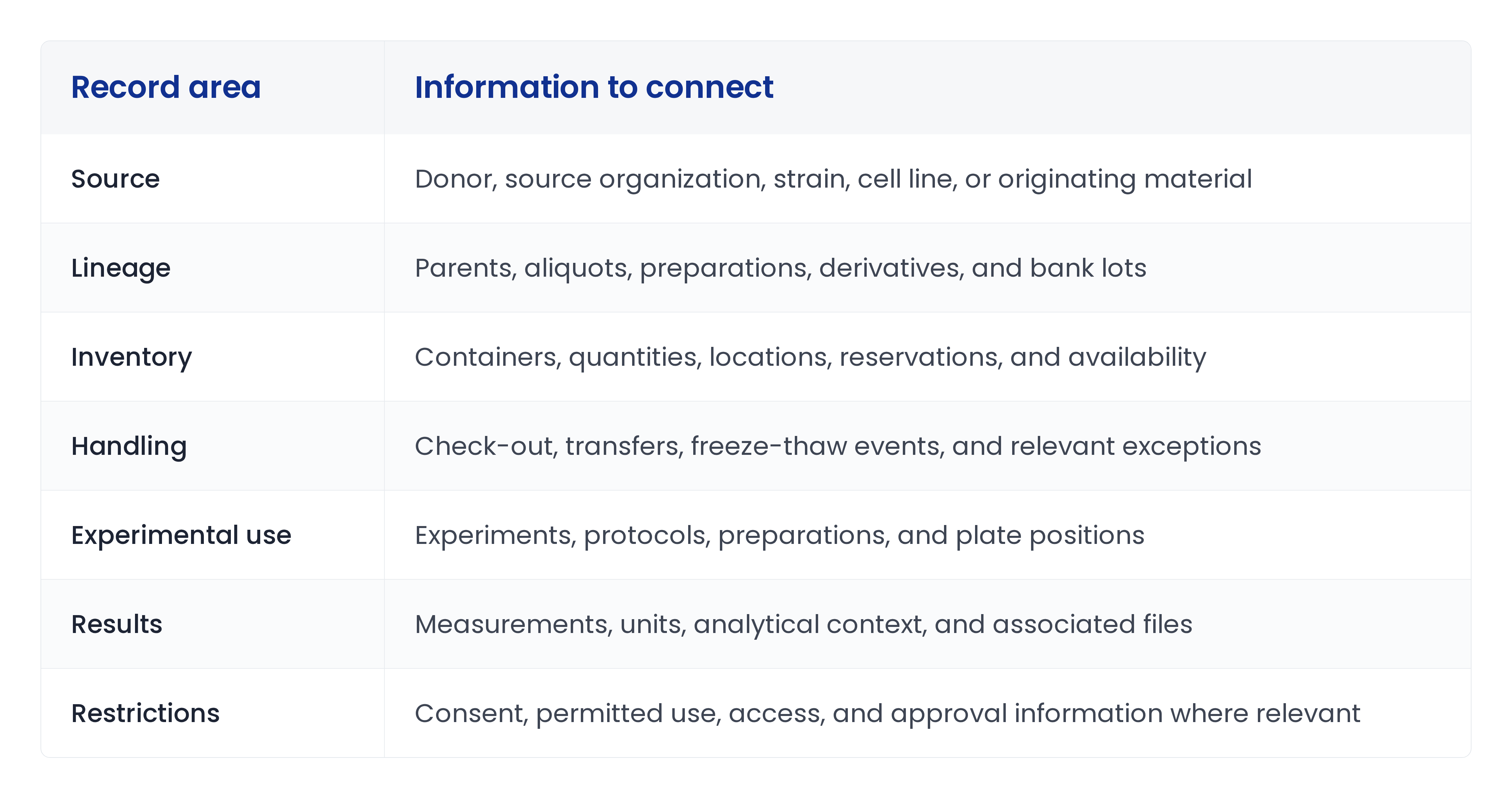
Keep identity separate from description. A familiar cell-line name can coexist with distinct identifiers for its banks, vials, and preparations.
Keep lineage separate from location. Moving a vial changes where it is. Creating a derivative changes its relationship to other material.
Keep measurements separate from judgments about them. A result, its acceptance status, and a scientist’s interpretation are related but different records.
ISO 20387:2018 addresses biobank competence and consistent operation, including the quality of biological material and associated data. It does not prescribe this software architecture, but it reinforces the importance of treating material and data together.
Plate records carry the connection into testing
Plate preparation is a common point where a clear sample history becomes a naming exercise.
A destination well may contain an aliquot, a dilution, a mixture, or a derived preparation. The record should describe what entered the well and how it was prepared, not just copy the source label.
Preserve source-to-destination mapping alongside preparation conditions and resulting measurements.
If a plate is rerun, retain the distinction between the original and repeat measurements. If a well is excluded, record that decision without removing the evidence of what happened.
Test the connection in both directions. From a well, the scientist should be able to identify the source material. From a vial, the scientist should be able to find its destination wells and results.
An attached plate map can document the work. Structured relationships make that work easier to query.
AI makes connected records easier to use
AI can offer another way to retrieve and summarize information. It cannot reliably replace relationships that were never recorded.
Useful tasks include finding experiments associated with a bank lot, locating available samples with relevant assay results, and comparing the recorded preparations behind two outcomes.
The answer needs an inspectable route back to source records. A plausible summary is not enough if the user cannot establish which samples and measurements it includes.
LLM extraction can also help bring information from PDFs and certificates into structured records. Review remains important. Sample identity, units, methods, and document context all need to be checked before extracted values are relied on.
Separate extraction from interpretation. Identifying a value in a certificate does not establish that the value applies to every related vial or derivative.
The foundation is still the data model. AI provides another way to work with it.
Uncountable connects samples, experiments, and results
Uncountable brings sample management and experimental data into one R&D platform. Teams can connect source material, lineage, inventory, plates, experiments, and test results without treating storage as a separate endpoint.
Bodie, Uncountable’s AI assistant, provides a conversational way to work with R&D data. Uncountable describes capabilities including historical data search, experiment design, visualization, and recording results. LLM extraction from PDFs can also help bring document-based information into the platform.
The objective is a record scientists can follow from stored material to experimental use, and from a result back to its source.
.png)

.png)
