The EU’s PFHxA restriction now applies to cosmetics and food-contact paper and board. From October 10, 2026, products in these categories placed on the EU market must contain less than 25 ppb of PFHxA and its salts, and less than 1,000 ppb of PFHxA-related substances. Mixtures and articles placed on the market before that date are exempt.
For R&D, regulatory and quality teams, the immediate task is reviewing the evidence behind affected products. Which raw materials could contain these substances? What do supplier declarations and test results actually cover? Can those records be traced to the formulation and material lots used?
This article explains the restriction and the records that can help teams answer those questions.
What does the restriction cover?
Commission Regulation (EU) 2024/2462 adds entry 79 to Annex XVII of REACH. It covers PFHxA, its salts and PFHxA-related substances: substances whose molecular structures give them the potential to degrade or transform into PFHxA. The EU adopted the restriction because PFHxA is highly persistent, mobile in the aquatic environment and associated with potential adverse effects on human health and the environment.
For formulators, the related-substances group is important. Checking for PFHxA alone does not address the full restriction. A review also needs to consider substances that could form PFHxA, using the regulation’s structural definitions and exclusions to establish what is in scope.
The two concentration limits
Products must meet both limits:
What is measuredRequired concentrationEquivalentSum of PFHxA and its saltsBelow 25 ppbBelow 0.025 ppm, or 25 µg/kgSum of PFHxA-related substancesBelow 1,000 ppbBelow 1 ppm, or 1 mg/kg
The thresholds apply to the sums of the substances in each group, not to each substance individually. A result covering PFHxA alone therefore does not establish compliance with both limits.
Which products are affected, and when?
The restriction has several application dates:
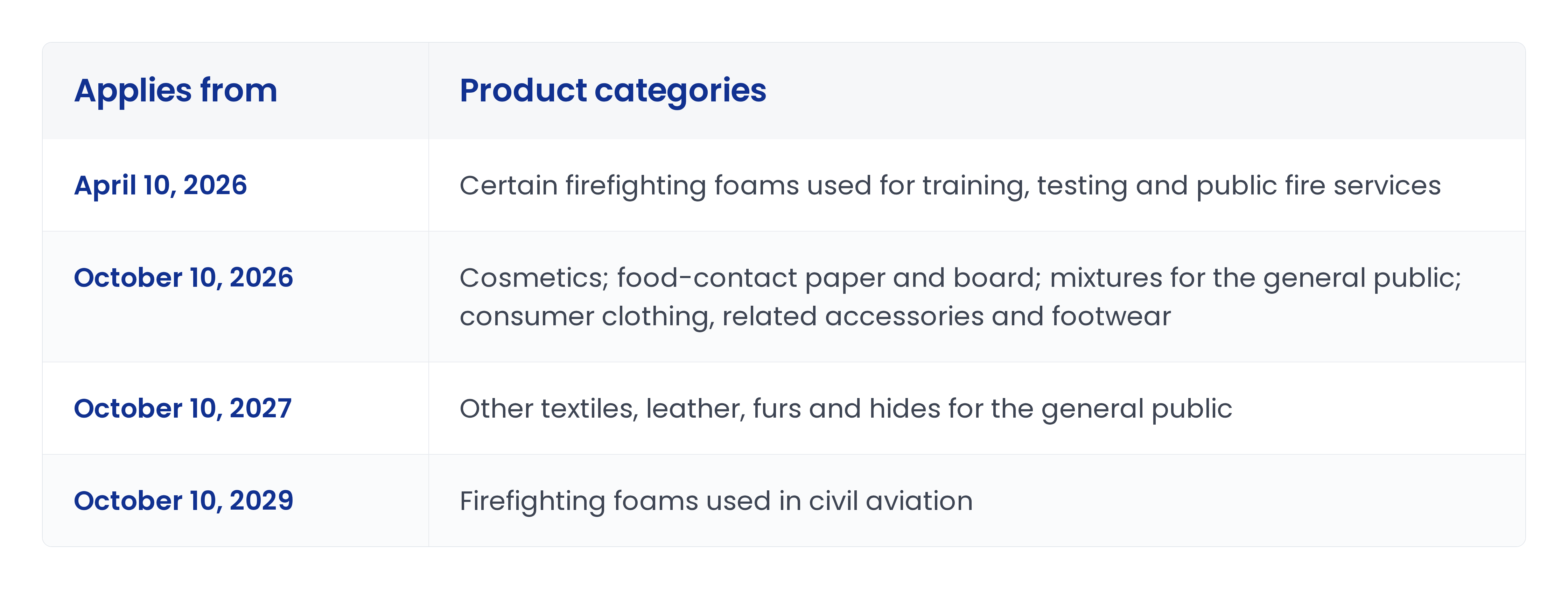
The regulation includes specific exemptions and conditions. These include certain textile and related articles used in specified Category III personal protective equipment, medical devices and in vitro diagnostic devices, as well as construction textiles. Teams should check the relevant provision rather than assume an entire product category is exempt.
For cosmetics and food-contact teams, the October 2026 deadline is now in effect. The food-contact provision specifically covers paper and board; it is not a blanket restriction on every type of food packaging.
The market-placement date matters
The regulation exempts relevant mixtures and articles placed on the market before their applicable deadline. Its stated rationale is that suppliers should be able to demonstrate that earlier market placement.
That distinction matters when reviewing existing stock. “Made before October 10” does not, by itself, establish that a product was placed on the market before October 10.
A useful product record should connect the batch or lot to its formulation version, raw-material lots and supporting compliance evidence. Where a business relies on the pre-deadline exemption, it should also retain the records supporting the market-placement date.
Three records to review
The following are practical recordkeeping priorities, not a separate documentation checklist prescribed by entry 79.
1. Supplier declarations and analytical results
Review the evidence for raw materials that could contain PFHxA, its salts or related substances. Keep declarations and test reports linked to the relevant material, with their scope, date and lot coverage clear.
The important question is what the evidence establishes. Does a declaration address both restricted groups? Which substances does a test measure? Is the reporting limit low enough to assess the applicable threshold? A document labeled “PFAS-free” needs a clear definition and supporting basis before it can be used in a compliance assessment.
2. Reformulation and verification records
Where an ingredient or material has been replaced, retain the original and revised formulation versions, the reason for the change and the evidence used to assess the replacement.
Keep performance results alongside the compliance assessment. That makes it easier to explain both why the substitution was made and whether the revised product still meets its technical requirements.
3. Batch and lot traceability
Link each affected batch to the formulation and raw-material lots actually used. Attach the relevant declarations, test results and regulatory review rather than leaving them in separate folders or email threads.
The goal is traceability: being able to retrieve the evidence for a specific product without reconstructing its history after a customer or authority asks.
How Uncountable helps
Uncountable brings regulatory screening into the formulation workflow. For rules and markets covered by its regulations database, teams can see pass-or-fail results alongside a recipe and retain the jurisdiction, product category, limit, source and last-checked date with it. Ingredient or concentration changes update the screening result as the formulation is developed.
That screening supports regulatory review; it does not replace evidence about what a material contains. Teams should confirm PFHxA coverage and the data needed for their product category with Uncountable. The platform’s live pass-or-fail result also does not currently act as an automatic release gate.
This article provides general information, not legal advice. Consult the regulation and qualified regulatory advisers when making compliance decisions.

.png)