.png)
A supplier substitution is rarely just a procurement event.
An ingredient change may begin with a supply constraint, price increase, quality concern, reformulation objective, customer request, or new commercial requirement. The request can sound straightforward: replace one botanical, colour, sweetener, flavour component, acidulant, stabilizer, or processing aid with another.
For a beverage product, the decision is rarely simple.
An ingredient contributes to product character through its chemistry, physical form, supplier process, lot variability, interactions with other ingredients, and behavior during production. Two materials can appear equivalent on a specification sheet while producing perceptible differences in flavour, aroma, colour, mouthfeel, clarity, carbonation behavior, or shelf-life stability.
The real question is not whether an alternative ingredient can be purchased. It is whether it can deliver the intended product outcome in the defined formula, process, packaging, and market context.
Certificate equivalence is not flavour equivalence
Certificates of analysis are essential quality documents. They provide evidence that a material meets the attributes specified and tested by the supplier or receiving organization.
They may not capture every difference that affects beverage character.
For some ingredients, meaningful differences can arise from source material or botanical origin, extraction or purification method, minor-component profile, volatile compounds, sensory potency, moisture content, particle size, solubility, dispersion behavior, colour, turbidity, or interaction with other ingredients. Supplier lot-to-lot variation can also matter, particularly for botanicals, natural extracts, flavours, colours, and other complex raw materials.
A specification comparison therefore provides a necessary starting point, not always a sufficient conclusion.
This does not mean every supplier change requires a full redevelopment programme. It means the evidence required should reflect the ingredient’s functional, sensory, and commercial importance in the finished beverage.
A minor processing aid may need a different assessment from a flavour-defining botanical. A colour contributor used at low dosage may still require close review if it changes consumer perception. A sweetener substitution may affect not only sweetness intensity but onset, lingering character, mouthfeel, solubility, flavour release, and stability.
Map the change before testing
Before bench work begins, teams should establish the real scope of the proposed substitution.
The key question is not simply, “What ingredient are we replacing?” It is, “Where does this ingredient appear, what does it do, and what evidence will be required before the organization can approve the change?”
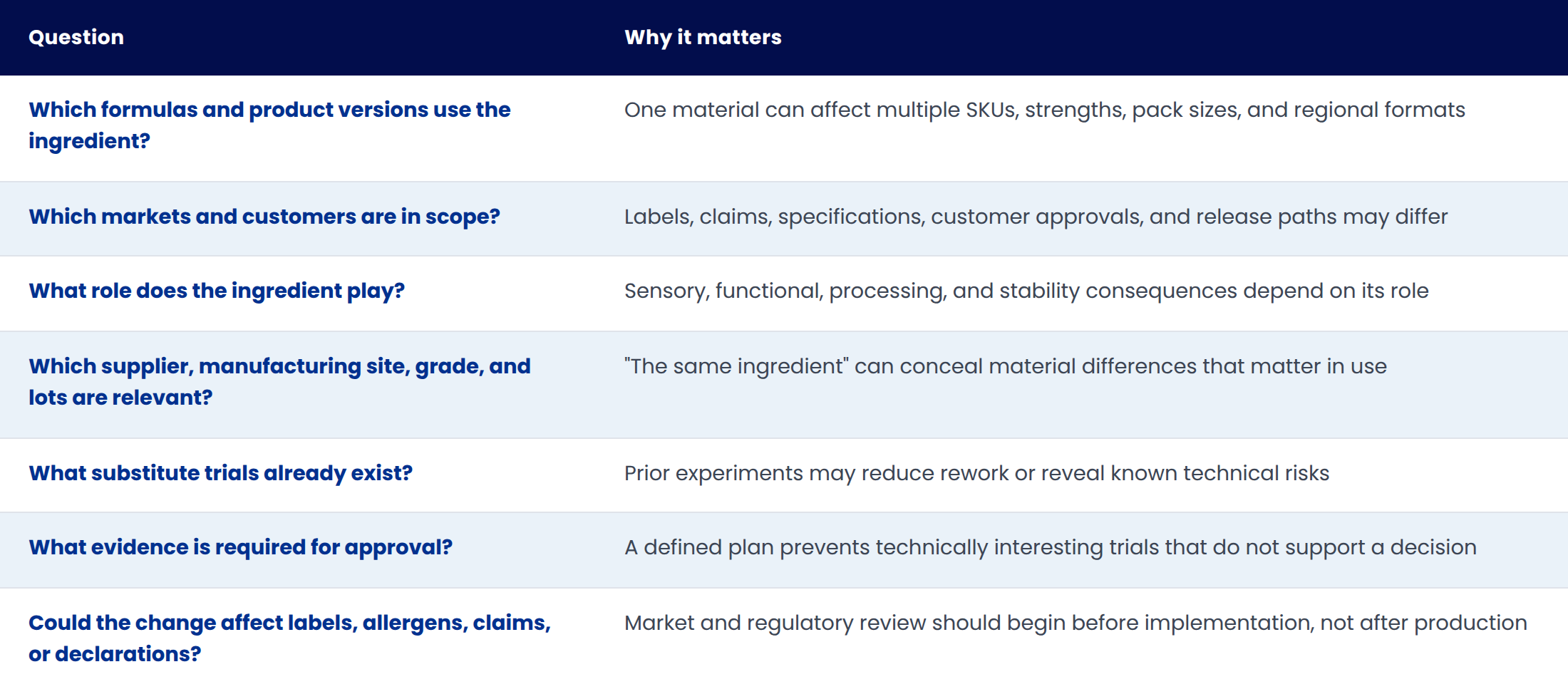
The aim is not to create a generic supplier-qualification exercise. It is to understand whether the ingredient substitution could alter the product consumers recognize. That requires product context. Teams need to know the affected formula version, the ingredient’s role and dosage, its supplier and lot history, relevant processing conditions, target product specifications, packaging format, shelf-life expectations, and intended market.
Match the evidence to the risk
The evidence plan should reflect the potential effect on product character.
For a lower-risk change, such as an approved alternate source with a strong use history and limited sensory or functional influence, a document review, specification comparison, supplier-status check, and targeted confirmation may be sufficient.
A moderate-risk change may involve a new supplier for an ingredient that has a measurable but limited effect on the product. In that case, the team may need comparative analytical work, bench trials, and a structured difference test or trained-panel review.
A higher-risk change may involve a sensory-defining botanical, flavour, sweetener, colour, acid, or stabilizing ingredient. The appropriate evidence may include multi-lot comparison, formula optimization, structured sensory profiling, stability assessment, packaging compatibility checks, a representative production trial, and coordinated product, quality, commercial, and market review.
The goal is proportionality. A team should not apply the same burden to every material change. But it should also avoid reducing a high-impact sensory decision to a specification comparison alone.
Plan the evidence before experiments begin. Otherwise, teams can complete technically useful trials without answering the question the business ultimately needs resolved: can this substitute be approved without changing the intended product character?
Make sensory evidence usable
Informal tasting is valuable during early exploration. It helps teams identify obvious differences, generate hypotheses, and determine which formulations deserve further work. It is not always sufficient for a controlled product decision.
For sensory-critical substitutions, teams should define the comparator and test samples, formula and lot context, production or preparation conditions, evaluation group, attributes to assess, evaluation method, serving conditions, and acceptance criteria or decision rule. They should also connect the sensory result to the supporting formulation, supplier, analytical, and processing evidence.
This turns sensory work from a discussion that happened in a tasting room into evidence that product development, quality, regulatory, commercial, and leadership teams can understand.
ISO 6658:2017 provides general guidance on sensory-analysis methodology, including tests for examining foods and other products and relevant statistical considerations.
ISO 13299:2016 provides guidance for establishing sensory profiles, including profiles developed through descriptive analysis by trained assessors.
For teams using trained or expert assessors, ISO 8586:2023 specifies criteria and procedures for the selection and training of sensory assessors for food and beverage products.
These standards do not prescribe one universal approval protocol for all ingredient changes. They provide a useful methodological foundation for designing sensory work that is appropriate to the product, decision, and organization.
Review market impact early
An ingredient substitution can affect more than the liquid.
Depending on the product and market, it may require review of ingredient declarations, allergen information, nutrition or compositional statements, product descriptions, customer specifications, claims, packaging copy, online product information, and commercial agreements.
Product-development teams do not need to make legal determinations. They do need to give regulatory, quality, and commercial colleagues an accurate, versioned view of what has changed.
That view should identify the affected formulas and ingredient versions, supplier, grade, manufacturing-site and lot scope, relevant products and packaging formats, applicable markets, evidence generated through testing and assessment, and proposed implementation timing.
Starting this review early gives teams time to resolve market questions before the final approval and production-release stage. It also reduces the risk that a technically acceptable substitute becomes delayed because packaging, claims, customer approval, or market-specific requirements were considered too late.
Approve a defined change
Avoid recording only that an “ingredient substitution” has been approved.
A meaningful approval defines what the decision covers.
It should identify the formula or blend versions, supplier, manufacturing site, and grade; product, market, and packaging scope; applicable process conditions and specifications; evidence reviewed; open conditions or restrictions; effective date; inventory-transition approach; and any monitoring or confirmation required after implementation.
This matters because an approval for one supplier grade, one formula version, or one market should not automatically be interpreted as approval for another.
A later user should be able to see exactly what changed, why the change was approved, which evidence supported the decision, and the conditions under which the approval remains valid.
This is also where connected records matter. The ingredient substitution should link to the relevant material, formula, supplier records, sensory evidence, analytical results, change-control record, quality review, and market-impact assessment. A future team should not need to reconstruct the decision from email attachments and meeting notes.
Confirm product character after launch
The decision is not necessarily complete with the first production run.
The team should confirm the outcome using indicators appropriate to the change and product. This may include first-batch analytical results, sensory confirmation, stability performance, production or fill performance, supply continuity, customer feedback, or consumer feedback.
For a supplier substitution involving a complex flavour or botanical, reviewing multiple production lots may be more informative than relying on a single initial batch. For a stabilizer or processing aid, production behavior, clarity, sedimentation, or shelf-life performance may be more relevant than a large sensory study.
Attach the outcome to the product and change record. This helps the organization turn each substitution into reusable knowledge.
The next ingredient change should begin with stronger evidence than the last: which alternatives were tested, under what conditions, what differences were observed, which supplier lots were used, what approval scope applied, and how the product performed after implementation.
Treat substitution as product knowledge
A beverage ingredient substitution is not only a sourcing decision. It is a test of whether the organization can preserve product character while managing supply, cost, quality, and market requirements.
The answer depends on connected evidence: the right material and lot, formula version, process conditions, sensory assessment, analytical results, supplier and quality context, market scope, and approved change decision.
When this evidence is connected, teams can move faster without relying on assumptions. They can identify where a historical substitute worked, determine whether the conditions are comparable, design proportionate testing, and make an approval that is clear enough to use later.

.png)