.png)
A release specification is indispensable. It defines the controlled boundary for what an organization will accept, release, purchase, supply, or use. But it does not necessarily contain every piece of knowledge needed to answer a broader question:
Will this ingredient perform as expected in a specific process, formulation, or customer application?
A batch can meet every approved release criterion and still behave differently from a previous batch in solubility, dispersibility, colour, odour, taste, stability, rheology, or application performance. That does not mean the specification has failed. It means a specification is designed to answer a specific quality question, not every product, process, or customer question that follows.
For industrial-biotech teams, the practical challenge is knowing when a release decision is sufficient and when the decision needs broader evidence from development, fermentation, downstream processing, analytical testing, application work, customer support, and quality investigations.
A specification answers one critical question
A well-designed ingredient specification may define identity, key compositional attributes, physical properties, microbiological requirements, analytical methods, acceptance criteria, packaging requirements, storage conditions, and shelf-life expectations.
Its core purpose is usually clear: Does this batch meet the approved criteria for release or use?
That is a critical quality decision.
In regulated life-science contexts, ICH Q6A defines a specification as a list of tests, references to analytical procedures, and acceptance criteria such as numerical limits, ranges, or other criteria. It establishes the set of criteria that a material should meet to be considered acceptable for its intended use.
Although industrial-biotech ingredients are used across diverse regulatory and commercial contexts, the general distinction remains useful: a release specification defines the controlled quality boundary for the decision it was designed to support.
It does not automatically prove that a compliant batch is functionally interchangeable with every previous batch, suitable for every customer formulation, or appropriate for a new end use.
“Within specification” is not always “functionally comparable”
Industrial-biotech ingredients can be influenced by variables that are not always included in routine release testing.
Those variables may include the biological system, strain, or cell-line version; feedstock source, supplier, and lot; fermentation or process recipe; scale and actual operating conditions; downstream route; drying or physical-form history; minor compositional patterns; impurity profile; particle size; dispersibility; solubility; colour; odour; taste; and performance in a customer’s formulation or processing environment.
Not every factor belongs in a release specification.
Adding every possible measurement can make a specification slow, expensive, difficult to operate, and less useful as a clear release-control tool. It may also introduce tests that do not reliably predict performance across all potential applications.
The practical alternative is not an infinitely broad specification. It is a connected evidence model.
The organization should retain relevant development, process, analytical, functional, application, and quality evidence in controlled source records. When a decision requires more than a pass-or-fail release result, authorized teams can retrieve and evaluate that broader evidence.
Decide when the specification is enough
The right question is not whether specifications matter. They do. The question is whether the decision being made is the same decision the specification was designed to support.
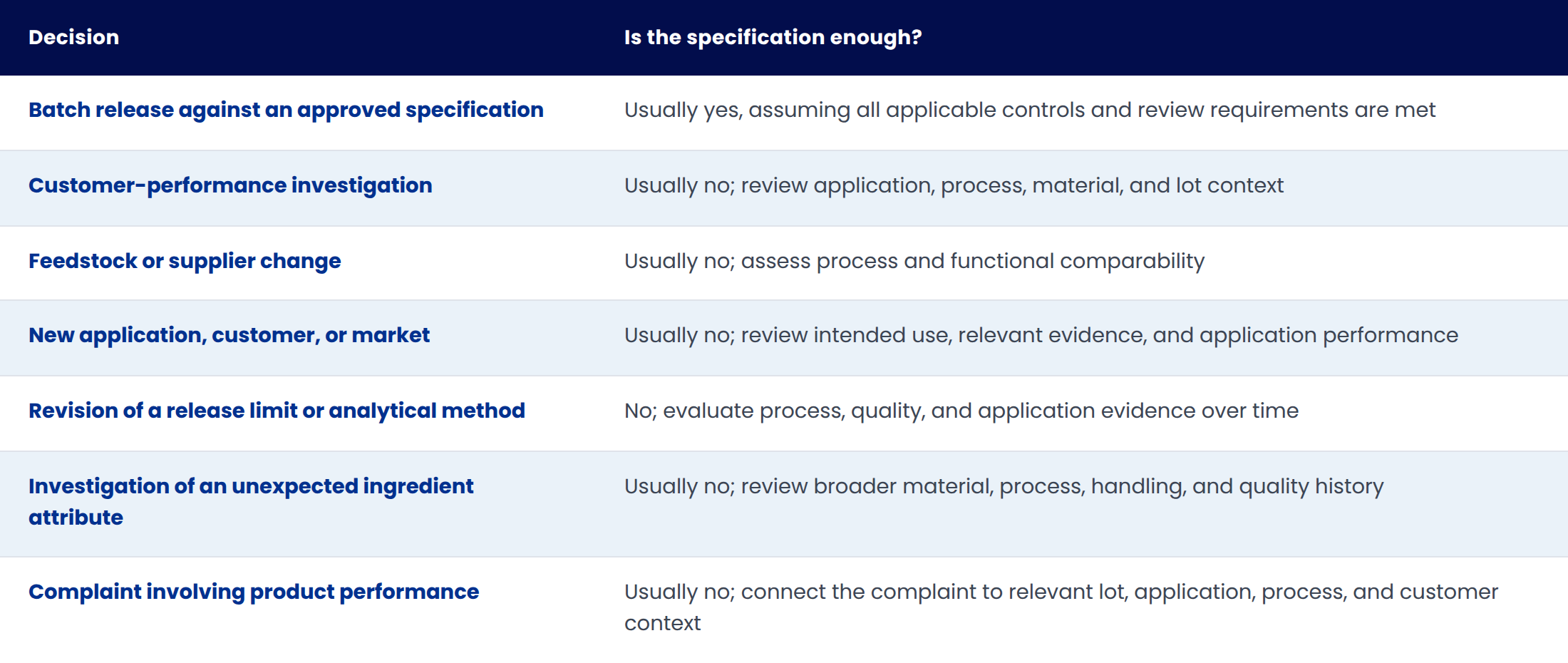
This distinction prevents teams from using a release result to answer a question it was not designed to answer.
For example, a batch may meet all approved release limits for identity, potency, moisture, microbiology, and particle size. A customer may still report reduced dispersibility in a high-solids formulation or unexpected flavour effects in a finished product. The batch result remains valid. The performance question requires additional evidence.
Similarly, a feedstock change may not cause a batch to fail release. It can still introduce a shift in process behavior, minor composition, physical form, or downstream application performance that is meaningful for certain customers or formulations.
Link the specification to evidence
A specification does not need to become a repository for every development, process, or customer record. It does need clear connections to the information that can explain its applicability, limits, and performance.
For an industrial-biotech ingredient, relevant connected evidence may include the approved ingredient identity; grade and process context; strain or biological-system version where applicable; feedstock, source-material, or supplier scope; controlled analytical methods; process-development and scale-up results; production-history information; downstream-processing conditions; relevant application studies; customer technical-service findings; complaints and quality investigations; and changes that could affect release criteria or functional performance.
The objective is not duplicate data entry, but retrieval.
When a customer asks why a batch performs differently, a technical-service scientist should be able to connect the complaint to the correct lot, ingredient grade, production history, analytical profile, sample, formulation, application conditions, and quality investigation. When product development considers a new use case, the team should be able to identify which prior data came from comparable formulations and processes.
A specification remains the release boundary. Connected source records provide the context needed when a release outcome alone does not resolve the decision.
Improve specification governance with real evidence
Connected evidence helps teams ask better questions over time.
Are current specification limits supported by the most relevant process and application data? Which attributes tend to appear before customer-performance issues? Does a feedstock, process, supplier, or downstream change introduce risk that routine release testing does not capture? Are the analytical methods and acceptance criteria still appropriate for intended uses? Does the ingredient need a separate grade, application-specific specification, controlled technical guidance, or additional customer qualification process?
These questions do not mean specifications should change constantly.
A stable release specification is valuable. It enables consistent decisions, operational efficiency, and reliable communication between quality, manufacturing, suppliers, and customers. Changes should follow controlled processes and be supported by appropriate evidence.
But specification governance should be informed by how the ingredient actually performs over time. When recurring application issues occur among compliant lots, the answer may be to improve traceability, add functional guidance, develop a separate grade, refine a process-control strategy, or investigate whether an existing specification attribute is an early signal of a broader performance issue.
The answer is not automatically “tighten the specification.”
Connect process knowledge to application outcomes
Industrial-biotech ingredients often sit between a biological production process and a downstream customer application. That distance can make performance issues difficult to investigate.
A fermentation team may understand changes in feedstock, process conditions, yield, or downstream purification. A quality team may understand release results and deviations. An application scientist may understand the customer formulation, dosage, processing conditions, and end-use performance. A technical-service team may own the customer issue.
If those records remain disconnected, each team can see part of the story while no one can efficiently see the whole picture.
Connected data allows a team to follow the evidence from biological system or feedstock through process conditions, finished ingredient, batch release, customer application, and quality outcome. It allows teams to compare lots by more than their certificate values and to distinguish a material issue from a formulation, handling, process, or customer-use issue.
This is especially valuable for recurring investigations. Instead of beginning each complaint by assembling scattered records, teams can begin with a traceable evidence path and focus their expertise on interpreting the result.
Start with one decision
Choose a recurring decision where a specification result does not settle the question.
It may be a customer technical-service investigation, a feedstock or supplier qualification, a new application launch, a recurring attribute difference between compliant lots, an unexpected shift in dispersion or colour, or a proposed change to a release limit or analytical method.
Then ask:
Can the team move from the specification to the relevant process, analytical, application, and quality evidence without rebuilding the story manually?
If the answer is no, the first gap is not necessarily in the specification. It may be in the connected knowledge around it.
A better evidence path enables teams to preserve the discipline of release specifications while making better decisions about functional comparability, application fit, customer support, and process improvement.

.png)