
Cloud PLM software can help manufacturers manage product definitions, changes, specifications, approvals, and handoffs across R&D, quality, manufacturing, and commercial teams. The right platform depends on the kind of product data your organization needs to control.
For some companies, the central product record is a discrete assembly of parts, CAD files, configurations, and engineering change orders. For others, it is a formulation connected to ingredients, supplier grades, process conditions, samples, test results, specifications, and approval evidence. Many organizations need to manage both.
This guide compares cloud PLM options through that lens. It is designed for R&D, product, quality, and operations leaders who need to evaluate how a platform will support real product workflows, not just a generic list of features.
How we assessed platforms: This overview reflects publicly available product information reviewed in August 2026. Capabilities, modules, deployment options, integrations, and implementation approaches vary by configuration. Use this guide to narrow the field, then validate requirements through a live workflow demonstration and written vendor documentation.
What cloud PLM should manage
Cloud deployment does not define whether a PLM platform will fit the work. The product data model, workflow coverage, integrations, governance approach, and implementation fit matter more.
Evaluate whether a platform can support the records and decisions your teams manage every day:
- Product definitions, revisions, variants, and effective dates
- Bills of materials, formulas, sub-recipes, or material compositions
- Engineering, technical, quality, regulatory, and commercial change workflows
- Specifications, approved materials, suppliers, and alternatives
- Laboratory or development evidence that supports product decisions
- Manufacturing handoffs and enterprise-system integrations
- Traceability from a material or component change to affected products
- Role-based access, audit trails, and controlled approvals
If the product is defined primarily by formulas, process conditions, and test evidence, rather than by a discrete BOM, the data model requires additional capabilities. Evaluate whether the platform can represent those records as structured, version-controlled product data and preserve their relationship to specifications, quality evidence, and approved product changes.
Cloud PLM comparison at a glance
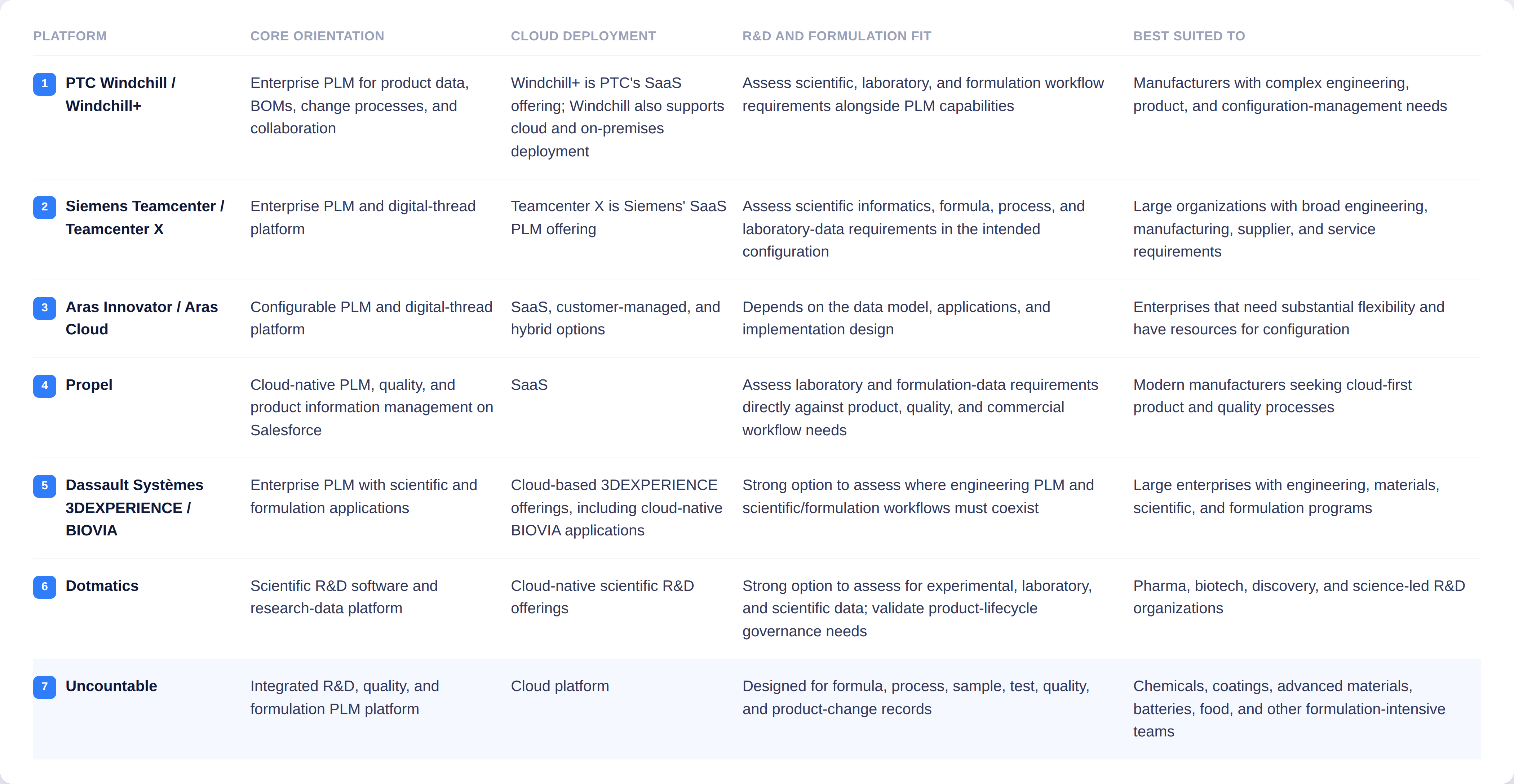
PTC Windchill and Windchill+
PTC Windchill is an enterprise PLM platform used to manage product data, bills of materials, change processes, and cross-functional product collaboration. PTC offers Windchill+ as a SaaS deployment intended to provide managed infrastructure, continuous updates, and cloud delivery.
Windchill is worth evaluating when the organization’s central product challenge involves complex engineering structures, configuration management, CAD-connected workflows, product variants, service information, and formal engineering change control.
For R&D-intensive organizations, the key question is how the required scientific and technical context will connect to the PLM record. Ask the vendor to demonstrate how formulations, process conditions, laboratory evidence, specifications, samples, and results are represented, governed, and linked to approved product revisions in the intended implementation.
Siemens Teamcenter and Teamcenter X
Siemens Teamcenter is an enterprise PLM platform designed to connect people, processes, and product information across the lifecycle. Teamcenter X provides a Siemens-operated SaaS deployment model for the Teamcenter portfolio.
Teamcenter is worth evaluating for organizations with broad enterprise requirements across engineering, manufacturing, supply, service, configuration management, and the digital thread.
R&D and quality leaders should validate the platform against a real technical workflow. Ask how the system will manage formulas or material compositions, process parameters, specifications, scientific results, and the evidence required to approve a change. The answer may involve Teamcenter configuration, connected applications, or integration with specialist laboratory and scientific systems. The important point is to assess the complete workflow rather than evaluating PLM in isolation.
Aras Innovator and Aras Cloud
Aras Innovator is a configurable PLM platform positioned around product lifecycle and digital-thread use cases. Aras offers cloud, customer-managed, and hybrid deployment options.
Aras can be relevant when an enterprise needs extensive flexibility in its product model, workflows, integrations, and lifecycle processes. That flexibility can be valuable when the organization has complex requirements that do not fit a predefined model.
It also makes implementation design especially important. Teams should define their core entities, ownership rules, versions, relationships, approval paths, and integration requirements before treating configurability as a solution. Ask for a demonstration using a real product family, a material or formula change, supporting specifications, and evidence from R&D or quality. Confirm which capabilities are available out of the box, which require configuration, and which require custom development.
Propel
Propel provides cloud-native PLM on the Salesforce platform and positions the product around product development, quality, and commercial workflows.
Propel is worth assessing for teams that want cloud-first product lifecycle and quality processes with close connections to customer, commercial, and product information managed in the Salesforce ecosystem.
Formulation-intensive teams should test the fit directly. Use a real formula, a supplier-material change, a product variant, specifications, and associated test evidence. Confirm whether the platform can model the required relationships without relying mainly on documents or customized fields that are difficult to govern across R&D, quality, and manufacturing.
Dassault Systèmes 3DEXPERIENCE and BIOVIA
Dassault Systèmes combines its 3DEXPERIENCE PLM platform with BIOVIA applications for scientific and formulation work. BIOVIA Formulation Design is a cloud-native application for creating, adapting, managing, testing, labeling, and launching formulations. It supports workflows involving recipes, ingredients, and domain-specific calculations.
This combination is worth evaluating when an organization needs enterprise PLM alongside scientific R&D, formulation, simulation, laboratory, or materials capabilities.
The primary evaluation question is operational fit. Determine how formula design, experimental records, quality results, specifications, controlled product revisions, and downstream manufacturing or ERP data will be connected in the configuration you plan to deploy. Ask vendors to demonstrate the exact transition from formulation development through approved product definition and change control.
Dotmatics
Dotmatics provides scientific R&D applications and a cloud-native research-data platform. Its offering is focused on bringing scientific workflows, experimental data, specialized tools, and analytical work together for research organizations.
Dotmatics is worth assessing when scientific research, laboratory workflows, experimental data, and analysis are central to the organization’s product-development process. It is particularly relevant for life-sciences, biotech, discovery, and science-led R&D environments.
Organizations that also require formal product lifecycle management should evaluate the boundary between scientific data management and controlled product definition. Test how approved formulations, specifications, commercial product variants, manufacturing handoffs, quality workflows, and formal change governance will be handled. A strong scientific data environment can be part of the answer, but it should be assessed against the full lifecycle workflow.
Uncountable
Uncountable is a cloud platform for R&D, quality control, and product lifecycle management in formulation-intensive industries. It is designed to connect formulas, materials, process parameters, samples, test results, specifications, quality information, and controlled product changes in one data model.
Uncountable is worth evaluating when the product is defined by a formula, process, and technical evidence; and when R&D, QC, quality, and product teams need to work from connected records rather than reconcile data across separate systems.
A useful evaluation workflow is a material or supplier change. Ask the platform to identify every affected formula and product, show the related specifications and test evidence, route the change through review, preserve revision history and effective dates, and publish the approved information to downstream systems. That workflow reveals whether the system can support the technical relationships that formulation teams manage every day.
Choose based on the data that drives decisions
Start with the records that create the most value and risk in your organization.
Choose a discrete-first cloud PLM platform when the central product record is an assembly of parts governed by CAD, configuration rules, bills of materials, and engineering changes.
Evaluate an enterprise PLM platform with scientific or formulation extensions when you need both large-scale engineering PLM and governed R&D or formulation workflows.
Evaluate laboratory-informatics or formulation-first platforms when experiments, formulas, process conditions, samples, and test results provide the primary evidence behind product decisions.
Consider an integrated approach when R&D, QC, specifications, quality events, and product changes need to share identity, version, status, and traceability without repeated exports or manual reconciliation.
For a guide to moving from selection into rollout, see Formulation PLM Implementation: A Practical Guide for Manufacturers.
Evaluate vendors with a real workflow
Do not make a cloud PLM decision from a generic demonstration.
Choose one current product family that includes a meaningful product structure, active revision, material or component change, specifications, test or quality evidence, relevant approvals, and a downstream handoff. Ask each vendor to demonstrate the same workflow from beginning to end.
- Create or revise the controlled product definition.
- Show which formulas, products, specifications, manufacturing records, or customer commitments are affected by a material or component change.
- Connect the decision to applicable technical, quality, and regulatory evidence.
- Route the change through the appropriate review and approval process.
- Preserve versions, effective dates, audit history, and the rationale for the decision.
- Show how approved information reaches ERP, manufacturing, quality, or customer-facing systems.
- Explain what is standard functionality, configurable functionality, and custom development.
The right cloud PLM platform is the one that can support this workflow with the data model, governance, integrations, and operating model your team can maintain.
See Uncountable with your workflow
Cloud PLM should help teams manage the actual records behind product decisions, whether those records are engineering structures, formulas, process conditions, laboratory evidence, specifications, or controlled changes.
Schedule a demonstration with Uncountable to review a real formulation, material-change, product-change, quality, or R&D-to-manufacturing workflow on a connected R&D, QC, and PLM data model. Uncountable states that its platform brings R&D, quality control, and PLM together to reduce exports and re-keying across teams.

.png)

