
A biobanking LIMS tracks what a sample is, where it is, how it has been handled, and whether it is available for use. It should preserve that history through aliquoting, storage, retrieval, shipment, and disposal. For R&D teams, it also needs to connect the stored sample to the experiments and results it produces.
That last requirement deserves more attention during buying decisions. A freezer map can tell you where to find a vial. It cannot, by itself, tell you whether that vial produced the result behind a formulation decision, a failed assay, or a promising strain.
The useful distinction is not between basic and advanced biobank software. It is between features that maintain a reliable sample record and features that make the record useful to the people doing the science.
What are the must-have features of a biobanking LIMS?
Start with identification, location, handling, and access. These are not administrative extras. They determine whether staff can retrieve the right material and explain what happened to it.
ISBER Best Practices provides a practical framework for repository operations. ISO 20387:2018 addresses biobank competence, impartiality, and consistent operation, including the quality of biological materials and associated data. Neither should be reduced to a software shopping list, but both provide context for evaluating the records a system must support.
A useful buyer checklist looks like this:
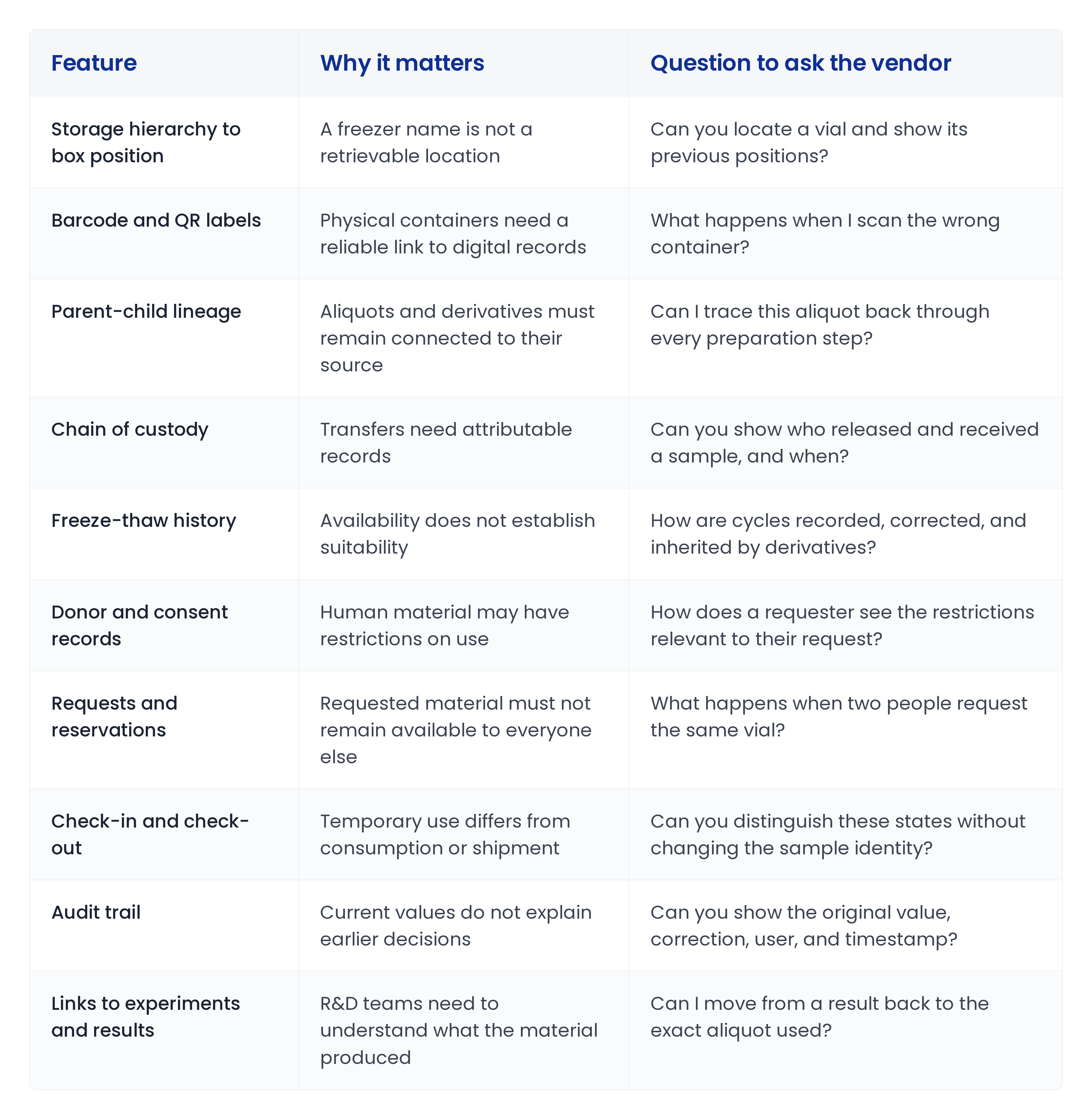
Test how these features work together. A barcode scan that opens a record is useful. A scan that also verifies the expected sample, records a transfer, and updates its location is more useful.
Likewise, an inventory count needs context. Ten vials in storage may include reserved, restricted, depleted, or quarantined material. Ask whether the system distinguishes physical presence from availability.
Consent needs similar care. Storing a consent document is not the same as making its restrictions visible during a request. Ask how consent versions, permitted uses, and changes in status are represented. Then establish which decisions remain with authorized staff.
Which features matter more for R&D biobanks?
An R&D biobank needs the same inventory discipline as other repositories. It also needs traceability between stored material and experimental work.
Consider a cell bank used in assay development. The relevant record may include the source line, bank lot, vial, passage history, culture preparation, plate, assay conditions, and resulting measurements. If the sample record ends at check-out, someone must reconstruct the rest elsewhere.
Three capabilities deserve particular attention.
Can samples connect to experiments and test data?
Ask for a bidirectional link. Starting from an aliquot, you should be able to find the experiments that used it. Starting from a result, you should be able to identify the material that produced it.
A sample ID pasted into a notes field is a weak substitute. It relies on consistent typing and does not necessarily support queries across related records.
Test a real question: “Show every result generated from this source lot, including results from its derivatives.” The answer should not require several exports and a spreadsheet join.
Can the system represent plates properly?
A plate is not just a container with a name. Its wells have identities, contents, preparation histories, and destinations.
Ask the vendor to demonstrate transfers between source vials and destination wells. Check whether the record preserves which aliquot went into each well and how the resulting measurements connect back.
Also test changes. What happens when a well is excluded, a plate is rerun, or material is transferred into another plate?
Can the data model represent your materials?
A donor, tissue sample, cell line, strain, extract, and working bank are not interchangeable records.
Configurable entities let teams describe those differences without forcing every object into one generic sample form. The evaluation question is practical: can your team maintain those definitions, relationships, and required fields without commissioning a new development project each time?
Which biobanking LIMS features are often oversold?
Customization, AI, and dashboards can all be useful. They become distractions when vendors demonstrate the presentation rather than the workflow.
When does customization become a maintenance problem?
Some workflows need custom development. The risk is buying a system that requires it for routine changes.
Ask who can add a sample type, change an approval route, or update a required field. Establish what requires vendor involvement, how changes are tested, and what happens during upgrades.
A custom screen is not inherently a better fit. Sometimes it simply conceals a rigid underlying model.
When is “AI” doing more than searching?
Plain-language search can save time. It should still be described accurately.
Ask the vendor to show the source records behind an answer, explain the scope of the query, and distinguish retrieved information from inferred conclusions. If the feature extracts values from a PDF, inspect the source document and the proposed record together.
Do not accept a fluent answer as evidence that the sample relationships are correct.
Which dashboards will change a decision?
A dashboard earns its place when someone uses it to act.
Available stock by project, unresolved custody transfers, restricted material awaiting review, and samples affected by a storage incident may support daily work. An attractive chart of total vials may not.
Ask who uses each view, what decision it supports, and whether users can inspect the records behind it.
How should you evaluate a biobanking LIMS in a demo?
Give the vendor a small, representative scenario in advance. Then ask them to complete five tasks live.
- Receive a source sample and create aliquots. Check identifiers, labels, parent-child relationships, required information, and starting quantities.
- Move a box and retrieve one vial. Confirm that the system preserves the location history and records check-out without losing the storage context.
- Process two competing requests. Ask what happens when both users want the same material, one request requires approval, and the available quantity changes.
- Record a handling exception. Add a freeze-thaw event or identify samples associated with a temperature excursion. Inspect how the event becomes visible during later selection.
- Trace a result back to its source. Start with an assay measurement and follow the plate, aliquot, parent sample, storage history, and relevant restrictions.
Include a mistake in the demonstration. Correct a location or a quantity and inspect the audit trail. Routine workflows often look convincing. Corrections reveal how the system actually handles records.
Finally, ask how your existing data will be migrated and checked. A polished new inventory does not resolve duplicate identifiers, uncertain locations, or missing lineage in the old one.
How does Uncountable approach biobanking LIMS?
Uncountable brings biobank inventory into the same R&D data platform as experimental work. Teams can track storage to box position, maintain lineage and signed chain of custody, manage requests and reservations, and connect samples with experiments and test data.
The aim is not simply to digitize the freezer. It is to keep the stored material connected to the scientific record, including the plates, handling history, and results needed to understand its use.

.png)
.png)
