
Spreadsheets stop being reliable for biobank sample management when keeping them accurate depends on someone remembering what happened outside the file. The warning signs are not just a growing inventory. They are unrecorded moves, uncertain availability, missing handling history, and time spent checking whether the record matches the freezer.
A sample tracking spreadsheet can be perfectly readable and still be wrong. The row says a vial is in box B12. A colleague moved the box during maintenance, another person took the vial for testing, and neither change reached the file.
The cost is the work required to discover and resolve that difference.
How do samples get lost in a spreadsheet biobank?
A sample does not have to disappear to become effectively lost. It may be present in the building but absent from a location anyone can confidently retrieve.
A box moves to another freezer. Someone updates the freezer column but not the rack. An aliquot is created and entered under a slightly different source name. A depleted vial remains listed as available because its row was never closed.
These are recordkeeping failures, not necessarily careless behavior. The workflow allows physical activity to happen separately from the inventory update.
The problem becomes harder when a row carries several meanings. A comments field might contain a storage note, a reservation, a handling exception, and a reminder to contact the sample owner. None of those entries necessarily changes what another user can request.
ISBER Best Practices provides a broader framework for repository management than an inventory list alone, covering the practices needed to maintain usable biological and environmental collections. The relevant question is whether your records support the repository’s work, not whether they contain every sample name.research.
Position-level tracking helps, but only if movements are recorded. A detailed freezer map that nobody updates is still an unreliable map.
What does a lost or degraded sample really cost?
There is no defensible universal price for a lost sample. A replaceable reference material and an irreplaceable longitudinal specimen have different consequences.
Build the calculation from your own work:
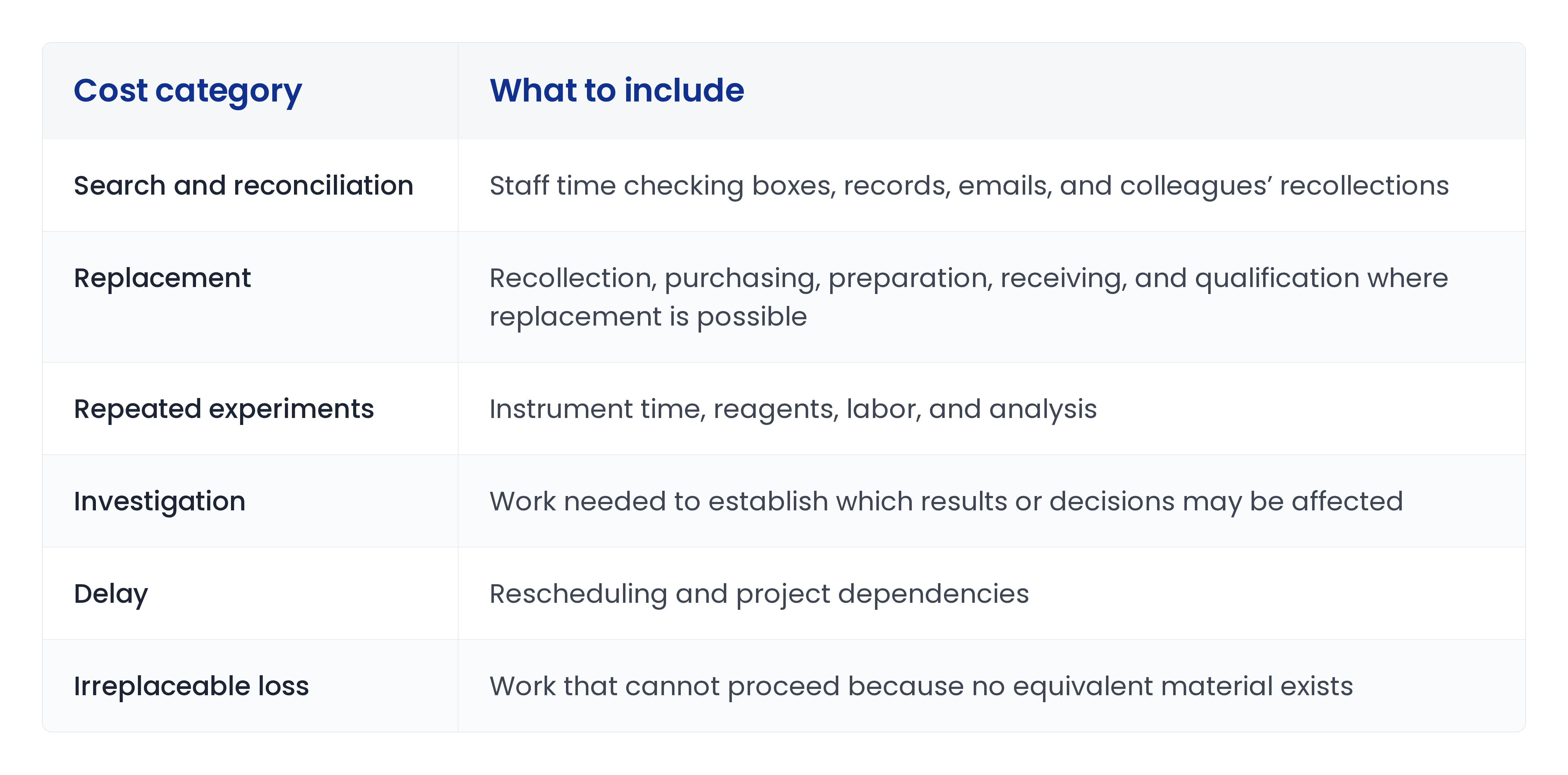
Keep verified costs separate from estimates. An unavailable sample does not automatically invalidate a study, and a missing handling record does not prove degradation. It does create a question someone must resolve.
The scientific impact also depends on the material and measurement. In a study of serum and plasma proteins, repeated freezing and thawing affected some measured proteins while others remained stable under the tested conditions. A simple “sample still in freezer” status cannot capture that distinction.
The practical cost of incomplete history is uncertainty. A team may repeat an experiment because it cannot establish whether the material was suitable. Alternatively, it may continue using material whose limitations are not visible to the scientist.
Neither cost appears in the spreadsheet’s purchase price.
Why do audits get harder with a spreadsheet inventory?
Audits ask for evidence of what happened, not just the current answer.
An inventory row may show the present location and quantity. It may not establish who changed them, why they changed, what the previous values were, or who accepted a transfer.
Some spreadsheet platforms provide version history and access controls. Those functions can help. They are not automatically equivalent to a sample-specific audit trail or a signed custody record.
The distinction matters when reconstructing an event. “This file changed on Tuesday” is not the same as “this user transferred these vials to this recipient at this time.”
ISO 20387:2018 addresses competent, consistent biobank operation and the quality of biological materials and associated data. Software supports that work when records can be retrieved and understood in their operational context. A current inventory alone does not establish the full history.
Audit preparation becomes expensive when staff must assemble that history from inboxes, file versions, paper forms, and freezer notes. The issue is not the effort required to print a report. It is the effort required to establish whether the report is trustworthy.
What breaks when more people use the bank?
Shared access exposes the gap between an inventory and a transaction system.
Two scientists check the same file and see one available vial. Both email a request. The sample manager approves one, but the spreadsheet still shows the vial as available while the first scientist schedules work.
A reservation should change availability before physical retrieval. An email does not necessarily do that.
The same problem appears in returns. A checked-out vial may come back partially used, with another thaw cycle and a different storage position. Simply changing its status to “returned” leaves important questions unanswered.
More users also introduce different responsibilities. A requester may need to see available material without seeing donor information. A technician may need to move samples without changing consent records. A manager may need to approve distribution.
A shared file can be configured carefully, but the maintenance burden grows when permissions, status changes, and approval decisions must be coordinated manually.
What are five signs it is time to move to a LIMS?
Look for repeated operational problems rather than an arbitrary inventory threshold.
- Staff verify routine locations by asking a particular colleague. The record is no longer the dependable starting point.
- Requests require several emails to establish availability. Inventory and demand are being managed separately.
- Aliquots and derivatives are difficult to reconcile. The team can find individual records but cannot confidently reconstruct lineage.
- Audit preparation involves rebuilding events. Evidence exists, but it is scattered across files and communications.
- Experimental results cannot be traced back to exact material. The bank tracks storage while scientists maintain a separate version of sample identity.
Before migrating, identify what needs correction. Separate confirmed locations from assumed ones. Resolve duplicate identifiers. Define how quantities, reservations, restrictions, and derivatives should be represented.
Importing the existing file without that work can move the same uncertainty into a more expensive system.
How does Uncountable approach biobank sample management?
Uncountable combines position-level inventory with reservations, requests, approvals, check-in/check-out, and barcode or QR labels. Teams can maintain lineage, freeze-thaw records, and signed chain of custody alongside the material.
Because samples can also connect to experiments and test data, the record does not have to end when a vial leaves storage. That reduces the need to maintain separate accounts of where material is and what it has been used for.

.png)
.png)
