
ISO 9001 and ISO/IEC 17025 are often discussed in the same quality conversation. Both can involve audits, controlled procedures, competence, records and improvement. But they do not mean the same thing.
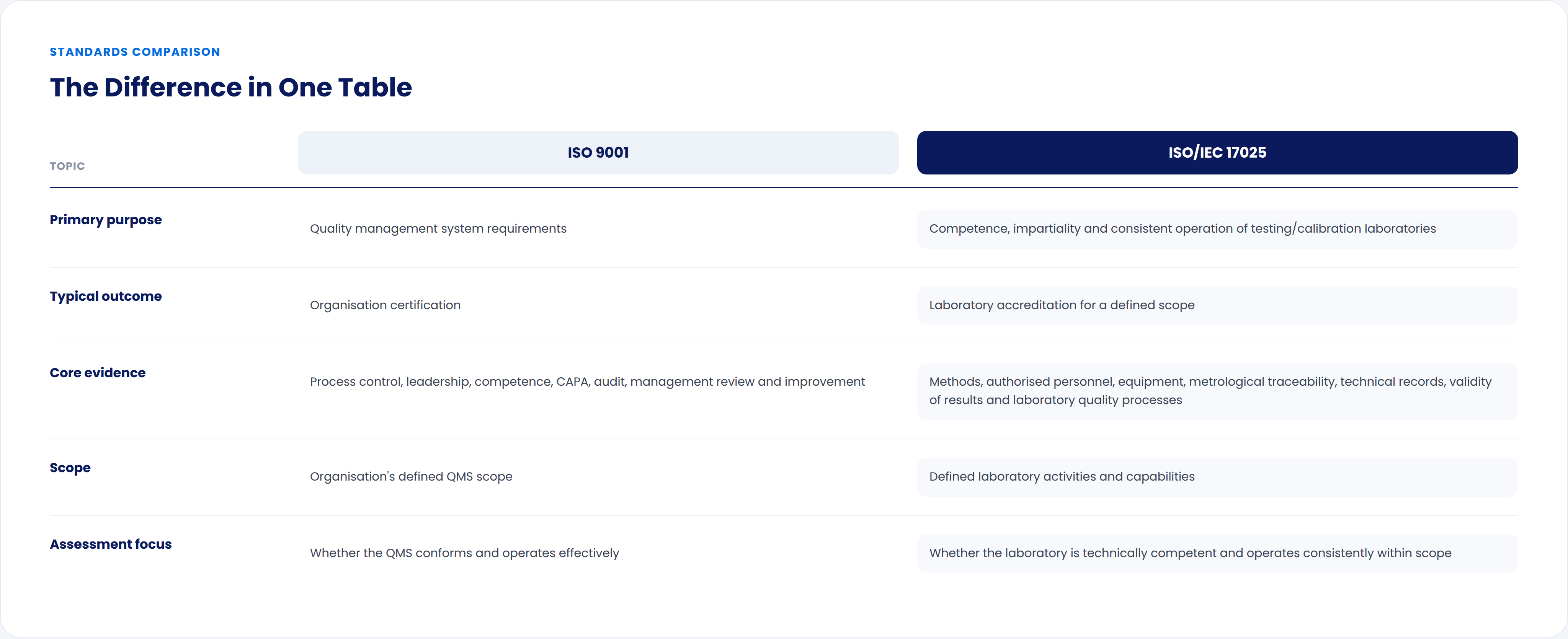
The most important distinction is this: An organisation can be certified to ISO 9001. A testing or calibration laboratory can be accredited to ISO/IEC 17025 for a defined scope of laboratory activities.
Using the right language matters. It shows that the organisation understands the type of quality evidence being assessed.
What ISO 9001 addresses
ISO 9001 is a quality management system standard. It provides requirements for an organisation’s quality management system and is used by certification bodies to assess whether that system conforms to the standard.
The focus is broad: organisational context, leadership, planning, support, operations, performance evaluation and improvement.
A certified organisation needs to demonstrate controlled processes, competent people, documented information, management of nonconformities, corrective action, internal audit and management review.
ISO has scheduled the sixth edition of ISO 9001 for publication on 16 September 2026.
What ISO/IEC 17025 addresses
ISO/IEC 17025:2017 specifies general requirements for the competence, impartiality and consistent operation of testing and calibration laboratories.
The focus is laboratory-specific. It includes evidence around methods, personnel competence, equipment, metrological traceability, technical records, validity of results and management-system processes.
Laboratory accreditation is typically granted by an accreditation body for a defined scope. The scope matters. It identifies the activities, methods, measurements or testing/calibration capabilities covered by the assessment.
The standards can overlap in practice
A laboratory accredited to ISO/IEC 17025 still needs management-system evidence. It needs controlled procedures, internal audits, corrective action, management review and improvement.
An organisation certified to ISO 9001 may operate laboratories that need strong method, training, equipment and technical-record controls.
The overlap is real. The evidence emphasis is different.
For example, an ISO 9001 audit may ask whether a training process is controlled and effective across the organisation. An ISO/IEC 17025 assessment may ask whether a particular analyst was competent and authorised to perform a particular method using relevant equipment for a specific result.
The second question is more technically contextual.
.png)
What this means for digital quality systems
A platform cannot grant ISO 9001 certification or ISO/IEC 17025 accreditation. Certification and accreditation are decisions made through assessment of the organisation or laboratory, its people, processes, records and practice.
Digital systems can support the evidence behind both.
For ISO 9001, useful capabilities may support:
- Controlled documents.
- Training and competency.
- Nonconformity and CAPA.
- Change control.
- Internal audits.
- Management-review evidence.
- Supplier and process-quality records.
For ISO/IEC 17025, useful capabilities may support:
- Controlled methods and procedures.
- Method-linked training and authorisation.
- Equipment and quality-event context.
- Nonconforming work and corrective action.
- Audit and management-review workflows.
- Retrieval of connected laboratory quality evidence.
The key is to avoid overclaiming. Use language such as “supports preparation for certification audits” or “supports laboratory quality evidence for accreditation assessments.” Avoid “get certified” or “achieve accreditation with software.”
The practical test
Whether your priority is ISO 9001 certification, ISO/IEC 17025 accreditation or both, ask:
Can we retrieve the evidence needed to explain how a process or laboratory activity was controlled?
For ISO 9001, that might mean tracing a nonconformance through CAPA, change, audit and management review.
For ISO/IEC 17025, that might mean tracing a result to the approved method, competent person, equipment, technical record and quality response.
The records may sit in different systems. The evidence path should still be clear.
.png)
.png)
.png)
