
Nonconforming work is one of the most revealing laboratory workflows.
When everything works as intended, disconnected systems can remain hidden. A method sits in one location, calibration records in another, technical data in a LIMS, training in an LMS and CAPA in a QMS. People know where to look, and routine work continues.
When something goes wrong, the gaps become visible.
A laboratory may need to determine whether an equipment issue affected prior results, whether a method deviation invalidated work, whether an analyst was authorised, whether a sample was handled correctly or whether customers need to be informed. That requires evidence across several systems and functions.
ISO/IEC 17025:2017 requires laboratories to have a procedure implemented when any aspect of laboratory activities or results does not conform to their own procedures or agreed customer requirements. The laboratory must take appropriate action based on risk, evaluate the significance of nonconforming work, decide on acceptability, notify the customer where appropriate and authorise resumption of work where needed.
The precise workflow depends on the laboratory and its accredited scope. The information challenge is common: can the laboratory connect the event to the technical work it affects?
What a nonconforming-work record needs to answer
A quality record should do more than describe the incident. It should establish scope.
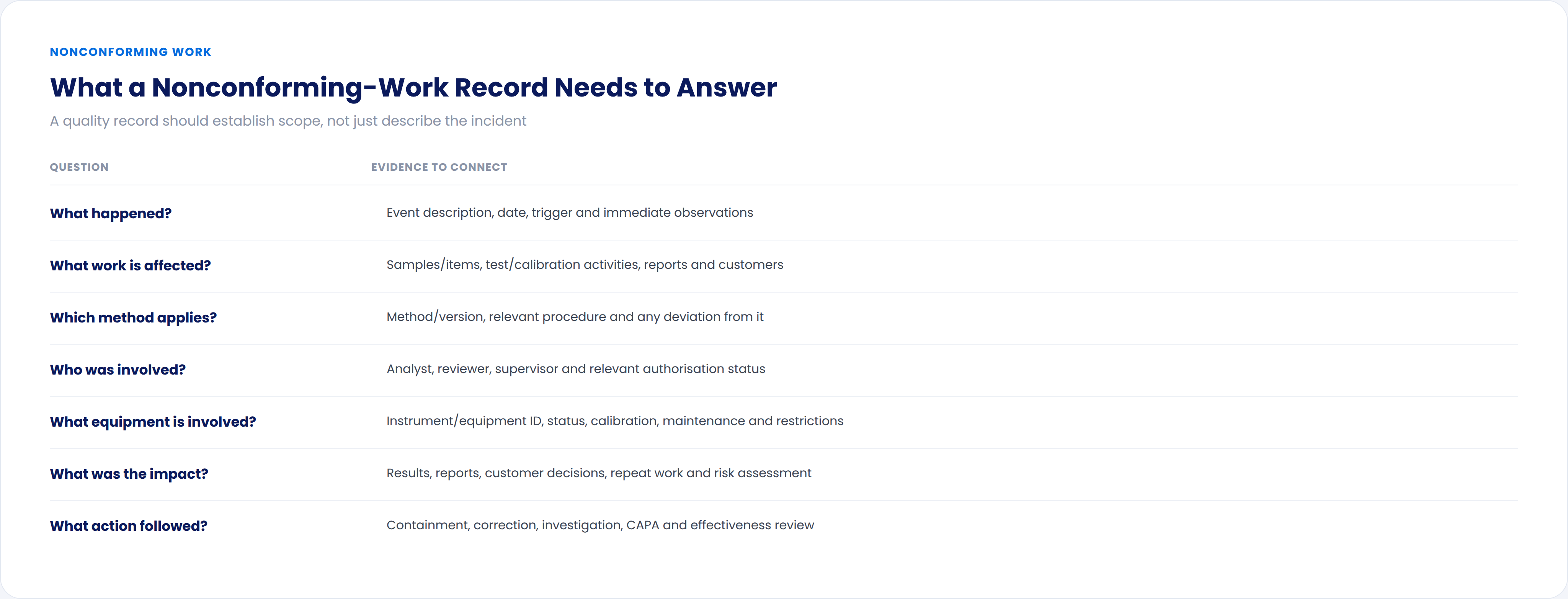
Without structured links to this information, the laboratory may have to rebuild scope manually each time an event occurs.
The equipment example
Imagine an instrument is found to have been operating outside an expected condition.
The immediate question is not only whether the instrument needs repair or recalibration. The laboratory may need to identify:
- When the issue began or could have begun.
- Which methods use the equipment.
- Which tests/calibrations were performed in the relevant period.
- Which analysts and samples/items were involved.
- Which results or reports may require review.
- Whether customers need communication.
- Whether a broader system issue requires corrective action.
If equipment records and technical work records are disconnected, the impact assessment becomes a spreadsheet exercise. It may be completed successfully, but it will be slower and more vulnerable to omission.
The method-deviation example
A method deviation can have similar consequences. A laboratory may need to determine:
- Which approved method/version should have been used.
- What actually happened.
- Whether the deviation affects validity of the result.
- Which samples/items and reports are in scope.
- Whether the person was trained/authorised.
- Whether the deviation reflects a procedure, training, equipment or planning issue.
- What correction and preventive action are required.
The laboratory needs the original technical evidence, not merely a narrative after the fact.
A connected workflow supports faster, more disciplined assessment
A practical workflow can follow this sequence:
1. Capture the event and immediate containment: Record what was observed, when, by whom and what immediate action was taken. Preserve the original technical context.
2. Identify affected entities: Link the event to relevant methods, equipment, people, samples/items, activities, results and reports.
3. Assess significance and impact: Use the connected evidence to determine what work may be affected, what needs review and whether customer communication or work suspension is required under the laboratory’s procedures.
4. Investigate and determine action: Identify cause where appropriate, define corrections and corrective actions, assign owners and retain supporting evidence.
5. Verify effectiveness and close: Confirm that actions were completed, assess effectiveness and authorise return to normal activity where required.
This structure keeps the technical scope and quality response together without requiring all source data to be copied into one system.
How to test your current process
Select a completed nonconforming-work event and ask:
- Can we identify every affected result without manual searching?
- Can we retrieve the methods, people and equipment linked to those results?
- Can we show the immediate impact assessment and decision rationale?
- Can we connect corrective action to the original technical issue?
- Can we identify whether similar events have occurred before?
If the answer depends on experienced staff remembering which folders or systems to search, the laboratory has identified a valuable improvement opportunity.
Nonconforming work is a learning workflow
The purpose is not only to close an incident. It is to understand whether the event reveals a broader weakness in method control, competence, equipment management, sample handling, data review or quality-system design.
When nonconforming work is connected to methods, equipment, results, CAPAs and audits, the laboratory can detect recurring patterns and use them in management review and continual improvement.
.png)
.png)
.png)
