
.png)
A qualification record is the connected evidence behind an electronics material change: what changed, which materials and products it affects, how risk was assessed, what evidence was gathered, what was decided, and how the change performed after approval. It lets teams judge a supplier, formulation or process change on evidence rather than on a claim of equivalence, and avoid late-stage surprises.
"Equivalent" is a conclusion, not a label
A supplier may describe a grade as equivalent. A certificate of analysis may meet the receiving specification. A technical team may see no obvious difference in the nominal material definition.
None of those facts alone establishes that a change is safe for an electronics-material application.
For a process-sensitive material, equivalence is a conclusion supported by evidence. The required evidence depends on the material's functional role, the scale of the change, the product and customer scope, process sensitivity, and the consequences of a downstream failure.
This is why electronics supply chains use structured qualification and change-notification practices. JEDEC J-STD-046 sets requirements for timely customer notification of changes to electronic products and associated processes. SEMI traceability work includes standardisation efforts for incoming material identification and electronic exchange of part-quality information. Individual customers may impose more detailed requirements, including qualification prior to production shipment for changes to materials, supplier sources or manufacturing processes.
The real change surface is wider than the change request
A request might state: "Approve supplier B for material X." The real impact assessment may need to consider:
- Which internal material records, grades and specifications are affected?
- Which formula, blend or product versions use the material?
- Which supplier sites and material lots are in scope?
- Which manufacturing steps and process windows are sensitive to its properties?
- Which metrology methods and acceptance criteria will demonstrate comparability?
- Which products, applications, customers and geographies rely on the affected material?
- Which customer qualifications, declarations or change notifications are required?
- Which previous deviations, complaints or reliability trends involve this material class?
If those relationships are not visible, change assessment becomes a manual search exercise. That makes it slower, but more importantly, it increases the likelihood of late discovery.
The six components of a qualification record
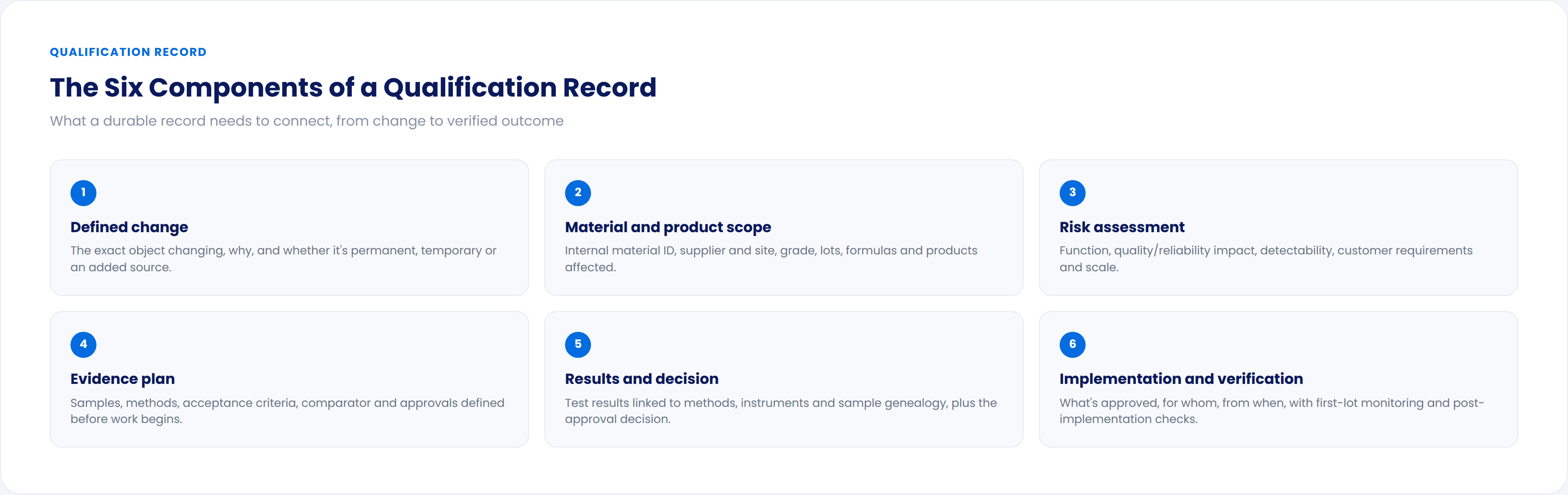
A durable qualification record should connect six categories of evidence.
1. Defined change
Capture the exact object changing: material, supplier, site, grade, specification, formula, process parameter, method or packaging condition. Record why the change is being made and whether it is permanent, temporary or an additional approved source.
2. Material and product scope
Identify the internal material ID, supplier and site, commercial grade, lots used in studies, formulas and products affected, and the customer/application scope.
3. Risk assessment
Consider material function, potential effect on quality and reliability, degree of difference from the reference condition, process sensitivity, ability to detect failure, customer requirements and the number of products or customers involved.
4. Evidence plan
The plan might range from documentary review to detailed formulation, process, metrology and reliability studies. It should define the samples, methods, acceptance criteria, comparator, test conditions and approval requirements before work begins.
5. Results and decision
Link the actual test results to methods, instruments, sample genealogy and process conditions. Record the reviewer, approval decision, conditions and limitations.
6. Implementation and verification
State what is approved, for whom, from what date and under which process/specification conditions. Define first-lot monitoring, customer notification, expiry/review and post-implementation checks.
A risk-based evidence ladder for material changes
Not every change requires a full customer requalification. But every change should have a justified level of evidence.
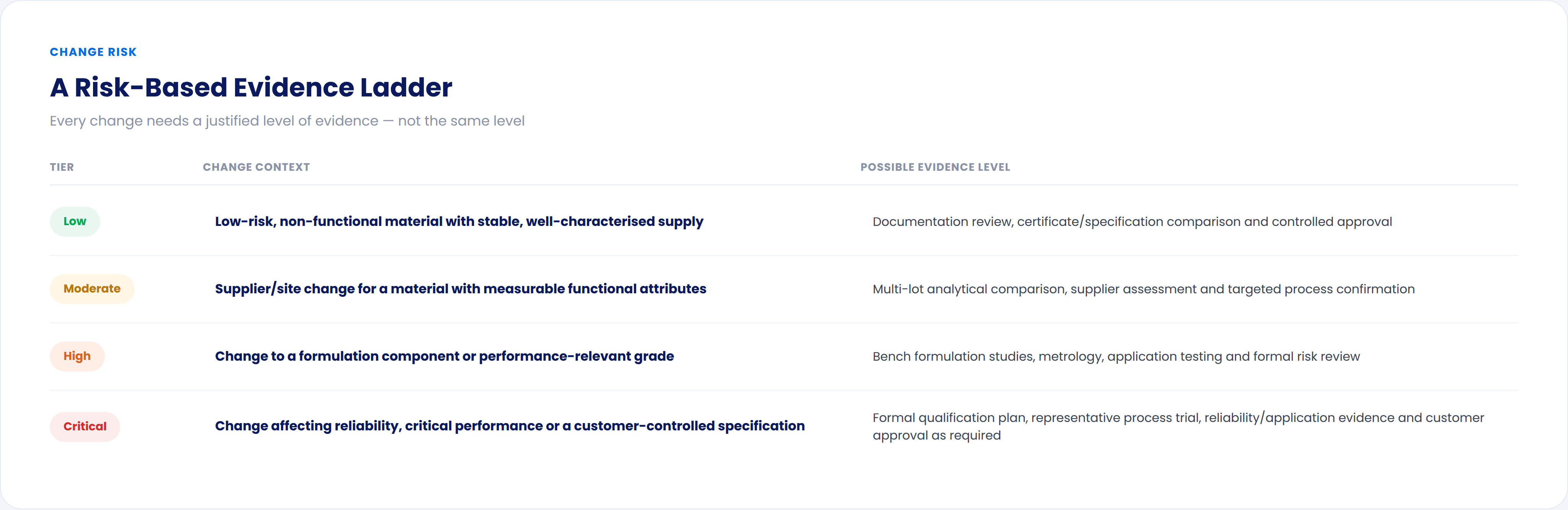
The point is not to standardise every scientific study. It is to make the basis for the selected study clear and proportionate.
Why certificates are rarely the full answer
Certificates are valuable, but they only cover the parameters specified and measured. A specification may not capture every attribute that affects downstream performance: low-level impurities, particle morphology, moisture, dispersion behaviour, residual solvents, rheology or interactions with other components.
The practical question is not "Does the new supplier's certificate match the old one?" It is "Does the combination of documentary, analytical, formulation, process and application evidence show that this material will perform as intended in the approved use?"
Build change control around relationships
A strong workflow does not require every record to be copied into a new system. It does require stable references among authoritative systems:
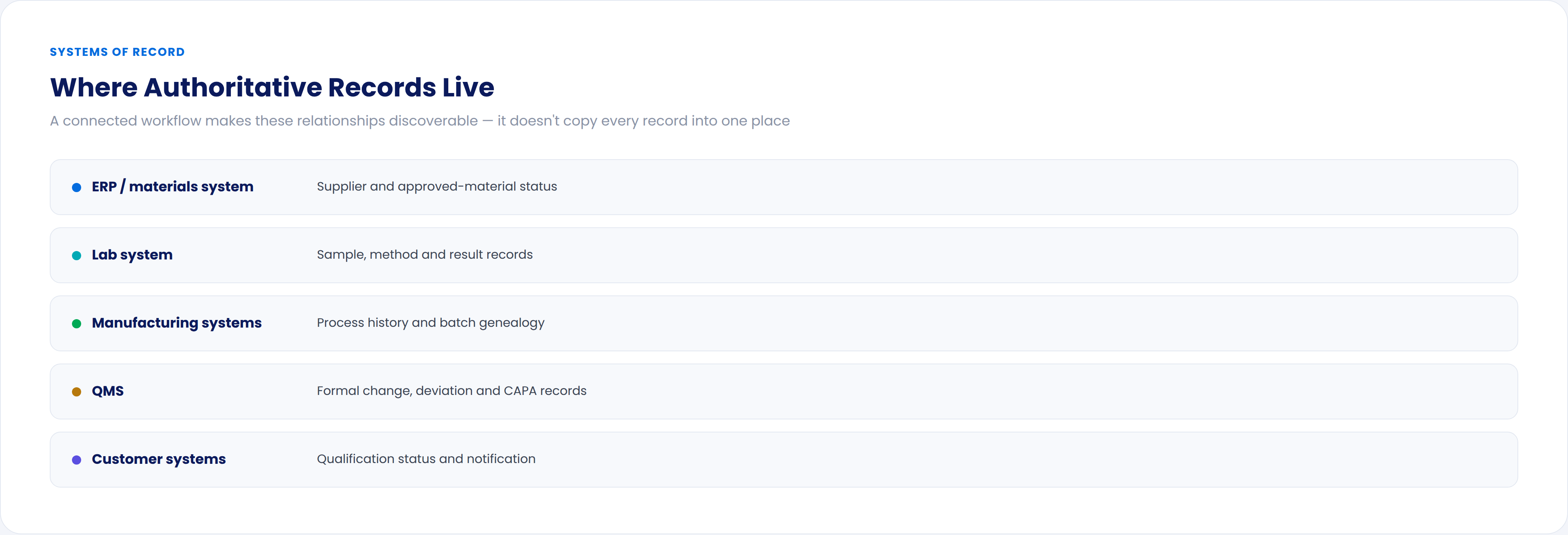
- The ERP or materials system may own supplier and approved-material status.
- The lab system may own sample, method and result records.
- Manufacturing systems may own process history and batch genealogy.
- The quality management system (QMS) may own formal change, deviation and CAPA (corrective and preventive action) records.
- Customer systems may track qualification status and notification.
The qualification workspace or change record should make those relationships discoverable, while leaving official records in their appropriate systems of record.
Common gaps that cause late-stage surprises
Most late-stage surprises in electronics material changes trace back to a small number of gaps in the qualification record rather than to the science itself.
- Scope taken from the request. The assessment covers only the product named in the change request, and a second product or customer that uses the same material is found later.
- Evidence plan written after testing. When acceptance criteria are set once results are in, it is hard to show that the study was designed to answer the right question.
- Results not tied to lots. Test data is recorded without the supplier lot, sample genealogy or process conditions, so a later deviation cannot be compared with the qualification study.
- Approval without conditions. The decision records that a change was approved, but not for which products, sites or specification limits, or for how long.
- No post-implementation check. First production lots are not monitored against the qualification evidence, so a drift is noticed only through a customer complaint.
For example, a team approving a second source for a dielectric material might qualify it on one product line, then find months later that the same material sits in a product with a tighter customer specification. A record that started from the material, rather than from the request, would have shown both uses at the outset.
Verify the change after approval
The final question is whether the approved change behaved as expected. Monitor the first relevant lots or production runs, key process and quality indicators, customer feedback and any deviations. Then link the outcome back to the original decision.
This turns change control into reusable knowledge. The next time a comparable change is proposed, teams can find not only the approval but also the evidence, conditions and real-world outcome behind it.

.png)

