
A Laboratory Information Management System isn't a nice-to-have anymore. For labs generating meaningful volumes of samples and data, it's closer to essential infrastructure, and the market reflects that: estimates put the global LIMS market between $1.5 billion and $2.8 billion in 2025, with compound annual growth rates ranging from roughly 6% to 12% through the early 2030s depending on the source. Within the broader laboratory informatics category, LIMS alone accounts for 54.6% of total market share, more than any other lab software category, because it functions as the central data backbone that everything else in the lab plugs into.
What a LIMS actually does
At its core, a LIMS manages and organizes the large volumes of data a laboratory generates, from analytical instruments, sample tracking, and lab notebooks, and consolidates it into a single, centralized system. The goal isn't just storage. It's making sure that information stays accurate, accessible, and secure as it moves through the lab's workflows, from sample intake to final report.
That centralization does real work. Instead of results scattered across instrument printouts, spreadsheets, and paper logs, a LIMS creates one place where staff can retrieve, analyze, and report on data without hunting across multiple systems.
Why LIMS adoption has become non-negotiable
Three pressures are driving the shift from optional tool to standard infrastructure.
Data quality demands have gone up. As industries depend more heavily on lab results for critical decisions, whether that's a pharmaceutical release, a materials qualification, or a food safety check, the tolerance for manual data entry error has shrunk. A LIMS enforces standardized, consistent data capture across the organization, which directly reduces the error rate baked into manual processes.
Regulatory expectations have gotten stricter. In regulated industries, LIMS platforms now do the heavy lifting of proving that electronic records meet FDA 21 CFR Part 11 standards, the regulation that makes electronic records and signatures legally equivalent to paper ones. That means field-level, immutable audit trails capturing who changed what, when, and why, unique user credentials with no shared logins, and validated system controls covering everything from instrument interfaces to record retention. Labs are also increasingly held to ALCOA+ principles, meaning data must be attributable, legible, contemporaneous, original, accurate, complete, consistent, enduring, and available. Meeting that bar manually, across every sample and every report, isn't realistically sustainable at scale.
Automation has become a competitive necessity, not a luxury. A LIMS automates sample tracking, data entry, and routine analysis, freeing lab staff from repetitive manual work and directly improving throughput. Labs still running these processes by hand are, in practical terms, competing with one hand tied behind their back against organizations that automated years ago.
The core benefits, and what's actually behind them
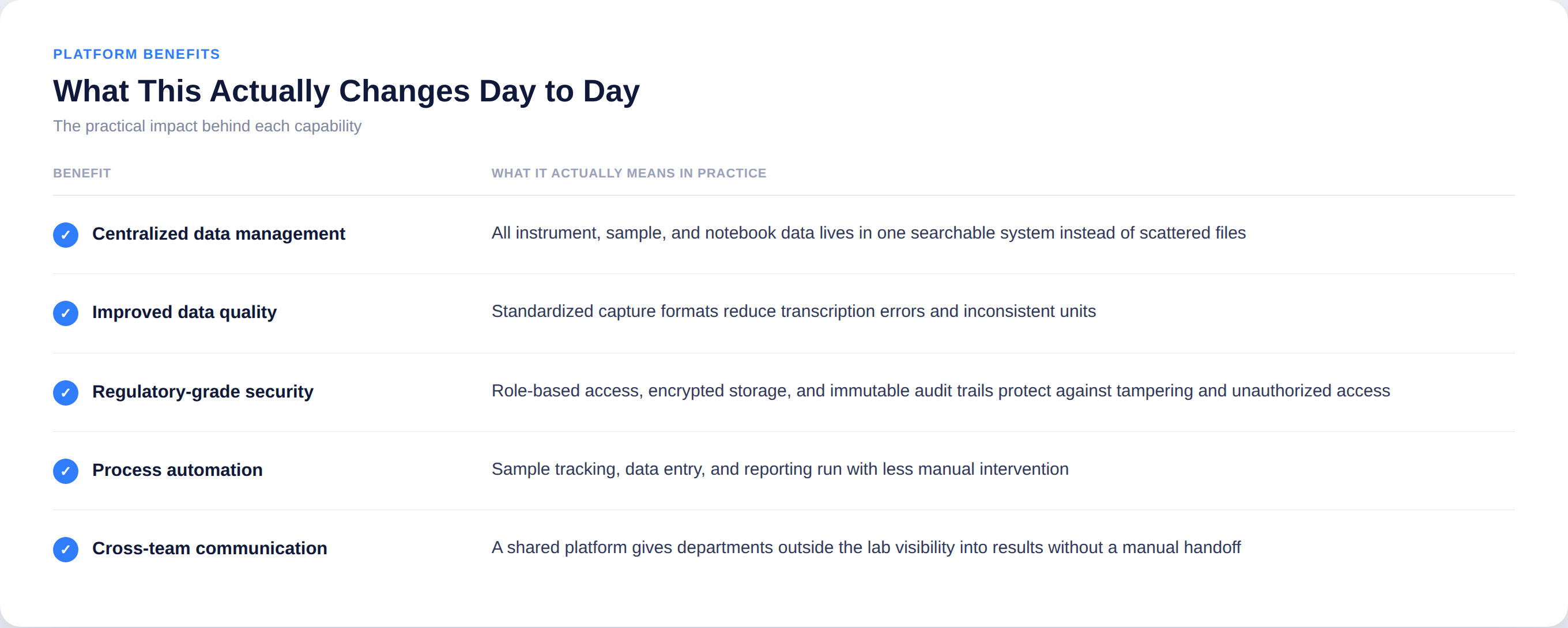
BenefitWhat it actually means in practiceCentralized data managementAll instrument, sample, and notebook data lives in one searchable system instead of scattered filesImproved data qualityStandardized capture formats reduce transcription errors and inconsistent unitsRegulatory-grade securityRole-based access, encrypted storage, and immutable audit trails protect against tampering and unauthorized accessProcess automationSample tracking, data entry, and reporting run with less manual interventionCross-team communicationA shared platform gives departments outside the lab visibility into results without a manual handoff
Each of these compounds over time rather than delivering a one-time gain. Centralized, well-structured data isn't just easier to work with today; it becomes the foundation for trend analysis and predictive work later, since a system built on inconsistent, poorly captured data can't support that kind of analysis regardless of what's layered on top of it.
What actually determines whether a LIMS delivers
Not every LIMS implementation produces these benefits automatically. The regulatory compliance piece, in particular, depends entirely on configuration and disciplined use, not just the presence of the software. A LIMS that satisfies GxP and 21 CFR Part 11 requirements needs proper system validation before use, routine audit trail review as part of normal quality oversight (not something scrambled together before an inspection), and strict enforcement of unique user access with no exceptions for convenience.
The same logic applies to data quality and automation benefits. A LIMS configured with direct instrument integration prevents the backdated manual entries and transcription errors that undermine data integrity elsewhere. One left to rely on manual data entry into structured fields still carries much of the original error risk, just with better formatting.
Choosing and implementing a LIMS well
Getting real value out of a LIMS comes down to matching the system to how the lab actually operates, not just its feature list. For regulated industries specifically, that means confirming the platform's validation package, audit trail granularity, and electronic signature handling meet Part 11 requirements before deployment, not after a first inspection surfaces a gap. It also means integrating the LIMS with the rest of the lab's data ecosystem rather than running it in isolation, since a LIMS disconnected from ELN or SDMS systems just relocates the silo problem instead of solving it.
A LIMS isn't just a tool for keeping data organized. It's the system that determines whether a lab's results can be trusted, defended under audit, and actually reused, which is a much higher bar than simply having somewhere to store the numbers.
.png)
.png)
.png)
