
A scientific data management system, or SDMS, is software designed to capture, index, secure, organize, retrieve, and retain the scientific data files a laboratory generates. Its primary role is to manage raw and native instrument output, such as chromatograms, spectra, images, instrument logs, reports, and proprietary data files, along with the metadata needed to understand and find those records later.
An SDMS fills a gap that often appears as laboratories add instruments, analytical methods, users, locations, and years of retained data. A LIMS or ELN may support file attachments or links, but storing a file next to a record is not the same as managing high volumes of raw scientific data as governed, searchable, long-lived records. Instrument data can otherwise remain distributed across instrument computers, shared drives, removable media, or personal folders, with inconsistent naming and little context.
The problem becomes visible when someone needs to revisit a result. A scientist may need the original chromatogram behind a reported value, a quality team may need to reconstruct a record during an investigation, or an auditor may ask to see the source data and its history. An SDMS gives the organization a controlled way to preserve and retrieve that information, rather than relying on whoever originally saved the file to remember where it is.
How is an SDMS different from a LIMS or ELN?
LIMS, ELN, and SDMS platforms can overlap in practice, particularly when products offer attachments, integrations, reporting, or shared metadata. The key distinction is the role each system plays as a laboratory’s primary system of record.
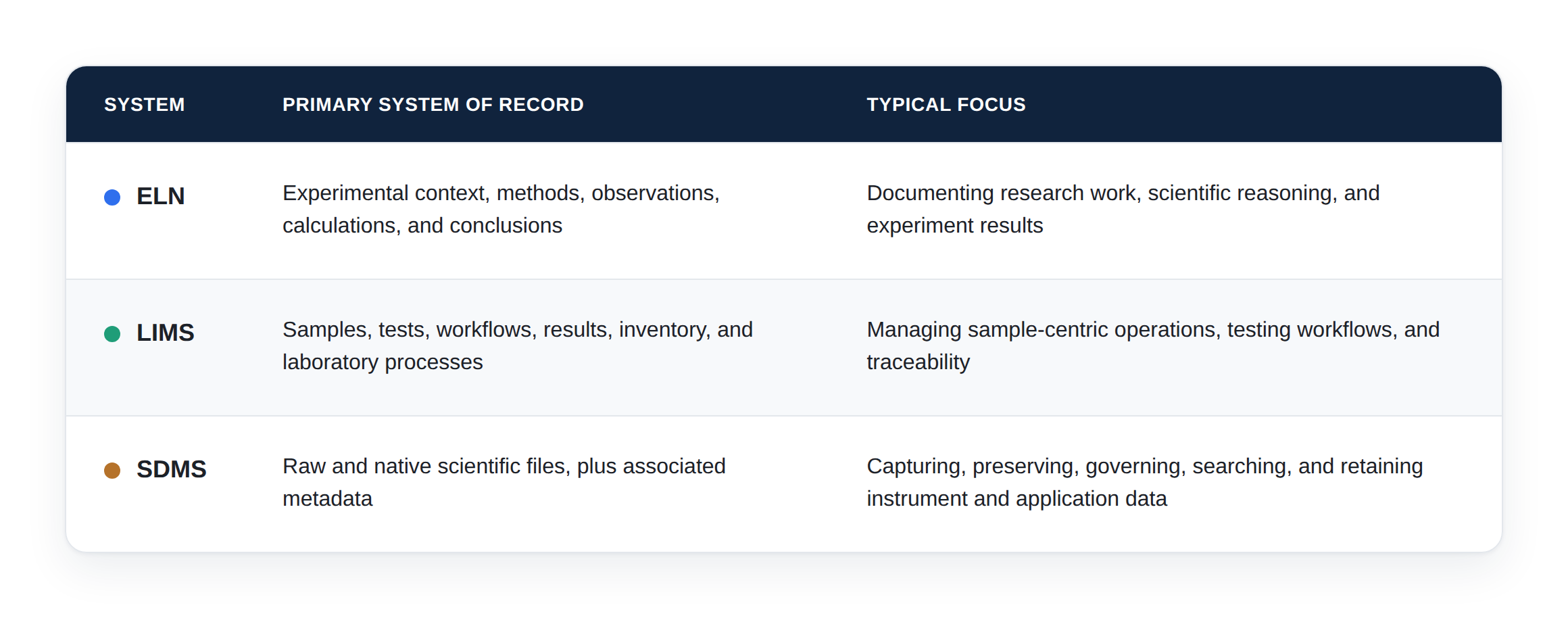
An ELN helps researchers record what they did, why they did it, and what they observed. A LIMS helps laboratories manage the operational side of the work: samples, specifications, test status, instrument use, inventory, approvals, and reporting. An SDMS focuses on the underlying files created by instruments and scientific applications, including data that may be too large, too complex, or too varied to manage effectively inside structured workflow records alone.
For example, a LIMS may record that sample A-104 passed a purity test, while the SDMS stores and indexes the native chromatographic file, associated report, instrument metadata, and relevant audit history behind that result. The ELN may document the experimental rationale, sample preparation, method changes, and interpretation of the outcome.
An SDMS typically complements a LIMS and ELN rather than replacing either. It may be deployed as a dedicated repository, integrated into a broader laboratory-informatics environment, or connected through APIs and links to the systems where samples, experiments, and results are managed. The objective is not simply to store more files. It is to maintain traceability from a scientific conclusion back to the source data that supports it.
Why does SDMS matter for regulatory compliance?
In regulated and quality-critical laboratories, raw data is not just an operational byproduct. It can be part of the evidence used to demonstrate that a result is accurate, reproducible, attributable, and trustworthy. If a laboratory cannot locate the original instrument output behind a reported result, or cannot show who created, changed, reviewed, or approved a record, it may struggle to support an investigation, submission, inspection, or product-quality decision.
For FDA-regulated work, 21 CFR Part 11 may apply when electronic records are used to satisfy requirements under applicable FDA regulations, often called predicate rules. The specific controls needed depend on the intended use of the system, the type of records it manages, and the organization’s risk assessment. In practice, organizations commonly need reliable record retention, controlled access, auditability, and the ability to retrieve records and associated information for review or inspection. FDA describes an audit trail as a secure, computer-generated, time-stamped electronic record that enables reconstruction of the creation, modification, and deletion of an electronic record. FDA guidance also states that audit trails should be retained for at least as long as the electronic records they support.
A modern SDMS can support those requirements by helping laboratories preserve original files, apply access controls, record relevant user activity, manage retention, and retrieve data with consistent metadata. It does not, by itself, make an organization compliant. Compliance also depends on the system’s configuration, validation where required, documented procedures, user training, governance, and the quality of the laboratory’s day-to-day data practices.
The practical risk is straightforward: when raw instrument data is scattered across local drives and disconnected folders, laboratories may lose visibility into which file is the authoritative source, whether it has been altered, and how it relates to the reported result. A governed SDMS reduces that risk by creating a more reliable record of the data lifecycle.
What capabilities does a modern SDMS need?
The right SDMS depends on a laboratory’s instrument landscape, regulatory obligations, data volumes, and existing LIMS, ELN, CDS, and enterprise systems. However, a modern platform should be evaluated against a consistent set of capabilities.
Automated data capture and native-file retention
An SDMS should capture or ingest data from laboratory instruments, instrument software, and related applications without creating a dependence on manual file transfers. It should preserve native source files as well as commonly used outputs such as PDFs, images, reports, and exported data.
Native-file retention matters because a static report may not contain all of the information needed to review or reconstruct an analysis. The original data file may include acquisition parameters, integration settings, calculation logic, instrument configuration, or other details that do not appear in a final report.
Metadata, indexing, and search
A file archive only becomes useful when people can find what they need. The SDMS should index files and capture meaningful metadata, whether automatically from connected systems or through controlled user input.
Users should be able to search by fields relevant to laboratory work, including sample ID, project, material, batch, instrument, method, analyst, experiment, date, file type, or result status. Full-text search can also help users locate reports and documents when a precise identifier is unavailable.
The goal is to make historical data reusable. A scientist investigating a formulation issue should be able to find prior runs associated with a material or project. A quality team should be able to retrieve the supporting record for a result without asking multiple people to search shared drives. An auditor should be able to follow a result back to the source data without a manual reconstruction exercise.
Integration and traceability
An SDMS should connect to the systems that create, use, and govern laboratory data. That can include instruments, chromatography data systems, imaging systems, LIMS platforms, ELNs, quality systems, identity-management tools, and enterprise data repositories.
Integration is what turns an SDMS from a passive file store into part of the laboratory’s data foundation. When a result in the LIMS or an experiment in the ELN links directly to the supporting raw data, scientists and reviewers can move between context and evidence without repeating searches across disconnected applications.
This is especially important in multi-site organizations. Consistent links, identifiers, and metadata standards help ensure that a record remains understandable when it moves between teams, systems, locations, or stages of development.
Data integrity and access controls
Scientific data needs protection from accidental loss, inappropriate change, and unauthorized access. A robust SDMS should support role-based permissions, controlled access, record-retention policies, backups and recovery, and a clear approach to preserving authoritative source files.
For regulated workflows, organizations may also require secure audit trails, electronic signatures, review and approval workflows, and support for validated use. Electronic signatures are not necessary for every SDMS deployment, but they can be important when the system is used in a workflow that requires compliant approval or signoff.
The most important question is whether the platform can preserve the original source record and provide a reliable history of relevant actions. In many raw-data workflows, immutability and traceability matter more than conventional “version control,” because the original instrument output should remain identifiable even when derived files, reports, calculations, or interpretations change.
Scalable storage and lifecycle management
Instrument data accumulates quickly. A laboratory may need to retain files for years or decades, even as instrument software changes, teams reorganize, projects end, or sites are added. The SDMS should therefore support scalable storage, backup, recovery, archival, retention policies, and migration planning.
A procurement review should also consider file-format support, storage architecture, performance at volume, vendor lock-in, export options, and the ability to retain both files and associated metadata during a future system migration. A repository that is easy to populate but difficult to retrieve data from later can create a new long-term data-management problem.
When does a laboratory need an SDMS?
A laboratory may need an SDMS when its existing systems no longer provide a reliable way to manage raw data at scale. This often becomes apparent when teams spend too much time searching for files, struggle to connect results to underlying instrument data, rely on unmanaged storage locations, or cannot apply consistent retention and access controls across instruments and sites.
Common indicators include:
- Raw instrument files are stored on local PCs, shared drives, removable media, or application-specific folders.
- Scientists must manually rename, move, upload, or attach files to make them available to others.
- The laboratory cannot reliably link a reported result to the native data file that supports it.
- Instrument data is difficult to search by sample, material, method, project, analyst, or date.
- Audits, investigations, technology transfers, and reanalysis requests require extensive manual record collection.
- Multiple sites or teams use different naming conventions, folder structures, and data-retention practices.
- The organization needs to retain growing volumes of scientific data while maintaining data integrity and usable access.
These needs occur most often in data-intensive or regulated environments, including pharmaceutical and biotech R&D, analytical and quality-control laboratories, clinical research, environmental monitoring, food and agricultural testing, manufacturing, chemicals and materials development, energy and engineering, and academic or government research.
Where does an SDMS fit into a connected R&D data strategy?
An SDMS solves a specific problem: preserving and making available the raw, unstructured, and often high-volume data generated by laboratory instruments and scientific applications. It does not replace the systems used to manage samples, document experiments, run workflows, interpret results, or make product-development decisions.
Its value depends on the quality of its connections to the rest of the R&D data environment. If raw files are retained in an SDMS but cannot be easily related to the sample, formulation, material, method, result, or experiment that produced them, the organization has created a better archive, but still a silo.
A connected data strategy establishes traceability across those layers. It lets a user move from a product or formulation to an experiment, from an experiment to a sample and result, and from that result to the supporting raw instrument file. That makes data easier to trust, review, reuse, and apply in future work.
The strongest SDMS strategy is therefore not just about satisfying retention requirements. It is about turning historical scientific data into a usable organizational asset. When raw data is consistently linked to structured experimental and laboratory records, teams can spend less time locating evidence and more time comparing results, identifying patterns, transferring knowledge, and making better R&D decisions.
Uncountable helps R&D teams create that connection by bringing formulation, material, experiment, and result data into a structured record while linking those records to the supporting files and source data behind them. Explore how ELN and LIMS workflows can operate on a shared R&D data layer, or book a demo to discuss how your team currently captures, connects, and retrieves laboratory data.
.png)
.png)
.png)
