Most R&D teams that try AI on their own data run into the same problem. The model works. The data feeding it is scattered across notebooks, spreadsheets and instrument folders, or it's missing the context that explains each result.
Industry analyst firm Axendia makes that case in its new briefing note on Uncountable, From Discovery to Manufacturing: Unifying Product Development with AI. Senior Industry Analyst Sandra Rodriguez wrote it after a briefing with Jason Hirshman, Uncountable's Co-Founder and CTO, Joseph Mann, VP of Solutions Engineering, and Zeeshan Mahmood, Director of Partnerships.
Here's a short summary. Axendia's full analysis, including its caveats and recommendations, is on the Axendia blog.
The models weren't the problem
Uncountable started in 2016 as a machine learning consultancy for chemicals and materials companies, using methods such as Bayesian optimization. Axendia describes what the team kept finding: customers' data often wasn't structured or connected enough for the models to help.
“After two years, we realized that AI and machine learning models weren’t really the problem,” Zeeshan told Axendia. “It’s garbage in, garbage out.”
The note includes one example. A customer's colleague forgot to upload part of a dataset, and the model run that followed was wasted effort. No algorithm fixes that. So the company changed direction: “Why don’t we focus on being a system of record?”
From the lab notebook to the plant floor
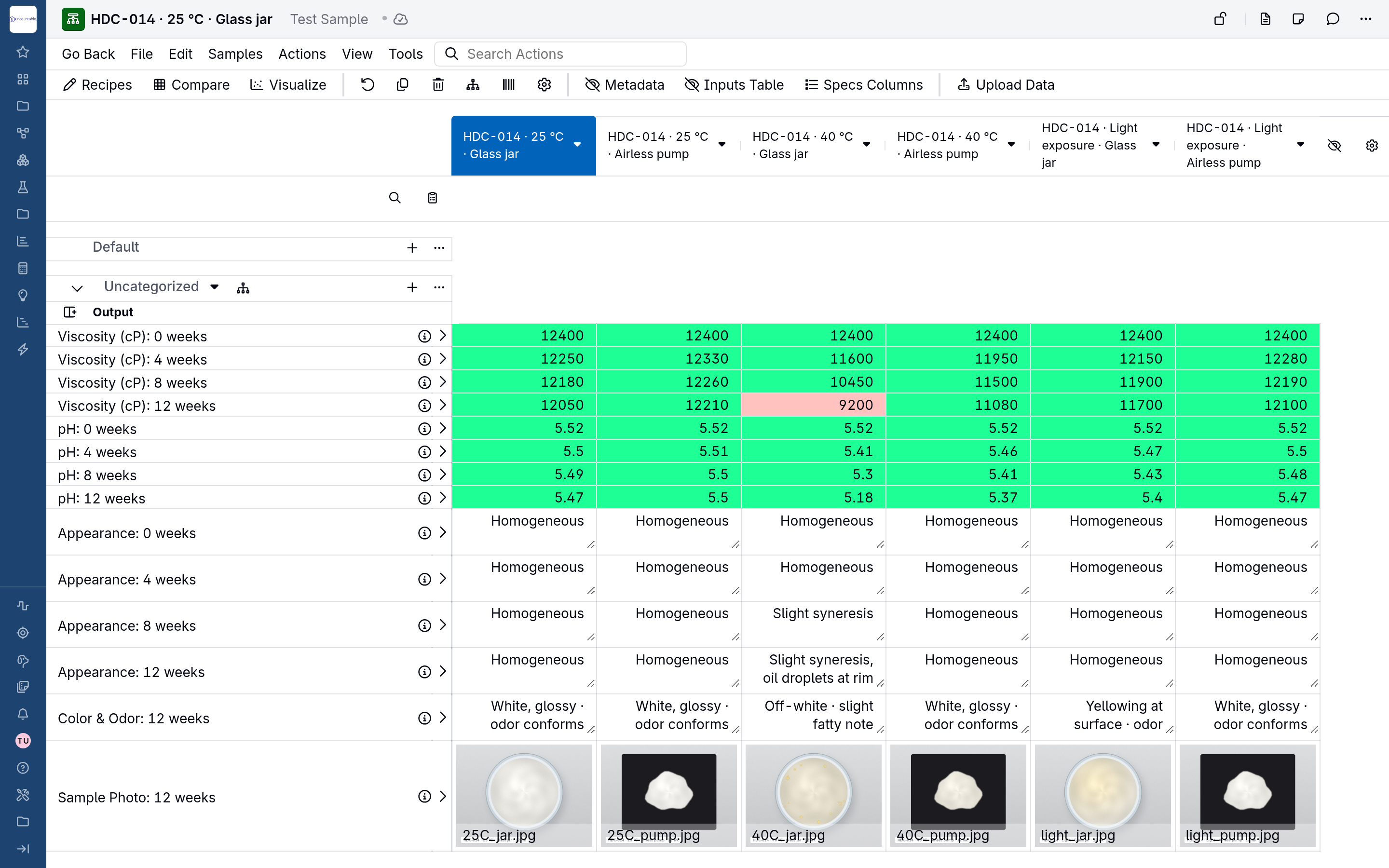
Axendia describes a platform built on one relational data model that can be configured as an ELN, LIMS, PLM, QC LIMS or QMS, and that can integrate with a company's existing systems instead of replacing them. Bills of materials, specifications, formulations, recipes and supplier documents sit in the same model as the experiments that produced them.
“The platform can support research activities while also providing more structured processes for product development, quality, and lifecycle management,” Joseph explained.
Axendia sees this as especially relevant for formulated products, where ingredients, test results, supplier data and process conditions all shape the final product. It also notes that end-to-end traceability depends on implementation scope, integrations, data governance and configuration.
On quality and validation, the note covers configurable QMS and QC LIMS workflows with audit trails, and validation documentation assessed against 21 CFR Part 11 and EU Annex 11 (see our GxP compliance page for more). For engineering teams, CAD files can be uploaded and viewed in the platform and opened in external design tools for editing.
What can AI do once scientific data is structured?
Axendia's section on AI covers Bodie, Uncountable's AI assistant. Because Bodie works on records that already carry their formulations, conditions and results, scientists can ask it specific questions about prior work.
“Because your data is structured, you can actually now ask it very pointed questions,” Zeeshan said. “It can create graphs for you, it can do formulation prediction, it can suggest synthesis routes.”
The note lists early applications including formulation optimization, trend analysis of experimental data, investigating out-of-specification results, and design of experiments. Axendia is clear that the benefit depends on data quality and completeness, and on whether each AI method suits the task.
Check the data foundation before the AI tool
Axendia's wider market research points R&D leaders toward two things: strengthen data foundations for AI, and tie AI plans to measurable business outcomes. Both start with the same question: can your team find an experiment, the materials and conditions behind it, and the quality results that followed, without asking three people?
If the answer is no, a better model won't change much. Connecting those records will, and that's what lets the learning from one project carry into the next one, and into the plant.
Thank you to Sandra and the Axendia team for the briefing. Read the full briefing note on Axendia.