
Chemical product development is slow for reasons that have less to do with chemistry and more to do with how data moves, or doesn't move, between the people working on it. New chemical products now take an average of 11.3 years and $268 million to bring to market, up nearly 10% from the previous decade, and much of that delay comes from data fragmentation rather than the science itself. ELNs and LIMS exist specifically to close that gap, but only when they're deployed with a clear understanding of what they actually fix.
Where the time actually goes
Traditional chemical R&D loses time in predictable places: manual note-taking, sample tracking done by hand, data trapped in individual notebooks, and rework caused by simply not being able to find prior results. One documented case in coatings formulation cut development time from 9 months to 6 weeks by digitizing lab notebooks and standardizing data formats before layering in more advanced tools. A separate polymer formulation program reduced a task that traditionally took 3 to 6 months down to 3 days once the underlying data infrastructure could support faster iteration. These aren't edge cases. They're representative of what happens once the basic data bottleneck is removed.
Regulatory compliance adds its own tax on speed. A single EU REACH registration can cost anywhere from under €10,000 to more than €2 million depending on tonnage band and existing data availability, and the process demands detailed audit trails and traceable data lineage at every step. Manual record-keeping makes that traceability slower to assemble and easier to get wrong, which is exactly where digital systems earn their keep.
What ELNs and LIMS each actually solve
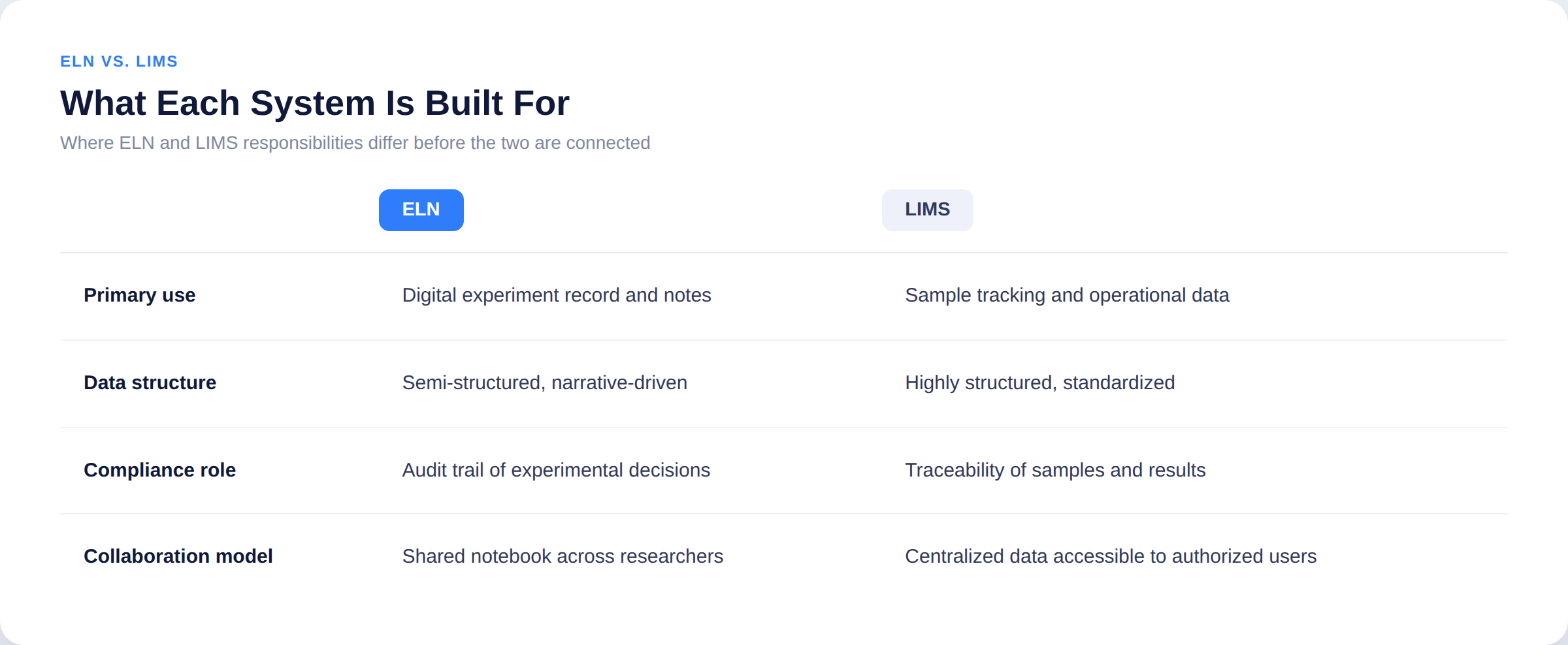
The two systems aren't interchangeable, and understanding the split matters for getting real value out of either one.
ELNs replace the notebook, not the lab. They let chemists record experimental procedures, observations, and results digitally instead of on paper, making everything instantly searchable and shareable rather than locked in a binder on someone's desk. That searchability alone eliminates a huge share of the "has anyone tried this before" rework that quietly extends development timelines.
LIMS replace the spreadsheet, not the notebook. They centralize data storage, automate data entry, and enforce data integrity across an organization rather than within one chemist's personal files. Where ELNs are about experimental narrative, LIMS are about operational consistency: sample tracking, inventory, and compliance workflows that stay standardized regardless of who's running them.
Where the real acceleration comes from
Four capabilities, taken together, are what actually shorten chemical development cycles rather than just digitizing existing paperwork.
Automated data capture. ELNs and LIMS that pull data directly from instruments remove the manual transcription step that introduces both delay and error. This is also the foundation for any AI-driven formulation work down the line, since models need consistently captured, structured data to train on.
Real-time, distributed collaboration. Cloud-based access means chemists in different labs or time zones can work from the same dataset instead of waiting on emailed spreadsheets or version-conflicted files. For global chemical R&D operations, this alone removes days of latency per project cycle.
Built-in audit trails and electronic signatures. These aren't just compliance checkboxes. They're what makes REACH, GLP, or other regulatory documentation assembly fast instead of a weeks-long scramble to reconstruct who did what and when.
Pattern discovery across historical data. LIMS with AI-based analytics capabilities can surface trends across large datasets that would take a human analyst weeks to find manually, turning years of accumulated formulation data into an active resource instead of an archive nobody revisits.
Choosing systems that don't create new bottlenecks
Not every ELN or LIMS delivers on this. A few factors determine whether a system actually accelerates development or just adds another tool to manage:
- Scalability matters because migrating platforms mid-project is its own multi-month delay; choose a system that can handle your data volume and user base for years, not just the current pilot.
- Integration depth determines whether ELN and LIMS data actually connect to each other and to materials informatics tools, or whether chemists end up manually reconciling data between systems, recreating the exact problem these tools are meant to solve.
- Compliance alignment, particularly for GLP or industry-specific regulatory frameworks, needs to be built into the system rather than bolted on, since retrofitting compliance after deployment is slower and riskier than building around it from the start.
The chemical companies compressing their development timelines aren't necessarily doing different chemistry. They're removing the data friction that used to eat months of every project before the actual science ever had a chance to move.
.png)
.png)
.png)
