To reuse R&D data across ELN, LIMS, and PLM, teams need to keep the context behind each result, connect records through common identifiers and clear system ownership, and search by the scientific question rather than by file or project name. The aim is to understand what has already been tested before planning new work.
The records exist. Establishing which trials are relevant takes longer than finding the files.
R&D data reuse means making previous work findable and understandable enough to inform a new decision. That includes successful formulations, failed trials, unexpected results, and the evidence behind decisions not to pursue an approach.
The goal is not to copy an old formulation or assume a historical result still applies. It is to understand what has already been tested, identify what remains uncertain, and plan the work accordingly.
Why retained data is not necessarily reusable
A result loses much of its usefulness when it becomes separated from the conditions that produced it.
A viscosity value may be available without the formula version, measurement temperature, sample age, or test method. A successful trial may be documented without the supplier grade or processing conditions. A rejected formulation may retain its results but not the reason it failed the project requirements.
These gaps affect interpretation. Two experiments can appear comparable while differing in ways that matter to the current question.
The problem also arises across systems. An ELN (electronic lab notebook) may document preparation and observations, a LIMS (laboratory information management system) may hold sample and test records, and PLM (product lifecycle management) may govern the approved product definition. Researchers need the relationships between those records, not just access to each application.
Preserve the context needed for comparison
Define the information a future user needs to assess an experiment. For formulation and materials development, that commonly includes the following information, and what each item helps establish:
- Formula or composition version: exactly what was tested
- Material identity, grade, source, and quantity: whether inputs are comparable
- Processing conditions: how preparation may have affected performance
- Sample or batch identifier: which physical material produced the result
- Test method, conditions, value, and unit: how the measurement was generated
- Project objective and acceptance criteria: what the team was trying to achieve
- Decision and record status: whether the result was preliminary, accepted, rejected, or superseded
Keep observations and explanations alongside those structured fields. A numerical result may show that a trial missed its target, while the scientist’s notes explain an unusual processing behavior or a reason to investigate further.
The required fields will differ by workflow. A coatings team may need cure conditions and substrate information; a food team may need sensory and shelf-life context. Capture what supports comparison and interpretation rather than requiring every possible field for every experiment.
Connect ELN, LIMS, and PLM without losing ownership
Improving reuse does not necessarily require replacing existing systems. It requires clear record ownership and dependable connections.
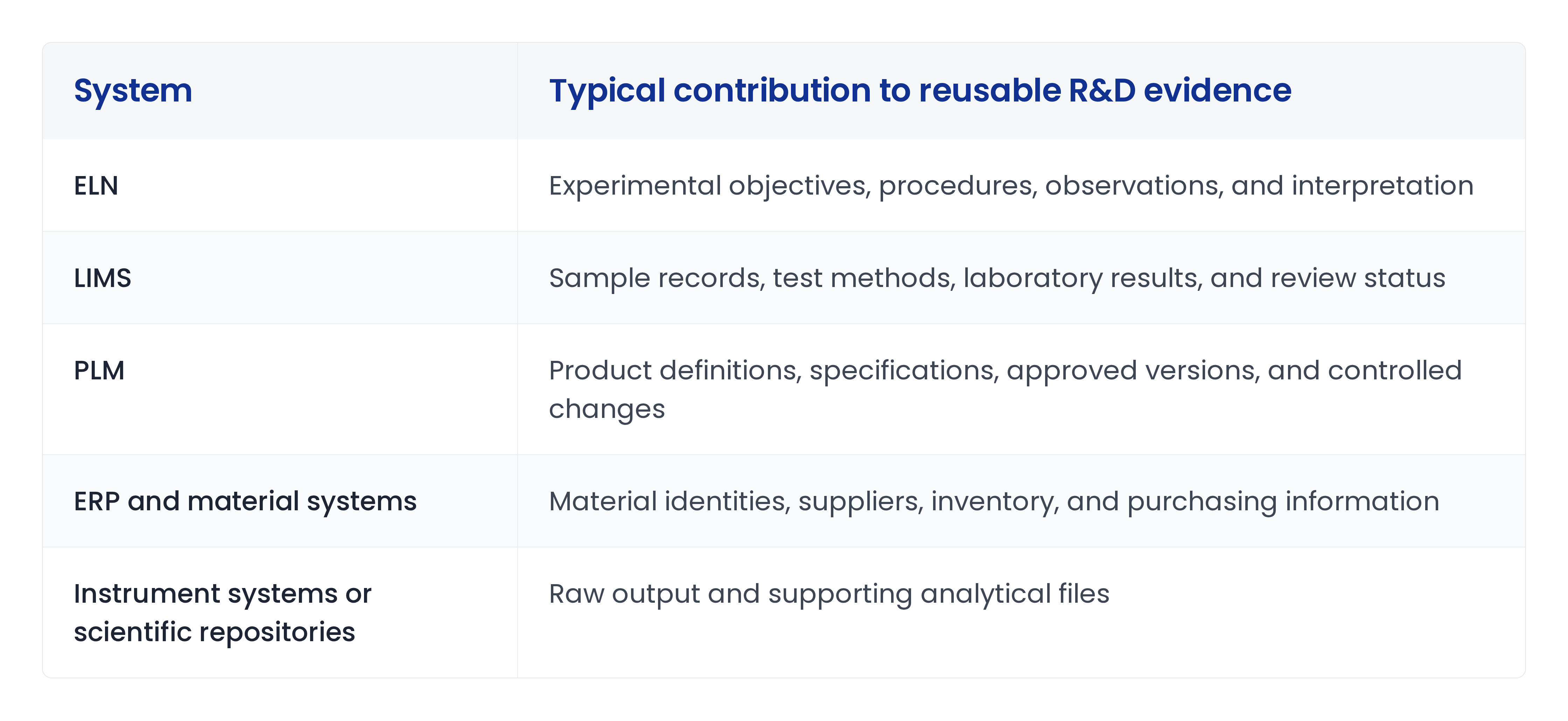
These responsibilities vary by implementation. Establish which system is authoritative for each record and preserve links back to it.
Common identifiers are essential. The same material may appear under an internal code, supplier name, and legacy abbreviation. Map those identities so users can find related work without incorrectly treating different grades as equivalent.
Version and status information need the same care. An exploratory formula is not an approved product definition, and a preliminary result should not become indistinguishable from reviewed evidence when records are brought together.
Search historical R&D data by the scientific question
Project names and keywords are useful starting points, but many reuse questions depend on structured criteria:
- Which formulations used this supplier grade?
- Which trials achieved the target property under comparable conditions?
- What alternatives were tested before this material was selected?
- Which process changes accompanied an improvement or failure?
- What evidence supported the formula now moving to scale-up?
For a solvent-substitution project, the team may need to narrow historical work by resin system, replacement concentration, drying conditions, and performance results. The candidate records then need review for differences in application, method, and requirements.
Search identifies possible evidence. Scientific judgment determines whether that evidence is relevant.
Use prior work without treating all repetition as waste
Repeating an experiment can be necessary. Teams may need to confirm a result, assess a new supplier grade, investigate lot variability, or establish whether laboratory performance holds at production scale.
Avoidable repetition is different: the trial is repeated because earlier work could not be found or interpreted.
Before planning a study, review comparable experiments and document what the new work needs to establish. Historical evidence may rule out an unsuitable direction, suggest a useful starting point, or show that confirmation is still required.
This approach improves the experimental plan even when the decision is to repeat the work.
Apply reuse to recurring development problems
Raw-material substitution is one practical starting point. Prior experiments can reveal alternatives and the tradeoffs that led to their acceptance or rejection. Current availability, requirements, and performance still need assessment.
Quality investigations benefit from connected records too. Teams can examine whether similar issues occurred with a material lot, process condition, formulation revision, or test-method change.
For technology transfer and scale-up, previous trials help receiving teams understand critical parameters and the evidence behind an approved formula. The final specification alone may not explain the development decisions that produced it.
Introduce AI for data reuse around a defined task
AI and statistical tools can help retrieve, summarize, compare, or model historical work. Their usefulness depends on the records available and the question being asked.
Separate retrieval from prediction. Finding experiments about a material is different from predicting how a new formulation will perform. The latter requires a suitable dataset, defined inputs and outcomes, and an evaluation approach appropriate to the intended use.
For either task, users need access to the supporting records. They should be able to inspect the formula version, materials, conditions, methods, and results behind an output.
Incomplete or inconsistent context can produce misleading suggestions. Treat AI as decision support, retain expert review, and evaluate performance against the specific workflow rather than assuming a searchable archive is ready for every analytical use.
Start with one question and test the answer
Choose a recurring question that is difficult to answer today. Limit the first effort to a product family, material class, or experimental workflow.
Map where the relevant information lives. Identify the fields and relationships needed to retrieve comparable records, then test the process with scientists who know the work.
When they cannot interpret a result, establish why. The gap may be missing context, inconsistent identifiers, unclear versioning, restricted access, or a broken connection between systems.
Improve new-data capture while selectively enriching historical records that support the chosen question. A complete archive migration is not a prerequisite for making useful progress.
Evaluate a platform with your own records
Use a realistic case rather than a generic demonstration. A supplier substitution, failed formulation, scale-up study, or recurring quality issue can reveal whether the proposed system supports reuse.
Ask the vendor to demonstrate finding comparable experiments, inspecting their context, distinguishing versions and statuses, and following results back to source evidence. Include the relevant access restrictions.
If analytics or AI are included, ask how users identify the records behind an output and assess whether the result is appropriate for the current decision.
A credible implementation should show how selected records become usable, not promise that every historical file will immediately support analysis.
Book a demo of Uncountable to discuss your R&D records, recurring reuse questions, and the connections needed to support them.