
Paper lab notebooks fail in ways that are easy to underestimate until the data is actually lost, misread, or impossible to find months later. ELN adoption reflects that reality: usage jumped from 66% to 81% of labs in a single year, and the shift isn't cosmetic. It's a response to specific, measurable failure modes that paper simply can't fix, no matter how disciplined the note-taker.
The failure modes paper notebooks can't solve
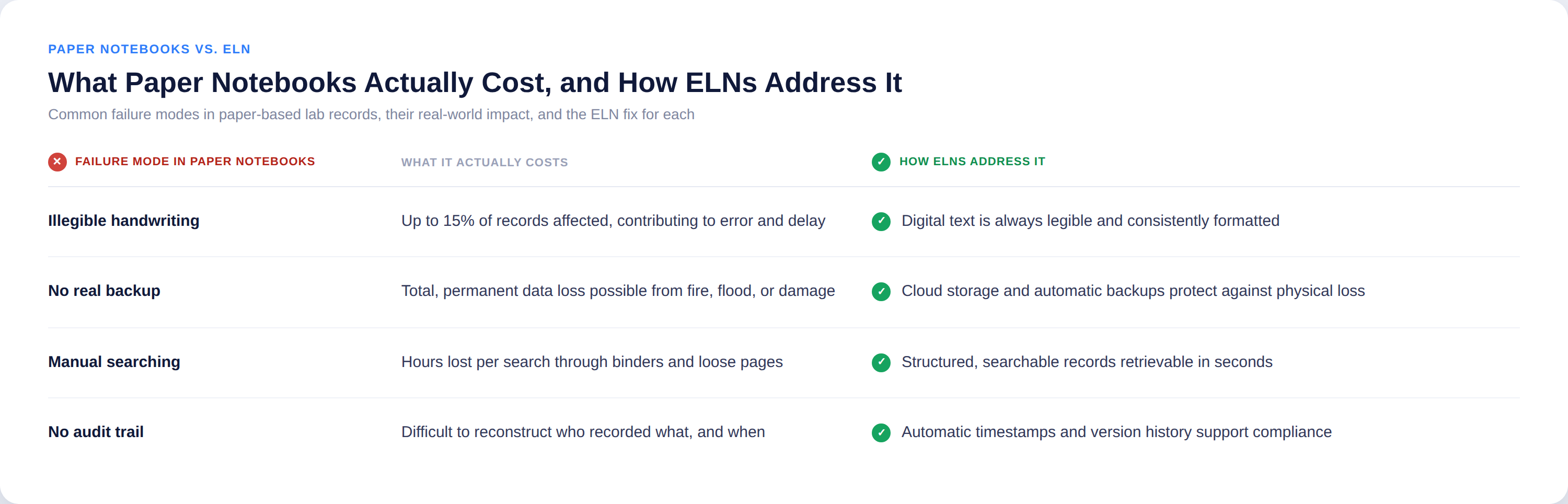
Illegible handwriting isn't a minor annoyance in a lab record; it's a documented, recurring source of error. Studies of handwritten records found illegibility rates as high as 15%, and one comparative study found handwritten records defective enough that meaning was unclear in 15% of cases, compared with zero illegibility in electronic records reviewed in the same study. Errors compound from there: handwritten input carries an 8.8% error rate at the word level, nearly three times the 3.0% rate for typed input in the same test conditions.
Then there's the physical vulnerability paper simply can't engineer around. When a fire broke out in a University of St. Andrews chemistry building, researchers scrambled to save equipment and reagents, but records with only paper backups tied to the building faced permanent loss, while data with digital, off-site backups was recoverable almost immediately. That's not a hypothetical: fire, flood, or even a misplaced binder can end years of documented work in a way that a properly backed-up ELN simply cannot.
The six benefits that actually matter
Accuracy and consistency. ELNs give every researcher a centralized platform for capturing data in real time, which removes the risk of losing or misplacing information and ensures every team member is working from the same current version rather than someone's personal notebook.
Collaboration and sharing. A centralized platform means teams can work together and share information in real time regardless of physical location, which matters directly for distributed or multi-site research groups that paper notebooks were never designed to support.
Searchability and retrievability. Structured, electronic storage means specific experiments, protocols, or observations from months or years ago can actually be found again, rather than requiring someone to flip through binders hoping the right page turns up. This also makes historical data genuinely reusable: researchers can pull past results into new experiment design instead of unknowingly repeating work.
Regulatory compliance. ELNs capture and store data in a consistent, secure, auditable format, which creates the kind of traceable record regulators expect and paper notebooks can't reliably reconstruct after the fact.
Scalability and reliability. As research grows in scope and complexity, ELNs handle the resulting data volume and multi-team collaboration in ways paper physically can't, and their backup and storage architecture means hardware failure or an unexpected event doesn't threaten the underlying record the way a fire or flood does to physical books.
Visualization and graphing. Built-in graphing tools let researchers generate and customize charts directly from captured data, surfacing trends and outliers far faster than manually compiling numbers from scattered notes into a spreadsheet after the fact.
Why adoption still lags in some settings
Despite the clear case, ELN uptake in academic labs has historically trailed industry, with estimates as low as 4% of small academic labs having a system in place in earlier surveys, even as broader adoption climbed toward 81% across labs overall more recently. Cost is consistently the top-cited barrier: one survey found a majority of researchers willing to pay up to $50 a month for an ELN but resistant once pricing crossed the $100 threshold, alongside concerns about ease of use and cross-device accessibility. That gap matters because it means the benefit case for ELNs isn't in question. What varies is whether the specific platform fits a lab's budget, workflow, and technical comfort level closely enough to get used consistently rather than abandoned after a few months.
What to weigh beyond the ELN itself
An ELN solves the notebook problem specifically, but it's one piece of a broader lab digitization decision. Organizations evaluating this shift should also understand how ELNs relate to LIMS, laboratory execution systems, inventory tracking software, and end-to-end R&D platforms, since choosing in isolation risks picking a tool that doesn't connect to everything else the lab eventually needs.
The labs still relying on paper aren't just working slower. They're carrying a level of data risk, from illegibility, physical loss, and unsearchable history, that most industries stopped accepting years ago.
.png)
.png)
.png)
