A laboratory information management system (LIMS) connects samples, test results, instruments, and laboratory workflows. Its value comes from keeping those records linked: a result should be traceable to the sample tested, the method used, the person responsible, and the equipment that generated it. The main LIMS features are sample management and traceability, test and workflow management, access controls, audit trails, instrument connectivity, inventory and equipment records, integration with other systems, and search and reporting.
When evaluating a LIMS, start with the work your laboratory needs to manage. Sample tracking, workflow controls, data security, and integration are central considerations. Formulation management, project planning, advanced analytics, and AI may also be important, particularly for R&D teams, but their relevance depends on your workflows.
What does a LIMS do?
A LIMS manages laboratory information from sample receipt or creation through testing, review, and reporting. It gives teams a structured place to record what happened to a sample, retrieve its results, and understand the context behind those results.
This helps reduce the fragmentation created by separate spreadsheets, instrument files, and paper records. Instead of reconstructing a sample’s history across several systems, users can follow connected records through the laboratory workflow.
These benefits depend on implementation. A system still needs appropriate data structures, configured workflows, reliable integrations, and consistent use. Installing a LIMS does not, by itself, guarantee accurate data or regulatory compliance.
Core LIMS features and capabilities
Sample management and traceability
Sample management is a central LIMS function. Each sample should have a unique identifier and a record of its source, status, location, relevant dates, and handling requirements.
Evaluate how the system handles your actual sample lifecycle, including preparation, transfers, testing, retesting, storage, and disposal. Barcode support can help users identify samples and record movements, while linked records make it easier to follow the relationship between a sample and its results.
Test and workflow management
A LIMS should support the sequence of work required for different samples and test requests. This can include assigning tests, recording results, routing work for review, and managing approvals or retests.
Look beyond whether a vendor offers “workflow management.” Ask how workflows are configured, how exceptions are handled, and whether different teams can use appropriate processes without losing consistency in the underlying data.
Data security and access controls
Laboratory records can contain sensitive research, customer information, and intellectual property. Evaluate both the vendor’s security practices and the controls available to your administrators.
Role-based permissions should let you define who can view, enter, review, approve, or modify records. Authentication options, security assurance documentation, and the handling of user access changes should also form part of the evaluation.
Audit trails and compliance support
For laboratories with regulated workflows, a LIMS should provide controls that support their electronic-record and data-integrity requirements. Relevant capabilities may include audit trails, electronic signatures, record retention, and controlled review and approval.
Ask vendors to demonstrate how changes are recorded, how approved records are protected, and how corrections remain traceable. Compliance depends on the system’s configuration, validation where required, procedures, and use, not simply on the presence of an audit-trail feature.
Instrument connectivity
Instrument integration reduces the need to retype results and helps preserve the metadata associated with a measurement. The appropriate connection depends on the instrument, its output, and the laboratory’s network environment.
Uncountable supports three main connection approaches:
- Direct API connections for instruments that can exchange data through supported interfaces.
- Serial or USB connections through a local agent.
- File-based connections that ingest instrument exports from an accessible location.
Some integrations capture results in one direction; others can also send instructions or protocols back to instruments. During evaluation, confirm how results are matched to the correct sample, which metadata is captured, and how failed transfers are handled.
For more detail, read Uncountable’s Instrument Connectivity Overview.
Inventory and equipment records
Inventory capabilities help teams connect laboratory work with the materials used to perform it. Depending on your requirements, this may include tracking quantities, locations, lots, and consumption against experiments or tests.
Equipment records provide another part of the result’s context. Linking an instrument to its calibration and maintenance history helps teams investigate whether its operating condition affected a particular measurement.
Integration with other systems
A LIMS rarely operates in isolation. It may need to exchange information with an electronic lab notebook (ELN), enterprise resource planning (ERP) system, scientific data management system (SDMS), or other business applications.
Evaluate the available APIs, supported data exchanges, and integration responsibilities. The aim is not simply to move files between systems, but to preserve the relationships between samples, materials, methods, results, and downstream records.
Search, reporting, and collaboration
Recorded data is useful only when people can find and interpret it. A LIMS should help users search structured records, filter results, and retrieve the context needed for reporting or investigation.
For teams working across departments or sites, assess how permissions and shared workflows support collaboration. Reviewers and other stakeholders should be able to access the information relevant to their work without relying on repeated spreadsheet exports or manual handoffs.
Five types of information a LIMS should store
A useful LIMS record captures more than a sample identifier and a result. These five categories provide the context needed to interpret laboratory work and investigate questions later.
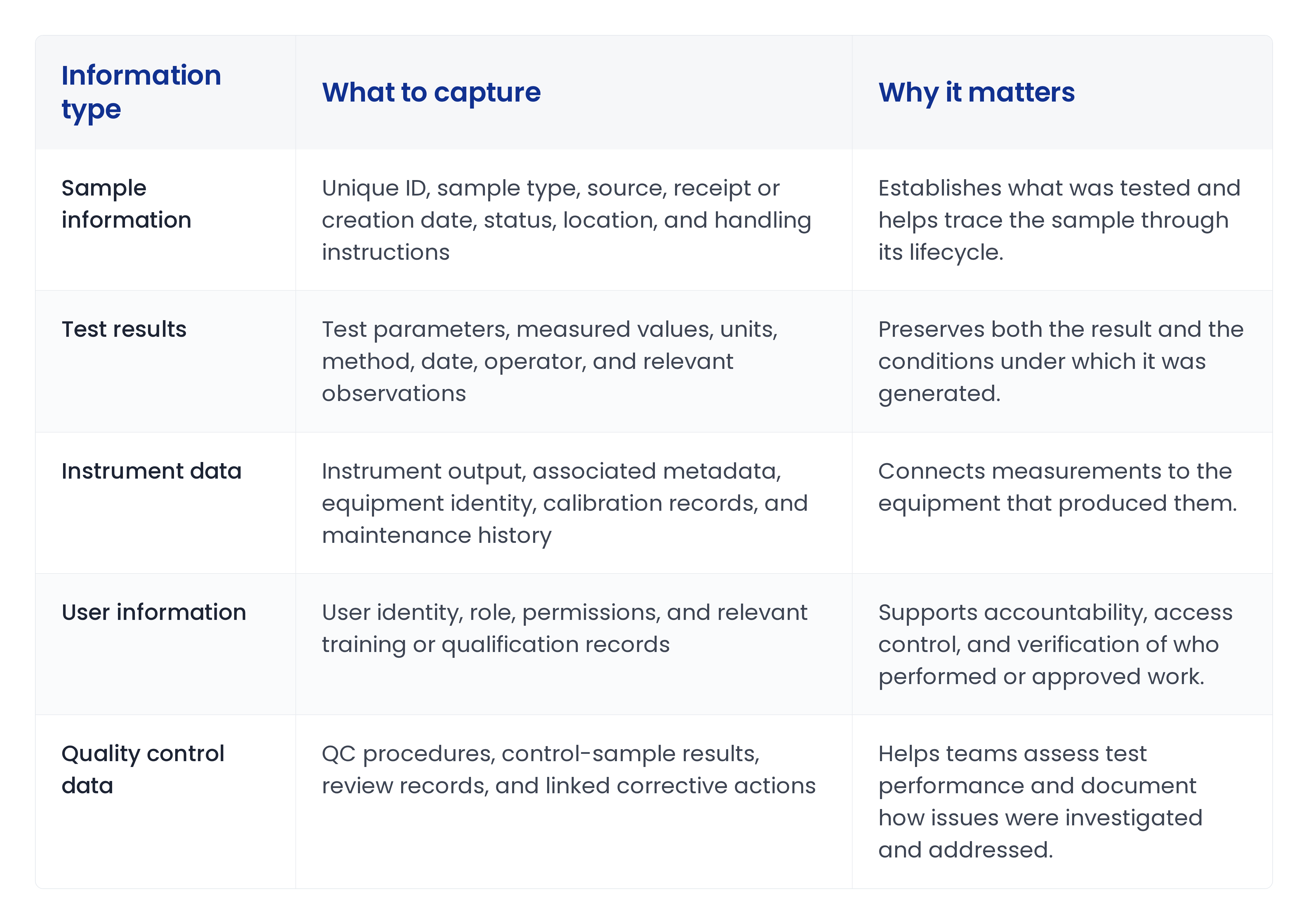
The connections between these categories are as important as the records themselves. If a result is questioned, the team should be able to identify the sample, test method, operator, instrument, and relevant QC information without searching several disconnected systems.
For example, investigating an unexpected measurement may require checking whether similar samples showed the same pattern, which instrument was used, and whether its calibration or QC records indicated a problem.
Additional LIMS capabilities for R&D laboratories
Some laboratories need capabilities beyond sample and test management. For R&D teams, the priority may be connecting results to formulations, experimental procedures, project objectives, and previous development work.
Formulation and ELN integration
Formulation teams need to understand how ingredients, amounts, processing conditions, and procedures affect measured properties. Connecting LIMS results with formulation and ELN records makes it easier to compare experimental inputs with their outputs.
These capabilities may be delivered through an integrated platform or connections between systems. Either way, assess whether users can follow the complete experimental record without manually reconciling identifiers and files.
Visualization and statistical analysis
Graphs and analytical tools help scientists compare results, identify trends, and investigate relationships. Depending on the laboratory’s work, useful capabilities may include scatter plots, comparison charts, correlation analysis, and design-of-experiments tools.
Confirm whether the available tools support your analytical methods and whether they preserve a clear connection to the underlying records. Not every laboratory needs the same level of built-in analysis.
Project and scheduling tools
Project views, task scheduling, and resource planning can help teams coordinate work across samples, instruments, and people. These capabilities are especially relevant when laboratory activities contribute to larger development programs.
Evaluate them against specific planning needs, such as tracking project progress, understanding workloads, or scheduling shared equipment.
AI and machine learning
AI and machine learning can support experimental analysis and planning, but their usefulness depends on the quality and context of the underlying data.
For teams evaluating these capabilities, ask vendors to demonstrate a relevant workflow rather than relying on broad claims. Assess the data requirements, how users review outputs, and whether the functionality addresses a real scientific or operational need.
How to evaluate a LIMS
Build your evaluation around representative laboratory workflows, not a checklist of feature names. Ask vendors to demonstrate how a sample enters the system, receives test assignments, acquires instrument results, moves through review, and becomes part of a report.
Include exceptions in the demonstration: a retest, a corrected result, an instrument-transfer failure, or a user without the required approval permissions. These scenarios reveal how the system handles the work that does not follow the simplest path.
For R&D laboratories, also test whether users can connect results to formulations and experimental procedures, search historical work, and compare findings across projects. The right LIMS should support both the immediate workflow and the context needed to reuse the resulting data.
Explore Uncountable’s laboratory information management system to learn more about connecting laboratory data and workflows, or check out our Guide: How To Choose a LIMS.