
Laboratory informatics and materials informatics get lumped together constantly, but they solve different problems. One keeps your lab running efficiently. The other tells you what to build next. Understanding where they overlap and where they diverge is what separates a genuinely structured R&D operation from one that just has more software than it did five years ago.
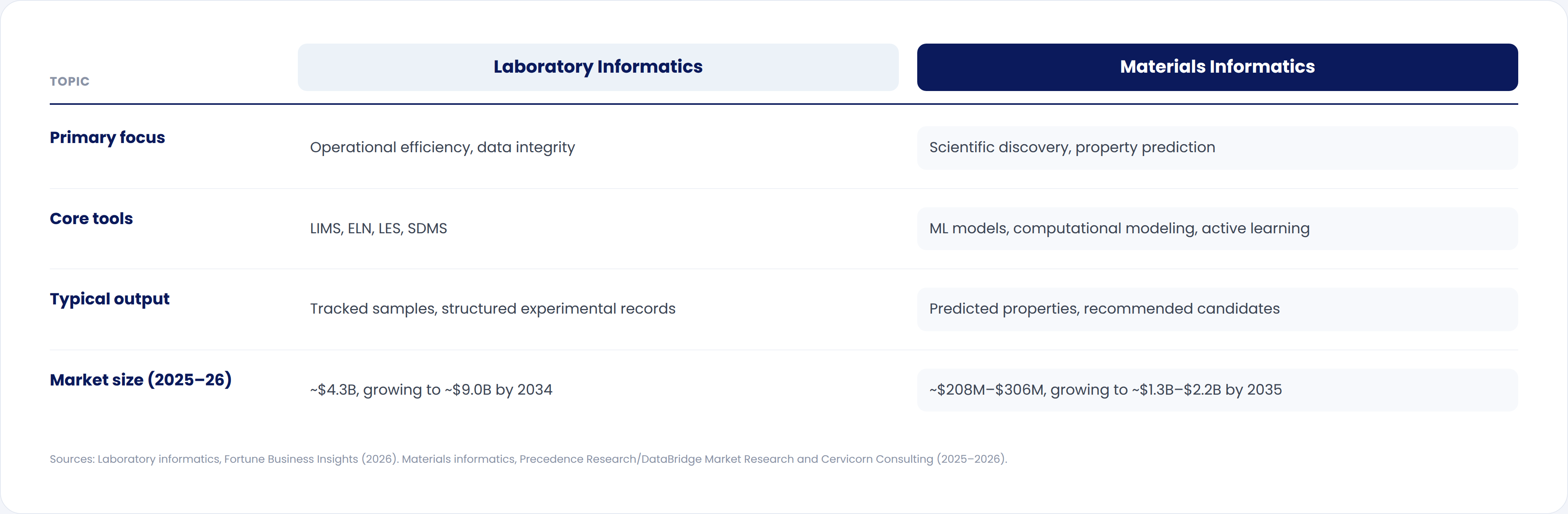
This distinction has real budget implications right now. The global laboratory informatics market (LIMS, ELN, SDMS, and LES combined) was valued at roughly $4.8 billion in 2025 and is projected to reach $10.2 billion by 2034. Materials informatics is smaller but growing faster: estimates range from $208 million to $373 million in 2026, with most forecasts putting compound annual growth above 18 to 22% through the mid-2030s. Both are scaling because the underlying problem, unstructured R&D data, has become too expensive to ignore.
What each one actually does
Laboratory informatics is operational. It covers the systems that run day-to-day lab work: data acquisition, sample tracking, protocol execution, and inventory management. This is the domain of Laboratory Information Management Systems (LIMS), Electronic Lab Notebooks (ELNs), Laboratory Execution Systems (LES), and Scientific Data Management Systems (SDMS). Within the laboratory informatics market, LIMS alone accounts for roughly 38% of total revenue, with ELNs the fastest-growing segment at a projected 10.2% CAGR through 2034.
Materials informatics is discovery-focused. It applies machine learning, pattern recognition, and computational modeling to predict material properties and accelerate the search for new formulations. This is where active learning approaches have produced measurable results: one widely cited case found a target composition after testing just 61 of 605,000 possible formulations, using ML models to guide each successive experiment. In another study, a machine learning model trained on density functional theory data found new stable compounds 30 times faster than undirected search.
Why they need each other
Neither discipline works well in isolation. Materials informatics models are only as good as the data they're trained on, and that data has to come from somewhere structured and consistent, which is exactly what laboratory informatics is built to produce. A LIMS or ELN captures clean, quality-controlled experimental records; those records become training data for predictive models.
The reverse is just as important. A materials informatics model might flag a promising formulation, but that prediction only becomes useful once it's turned into an actual experiment, tracked and executed through the same lab systems, with results fed back into the model. This closed loop, prediction, experiment, data capture, refined prediction, is what actually compounds over time. Without laboratory informatics feeding it clean data, an AI materials model is guessing. Without materials informatics interpreting the results, a well-run lab is just generating spreadsheets faster.
The real bottleneck is structure, not software
Buying both a LIMS and a materials informatics tool doesn't automatically solve anything if the data connecting them is inconsistent. Unstructured data, exported PDFs, mismatched units, missing metadata, is the most common reason R&D organizations fail to get value out of either system. A structured data layer that standardizes formats and preserves full experimental context (not just final results) is what actually makes ELN, LIMS, and SDMS systems interoperable, and what gives materials informatics tools something reliable to learn from.
This is a solvable problem, but it requires treating data structure as infrastructure, not an afterthought bolted onto whichever tool was purchased most recently.
What a unified approach looks like
Rather than running laboratory informatics and materials informatics as separate systems that occasionally export data to each other, some platforms now combine both under one structured data model. That means ELN, LIMS, and machine learning capabilities operate on the same underlying records, so a result captured during an experiment is immediately usable as training data, with no export, reformatting, or manual cleanup step in between.
This matters most for organizations running high volumes of formulation or materials work, where the loop between experiment and prediction needs to run continuously rather than in disconnected batches. Related reading on how this plays out in practice: laboratory information management systems in modern labs, moving from paper lab notebooks to ELNs, what a scientific data management system actually does, managing laboratory inventory efficiently, and how AI is accelerating R&D.
Organizations that treat laboratory informatics and materials informatics as one connected system, rather than two separate purchases, are the ones positioned to actually compound their R&D data over time instead of just accumulating more of it.
.png)
.png)
.png)
